⏱ 19 min read
Zero Trust is often sold like a silver bullet and implemented like a tax audit. Every request must be checked. Every identity must be verified. Every service must prove its innocence at the border. The slogans sound clean. The reality is not.
In a large enterprise, policy evaluation is never one thing. It is not a single gateway, not a lone policy engine, not a magical “allow/deny” function hidden in an API product sheet. It is a stack of judgments made at different moments, with different fidelity, under different failure conditions. Some checks happen before a user gets a token. Some happen at the API edge. Some happen inside the service. Some happen after the fact when the event stream catches up and compliance starts asking painful questions.
That is the real story: policy in Zero Trust is layered because the enterprise is layered. Identity systems are messy. Data ownership is fragmented. Regulations arrive faster than refactoring budgets. And the most dangerous thing an architect can do is pretend that one policy decision point will tame all of it.
So the right question is not, “Do we have policy enforcement?” The right question is, “What policy belongs at which layer, with what semantics, and what happens when those layers disagree?”
That is where architecture begins.
Context
Zero Trust architecture emerged as a reaction to a failed assumption: that networks have trustworthy insides. Once attackers, contractors, compromised laptops, vendor integrations, and cloud sprawl made that fiction impossible to maintain, enterprises shifted toward continuous verification. Identity became the new perimeter. Context became a first-class input. Authorization moved closer to each request.
But in real organizations, a request is rarely just a request. It is a thread crossing multiple bounded contexts: workforce identity, customer identity, HR roles, finance entitlements, device posture, data sensitivity, jurisdiction rules, and application-specific business constraints. A payment approval in treasury is not semantically the same thing as “write access” in a storage service, even if both collapse to a boolean at the enforcement point.
This is why domain-driven design matters here. Policy is not merely infrastructure. Policy expresses business meaning. “A branch manager may approve loans up to 250,000 within their region during business hours if dual-control is satisfied” is a domain rule dressed in security clothing. If you flatten that into a generic IAM role assignment, you haven’t simplified the problem. You’ve hidden it.
Zero Trust therefore needs policy evaluation layers that reflect both technical topology and domain semantics. The enterprise must decide which policies are global and shared, which are contextual and local, and which are business rules owned by specific domains. Without that separation, policy turns into a junk drawer.
And junk drawers become outages.
Problem
Most failed Zero Trust programs suffer from one of three pathologies.
First, they centralize too much. A single policy engine becomes the answer to every question: identity verification, API access, field-level authorization, data residency, fraud controls, and workflow approvals. This creates a seductive diagram and a terrible operating model. The central team becomes a bottleneck. Domain teams lose ownership. Decision latency grows. The policy language becomes either too abstract to be useful or too complex to govern.
Second, they decentralize too much. Every service rolls its own authorization logic, its own entitlements model, its own interpretation of “employee,” “contractor,” “region,” “customer consent,” and “privileged action.” In that world, consistency disappears. Audits become archaeology. Incidents become arguments.
Third, they confuse identity assertions with business permission. A valid token says who the caller claims to be. It does not say whether they may reverse a trade, view sealed HR records, or export customer data under current legal conditions. Authentication and authorization are related. They are not interchangeable. Enterprises that blur them eventually pay in either breach costs or operational drag.
The hard problem is not whether to evaluate policy. The hard problem is how to split policy across layers so that each layer does what it is good at and no more.
Forces
Several forces shape the architecture.
1. Global consistency versus domain autonomy
Central security teams need consistent identity assurance, baseline controls, and auditability. Domain teams need freedom to express local rules in business language. These are both legitimate needs. If central architecture crushes local semantics, policy becomes brittle. If domain autonomy ignores enterprise controls, policy becomes chaotic.
2. Request-time certainty versus event-time truth
Some decisions must happen synchronously: can this request proceed right now? Others are only knowable after reconciliation across systems: was the policy state accurate, did the entitlement change mid-flight, was segregation-of-duties violated after the action? Zero Trust requires both request-time enforcement and event-time verification.
Kafka and event-driven microservices matter here because entitlement changes, device posture updates, HR moves, risk signals, and customer consent updates often arrive asynchronously. Request-time systems operate on snapshots. Event streams reveal the moving ground underneath them. microservices architecture diagrams
3. Latency versus richness
The richer the policy context, the slower and more failure-prone the evaluation path. Pulling identity attributes, device posture, geolocation, account state, dynamic risk score, data classification, and workflow state into every decision may be theoretically pure and practically disastrous. Most enterprises need a fast path and a deeper path.
4. Static authorization versus contextual authorization
Role-based access control remains useful because enterprises need manageable coarse-grained permissions. But Zero Trust pushes toward attribute-based and relationship-based evaluation. Context matters. Device health matters. Time matters. Resource ownership matters. Customer consent matters. Previous actions matter.
No single model wins everywhere.
5. Perfect prevention versus graceful degradation
Security people often prefer fail closed. Operations people fear that phrase because they remember payroll outages and frozen call centers. Some policy layers should fail closed. Others should degrade carefully, using cached decisions, risk-based restrictions, or compensating controls. The architecture must state this explicitly.
Solution
The most robust pattern is policy evaluation in layers, each with a distinct responsibility, semantic boundary, and failure posture.
At minimum, use four layers:
- Identity and trust establishment layer
Validates the caller, device, session, and baseline trust context.
- Edge authorization layer
Performs coarse-grained policy checks at ingress: can this principal call this API or endpoint under these conditions?
- Domain policy layer
Executes business-aware authorization inside the bounded context using domain semantics and resource state.
- Event-time assurance and reconciliation layer
Verifies decisions, detects drift, reconciles asynchronous changes, and produces evidence for audit and response.
This is not ceremony. It is separation of concerns.
The identity layer is about trust claims. The edge layer is about controlling entry. The domain layer is about meaning. The reconciliation layer is about truth over time.
That split gives you a crucial property: a domain can own the rules that only it understands, while enterprise security retains common control points and visibility. The architecture stops pretending that one PDP can answer every question equally well.
Here is the conceptual shape.
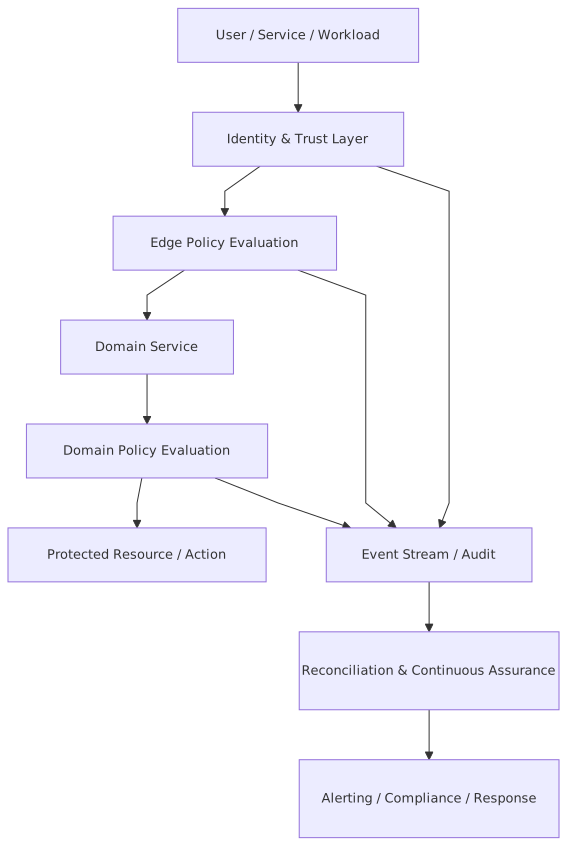
The design principle is simple: push generic checks outward, keep semantic checks inward, and use event streams to reconcile what request paths cannot fully know.
Architecture
Let’s unpack each layer.
Identity and trust establishment layer
This layer is responsible for authentication, token issuance, workload identity, device posture, session state, and initial risk context. It answers questions like:
- Is this principal authenticated with the required assurance level?
- Is the device compliant?
- Is the workload identity valid and issued by a trusted authority?
- Is there an elevated risk signal that should constrain downstream access?
This is where standards and centralized platforms shine: OIDC, SAML, mTLS, SPIFFE-like workload identity, device posture brokers, conditional access. Keep it standardized. Keep it boring. Boring is good.
What this layer must not do is pretend to know domain truth. It should never be the sole authority for business actions like “approve invoice,” “release shipment,” or “view merger documents.” It can assert claims. It cannot own every domain rule.
Edge authorization layer
The API gateway, service mesh, ingress proxy, or application gateway is the right place for coarse-grained authorization. Think of checks such as:
- Is this token allowed to invoke this API?
- Is the caller from an approved network or region?
- Does this client have the required scope?
- Is this endpoint blocked during incident containment?
- Is rate or behavioral policy exceeded?
This layer is optimized for scale, consistency, and centralized control. It is also the right place to apply broad deny policies quickly during emergencies.
However, edge policy should remain intentionally shallow. If the gateway starts calling six systems to determine whether a specific claims adjuster can modify this particular case based on state transitions and regulatory jurisdiction, you have moved domain logic into infrastructure. That road ends in pain.
Domain policy layer
This is the heart of the matter.
Inside each bounded context, policy evaluation uses domain language and local state. It knows what a policy subject, protected resource, action, and constraint actually mean in business terms. It can evaluate rules such as:
- A clinician may access a patient record only if they are part of the care team or in a break-glass emergency workflow.
- A procurement manager may approve a purchase order only if the amount is below their delegated authority and the vendor is not under sanction review.
- A trader may execute within desk limits unless a circuit breaker is active or a pending compliance hold exists.
These are not gateway rules. These are domain invariants with security consequences.
Domain-driven design provides the discipline here. Authorization belongs close to the aggregate, process manager, or domain service that understands the state transition. If policy is inseparable from business meaning, put it where the meaning lives.
That does not mean every domain team should invent its own policy engine. Shared libraries, sidecars, policy decision services, or reusable policy-as-code components can help. But the ownership of semantics should remain with the domain.
Event-time assurance and reconciliation layer
This layer is the one many Zero Trust diagrams conveniently ignore. It should not be ignored.
Why? Because enterprise policy state is often eventually consistent. HR updates role changes. IAM propagates group membership. Customer consent revocations stream from another platform. Device posture flips after the token was issued. Regional residency tags get corrected after a data sync. A request may be allowed based on the best available information at the time and later turn out to be misaligned.
That is not necessarily negligence. It is distributed systems reality.
So build a reconciliation layer that consumes events from Kafka or equivalent streams: access decisions, policy inputs, entitlement changes, domain state changes, risk events, and audit logs. It should detect: event-driven architecture patterns
- decisions made on stale attributes
- policy drift across services
- segregation-of-duties conflicts
- retroactive violations after asynchronous updates
- suspicious access patterns that single request-time checks miss
Reconciliation is where continuous assurance becomes real. It closes the gap between “we evaluated policy” and “the decision still stands under the current truth.”
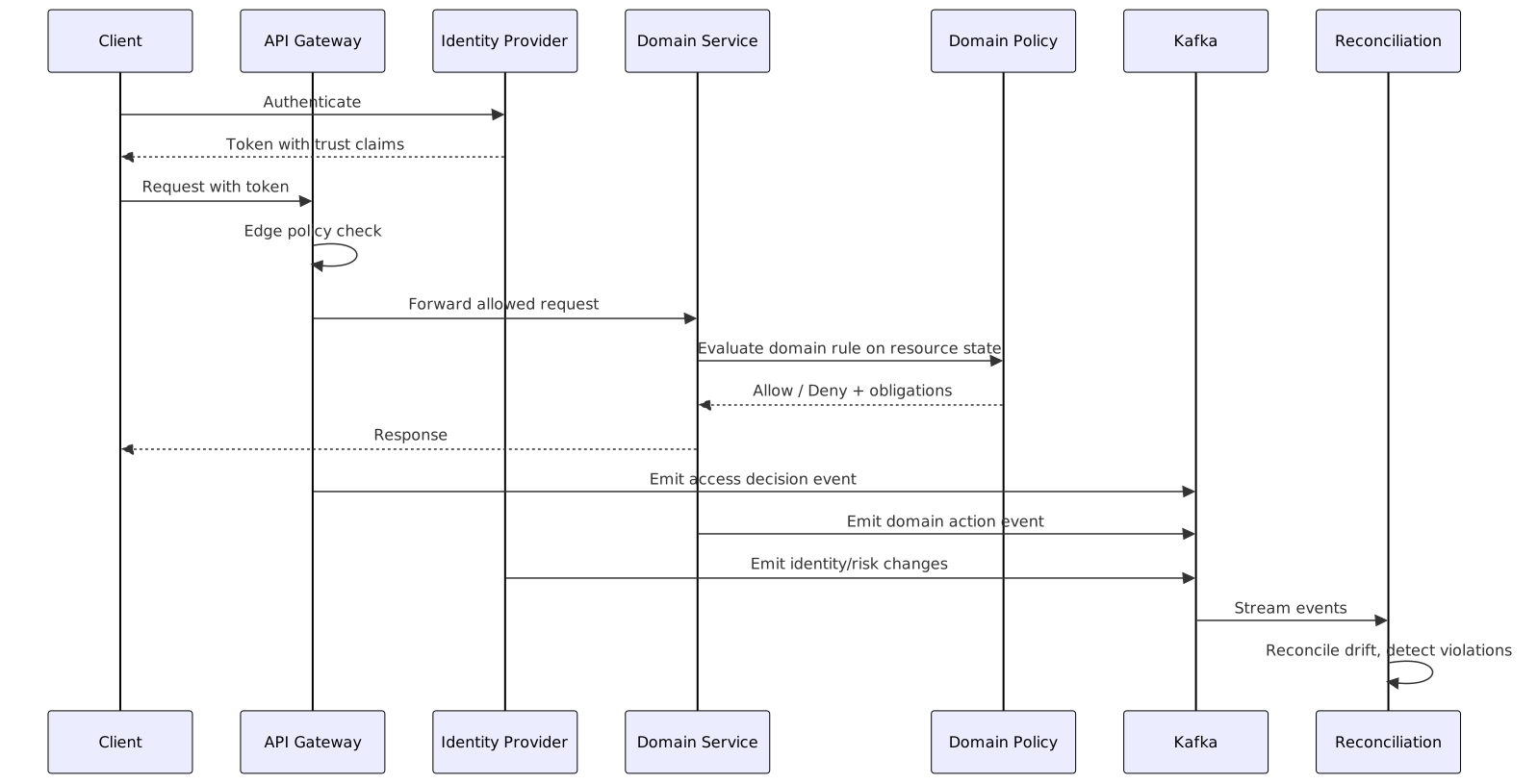
Domain semantics discussion
If there is one mistake architects make repeatedly, it is treating policy as a universal grammar. It isn’t.
“Role,” “entitlement,” “scope,” “permission,” “consent,” “delegation,” and “approval” are not synonyms. They live in different domains and carry different consequences.
A role in HR might describe organizational standing. A permission in IAM might grant access to an endpoint. A delegation in finance may be time-bound and amount-bound. Customer consent in a privacy domain may be revocable and purpose-limited. An approval may require separation of duties and full evidence capture. Trying to cram these into one flattened authorization model creates ambiguity. Ambiguity in security systems is a polite word for bugs.
This is where bounded contexts matter. Each domain should define its own ubiquitous language for protected actions and constraints, then map those semantics into enterprise policy frameworks. The mapping is important. The flattening is dangerous.
Good architecture distinguishes between:
- enterprise-wide trust semantics, such as identity assurance level or device compliance
- cross-domain access semantics, such as coarse application access or API scope
- domain-local business semantics, such as delegated authority, ownership, consent purpose, legal hold, or workflow stage
That distinction makes policy understandable. And understandable policy is governable policy.
Migration Strategy
No serious enterprise gets to rebuild authorization from scratch. You inherit legacy IAM, hard-coded ACLs, LDAP groups with folklore meanings, ERP transaction roles, API gateway plugins, and spreadsheets passed around by auditors. Migration must be progressive.
Use a strangler approach.
Step 1: Inventory decisions, not just systems
Catalog where policy decisions are actually made today: UI, middleware, database, batch job, API gateway, mainframe transaction, manual approval queue. Most enterprises know where users authenticate. Far fewer know where authorization is hidden.
Step 2: Separate policy classes
Classify existing rules into layers:
- trust establishment rules
- edge access rules
- domain business authorization
- reconciliation and detective controls
This is the architectural breakpoint. You are not just moving policies. You are reclassifying them.
Step 3: Introduce an external edge decision capability
Start with ingress because it gives quick wins: consistent scopes, client policies, token validation, emergency deny controls, and basic context checks. Do not overreach. Keep edge logic coarse-grained.
Step 4: Extract domain authorization behind stable interfaces
For high-value domains, move authorization logic out of scattered controller code and into explicit domain services or policy modules. Keep the policy close to aggregates and workflow state. Expose policy decisions as domain capabilities, not generic “checkPermission()” calls devoid of meaning.
Step 5: Emit decision events
Every meaningful policy decision should produce an event. This is where Kafka becomes strategic. Without decision telemetry, reconciliation is fantasy. Emit identity changes, edge decisions, domain decisions, obligations, denials, and policy versions used.
Step 6: Build reconciliation before you trust eventual consistency
Asynchronous policy updates will create temporary gaps. Reconciliation detects and repairs them. It can flag retroactive violations, trigger case management, revoke sessions, or quarantine actions.
Step 7: Strangle legacy entitlements carefully
Replace legacy groups and ACLs with mapped policies over time, not overnight. During transition, dual-run old and new evaluations where feasible and compare results. This catches semantic mismatches before production fallout.
A practical migration view looks like this:

The migration lesson is blunt: do not start by centralizing every rule into one policy engine. Start by making the current mess visible, then impose structure layer by layer.
Enterprise Example
Consider a multinational bank modernizing corporate payments.
The legacy world looks familiar. Workforce users authenticate through a corporate identity provider. Application access is granted through AD groups. Payment entitlements live partly in the treasury application, partly in an ERP, partly in a custom approvals workflow. Regional rules differ across Europe, Asia, and North America. Sanctions screening is asynchronous. Device posture exists for employees but not uniformly for contractors. API access for partner channels runs through a separate platform.
Leadership announces a Zero Trust program. The first instinct is predictable: put a central policy engine in front of everything.
That would fail.
Why? Because “can call payments API” is not the same as “may approve this payment batch,” and neither is the same as “may release funds above threshold after sanctions status changes.” Those are different decisions with different owners and timing.
So the bank adopts layered policy evaluation.
At the identity layer, the bank standardizes authentication assurance, device compliance, and workload identity for internal services. Contractors receive stricter session conditions. High-risk sessions are tagged for downstream restriction.
At the edge, the API gateway enforces coarse access: treasury clients, partner applications, regional endpoints, token scopes, mTLS for machine clients, and emergency deny controls during incidents.
Inside the payments bounded context, domain policy evaluates:
- account authority and signatory rules
- amount thresholds
- maker-checker separation
- country-specific regulatory constraints
- payment state transitions
- customer-specific delegated limits
Sanctions updates and account authority changes arrive asynchronously through Kafka. The reconciliation service consumes:
- authorization decisions
- payment state changes
- authority updates
- sanctions screening events
- HR role changes
If a payment was approved based on a still-valid role at request time but sanctions status changed before release, reconciliation catches the mismatch and blocks settlement. If an authority delegation expired but cache lag allowed a stale approval, the action is flagged and queued for operational review.
Notice what happened here. Zero Trust stopped being a perimeter slogan and became a layered control model tied to business semantics. The bank did not force sanctions logic into the gateway. It did not trust static directory groups to express payment authority. It accepted eventual consistency and designed reconciliation instead of denying reality.
That is adult architecture.
Operational Considerations
A layered model buys clarity, but it raises operational demands.
Policy observability
Every decision needs traceability: principal, resource, action, context, policy version, inputs used, outcome, obligations, latency, and source layer. Without this, support teams cannot explain denials, auditors cannot reconstruct events, and engineers cannot tune performance.
Versioning and rollout
Policy changes are production changes. Treat them like code. Version them. Stage them. Test them against historical traffic where possible. Canary risky policy updates. Roll back fast.
Caching
Caching is both necessary and dangerous. Cached group membership or resource attributes reduce latency but risk stale decisions. The trick is targeted caching with explicit TTLs, event-driven invalidation, and policy-aware fallback strategies. Never cache blindly and call it optimization.
Obligations and side effects
A policy engine should not simply return allow or deny. It may return obligations: redact fields, require step-up authentication, force approval workflow, watermark exports, limit transaction amount, or route to manual review. Those obligations must be enforceable by the consuming service.
Governance
Central teams should own policy frameworks, shared controls, and minimum standards. Domain teams should own semantic rules in their bounded contexts. Governance works when ownership is explicit. It fails when everybody assumes somebody else owns policy quality. EA governance checklist
Tradeoffs
There is no free lunch here.
A layered policy architecture improves clarity and control, but it introduces more moving parts. You now have identity systems, gateways, domain policy modules, event streams, and reconciliation processes. This is not minimal architecture. It is necessary architecture for complicated enterprises.
Centralization gives consistency but risks bottlenecks and semantic poverty.
Decentralization gives expressiveness but risks divergence.
Request-time checks provide immediate protection but operate on snapshots.
Event-time reconciliation catches drift but cannot prevent every bad action in advance.
Shared policy engines reduce duplication but can become a monoculture. One policy bug then affects everything.
Domain-embedded policy preserves meaning but requires stronger engineering discipline across teams.
The right balance depends on business criticality, domain volatility, and operational maturity.
Failure Modes
The failure modes are painfully predictable.
The gateway becomes a god object
Teams keep adding “just one more policy” until the edge layer contains half the business logic in the company. Latency spikes. debugging becomes miserable. Domain ownership erodes.
Tokens become overloaded
Architects stuff every conceivable attribute into tokens to avoid lookups. Soon tokens are stale, enormous, hard to revoke, and semantically misleading. A token is a snapshot, not the living truth of the enterprise.
Domain teams bypass shared controls
In the name of autonomy, teams skip common trust checks, use local identities, or implement unobservable authorization paths. Audit and incident response suffer.
Reconciliation is omitted
The architecture assumes request-time evaluation is enough. Then asynchronous entitlement changes, delayed sanctions events, or stale caches create silent violations. The system “looked secure” and was not.
Policy semantics drift
Different teams define “manager,” “owner,” “consent,” or “region” differently. Shared reports become nonsense. Cross-domain enforcement breaks. This is a domain modeling problem disguised as security.
Fail-closed outages in the wrong layer
A dependency outage in a non-critical context blocks essential operations because nobody designed degraded modes. During an incident, the business discovers that security architecture can stop payroll.
When Not To Use
Not every system needs a richly layered policy model.
Do not use this approach in full if you have:
- a small, single-purpose application with simple user roles
- low regulatory pressure
- little domain variation
- no significant event-driven state changes
- a small team that would drown in operational complexity
In such cases, straightforward application-level authorization with a modest identity integration is enough. Over-architecting authorization is still over-architecting.
Likewise, if your organization lacks basic identity hygiene, jumping into elaborate policy layering is premature. Fix workforce identity, service identity, and asset trust foundations first. Zero Trust built on identity chaos is just expensive confusion.
Related Patterns
Several related patterns fit naturally with policy evaluation layers.
Policy Decision Point / Policy Enforcement Point remains useful, but treat it as a pattern family rather than a single central box.
Backend for Frontend can tailor edge policies for channel-specific experiences while leaving domain authorization intact.
Strangler Fig migration is the right modernization strategy for legacy authorization estates.
Event sourcing and CQRS can help where domain state and decision evidence must be reconstructed precisely, though they are not mandatory.
Saga orchestration becomes relevant when policy obligations require multi-step approvals or compensating actions across services.
Domain events over Kafka are especially valuable for reconciliation, continuous assurance, and retroactive control validation.
And behind all of these sits domain-driven design, because policy without domain language decays into generic security plumbing.
Summary
Zero Trust architecture is not a single checkpoint. It is a chain of judgments, each made with different information and different stakes.
The cleanest way to design it is through policy evaluation layers:
- trust establishment for identity and baseline assurance
- edge evaluation for coarse-grained access control
- domain policy for business-meaningful authorization
- event-time reconciliation for drift detection and continuous assurance
This layered model respects enterprise reality. It accepts that identity is shared, meaning is local, and truth changes over time. It gives central security teams common control where they need it and lets domain teams keep ownership of what only they understand.
Most importantly, it avoids the two classic disasters: the giant centralized policy brain that knows too little, and the fragmented microservice jungle where everybody makes up their own security semantics.
In the end, policy architecture is not about where you put the deny button. It is about where the enterprise keeps its meaning. If you get that wrong, Zero Trust becomes theater. If you get it right, it becomes a resilient operating model.
Frequently Asked Questions
What is enterprise architecture?
Enterprise architecture aligns strategy, business processes, applications, and technology in a coherent model. It enables impact analysis, portfolio rationalisation, governance, and transformation planning across the organisation.
How does ArchiMate support architecture practice?
ArchiMate provides a standard language connecting strategy, business operations, applications, and technology. It enables traceability from strategic goals through capabilities and services to infrastructure — making architecture decisions explicit and reviewable.
What tools support enterprise architecture modeling?
The main tools are Sparx Enterprise Architect (ArchiMate, UML, BPMN, SysML), Archi (free, ArchiMate-only), and BiZZdesign. Sparx EA is the most feature-rich, supporting concurrent repositories, automation, scripting, and Jira integration.