⏱ 21 min read
Data retention looks mundane right up until it blows up a program. Most architecture failures do not begin with distributed consensus, exotic scaling limits, or some clever algorithmic edge case. They begin with a simpler sin: we kept the wrong data for too long, deleted the right data too early, or could no longer explain why two systems disagreed about what “active,” “archived,” and “deleted” were supposed to mean.
That is the real problem. Retention is not an infrastructure setting. It is not merely a compliance policy. It is a boundary question. And boundary questions are architecture questions.
In most enterprises, retention logic leaks everywhere. It hides in database jobs, in Kafka topic configurations, in legal policies nobody translated into system language, in data warehouse lifecycle rules, and in service code written by teams who interpreted “seven years” in seven different ways. One system means “seven years after customer closure.” Another means “seven years after last transaction.” A third means “indefinitely if there is an open dispute.” The result is predictable: accidental complexity wrapped in governance language. EA governance checklist
A healthy architecture treats retention as a first-class domain concern. Not because lawyers said so, but because the business meaning of time matters. A customer record, a payment instruction, a claims document, a telemetry event, and a fraud signal do not age the same way. They have different obligations, different value curves, and different destruction rules. If we flatten them into one global retention timeline, we create elegant diagrams and terrible systems.
This article argues for data retention boundaries: explicit architectural boundaries around how long data is kept, where, under what legal and business semantics, and how that lifecycle is enforced across operational systems, events, analytical stores, and archives. The pattern borrows heavily from domain-driven design, event-driven architecture, and progressive migration practice. It is useful because enterprises are almost always dealing with mixed estates: old relational cores, Kafka streams, new microservices, data lakes, SaaS platforms, and several generations of reporting stacks all claiming to be the system of record.
And if you get this wrong, the failure is not just technical debt. It becomes regulatory exposure, operational confusion, and the sort of reconciliation exercise that consumes entire quarters.
Context
Every large enterprise eventually learns that “data architecture” is really several architectures forced to cohabit: enterprise architecture with ArchiMate
- operational data for transaction processing
- event data for integration and replay
- analytical data for reporting and machine learning
- archival data for legal, audit, and historical needs
- reference and master data for shared enterprise semantics
Retention behaves differently in each of these worlds.
An operational order database often wants current truth and recent history. A Kafka topic might need short retention for throughput reasons, or long retention for replay and audit. A warehouse may need years of curated history. A legal archive may require immutable storage with litigation hold capability. A machine learning feature store may need aggressive expiry because old features create drift and cost.
The mistake is to apply one retention policy as if “data” were one thing. It is not. Data is a projection of domain behavior. Retention timelines therefore need to be designed around domain semantics, not storage products.
This is where domain-driven design becomes useful. A bounded context should own the meaning of lifecycle states for the information it creates. If the Claims context says a claim is “closed,” that does not automatically mean the Billing context may purge related financial records. If the Customer Profile context says “deleted,” that may mean “removed from operational personalization,” not “erased from regulated financial archives.” Retention boundaries exist because domains age information differently.
A good architect insists on one uncomfortable truth: there is no universal delete in the enterprise. There are only context-specific lifecycle transitions with downstream consequences.
Problem
Most organizations inherit retention mechanisms rather than design them.
The CRM keeps customer data “forever” because no one wanted to break reports. The payment platform prunes transaction tables after 18 months to keep batch windows under control. Kafka topics have retention set by platform defaults. The lake stores everything because storage was cheap until it wasn’t. A privacy program then arrives and asks a question that sounds simple: “Show me where this customer’s personal data lives, when it expires, and why.” event-driven architecture patterns
That is when the architecture starts sweating.
The core problems tend to cluster around five themes.
First, semantic drift. The same concept is retained under different rules across systems because the business event that starts the clock is ambiguous. Is retention measured from creation date, last activity date, account closure, claim settlement, policy lapse, contract termination, or legal hold release? Enterprises often discover that they never agreed on the trigger event.
Second, topology sprawl. A single business fact spreads across operational stores, read models, Kafka topics, CDC pipelines, search indexes, caches, object storage, data marts, and vendor systems. Deleting or archiving in one place does not make the enterprise compliant or consistent.
Third, reconciliation debt. Once retention differs between systems, reports drift. Numbers change depending on whether they read from the source system, the event stream, or the warehouse. Teams waste time debating which system is “correct” when the real issue is mismatched lifecycle windows.
Fourth, unsafe coupling. Teams use retained data for purposes never anticipated by the original domain. Fraud models depend on customer interaction logs. Service teams mine support transcripts. Finance uses operational status history for audit. Then a retention change in one system becomes a surprise outage somewhere else.
Fifth, migration paralysis. Legacy estates cannot switch to a new retention model overnight. There are too many reports, too many dependent interfaces, and too many undocumented assumptions. So the organization carries two or three timelines at once, which is how architecture acquires scar tissue.
Retention is not hard because deletion is hard. It is hard because meaning over time is hard.
Forces
Architects need to balance several competing forces. Ignore any one of them, and the design becomes brittle.
Regulatory and legal obligations
Privacy regulations may require erasure or minimization. Financial, healthcare, insurance, and public sector rules may require long-term retention. Litigation hold can suspend deletion. Cross-border rules may change where retained data is allowed to live.
This is not just a policy matrix. It is a source of contradictory obligations. Sometimes you must forget and remember at the same time.
Business value decay
Not all data remains valuable. Session logs may be useful for 30 days, fraud events for 13 months, contracts for 10 years, and aggregated demand history for much longer. Retaining low-value detail indefinitely inflates cost and operational risk.
Performance and operability
Large operational tables become slow, indexes bloat, backups grow, and restore windows become unacceptable. Kafka clusters become expensive if every topic is treated as a permanent archive. Search platforms degrade when old documents are never removed. Retention is often what keeps systems fast enough to matter.
Domain semantics
The timer must start from meaningful business events. “Created timestamp” is easy but often wrong. Retention should be anchored to domain facts such as “policy terminated,” “case resolved,” or “customer relationship ended,” with exceptions such as legal hold, fraud investigation, and consent withdrawal.
Reconciliation and trust
Executives do not care that one system retained less history by design. They care that two reports disagree. A retention architecture must explain divergence, control it, and provide traceable reconciliation.
Migration reality
You rarely get to redesign the whole estate. Old systems continue to exist, and new ones arrive unevenly. Any credible solution must support progressive strangler migration, coexistence, and phased enforcement.
Solution
The central move is simple: define explicit data retention boundaries aligned to domain contexts and data products, then enforce lifecycle transitions through architecture rather than ad hoc scripts.
A retention boundary specifies:
- the domain owner of the data
- the business event that starts, pauses, or ends retention
- the classes of data involved: operational, event, analytical, archival
- the legal and business basis for keeping it
- where the authoritative lifecycle decision is made
- how downstream stores inherit or transform that lifecycle
- how exceptions such as legal hold, disputes, and investigations are handled
- how reconciliation proves the policy is working
This sounds bureaucratic. Done badly, it is. Done well, it becomes liberating. Teams finally know where retention decisions belong and where they do not.
A pragmatic architecture usually has three layers of retention responsibility:
- Domain lifecycle authority
The bounded context that knows the business meaning of the data publishes lifecycle events such as CustomerRelationshipClosed, PolicyTerminated, ClaimSettled, LegalHoldApplied, ConsentWithdrawn.
- Retention orchestration and policy evaluation
A policy service or rules capability computes retention deadlines, exceptions, and hold conditions. It should not invent domain semantics; it should evaluate them.
- Store-specific enforcement
Operational databases, Kafka topics, document stores, data lakes, warehouses, and archives apply deletion, compaction, anonymization, tiering, or immutable retention according to their role.
The key distinction is between business lifecycle and storage lifecycle. Business lifecycle belongs in the domain. Storage lifecycle belongs in the platform. Conflate them and both become messy.
Here is a conceptual view.
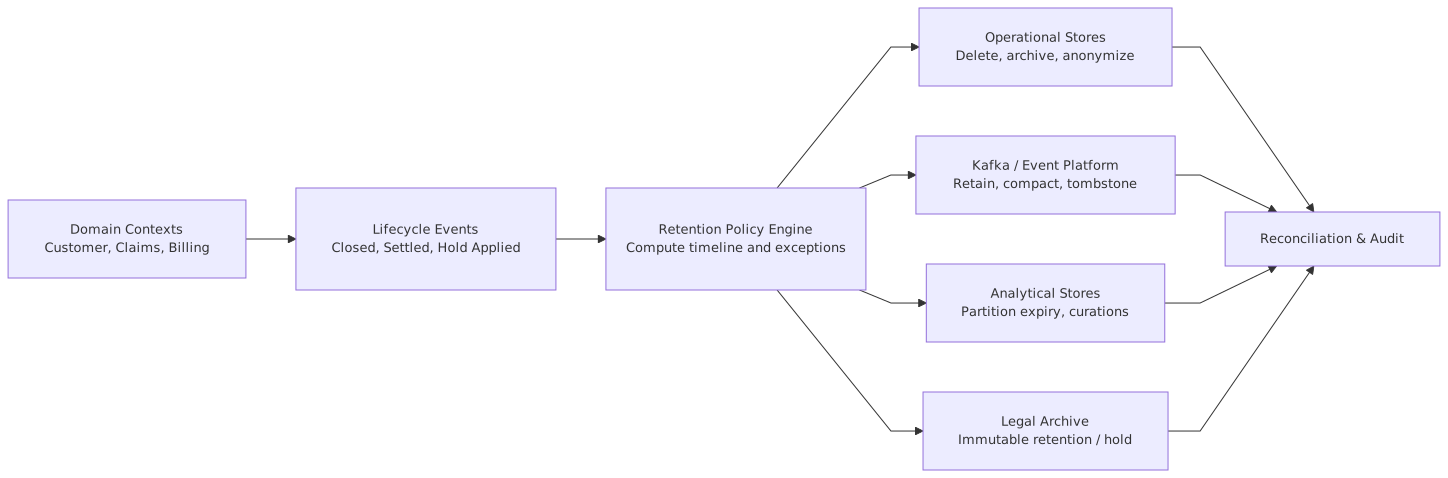
This pattern is not about centralizing all data decisions. It is about centralizing retention policy interpretation while preserving domain ownership of meaning.
Architecture
A robust retention-boundary architecture typically contains six elements.
1. Domain lifecycle model
Start with the domain, not the database. Define lifecycle states and triggering events with domain experts. This is where domain-driven design earns its keep.
For example, in insurance:
- Policy Created
- Policy Active
- Policy Lapsed
- Policy Terminated
- Claim Open
- Claim Settled
- Investigation Open
- Legal Hold Applied
- Legal Hold Released
Retention may begin on PolicyTerminated, but pause or extend on InvestigationOpen. Claims evidence may outlive the policy itself. Financial postings may outlive both. The point is to model the semantics honestly.
Memorable rule: Retention clocks start with business truth, not ETL convenience.
2. Data classification by usage and obligation
Within each bounded context, classify data by its purpose and legal basis:
- core transactional record
- personal data
- derived analytics
- evidence and audit
- integration events
- operational telemetry
- machine learning features
Each class may carry a different retention timeline. This avoids the common anti-pattern where deleting a customer profile accidentally removes legally required financial records, or where indefinite retention of operational logs creates privacy exposure.
3. Event-driven lifecycle propagation
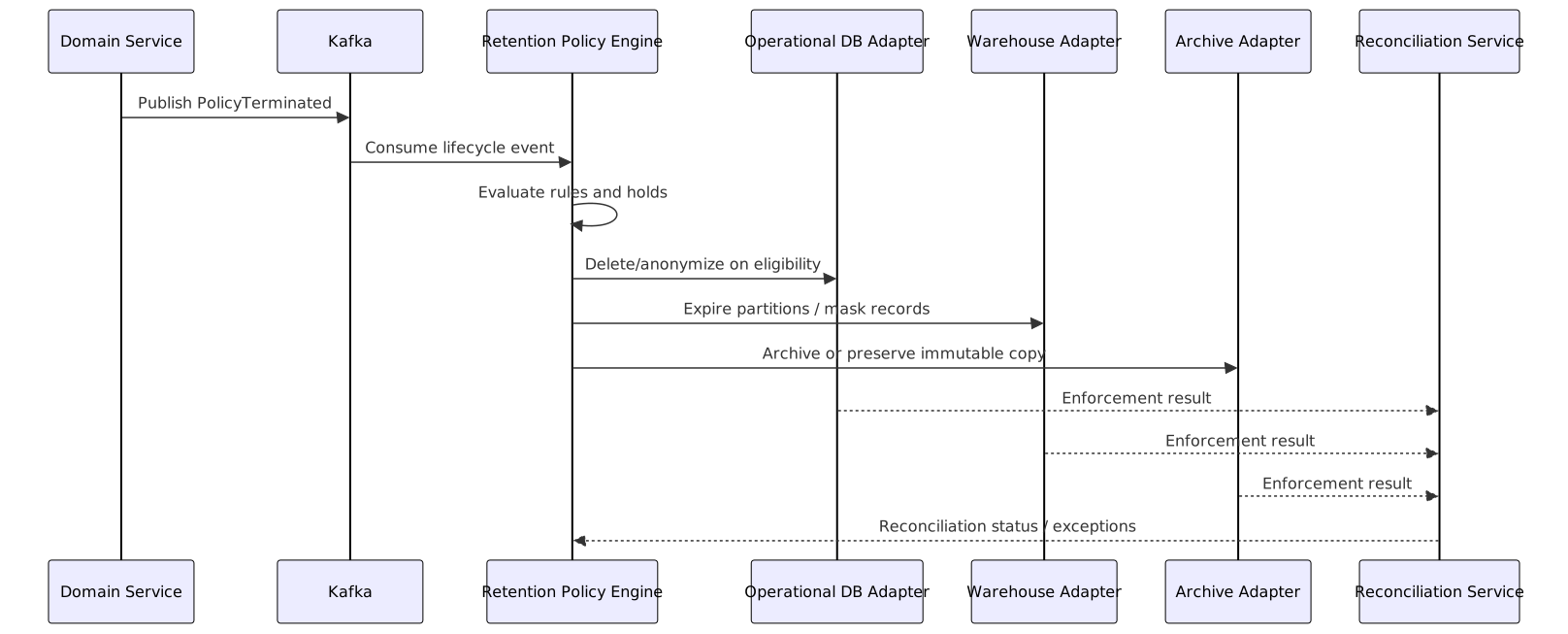
In a microservices and Kafka environment, lifecycle changes should propagate as events. This does not mean every service blindly copies retention rules. It means downstream consumers get the authoritative domain signal required to apply their own bounded policies.
A customer service might emit:
CustomerRelationshipEndedCustomerAnonymizationRequestedCustomerLegalHoldApplied
Downstream services then decide, within their own domain boundary, what that means. Search indexes may purge documents. Marketing systems may erase personalization data. Finance may preserve invoices under regulatory retention but sever links to nonessential profile data.
Kafka matters here because it exposes a subtle trap. Teams often treat Kafka as both integration fabric and historical archive. That can work for some event classes, but it should be explicit. Event topic retention is a platform concern, while legal retention is often an archive concern. Do not confuse replayability with compliance.
4. Retention policy engine
A policy engine evaluates retention rules based on metadata and lifecycle events. It may compute:
- eligible deletion date
- anonymization date
- archive transfer date
- hold status
- reconciliation status
This engine can be implemented as a service, rules engine, or policy-as-code capability. Keep it boring. Retention is not where you want heroic innovation.
Store policy decisions as durable metadata. That metadata becomes the enterprise truth for “why does this record still exist?” Without it, every audit becomes archaeology.
5. Store-specific enforcement adapters
Every storage technology has its own deletion and retention mechanics:
- relational databases: soft delete, hard delete, partition dropping, archival tables
- Kafka: time retention, log compaction, tombstones, tiered storage
- object storage: lifecycle policies, WORM retention, legal holds
- search indexes: document expiry or purge jobs
- warehouses/lakes: partition pruning, snapshot expiration, data masking
- caches: TTL
- backups: separate retention and destruction schedules
The architecture should standardize policy intent, not force identical implementation mechanics. This is a classic enterprise tradeoff: consistency of governance, diversity of execution. ArchiMate for governance
6. Reconciliation and audit trail
This is where mature architectures separate themselves from PowerPoint. You must be able to prove that a lifecycle instruction issued by a domain was actually enforced across stores, and explain exceptions.
That requires:
- policy decision logs
- data lineage
- control reports
- discrepancy queues
- replay/retry for failed enforcement
- attestation dashboards by domain and store
If there is one thing enterprises underestimate, it is this: retention without reconciliation is wishful thinking.
A useful runtime flow looks like this:
Migration Strategy
No enterprise starts greenfield here. Retention boundaries are usually introduced into a mess. So the migration strategy matters as much as the target design.
The right approach is progressive strangler migration.
Do not attempt a “big retention cutover.” It will fail for the same reason big ERP transformations fail: too many hidden dependencies, too many reports, too much operational entropy. Instead, wrap legacy retention behavior with explicit policies, then gradually shift authority to the new model.
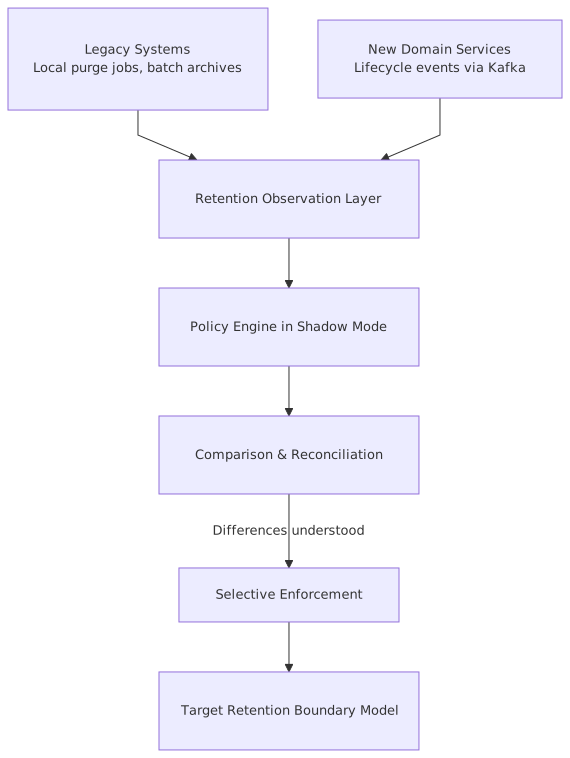
A sensible migration path has these stages.
Stage 1: Discover and map retention semantics
Inventory systems, data classes, and current retention behaviors. More importantly, identify trigger events used today, whether they are right or wrong. You are not just cataloging tables. You are surfacing hidden business assumptions.
Expect to find contradictions. That is normal.
Stage 2: Establish canonical lifecycle events
Define the domain events that should start or modify retention timelines. Introduce them first as published facts, even if legacy systems continue using their old jobs. This creates a semantic backbone without immediate operational disruption.
Stage 3: Dual-run policy evaluation
Run the new policy engine in shadow mode. Compare computed retention outcomes with legacy outcomes. This is where reconciliation starts early. You want discrepancy reports before you enforce anything.
Stage 4: Strangle downstream stores first
It is often safer to migrate analytical stores, indexes, and archives before touching core transaction systems. Warehouses and search platforms usually have fewer user-facing transaction risks and provide a good proving ground for policy enforcement.
Stage 5: Move operational deletion/anonymization to policy-driven control
Once confidence is high, replace local cron jobs and ad hoc scripts in operational systems with policy-driven orchestration. Keep local safeguards, but make policy intent explicit and observable.
Stage 6: Retire duplicate legacy logic
Only after sustained reconciliation success should you remove old retention jobs. Enterprises often skip this step and end up with two retention mechanisms racing each other. That is not resilience. That is chaos with monitoring.
This migration pattern matters because retention changes are often irreversible. If you delete too aggressively, you may not get the data back. So the migration should privilege explainability over speed.
A transition-state architecture often looks like this:
Enterprise Example
Consider a multinational retail bank modernizing customer and transaction platforms.
The bank has:
- a 20-year-old core banking platform
- a CRM package
- Kafka-based event streaming for new digital channels
- a cloud data lake and enterprise warehouse
- multiple microservices for onboarding, fraud, cards, and servicing
A privacy program demands stronger erasure capability for customer profile data. Meanwhile, regulators require long-term retention of transaction and audit records. The old answer was predictable: keep everything forever in the core, copy even more into the warehouse, and hope no one asks difficult questions.
The architecture team reframed the problem around retention boundaries.
Domain semantics
They defined separate bounded contexts:
- Customer Profile
- Account Management
- Transactions
- Fraud & Investigations
- Servicing Interaction
- Regulatory Archive
Crucially, they stopped pretending that “customer deleted” was a universal state.
In the Customer Profile context, relationship termination plus elapsed cooling-off period could trigger anonymization of nonessential personal attributes.
In Transactions, financial records remained retained for statutory periods.
In Fraud & Investigations, active cases overrode deletion and created hold events.
In Servicing Interaction, call transcripts and chat logs had shorter timelines unless linked to complaints or disputes.
Event backbone
New digital services published lifecycle events onto Kafka:
CustomerRelationshipEndedProfileAnonymizationEligibleInvestigationOpenedInvestigationClosedLegalHoldApplied
Legacy systems did not emit these natively, so the bank introduced a translation layer using CDC and batch extracts to synthesize equivalent lifecycle events where possible. Not perfect, but good enough to start.
Policy engine and enforcement
A policy engine calculated retention deadlines by context and record class. It did not tell the transaction platform to delete ledger entries. It instructed the Customer Profile service to anonymize profile fields, the search platform to remove customer documents, the data lake to mask personal columns in curated datasets, and the regulatory archive to preserve immutable transaction evidence.
Reconciliation
This was the make-or-break piece. Every lifecycle decision created a control record:
- source event
- policy version
- expected actions by store
- actual status
- exception reason
When the warehouse still held unanonymized profile copies after the CRM had masked them, reconciliation surfaced the lag. When fraud had applied a hold, the dashboard showed why profile deletion was suspended. Executives finally got one answer to the question “why is this data still here?”
Outcome
The bank did not achieve instant purity. It did achieve something more valuable: operationally trustworthy retention. Data volumes in operational profile stores dropped. Privacy requests became traceable. Audit conversations improved because the bank could explain divergence between contexts instead of pretending it did not exist.
That is what good enterprise architecture looks like. Not perfect uniformity. Controlled inconsistency with explicit reasons.
Operational Considerations
Retention boundaries live or die in operations.
Observability
You need metrics for:
- records eligible for deletion/anonymization
- records processed
- holds applied
- backlog age
- failed enforcement actions
- reconciliation mismatch rate
- policy execution latency
If these are not visible, retention will quietly decay into best effort.
Policy versioning
Retention rules change. Regulations evolve. Mergers happen. Product teams invent new states. Version policies and keep execution history tied to the version used. Otherwise you cannot explain historical decisions.
Backups and replicas
This is a classic blind spot. Teams purge primary stores but forget backups, DR replicas, extracts, and test environments. The architecture should define realistic handling:
- whether deleted data may persist in immutable backups until backup expiry
- whether test environments receive masked data only
- whether archive copies are discoverable and governed
Legal hold operations
Hold management must be operationally robust. A hold should suspend deletion consistently across stores without creating indefinite suspension due to stale flags. Holds need lifecycle too:
- applied by whom
- basis
- scope
- review date
- release event
Data contracts and metadata
Retention boundaries should be documented in data contracts and catalog metadata. Consumers need to know whether a dataset is ephemeral, policy-driven, compaction-based, or archived. This avoids the all-too-common complaint that “the data disappeared unexpectedly.”
Human process
Some retention decisions are not fully automatable, especially in investigations, litigation, and regulated exceptions. Design for operational workflows, approvals, and attestation. Enterprises run on software, but also on forms, queues, and risk committees. Pretending otherwise is childish.
Tradeoffs
This pattern is worth using, but it is not free.
Pro: Better alignment between business meaning and data lifecycle.
Con: More up-front modeling effort, and stronger governance discipline required.
Pro: Clearer separation of domain semantics from store mechanics.
Con: More moving parts: policy engines, adapters, reconciliation services.
Pro: Safer coexistence of privacy erasure and statutory retention.
Con: Hard conversations about context-specific truth. Stakeholders often want one enterprise-wide answer where several are necessary.
Pro: Better migration path for legacy estates.
Con: Extended period of dual-running and discrepancy management.
Pro: Improved auditability.
Con: Additional metadata, lineage, and control-reporting overhead.
There is also a cultural tradeoff. Teams used to owning local purge jobs may resist a policy-driven model. Platform teams may try to over-centralize. Domain teams may under-specify lifecycle semantics. Good architecture here needs both central standards and local accountability.
That balance is delicate. Like most worthwhile enterprise patterns, it works best when no one gets everything they want.
Failure Modes
The failure modes are predictable, which is useful because predictable failures can be designed against.
1. Treating retention as a platform-only concern
This leads to simplistic TTL settings and broad archive jobs with no domain understanding. It works until a legal hold, privacy request, or reconciliation issue appears.
2. Over-centralized governance with no domain ownership
A central team invents retention rules without understanding business semantics. The policies become detached from reality, and product teams route around them.
3. Event ambiguity
Lifecycle events are poorly defined. CustomerClosed means five different things. The policy engine then produces deterministic nonsense.
4. Kafka as accidental archive
Teams keep events indefinitely “just in case” and assume that solves compliance and audit. It rarely does. Event streams are integration assets first; archives are a separate design concern.
5. No reconciliation loop
Policies are evaluated, commands are sent, and no one checks completion. This creates paper compliance: the architecture says things are deleted, while stores quietly disagree.
6. Ignoring derived data
Deletes happen in source systems but not in marts, extracts, search indexes, feature stores, and BI caches. This is the enterprise version of cleaning one room and calling the house tidy.
7. Irreversible migration mistakes
Teams switch off legacy retention jobs and enable aggressive deletion before completing shadow reconciliation. Then they discover a hidden consumer or reporting dependency after the data is gone.
When Not To Use
This pattern is not universally necessary.
Do not over-engineer retention boundaries if:
- you have a small, single-application estate with minimal downstream replication
- retention rules are simple, homogeneous, and stable
- there is no material regulatory complexity
- operational and analytical data are tightly co-located with few copies
- the cost of a central policy/reconciliation capability exceeds the risk being managed
In a small SaaS application, a straightforward retention implementation inside one service may be sufficient. A simple policy table, scheduled purge, and audit log may do the job. Not every problem deserves an enterprise control tower.
Also, if your organization has not yet clarified domain ownership, retention boundaries can expose political dysfunction faster than they solve technical problems. They depend on real accountability. Without that, you will get diagrams and no decisions.
Related Patterns
Several adjacent patterns work well with retention boundaries.
Data mesh data products
Useful when teams own domain data products and publish explicit lifecycle and retention metadata. Dangerous if every team invents retention semantics independently without enterprise controls.
Event sourcing
Helpful when business history matters and replay is valuable. But event stores are not magical compliance archives. Retention and redaction still require explicit design.
CQRS and read models
Read models often need shorter retention and can be rebuilt. This makes them good candidates for aggressive expiry—provided rebuildability is real, not theoretical.
Archive by abstraction
A useful migration tactic: expose a consistent historical access interface while moving old records from operational stores to cheaper archival storage behind the scenes.
Policy-as-code
Strong fit for making retention rules testable, versioned, and reviewable. Just do not let the code obscure the business meaning.
Master data management
Relevant where survivorship and identity resolution complicate deletion or anonymization. MDM often becomes the place where “customer” semantics go to become political.
Summary
Data retention is not janitorial work. It is architecture at the fault line between business meaning, regulation, operational reality, and time.
The right design move is to create data retention boundaries aligned to domain semantics. Let bounded contexts own lifecycle meaning. Let a policy capability evaluate timelines and exceptions. Let each storage technology enforce retention in its own way. And above all, build reconciliation so the enterprise can prove what happened and explain why.
Use progressive strangler migration. Start by surfacing semantics and shadowing policy decisions. Move downstream stores first, then operational systems. Treat Kafka as an event backbone, not a magical answer to historical retention. Accept that different contexts will retain different truths for different lengths of time.
A final opinion, because architects should occasionally have one: the enterprise obsession with a single retention timeline is usually a symptom of shallow modeling. Real businesses are messier than that. Good architecture does not erase the mess. It gives it shape, boundaries, and evidence.
That is enough to keep systems honest. And in the long run, honesty is what makes architecture durable.
Frequently Asked Questions
What is enterprise architecture?
Enterprise architecture aligns strategy, business processes, applications, and technology in a coherent model. It enables impact analysis, portfolio rationalisation, governance, and transformation planning across the organisation.
How does ArchiMate support architecture practice?
ArchiMate provides a standard language connecting strategy, business operations, applications, and technology. It enables traceability from strategic goals through capabilities and services to infrastructure — making architecture decisions explicit and reviewable.
What tools support enterprise architecture modeling?
The main tools are Sparx Enterprise Architect (ArchiMate, UML, BPMN, SysML), Archi (free, ArchiMate-only), and BiZZdesign. Sparx EA is the most feature-rich, supporting concurrent repositories, automation, scripting, and Jira integration.