⏱ 19 min read
Architecture goes bad quietly.
Not with a dramatic outage. Not with a board-level crisis. It usually starts with something more ordinary: two teams both “own” customer data, three services publish different meanings of an order, and a platform group quietly becomes the bottleneck for every meaningful change. The code still deploys. The diagrams still look respectable. But the enterprise has begun to lose its grip on a far more important thing than technology: responsibility.
That is why an architecture ownership map matters.
Not as a pretty picture for a quarterly review. Not as another layer of governance theater. But as a living model of who is responsible for what, where domain semantics begin and end, and how teams, systems, and business capabilities line up when the organization is under pressure. In a modern enterprise shaped by Team Topologies, domain-driven design, event streams, platform engineering, and a long tail of legacy applications, ownership is architecture. If you cannot say who owns a capability, who defines its language, who reconciles conflicting truth, and who carries operational accountability, then your architecture is mostly wishful thinking.
This article lays out how to build an architecture ownership map that actually helps. We will look at the forces that make ownership messy, the structure of a practical solution, how it connects to bounded contexts and team interaction modes, and how to migrate toward it using a progressive strangler approach. We will also look at Kafka-backed microservices, reconciliation, operational concerns, tradeoffs, and the failure modes that tend to punish naive implementations. event-driven architecture patterns
The short version is this: systems fail in interesting ways, but organizations fail in repetitive ones. Shared ownership without sharp semantics is one of the oldest traps in enterprise architecture.
Context
Most enterprises do not have a clean greenfield topology. They have a patchwork.
There is a core transaction platform that predates the cloud by a decade. A CRM that someone calls “the source of truth” even though it is wrong half the time. A set of microservices built by enthusiastic product teams. A Kafka backbone that carries useful events and a lot of accidental ones. And around all of this, teams with different missions: stream-aligned teams shipping customer value, platform teams reducing cognitive load, enabling teams coaching adoption, and perhaps a complicated subsystem team guarding a difficult technical area.
In that world, architecture diagrams are often system-centric. Boxes and lines. APIs and queues. Environments and clusters.
What they miss is ownership.
A service map tells you what talks to what. An ownership map tells you who is accountable for the business meaning, the operational behavior, the data lifecycle, and the evolution path of each piece. That distinction is not bureaucratic. It is the difference between knowing where to route a packet and knowing where to route a decision.
Team Topologies gives us a useful social model for software delivery. Domain-driven design gives us a semantic model. An architecture ownership map brings the two together. It makes explicit how bounded contexts, team boundaries, and runtime integrations align. Or more often, where they do not.
Problem
The common enterprise problem is not lack of architecture artifacts. It is too many artifacts, each telling only part of the truth.
A capability map says “Order Management” is important. A solution diagram says there are seven services involved. An org chart says four teams contribute. A RACI says everyone is consulted. And then a production incident happens because pricing changed the meaning of “committed order” without telling fulfillment, while finance still reconciles against a nightly export from the monolith.
This is what ownership ambiguity looks like in real life:
- one domain concept appears in multiple systems with different meanings
- one team owns delivery, another owns runtime, and a third controls schema changes
- a platform team is accidentally the gatekeeper for all cross-team integration
- Kafka topics become shared databases with no semantic stewardship
- “source of truth” is declared by politics rather than by bounded context
- reconciliation is treated as an operational nuisance instead of a designed capability
- legacy systems keep hidden authority long after new services are introduced
The result is friction masquerading as complexity.
Teams become slower because every meaningful change requires negotiation. Incidents become harder because no one can distinguish between producer accountability, consumer assumptions, and business ownership. Governance becomes heavier because leadership senses the chaos and adds process. The map is missing, so the organization compensates with meetings. EA governance checklist
Forces
Several forces pull against clean ownership.
Domain complexity
Business concepts are not static nouns. They carry meaning that varies by context. “Customer” in sales is not always “customer” in billing. “Order” in e-commerce may differ materially from “order” in warehouse execution. Domain-driven design has been saying this for years, and enterprises still fall into the trap of a universal enterprise data model that pretends semantics are globally stable.
They are not.
An ownership map has to show semantic boundaries, not just technical deployment boundaries.
Legacy gravity
The old system may be ugly, but it usually still matters. It may remain the legal system of record, the financial authority, or simply the only place where certain edge cases have been encoded over years of hard knocks. That means ownership cannot be reassigned just because a new microservice exists. Authority migrates slowly, and often partially. microservices architecture diagrams
Team cognitive load
A team can only carry so much. If ownership maps assign broad technical surfaces or too many adjacent domains to one stream-aligned team, delivery suffers and operational quality drops. Team Topologies is useful precisely because it treats team boundaries as a first-class design concern. An ownership map must respect that.
Integration pressure
Kafka, APIs, batch interfaces, and event-driven workflows all create opportunities for coupling. Every shared schema, topic, or canonical event invites argument over meaning. Integration is where ownership ambiguity goes to multiply.
Enterprise control needs
Regulated industries, financial reporting, auditability, data retention, and service resilience are not optional. Architecture ownership cannot be a lightweight startup fantasy. Someone must be accountable for policy, compliance evidence, and failure handling.
Change over time
Ownership is not static. During migration, the old and new worlds overlap. Temporary dual writes appear. Reconciliation becomes necessary. Teams may have transitional responsibilities. A useful ownership map must model current state and target state, not just one clean future.
Solution
The architecture ownership map is a deliberately opinionated artifact. It answers four questions for every meaningful architectural element:
- Which team owns it?
- What business capability or bounded context does it belong to?
- What kind of ownership is this?
- How does authority evolve during migration?
The key move is to stop treating ownership as singular. In enterprises, ownership has layers. Conflating them is the root of a lot of pain. A practical ownership map distinguishes at least these dimensions:
- Business ownership: who is accountable for the business outcome and semantics
- Build ownership: who changes the code and schema
- Run ownership: who carries operational responsibility in production
- Data authority: which bounded context is authoritative for a specific concept
- Integration stewardship: who governs interface contracts, events, and consumer expectations
- Platform dependency: what is provided by a platform team versus owned by the stream-aligned team
This sounds heavier than it is. In practice, the point is clarity. One box can be operated by one team, built by another, and still not be the authority for the data it stores. Once that is explicit, arguments get shorter and designs get better.
Here is a simple ownership model.
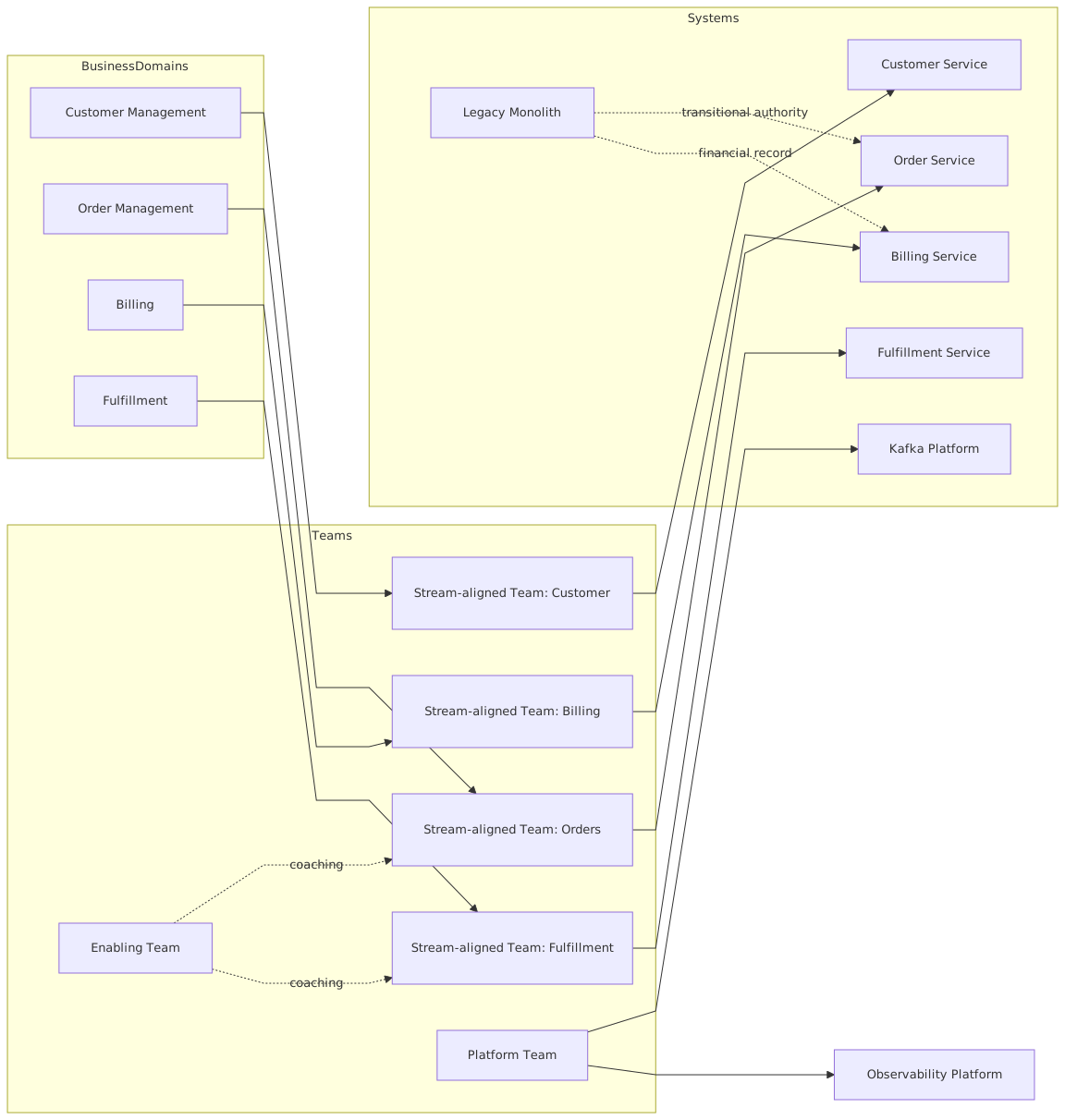
A good ownership map also makes semantic authority explicit. This is where DDD matters. Not every service that stores customer data owns the concept of customer. Some merely reference it. Some cache it. Some project it for local use. One bounded context defines it authoritatively for a given purpose.
That distinction matters enormously in Kafka-based architectures. Teams often publish events as if they were facts from heaven. They are not. An event is a statement made by a bounded context. It has local authority, scoped meaning, and consumers who may derive their own models from it. If you do not draw that line, your event backbone becomes a semantic junk drawer.
Architecture
An architecture ownership map works best when built around three layers: domain, team, and runtime.
1. Domain layer
Start with business capabilities and bounded contexts, not applications. This is where you identify domain semantics. Which context defines “order placed”? Which context determines whether a payment is settled? Where does product availability become a commitment rather than a forecast?
This is the hard part because it forces real conversations. It surfaces contradictions hidden by integration.
A useful rule: if two teams use the same term but make different decisions from it, you probably have two bounded contexts.
2. Team layer
Map contexts to team types from Team Topologies:
- Stream-aligned teams own the flow of change for customer or business value
- Platform teams provide internal products and paved roads
- Enabling teams help teams adopt practices or untangle difficult changes
- Complicated subsystem teams own areas needing specialist depth
The ownership map should show interaction modes too: collaboration, X-as-a-service, or facilitating. This matters because many architecture problems are really unresolved team interaction problems.
3. Runtime layer
Now map services, topics, databases, legacy systems, and external interfaces. For each element, mark:
- owning team
- bounded context
- data authority level
- operational accountability
- integration style
- migration status
This is where the map becomes useful for real delivery.

Domain semantics discussion
This is the place where architecture stops being wiring and starts being language.
Consider “Order.” In a retail enterprise:
- Sales thinks an order exists when a customer confirms checkout
- Fraud thinks an order is provisional until checks complete
- Warehouse thinks an order is real when allocation succeeds
- Finance thinks an order matters when payment is captured and recognized
One universal “Order” entity is a fantasy. A proper ownership map does not erase those distinctions. It makes them visible. The Order bounded context may own the commercial order. Fulfillment owns shipment commitments. Billing owns invoiceable obligations. They are related, but not identical.
This has consequences for APIs and Kafka topics. Events like OrderPlaced, OrderAllocated, and InvoiceIssued are not just status changes. They are claims emitted by different bounded contexts. Their names should reflect domain meaning, and the ownership map should show who is allowed to define and evolve them.
Reconciliation as a first-class concern
Large enterprises always have overlapping truth during transition. Pretending otherwise is childish.
Reconciliation is the capability that compares, aligns, and resolves differences between systems of partial authority. In ownership terms, reconciliation sits at the seam between bounded contexts and between old and new authority models. It may be automated, human-assisted, or batch-driven, but it must be designed.
A common mistake is to leave reconciliation to ad hoc SQL, spreadsheets, or support teams. That is not architecture. That is denial.
When a progressive migration introduces a new Order Service while the legacy ERP still owns financial booking, you need explicit reconciliation for order state, billing state, and exception handling. Ownership of reconciliation itself must be clear: who runs it, who resolves mismatches, and which system wins for which attribute.
Migration Strategy
Ownership maps are especially valuable during migration because migration is where authority gets blurry.
The sensible strategy is progressive strangler migration. Not a heroic rewrite. Not a one-weekend cutover. A staged reassignment of capabilities, semantics, and authority.
You do not replace a monolith by drawing a microservice diagram. You replace it by peeling off seams where domain ownership can be made real.
The migration sequence usually looks like this:
- Identify bounded contexts and current authority
- Expose ownership ambiguity and semantic conflicts
- Choose a candidate seam with manageable blast radius
- Build a new service and assign clear team ownership
- Introduce event publication or APIs around the seam
- Run dual read or dual publish where needed
- Add reconciliation for overlapping truth
- Shift authority attribute by attribute or workflow by workflow
- Retire old paths only after operational confidence exists
That is the strangler pattern with grown-up semantics.
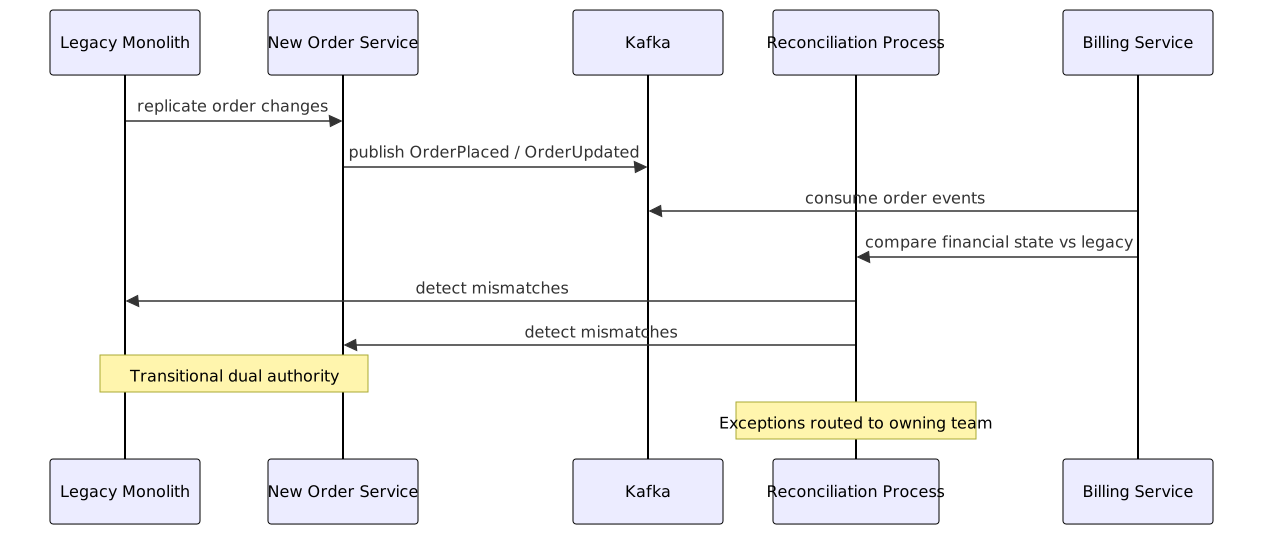
Progressive authority transfer
The critical migration idea is that authority does not move all at once.
For example, the new Order Service may first become the authority for order capture and customer-visible status, while the legacy system retains authority for credit rules and final booking. Later, pricing moves. Later still, inventory commitment moves to Fulfillment. The ownership map should show these transitions explicitly, ideally with state markers such as:
- current authority
- transitional shared authority
- target authority
- reconciled projection only
- deprecated interface
This lets teams and architects reason clearly about what has actually changed.
Kafka in migration
Kafka is useful here, but only when used with discipline.
Use it to publish domain events from contexts that own business changes. Use it to build projections and to decouple consumers. Use it to support gradual migration of read models and downstream integrations.
Do not use Kafka as an excuse to avoid ownership decisions. A topic with ten consumers and no semantic steward is not event-driven architecture. It is distributed confusion.
Schema versioning, topic ownership, retention policies, replay strategy, dead-letter handling, and consumer contract expectations must all be part of the ownership map or at least linked from it.
Enterprise Example
Consider a large insurer modernizing policy administration.
The organization has a legacy policy platform that handles policy issuance, endorsements, renewals, premium schedules, and regulatory reporting. Over time, digital channels, billing services, claims intake, and customer portals have grown around it. Leadership wants product-aligned teams, faster release cycles, and reduced dependence on the central policy platform team.
On paper, “Policy” looks like a single domain. In reality, it is several:
- Policy Origination: quote-to-bind workflow for new business
- Policy Servicing: endorsements and changes
- Billing: invoices, collections, arrears
- Claims Reference: policy coverage projection needed for claim intake
- Regulatory Reporting: legal reporting snapshots
The company initially tried to create a universal Policy Service. Predictably, it became a choke point. Every team depended on it. Semantics became overloaded. Releases slowed down.
The better move was to create an architecture ownership map.
They identified that:
- the Origination team owned quote-to-bind semantics and customer-facing policy lifecycle through issuance
- the Billing team owned invoice and payment obligations, not the entire policy
- the Claims team did not own policy but needed a claims-specific coverage projection
- the legacy policy platform remained the legal authority for certain endorsements during transition
- the platform team owned Kafka infrastructure, identity, and observability, but not business schemas
- an enabling team helped stream-aligned teams adopt event modeling and contract testing
This changed the design conversation. Instead of “how do we centralize policy logic,” the question became “which bounded context owns which part of policy semantics, and what interfaces reflect that ownership?”
They introduced Kafka topics owned by bounded context, not enterprise-wide entities. PolicyIssued came from Origination. InvoiceGenerated came from Billing. Claims consumed policy coverage projections rather than directly querying a canonical policy model. During migration, nightly and near-real-time reconciliation compared billing obligations and policy state between new services and the legacy platform.
The result was not perfect elegance. There were duplicate models. There was transitional complexity. But delivery improved because each team had clearer authority, and incidents got easier to resolve because semantic accountability was no longer hidden behind the phrase “shared service.”
That is a real enterprise lesson: duplication with clear ownership is often healthier than centralization with ambiguity.
Operational Considerations
Ownership maps die if they remain conceptual. They need operational hooks.
Incident management
Every production component must map to an owning team for runtime response. But that is not enough. The map should also indicate business escalation paths. If an order event is malformed, the platform team may help with Kafka operations, but the Orders team owns the semantics. Those are different responsibilities.
Observability
Metrics, logs, traces, and business events should align with ownership boundaries. A stream-aligned team should be able to observe its service behavior and domain outcomes without waiting for a central reporting team. Platform provides the tooling; teams own the signals that matter.
Contract governance
For APIs and event schemas, ownership should be explicit. Who approves breaking changes? Who communicates deprecation? Who supports consumer onboarding? Without this, Kafka and microservices drift into accidental coupling.
Data retention and compliance
If customer deletion requests, retention windows, and audit evidence span multiple contexts, the ownership map needs to show where the policy is enforced and where data is only replicated or cached. This is especially important in regulated enterprises.
Reconciliation operations
Reconciliation is not only a migration concern. In distributed systems, eventual consistency and partial failure are normal. Someone must own mismatch detection, replay, manual review flows, and cut-off rules. Reconciliation jobs without ownership become tomorrow’s financial adjustment scandal.
Tradeoffs
There is no free lunch here. Ownership clarity costs something.
More explicit boundaries can create model duplication
Yes. That is often good. Local models reduce coupling and preserve semantic integrity. But they also require translation and careful interface design.
Transitional ownership is messy
During strangler migration, some capabilities will have split authority. This is unavoidable. The map makes it visible, which can feel uncomfortable to organizations that prefer clean fiction.
Teams may resist semantic accountability
Owning a service is one thing. Owning the business meaning of an event or data set is harder. It requires sustained product and domain engagement.
Platform teams may feel disempowered
Good. Platform teams should enable, not quietly own the enterprise by controlling every dependency. Still, there is a balancing act. Too little central stewardship and the ecosystem fractures. Too much and delivery stalls.
Governance does not disappear
The ownership map is not an anti-governance artifact. It is better governance. It shifts from broad centralized approval to sharper accountability. Some enterprises struggle with that cultural change. ArchiMate for governance
Failure Modes
Most ownership maps fail in familiar ways.
The map becomes a static documentation exercise
If it is updated once a year, it is already dead. Ownership changes with org structure, migration progress, and system evolution.
Everything is marked as shared
This is the cardinal sin. Shared ownership is often a confession that nobody wants accountability. Shared interfaces may exist; shared semantics rarely work well.
The platform team becomes hidden owner of business architecture
This happens when event brokers, API gateways, schema registries, and deployment pipelines become de facto control points. Platform should provide leverage, not absorb business authority.
Bounded contexts are ignored in favor of application names
If the map says “SAP owns customer” or “CRM owns order,” it has probably confused system location with domain authority. Systems implement contexts; they are not the context.
Reconciliation is omitted
Then migration looks simpler than it is, until audit, finance, or operations discovers mismatches. Enterprises always pay for missing reconciliation. Usually with interest.
Kafka topics become enterprise-wide canonical contracts
That path leads to schema politics and synchronized paralysis. Topics should reflect bounded-context ownership and explicit consumer expectations, not a fantasy of universal semantics.
When Not To Use
Do not force a formal architecture ownership map everywhere.
If you have a small product organization with two or three teams, low regulatory burden, and a fairly clean domain boundary, a lightweight service catalog with clear team ownership may be enough.
Do not over-engineer this for a startup-scale environment where communication is direct and architecture is still fluid. The artifact adds value when coordination costs, semantic conflict, and migration complexity are significant.
Also, if the organization is unwilling to act on what the map reveals, do not pretend the artifact alone will save you. An ownership map exposes political and structural problems. If leadership has no appetite to resolve them, the map will simply document dysfunction more clearly.
Related Patterns
Several patterns complement an architecture ownership map.
Bounded Context Map
This is the natural DDD companion. It shows upstream/downstream relationships, customer-supplier dynamics, conformist contexts, anti-corruption layers, and partnership models. The ownership map adds team and operational accountability.
Team Topologies interaction modes
Collaboration, X-as-a-service, and facilitating are essential for making the ownership model practical. They explain how teams work across boundaries without collapsing those boundaries.
Strangler Fig Pattern
This is the default migration pattern for shifting ownership away from legacy systems progressively rather than through big-bang replacement.
Anti-Corruption Layer
Vital when a new bounded context needs to preserve its semantics while integrating with a legacy system that carries different language and rules.
Data Product thinking
Useful in analytical domains, though often over-applied. If a team publishes a governed analytical data product, ownership semantics should still be explicit. Not every table is a product.
Service catalog and developer portal
These are the operational homes for ownership metadata. The map should not live only in slide decks. It should connect to repos, runbooks, dashboards, APIs, and event contracts.
Summary
An architecture ownership map is not another enterprise artifact to decorate governance. It is a way of making responsibility visible where modern organizations most often lose it: at the intersection of domain semantics, team boundaries, and system integration.
The core idea is simple and stubborn:
- model bounded contexts before systems
- assign ownership by business semantics, not by infrastructure location
- distinguish build, run, and data authority
- make team topology explicit
- design reconciliation instead of pretending consistency is free
- migrate authority progressively with a strangler approach
- use Kafka and microservices to support clear ownership, not to blur it
The enterprises that do this well are not the ones with the prettiest diagrams. They are the ones where teams can answer basic but critical questions quickly: Who owns this concept? Who defines this event? Which system is authoritative right now? How do we reconcile drift? What is transitional, and what is target state?
That is architecture in the only sense that really matters.
Not boxes and lines.
Responsibility, made concrete.
Frequently Asked Questions
What is enterprise architecture?
Enterprise architecture aligns strategy, business processes, applications, and technology in a coherent model. It enables impact analysis, portfolio rationalisation, governance, and transformation planning across the organisation.
How does ArchiMate support architecture practice?
ArchiMate provides a standard language connecting strategy, business operations, applications, and technology. It enables traceability from strategic goals through capabilities and services to infrastructure — making architecture decisions explicit and reviewable.
What tools support enterprise architecture modeling?
The main tools are Sparx Enterprise Architect (ArchiMate, UML, BPMN, SysML), Archi (free, ArchiMate-only), and BiZZdesign. Sparx EA is the most feature-rich, supporting concurrent repositories, automation, scripting, and Jira integration.