⏱ 109 min read
Pharma Enterprise Architecture Blueprint: A Complete Reference Sparx EA best practices
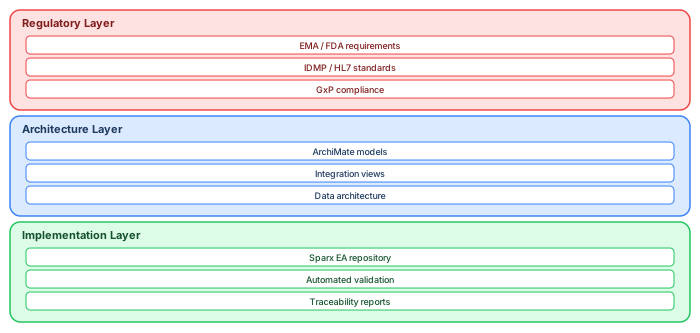
Part I – Context and Strategic Foundation
1. Introduction to Enterprise Architecture in Pharma
Enterprise Architecture (EA) in the pharmaceutical industry is not just about aligning IT with business strategy. It is about enabling scientific innovation while operating under some of the most demanding regulatory constraints in the world. It is about designing systems that can support the discovery of life-saving therapies, ensure patient safety, withstand regulatory scrutiny, and scale globally — all at the same time. free Sparx EA maturity assessment
This blueprint begins with a simple idea: pharma architecture is different. It cannot be approached like retail, banking, or telecom architecture. The consequences of failure are higher, the regulatory oversight is stricter, and the lifecycle of products is significantly longer. Therefore, the architectural thinking must be deeper, more structured, and more disciplined.
1.1 Why Pharma Needs a Specialized EA Blueprint
Pharmaceutical enterprises operate across a uniquely complex landscape:
- Decade-long R&D cycles
- Highly regulated clinical trials
- Strict manufacturing controls (GxP environments)
- Global supply chain serialization requirements
- Continuous pharmacovigilance and post-market surveillance
Unlike many industries, pharma must preserve traceability from molecule discovery to patient delivery. Every data point — from lab results to batch records — may one day be inspected by regulators such as the U.S. Food and Drug Administration or the European Medicines Agency. Architecture, therefore, becomes a mechanism for ensuring compliance by design, not as an afterthought.
A generic enterprise architecture framework is not enough. Pharma requires:
- Embedded compliance controls
- Data integrity guarantees
- Strict validation processes
- Clear segregation of GxP and non-GxP systems
- Full auditability and traceability
This blueprint adapts enterprise architecture practices (such as TOGAF) to the specific realities of pharma operations. ArchiMate in TOGAF ADM
1.2 The Pharma Value Chain: From Molecule to Market
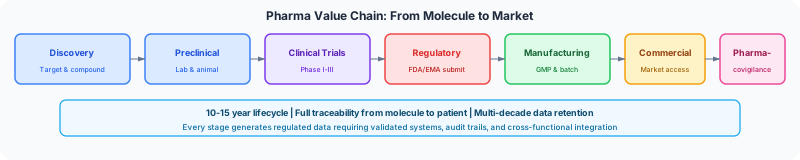
At the heart of the pharmaceutical enterprise lies a long and capital-intensive journey:
- Drug discovery
- Preclinical research
- Clinical trials (Phase I–III)
- Regulatory submission and approval
- Manufacturing and distribution
- Post-market surveillance
Each stage generates vast volumes of data and involves different stakeholders, systems, and regulatory obligations.
Enterprise Architecture must ensure:
- Seamless data continuity across stages
- Clear ownership and governance of information
- Standardized integration between R&D, manufacturing, and commercial systems
- Risk management embedded into operational processes
Architecture in pharma is not just structural — it is lifecycle-aware. Decisions made in early R&D may affect manufacturing scalability ten years later. A fragmented architecture can delay submissions, increase compliance risk, or slow innovation.
1.3 Innovation vs. Compliance: The Architectural Balancing Act
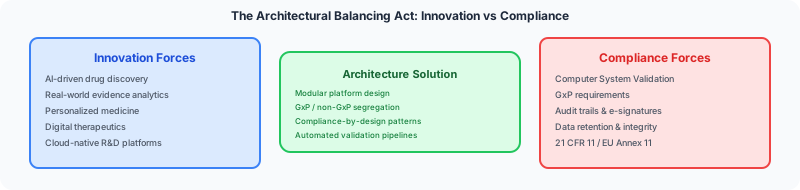
One of the defining tensions in pharmaceutical architecture is the balance between innovation and regulation.
On one hand:
- AI-driven drug discovery
- Real-world evidence analytics
- Personalized medicine
- Digital therapeutics
On the other hand:
- Computer System Validation (CSV)
- GxP requirements
- Audit trails and electronic signatures
- Data retention and integrity controls
Architects must design environments where innovation can flourish without compromising regulatory compliance.
This often requires:
- Clear segregation of exploratory and validated environments
- Modular platform architectures
- Strong data governance frameworks
- Automation of validation and testing processes
- Security and privacy embedded by design
The goal is not to slow innovation with control mechanisms — but to design architectures where compliance is systemically embedded.
1.4 The Role of Enterprise Architecture in Pharma
In a pharmaceutical enterprise, EA operates across four core domains:
- Business Architecture – defining capabilities such as Clinical Operations, Regulatory Affairs, and Pharmacovigilance
- Data Architecture – ensuring integrity, traceability, and interoperability of regulated data
- Application Architecture – structuring validated systems such as LIMS, MES, RIM, and CTMS
- Technology Architecture – supporting secure, scalable, and compliant infrastructure
But beyond domains, EA in pharma must also provide:
- Strategic alignment with therapeutic and commercial objectives
- Regulatory risk mitigation
- Standardization across global operations
- Governance over digital transformation initiatives
Enterprise Architecture becomes the bridge between:
- Science and IT
- Innovation and compliance
- Local regulatory needs and global operations
- Legacy systems and digital transformation
In mature pharma organizations, EA is not a documentation exercise — it is a strategic governance capability.
1.5 Guiding Principles for This Blueprint
This blueprint is built on several foundational principles:
- Compliance by Design – Regulatory controls are embedded in architecture patterns.
- Data as a Regulated Asset – Data is treated as evidence, not just information.
- Lifecycle Continuity – Architecture supports the full product lifecycle.
- Separation with Integration – GxP and non-GxP environments are clearly segregated but interoperable.
- Modularity & Platform Thinking – Enable innovation without destabilizing validated systems.
- Security & Privacy First – Patient data protection is fundamental.
- Traceability & Auditability – Every critical action is attributable and reconstructable.
These principles will guide every subsequent section of this blueprint.
1.6 How to Use This Blueprint
This document is structured to support multiple audiences:
- CIOs & CTOs – to shape digital transformation
- Chief Data Officers – to establish compliant data governance
- Enterprise & Solution Architects – to design reference architectures
- Regulatory & Quality Leaders – to ensure compliance alignment
- Program Managers – to drive roadmap execution
Each chapter will introduce:
- Conceptual explanations
- Pharma-specific patterns
- Reference architecture viewpoints
- Governance implications
Later sections will include diagrams such as:
- Capability maps
- Value stream models
- Data domain diagrams
- Application interaction diagrams
- Technology reference architectures
These diagrams will serve as practical tools for implementation — not just illustrations.
Closing Perspective
Pharmaceutical Enterprise Architecture is ultimately about enabling trust.
Trust from regulators. Trust from healthcare professionals. Trust from patients.
When architecture is thoughtfully designed, governed, and executed, it becomes an invisible enabler of life-saving innovation. When poorly structured, it becomes a barrier to agility, compliance, and growth.
This blueprint aims to provide a structured, pragmatic, and future-ready foundation for designing the modern pharmaceutical enterprise.
In the next section, we will examine the Pharma Industry Landscape and the external forces shaping enterprise architecture decisions.
2. Pharma Industry Landscape
Enterprise Architecture does not exist in isolation. It is shaped by the economic, scientific, regulatory, and geopolitical realities of the industry it serves. In pharmaceuticals, these realities are uniquely complex and constantly evolving.
Before defining capabilities, data models, or application landscapes, we must understand the environment in which the pharmaceutical enterprise operates. Architecture decisions in this sector are deeply influenced by patent cycles, regulatory harmonization efforts, scientific breakthroughs, and global health dynamics.
This section explores the structural forces that define the pharma landscape and, consequently, shape enterprise architecture.
2.1 The Pharmaceutical Value Chain
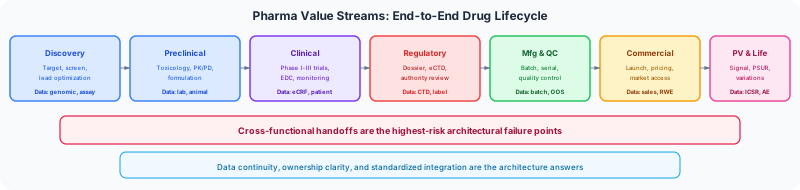
At a high level, the pharmaceutical industry transforms scientific discovery into approved, manufactured, and distributed medicines. However, this transformation is long, capital-intensive, and risk-heavy.
4
The core stages include:
- Discovery & Preclinical Research Target identification, compound screening, lab experimentation.
- Clinical Development Human trials (Phase I–III) generating structured and highly regulated data.
- Regulatory Submission & Approval Dossier preparation and submission to authorities such as the U.S. Food and Drug Administration and the European Medicines Agency.
- Manufacturing & Quality Control Production under Good Manufacturing Practice (GMP) with strict batch traceability.
- Distribution & Commercialization Global supply chains, serialization, and temperature-controlled logistics.
- Pharmacovigilance & Post-Market Surveillance Continuous monitoring of adverse events and safety signals.
From an architecture perspective, this value chain implies:
- Long data retention requirements
- Cross-functional integration across decades
- Tight coupling between regulatory documentation and operational systems
- Full traceability from molecule to patient
Unlike fast-cycle industries, pharma architecture must support multi-decade continuity.
2.2 Operating Models in Pharma

Not all pharmaceutical companies operate the same way. Enterprise Architecture must adapt to different strategic models.
Branded Pharma
Large research-driven organizations invest heavily in innovation and rely on patent protection. Architecture must support:
- Advanced R&D platforms
- Large clinical data ecosystems
- Global regulatory submissions
- Complex manufacturing networks
Generic Manufacturers
These organizations compete on efficiency and speed-to-market after patent expiry. Architecture emphasizes:
- Supply chain optimization
- Cost-efficient manufacturing
- Regulatory replication across markets
Biotechnology Companies
Often focused on niche therapies, biologics, or gene-based treatments. Architecture typically needs:
- Highly specialized lab systems
- Flexible research environments
- Scalable cloud-based analytics
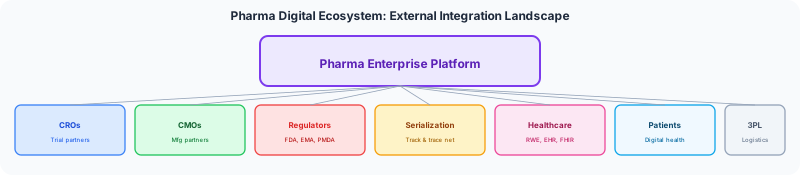
Contract Research & Manufacturing Organizations (CROs & CMOs)
These partners operate within the pharma ecosystem and integrate deeply into sponsor systems.
Architecture implications include:
- Secure external integration
- Data-sharing platforms
- Strong identity and access management
- Clear regulatory responsibility boundaries
The architectural blueprint must therefore be adaptable to organizational scale, maturity, and strategy.
2.3 Regulatory Environment as a Structural Force
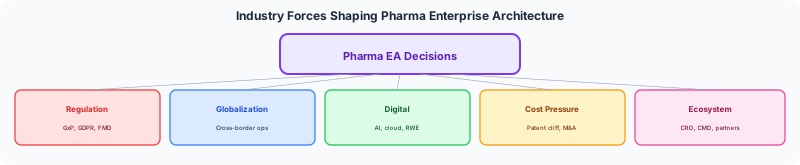
Regulation in pharma is not a constraint layered on top of operations — it is foundational.
Global harmonization efforts such as the International Council for Harmonisation of Technical Requirements for Pharmaceuticals for Human Use aim to standardize submission formats and safety expectations. However, local variations still exist.
Regulatory forces influence architecture in several ways:
- Mandatory audit trails
- Electronic signatures and system validation
- Data integrity requirements (ALCOA+)
- Periodic inspections
- Strict change control processes
Every critical system in a GxP environment must be:
- Validated
- Controlled
- Documented
- Traceable
Architecture, therefore, must incorporate:
- Validation workflows
- Segregated environments
- Compliance reporting mechanisms
- Evidence preservation strategies
This regulatory embeddedness distinguishes pharma architecture from most other industries.
2.4 Globalization and Market Expansion
Pharmaceutical companies operate across continents. A single product may be:
- Discovered in the United States
- Clinically tested in Europe and Asia
- Manufactured in multiple countries
- Distributed globally
Globalization introduces architectural challenges:
- Multi-region data residency
- Cross-border data transfers
- Localization requirements
- Serialization compliance across jurisdictions
- Multi-language documentation
Cloud strategies must account for: enterprise cloud architecture patterns
- Regional regulatory approval of cloud providers
- Data sovereignty
- Disaster recovery across geographies
Architecture must therefore balance global standardization with local regulatory compliance.
2.5 Emerging Industry Trends
The pharmaceutical landscape is undergoing structural change.
Personalized & Precision Medicine
Treatments tailored to genetic profiles require integration between:
- Genomic data
- Clinical systems
- Real-world evidence platforms
This drives demand for scalable analytics and advanced data platforms.
AI-Driven Drug Discovery
Machine learning models accelerate compound identification and target validation. This requires:
- High-performance computing
- Large research data lakes
- MLOps pipelines
- Model validation controls
Digital Therapeutics
Software-based treatments introduce hybrid regulatory models blending medical devices and pharma regulation.
Real-World Evidence (RWE)
Post-market data from wearables, electronic health records, and patient registries increasingly influences regulatory decisions.
These trends push architecture toward:
- Platform-based design
- Cloud-native data ecosystems
- API-driven integration
- Strong privacy-by-design principles
2.6 Competitive Pressures and Cost Dynamics
Drug development is expensive and uncertain. Patent cliffs, generics competition, and payer pressure force companies to:
- Optimize R&D productivity
- Shorten time-to-market
- Improve manufacturing efficiency
- Leverage digital transformation
Enterprise Architecture becomes a strategic lever for:
- Reducing system redundancy
- Standardizing platforms
- Enabling reuse of capabilities
- Accelerating integration
Architecture is no longer back-office governance — it is a driver of operational efficiency and competitive differentiation.
2.7 Architectural Implications of the Industry Landscape
The pharma landscape results in several non-negotiable architectural characteristics:
- Long Lifecycle Support – Systems must be sustainable for decades.
- Regulatory Embeddedness – Compliance controls must be architectural.
- Data Continuity – Traceability across lifecycle stages is mandatory.
- Global Scalability – Architecture must operate across regions.
- Partner Integration – Secure collaboration is essential.
- Innovation Enablement – Modern platforms must coexist with validated systems.
These structural forces define the boundaries within which the Pharma Enterprise Architecture Blueprint operates.
In the next section, we will define the Architecture Vision — translating these industry forces into strategic architectural intent and guiding principles.
3. Architecture Vision (TOGAF Phase A)
Before defining capabilities, data domains, or technology platforms, a pharmaceutical enterprise must articulate a clear Architecture Vision. In TOGAF terms, this corresponds to Phase A – Architecture Vision, where strategic intent is translated into a high-level target state.
In pharma, the Architecture Vision is not merely a technical ambition. It is a strategic commitment to enabling scientific innovation, ensuring regulatory trust, and scaling globally — without losing control over risk, data integrity, or patient safety.
This section defines the strategic drivers, stakeholders, principles, and target state that shape the Pharma Enterprise Architecture Blueprint.
3.1 Strategic Drivers Shaping the Architecture Vision
The pharmaceutical enterprise operates under a unique mix of pressures. These pressures define what the architecture must achieve.
1. Accelerating Drug Development
Time-to-market directly impacts revenue and patient outcomes. Architecture must reduce friction in:
- Clinical data consolidation
- Regulatory submission preparation
- Cross-functional collaboration
2. Regulatory Confidence
Agencies such as the U.S. Food and Drug Administration and the European Medicines Agency expect complete traceability and validated systems. Architecture must guarantee:
- Auditability
- Data integrity
- Controlled change management
- Evidence preservation
3. Digital Transformation
Cloud, AI, automation, and advanced analytics are reshaping pharma operations. Architecture must support modernization without destabilizing validated environments. hybrid cloud architecture
4. Global Standardization
Pharma enterprises operate across regions with varying regulatory nuances. Architecture must enable:
- Global platforms
- Local regulatory adaptability
- Consistent master data management
5. Cost and Efficiency Pressure
Patent cliffs and pricing pressures demand operational efficiency. Architecture must reduce duplication, standardize platforms, and enable reuse.
These drivers collectively shape the architectural intent.
3.2 Stakeholder Landscape
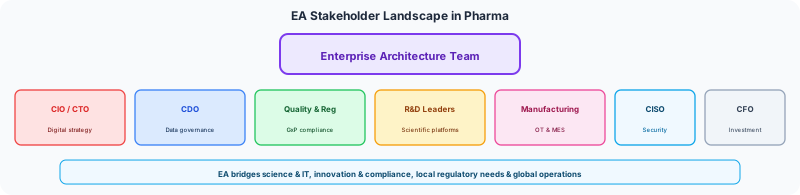
Architecture in pharma involves a wide and diverse set of stakeholders. Each group has different priorities and risk sensitivities.
Executive Leadership
- CEO, CIO, CTO
- Focus on growth, innovation, risk, and cost
R&D Leadership
- Head of Research, Clinical Operations
- Require flexibility, advanced analytics, scientific collaboration
Regulatory & Quality
- Ensure inspection readiness and compliance
- Demand traceability and validated systems
Manufacturing & Supply Chain
- Require high availability, serialization, and batch integrity
Commercial & Market Access
- Focus on forecasting, CRM, real-world evidence
External Stakeholders
- CROs and CMOs
- Health authorities
- Patients and healthcare providers
Architecture must reconcile these sometimes conflicting expectations. It must be flexible enough for research and strict enough for compliance.
3.3 Target Architecture Vision
The Architecture Vision defines the desired future state of the enterprise.
In a mature pharmaceutical organization, the target architecture should be:
1. Platform-Oriented
Core capabilities are delivered via standardized, reusable platforms:
- Clinical Data Platform
- Regulatory Submission Platform
- Manufacturing Execution Platform
- Enterprise Data & Analytics Platform
2. Modular and Segmented
Clear separation between:
- GxP and non-GxP environments
- Exploratory research and validated production systems
- Operational systems and analytical platforms
This segmentation reduces risk while preserving agility.
3. Data-Centric
Data is treated as a regulated, governed asset. The architecture ensures:
- End-to-end lineage
- Master data consistency
- Metadata transparency
- Controlled access
4. Cloud-Enabled but Compliance-Aware
Hybrid or multi-cloud environments are leveraged for scalability and analytics, while validated systems follow strict governance.
5. Secure by Design
Security and privacy controls are embedded across all layers:
- Identity and access management
- Encryption
- Zero-trust segmentation
- Monitoring and audit logging
The Architecture Vision is not a single diagram — it is a structured description of how the enterprise will operate digitally.
3.4 Architecture Principles for Pharma
Architecture principles translate vision into decision criteria. They guide solution design and governance.
Principle 1 – Compliance by Design
All systems supporting regulated processes must embed validation, audit trails, and traceability from inception.
Principle 2 – Data as Evidence
Data is treated as legally defensible evidence. Integrity, completeness, and attribution are mandatory.
Principle 3 – Lifecycle Continuity
Architecture decisions must support the full drug lifecycle — from discovery to post-market surveillance.
- Principle 4 – Modularity Over Monoliths
- Modular platforms reduce validation scope and accelerate innovation.
- Principle 5 – Standardization Before Customization
- Enterprise-wide standards reduce compliance risk and integration complexity.
- Principle 6 – Segregation with Controlled Integration
GxP and non-GxP systems are clearly segregated but interoperable through governed interfaces.
Principle 7 – Security & Privacy First
Patient data protection and cybersecurity resilience are foundational.
These principles will be referenced throughout the blueprint and serve as governance checkpoints.
3.5 Scope and Boundaries of the Blueprint
The Architecture Vision must clearly define scope.
This blueprint covers:
- Business capabilities across R&D, Clinical, Manufacturing, Regulatory, Commercial
- Data architecture across regulated and analytical domains
- Application and integration reference models
- Technology and infrastructure standards
- Governance and roadmap frameworks
It excludes:
- Detailed therapeutic-area specific architectures
- Vendor-specific implementation guides
- Product-level solution configurations
The intent is to provide an enterprise-level reference architecture adaptable to multiple pharma contexts.
3.6 Architecture Governance at Vision Level
The Architecture Vision must be governed to remain relevant and enforceable.
Key governance components include:
- Enterprise Architecture Board
- Design Authority for GxP systems
- Standard catalog management
- Exception and waiver process
- Architecture compliance reviews
In pharma, governance is not optional. It directly impacts inspection readiness and operational risk.
3.7 Measuring Architectural Success

An Architecture Vision must be measurable.
Indicators of success include:
- Reduced time-to-market
- Increased reuse of platforms
- Fewer regulatory observations related to systems
- Reduced integration complexity
- Improved data quality metrics
- Faster onboarding of partners
Architecture is valuable when it enables business outcomes — not when it produces documentation.
Closing Perspective
The Architecture Vision establishes the north star for the pharmaceutical enterprise. It aligns digital strategy with regulatory confidence, scientific ambition, and operational resilience.
In TOGAF terms, Phase A sets the direction. The subsequent phases will detail how this vision materializes across:
- Business Architecture
- Data Architecture
- Application Architecture
- Technology Architecture
In the next section, we move into the foundation of all enterprise structure: the Pharma Capability Model.
4. Pharma Capability Model
If the Architecture Vision defines where the enterprise wants to go, the Capability Model defines what the enterprise must be able to do*.*
In TOGAF terms (Phase B – Business Architecture), capabilities provide a stable, strategy-aligned view of the organization. Unlike processes, systems, or organizational charts, capabilities are relatively stable over time. They describe what the business does, not how it is currently implemented.
For a pharmaceutical enterprise, a well-defined capability model becomes the backbone of architectural planning, investment prioritization, and transformation roadmapping.
4.1 What Is a Business Capability in Pharma?
A business capability describes an ability the organization must possess to achieve its objectives.
For example:
- “Manage Clinical Trials” is a capability.
- “Submit Regulatory Dossiers” is a capability.
- “Ensure Batch Quality Release” is a capability.
Capabilities are:
- Technology-agnostic
- Organization-agnostic
- Process-agnostic
- Measurable in maturity
This abstraction is powerful in pharma because it allows architecture to remain stable even as tools, vendors, or operating models change.
4.2 Core Pharma Capabilities
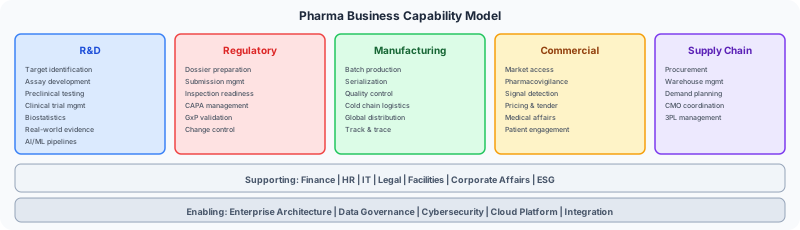
At the highest level, pharmaceutical enterprises revolve around five core capability domains:
4
1. Research & Development (R&D)
This domain includes:
- Target Identification & Validation
- Compound Screening & Optimization
- Preclinical Testing
- Clinical Trial Design & Execution
- Clinical Data Management
- Biostatistics & Analysis
R&D capabilities demand high flexibility, advanced analytics, and collaboration platforms.
2. Regulatory Affairs
This domain ensures compliance with authorities such as the U.S. Food and Drug Administration and the European Medicines Agency.
Capabilities include:
- Regulatory Intelligence
- Dossier Preparation
- Submission Management
- Labeling Management
- Regulatory Lifecycle Tracking
Architecture here must emphasize document traceability, structured content management, and submission standards.
3. Manufacturing & Quality
Core capabilities:
- Production Planning
- Batch Manufacturing Execution
- Quality Control Testing
- Batch Release & Certification
- Deviation & CAPA Management
- Validation & Qualification
These operate in strict GxP environments, requiring validated systems and high availability.
4. Supply Chain & Distribution
Capabilities include:
- Demand Forecasting
- Inventory Management
- Serialization & Track-and-Trace
- Cold Chain Management
- Global Distribution
Architecture must ensure real-time visibility, compliance with serialization laws, and global scalability.
5. Commercial & Market Access
Capabilities include:
- Customer Relationship Management
- Pricing & Market Access Strategy
- Medical Information Services
- Real-World Evidence Collection
- Pharmacovigilance
Here, integration between commercial data and safety monitoring becomes critical.
4.3 Supporting & Enabling Capabilities
Beyond core domains, pharma enterprises rely on enabling capabilities:
Corporate & Shared Services
- Finance
- Procurement
- Human Resources
- Legal
Enterprise IT & Digital
- Application Management
- Infrastructure Operations
- Cybersecurity
- Data Governance
- Enterprise Architecture
Governance & Risk
- Quality Assurance
- Internal Audit
- Enterprise Risk Management
Although not drug-facing, these capabilities are essential for operational integrity and compliance.
4.4 Capability Hierarchy and Levels
- A mature Pharma Capability Model typically has three levels:
- Level 1 – Domain
- Example: Manufacturing & Quality
- Level 2 – Capability
- Example: Batch Quality Release
- Level 3 – Sub-Capability
- Example: Electronic Batch Record Review
- This layered view enables:
- Investment mapping
- Application alignment
- Maturity assessment
- Gap analysis
Capabilities should not be confused with processes. For example:
- “Clinical Trial Monitoring” is a capability.
- The specific monitoring workflow is a process.
Architecture aligns systems to capabilities — not directly to processes.
4.5 Capability Maturity Assessment
One of the most powerful uses of the capability model is maturity assessment.
Capabilities can be evaluated across dimensions such as:
- Process standardization
- System support
- Data quality
- Automation level
- Regulatory robustness
For example:
This approach enables:
- Data-driven transformation roadmaps
- Risk-based prioritization
- Alignment with strategic objectives
4.6 Linking Capabilities to Architecture Domains
The capability model becomes the anchor for all architecture domains:
- Business Architecture → Defines capabilities
- Data Architecture → Identifies data domains supporting each capability
- Application Architecture → Maps systems to capabilities
- Technology Architecture → Enables capability execution
For example:
Capability: Clinical Data Management
- Data Domain: Clinical Trial Data
- Applications: CTMS, EDC, Data Warehouse
- Technology: Cloud analytics platform
This traceability ensures that every architectural decision directly supports business ability.
4.7 Capability-Based Planning in Pharma
Pharma transformation programs should be capability-driven rather than system-driven.
- Instead of asking:
- “Which ERP should we implement?”
- The better question is:
- “Which capabilities are we trying to improve, and why?”
- For example:
- Improving “Regulatory Submission Management” may require structured content platforms.
- Improving “Manufacturing Quality Oversight” may require MES modernization.
This shifts focus from tools to outcomes.
4.8 Architectural Implications of the Capability Model
A well-defined capability model provides:
- Strategic alignment
- Clear investment prioritization
- Reduced duplication across regions
- Better regulatory defensibility
- Improved platform standardization
It also enables the identification of:
- Overlapping systems
- Capability gaps
- Redundant applications
- High-risk manual processes
The capability model becomes the stable reference point for the entire enterprise architecture blueprint.
Closing Perspective
The Pharma Capability Model is the structural backbone of the enterprise. It provides clarity in a complex regulatory and scientific environment. It ensures that architecture decisions are grounded in what the organization must fundamentally be able to do.
In the next section, we move from static capabilities to dynamic flow — examining the Pharma Value Streams that connect these capabilities across the drug lifecycle.
Part II – Business Architecture
5. Pharma Value Streams
If capabilities describe what the organization must be able to do, value streams describe how value flows across those capabilities to deliver outcomes.
In pharmaceutical enterprises, value streams are long, highly regulated, and deeply data-driven. They connect research, clinical operations, manufacturing, regulatory affairs, and commercial teams into an end-to-end lifecycle that may span 10–20 years.
Understanding value streams is critical for Enterprise Architecture because they reveal:
- Cross-domain dependencies
- Data handoffs
- System integration points
- Regulatory control boundaries
- Bottlenecks and risk concentrations
Value streams move us from structural design to operational flow.
5.1 The End-to-End Drug Lifecycle Value Stream
At the highest level, the pharmaceutical enterprise revolves around one primary value stream:
From Molecule to Market — and Beyond
4
This lifecycle typically includes:
- Discovery
- Preclinical Research
- Clinical Development (Phase I–III)
- Regulatory Submission & Approval
- Manufacturing Scale-Up
- Market Launch
- Post-Market Surveillance
Unlike most industries, the pharmaceutical lifecycle does not end at launch. Pharmacovigilance and lifecycle management continue as long as the product remains on the market.
From an architectural perspective, this implies:
- Persistent data lineage
- Long-term archival and retention strategies
- Continuous integration between safety systems and operational platforms
5.2 Discovery & Preclinical Value Stream
The early-stage value stream focuses on identifying viable therapeutic candidates.
Key Stages
- Target Identification
- Compound Screening
- Lead Optimization
- In-vitro & In-vivo Testing
Architectural Characteristics
- High-volume experimental data
- Flexible research platforms
- Advanced analytics and AI models
- Integration with laboratory systems
Systems typically include:
- Electronic Lab Notebooks (ELN)
- Laboratory Information Management Systems (LIMS)
- High-performance computing platforms
At this stage, agility is critical. However, as compounds progress toward clinical trials, documentation rigor increases dramatically.
5.3 Clinical Development Value Stream
Clinical development transforms scientific hypotheses into evidence.
Key Phases
- Phase I – Safety
- Phase II – Efficacy
- Phase III – Large-scale validation
Core Capabilities Involved
- Clinical Trial Design
- Site Management
- Patient Recruitment
- Data Capture & Monitoring
- Biostatistics & Analysis
Regulatory authorities such as the U.S. Food and Drug Administration and the European Medicines Agency expect strict compliance with Good Clinical Practice (GCP).
Architectural Implications
- Structured clinical data standards
- Strong audit trails
- Electronic Data Capture (EDC) systems
- Secure integration with CRO partners
- Data anonymization and privacy controls
Clinical data becomes the evidentiary foundation for regulatory approval. Architecture must ensure integrity, traceability, and controlled change management.
5.4 Regulatory Submission Value Stream
Once sufficient evidence is gathered, the regulatory submission process begins.
Key Stages
- Dossier Compilation
- Structured Content Authoring
- Validation Checks
- Submission to Authorities
- Authority Queries & Responses
The submission format is governed by international harmonization initiatives such as the International Council for Harmonisation of Technical Requirements for Pharmaceuticals for Human Use.
Architectural Requirements
- Structured content management
- Document version control
- Submission tracking
- Metadata consistency
- Long-term archival
This stage demands strong integration between:
- Clinical systems
- Quality systems
- Manufacturing documentation
- Regulatory Information Management (RIM) platforms
The architecture must support defensible evidence compilation across multiple domains.
5.5 Manufacturing & Quality Value Stream
After approval, value shifts toward scalable and compliant production.
Core Activities
- Technology Transfer
- Production Planning
- Batch Manufacturing
- Quality Testing
- Batch Release
This environment operates under Good Manufacturing Practice (GMP).
Architectural Implications
- Manufacturing Execution Systems (MES)
- Electronic Batch Records
- Quality Management Systems (QMS)
- Equipment integration (OT/IT convergence)
- High availability and disaster recovery
Unlike R&D, manufacturing environments prioritize stability and control over agility.
Integration between operational technology (OT) and enterprise IT introduces cybersecurity considerations and strict segmentation requirements.
5.6 Commercial & Market Access Value Stream
Once products reach the market, value generation depends on:
- Launch readiness
- Supply chain reliability
- Sales engagement
- Market access strategy
- Real-world evidence collection
Architectural Focus Areas
- CRM systems
- Forecasting platforms
- Serialization systems
- Data analytics platforms
- Integration with pharmacovigilance
This stage blends regulated processes with competitive market dynamics.
5.7 Pharmacovigilance & Lifecycle Management
Post-market surveillance ensures patient safety and regulatory compliance.
Key Activities
- Adverse Event Reporting
- Signal Detection
- Risk Management Plans
- Periodic Safety Update Reports
Safety monitoring continues throughout the product lifecycle.
Architecture must ensure:
- Near real-time data intake
- Integration with global safety databases
- Regulatory reporting automation
- Secure handling of patient data
Pharmacovigilance closes the loop of the value stream — feeding insights back into regulatory updates and product improvements.
5.8 Cross-Functional Handoffs and Data Continuity
The most critical architectural risks in pharma occur at handoff points:
- Discovery → Clinical
- Clinical → Regulatory
- Regulatory → Manufacturing
- Manufacturing → Commercial
- Market → Safety Monitoring
Failures at these boundaries often result in:
- Delays in approval
- Incomplete documentation
- Data integrity findings
- Rework and compliance risk
Enterprise Architecture must ensure:
- Standardized data models
- Integrated platforms
- Controlled APIs
- Master data governance
- Clear ownership across domains
Value streams reveal where integration matters most.
5.9 Architectural Implications of Value Stream Thinking
Designing architecture around value streams provides:
- End-to-end traceability
- Reduced silos
- Clear prioritization of integration investments
- Better alignment between business and IT
- Improved regulatory defensibility
Instead of optimizing isolated systems, the enterprise optimizes the flow of value.
This approach also enables:
- Bottleneck analysis
- Risk concentration identification
- Digital transformation sequencing
Closing Perspective
Pharma value streams are long, regulated, and evidence-driven. They demand architectural continuity across decades and across domains.
Capabilities define structural strength. Value streams define operational flow.
Together, they provide the foundation for business architecture.
In the next section, we examine how these capabilities and value streams are organized structurally through the Pharma Operating Model.
6. Organizational & Operating Model
If capabilities define what the enterprise must be able to do, and value streams define how value flows, the operating model defines how the organization is structured to execute those capabilities consistently across geographies, functions, and partners.
In pharmaceuticals, the operating model is deeply influenced by:
- Regulatory obligations
- Global market presence
- R&D intensity
- Outsourcing strategies
- Risk management requirements
Enterprise Architecture must align with — and often shape — the operating model to ensure standardization, compliance, and scalability.
6.1 Global vs. Regional Operating Structures
Most pharmaceutical companies operate in a hybrid structure combining global standardization with regional autonomy.
4
Global Core
Global functions typically own:
- R&D strategy
- Clinical standards
- Regulatory submission frameworks
- Global manufacturing standards
- Enterprise IT and data platforms
The objective is consistency and compliance.
Regional & Local Units
Regions may adapt:
- Labeling requirements
- Market access strategies
- Local regulatory submissions
- Distribution networks
The objective is market responsiveness.
Architectural Implication
Enterprise Architecture must:
- Provide globally standardized platforms
- Allow controlled localization
- Ensure master data consistency
- Maintain centralized governance with regional flexibility
Without architectural standardization, regional divergence quickly leads to system fragmentation and compliance risk.
6.2 Centralized vs. Decentralized R&D
R&D structures vary significantly across pharma organizations.
Centralized Model
- Single global R&D governance
- Unified data platforms
- Standardized research tools
Advantages:
- Data consistency
- Faster cross-study analytics
- Easier regulatory compilation
Challenges:
- Potential rigidity
- Slower adaptation to niche research domains
Decentralized Model
- Independent research units
- Specialized therapeutic focus
- Flexible experimentation environments
Advantages:
- Innovation speed
- Scientific autonomy
Challenges:
- Data silos
- Integration complexity
- Submission harmonization issues
Architectural Balance
Enterprise Architecture must:
- Provide a unified data backbone
- Enable controlled research sandboxes
- Ensure eventual standardization before regulatory submission
This is often achieved through segmented environments:
- Exploratory environments (flexible)
- Pre-submission harmonized platforms (controlled)
6.3 Shared Services in a GxP Context
Many pharma organizations adopt shared service models for efficiency:
- Finance
- HR
- Procurement
- IT Operations
- Data Governance
However, GxP environments require special treatment.
For example:
- A shared IT team managing validated systems must follow strict change control.
- Centralized data governance must ensure ALCOA+ principles across all domains.
Architectural Implication
Shared services require:
- Clearly defined system ownership
- Role-based access control
- Standardized validation procedures
- Centralized monitoring and logging
In regulated industries, shared services must combine efficiency with documented accountability.
6.4 Governance & Decision Rights
Operating models define who decides what.
In pharma, governance typically includes:
- Executive Steering Committee
- R&D Governance Board
- Regulatory Review Committee
- Quality & Compliance Board
- Enterprise Architecture Board
Architecture must support:
- Transparent decision documentation
- Standard repositories
- Change management workflows
- Controlled configuration management
Governance structures are not optional — they are inspected during audits.
6.5 Outsourcing & Ecosystem Integration
Modern pharma companies rarely operate alone.
They collaborate with:
- Contract Research Organizations (CROs)
- Contract Manufacturing Organizations (CMOs)
- Academic institutions
- Technology partners
These collaborations introduce complexity in:
- Data exchange
- Responsibility boundaries
- Regulatory accountability
Authorities such as the U.S. Food and Drug Administration require clear delineation of sponsor responsibility even when processes are outsourced.
Architectural Requirements
- Secure B2B integration
- Controlled data access
- Audit logging across organizational boundaries
- Segregated environments
- Vendor validation documentation
The operating model must explicitly define digital responsibility boundaries.
6.6 GxP Segmentation within the Operating Model
One of the most important structural characteristics of pharma operating models is the separation between:
- GxP-regulated environments
- Non-GxP or exploratory environments
This segmentation impacts:
- Infrastructure
- Application deployment
- DevOps pipelines
- Access control
- Change management
For example:
- A validated Manufacturing Execution System (MES) operates under strict change control.
- A data science sandbox exploring predictive models operates under flexible governance — until results impact regulatory submissions.
Enterprise Architecture must define:
- Clear boundary rules
- Controlled data promotion pathways
- Validation checkpoints
- Audit trail continuity
This dual-mode operating model is fundamental in pharmaceutical enterprises.
6.7 Operating Model Patterns in Pharma
Four common patterns emerge in the industry:
1. Fully Integrated Global Model
Strong central control, standardized systems, centralized governance.
2. Federated Model
Global standards with regional system variations.
3. Platform-Based Model
Shared enterprise platforms with modular capability layers.
4. Biotech Agile Model
Lean organization, cloud-first architecture, high outsourcing reliance.
The architecture blueprint must be adaptable across these patterns.
6.8 Architectural Implications of the Operating Model
The operating model determines:
- Platform centralization
- Data governance structure
- Identity & access strategy
- Integration topology
- Validation ownership
- Change management workflows
Misalignment between architecture and operating model leads to:
- Duplicate systems
- Shadow IT
- Compliance risk
- Increased integration cost
Alignment ensures:
- Clarity of responsibility
- Scalable global operations
- Inspection readiness
- Efficient digital transformation
Closing Perspective
The pharmaceutical operating model is not simply an organizational chart — it is the structural framework within which regulated capabilities operate.
Enterprise Architecture must reflect:
- Global ambition
- Regulatory accountability
- Partner ecosystems
- Risk segmentation
- Governance discipline
With capabilities and value streams defined, and the operating model clarified, we now turn to one of the most defining aspects of pharmaceutical enterprises:
Regulatory & Compliance Architecture — where compliance is not layered on top, but embedded into the architectural fabric.
7. Regulatory & Compliance Architecture
In most industries, compliance is an overlay — a set of controls applied after systems and processes are designed.
In pharmaceuticals, compliance is foundational.
Regulatory authorities such as the U.S. Food and Drug Administration and the European Medicines Agency do not only inspect products — they inspect systems, processes, documentation, and data integrity. Architecture must therefore be designed so that compliance is embedded structurally, not retrofitted reactively.
This section defines how regulatory requirements shape enterprise architecture across business, data, application, and technology domains.
7.1 The GxP Framework Landscape
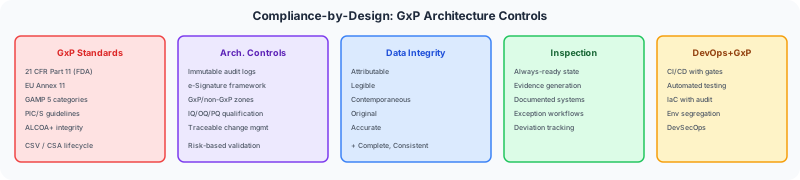
Pharmaceutical compliance is structured around GxP principles — a family of quality guidelines governing different stages of the drug lifecycle.
4
Key GxP domains include:
- GMP (Good Manufacturing Practice) – Manufacturing & quality control
- GCP (Good Clinical Practice) – Clinical trials
- GLP (Good Laboratory Practice) – Preclinical research
- GVP (Good Pharmacovigilance Practice) – Safety monitoring
Each GxP domain introduces requirements for:
- Controlled documentation
- Validated systems
- Audit trails
- Electronic signatures
- Change management
- Training & qualification records
Enterprise Architecture must recognize that different systems fall under different GxP scopes — and apply appropriate levels of control.
7.2 Compliance by Design
Regulatory compliance should not be treated as an afterthought. Instead, architecture must enable compliance by design.
This means:
- Systems are validated before productive use
- Audit logging is built-in, not optional
- Data integrity controls are enforced at the platform level
- Role-based access is centrally governed
- Change management is integrated with deployment pipelines
Compliance by design reduces:
- Remediation costs
- Inspection findings
- Operational disruption
- Regulatory risk
It also increases organizational confidence in digital transformation initiatives.
7.3 Computer System Validation (CSV)
Any system supporting GxP processes must undergo validation.
Validation ensures that:
- The system performs as intended
- Requirements are traceable
- Risks are assessed and mitigated
- Testing evidence is documented
Traditional CSV approaches are document-heavy and manual. Modern pharma organizations are moving toward risk-based validation aligned with guidance from the International Council for Harmonisation of Technical Requirements for Pharmaceuticals for Human Use.
Architectural Implications
Enterprise Architecture must support:
- Clear requirement traceability
- Version control and configuration management
- Test automation frameworks
- Controlled environment segregation
- Deployment documentation automation
In modern DevOps environments, validation must integrate seamlessly into CI/CD pipelines without compromising compliance.
7.4 Data Integrity & ALCOA+
Data integrity is one of the most scrutinized aspects during inspections.
The ALCOA+ principles require data to be:
- Attributable
- Legible
- Contemporaneous
- Original
- Accurate
- Complete
- Consistent
- Enduring
- Available
Architecture must enforce these principles at multiple layers:
Application Layer
- Mandatory audit trails
- Controlled data edits
- Timestamping
Data Layer
- Immutable logging
- Versioned datasets
- Backup and archival strategies
Infrastructure Layer
- Time synchronization
- Secure storage
- Access control
Failure to enforce data integrity can result in warning letters, product delays, or market withdrawal.
7.5 Audit Trails & Electronic Signatures
Regulatory bodies require that electronic systems:
- Capture all critical actions
- Record user identity
- Preserve historical states
- Protect against tampering
Electronic signatures must be:
- Unique to individuals
- Securely authenticated
- Linked to specific records
Architecture must ensure:
- Centralized identity and access management
- Non-repudiation controls
- Secure logging
- Tamper-evident storage mechanisms
Audit readiness is not a periodic activity — it must be continuous.
7.6 Inspection Readiness by Design
Regulatory inspections are unpredictable. Organizations must always be inspection-ready.
Architecture contributes by enabling:
- Rapid document retrieval
- Centralized compliance repositories
- Clear traceability matrices
- Controlled access to historical records
- Automated compliance reporting dashboards
Inspection readiness improves when:
- Systems are standardized
- Documentation is structured
- Metadata is consistent
- Evidence is digitally accessible
Enterprise Architecture reduces inspection stress by reducing system chaos.
7.7 Risk-Based Compliance Architecture
Not all systems carry the same regulatory weight.
Architecture should classify systems by:
- GxP impact level
- Patient safety impact
- Data criticality
- Regulatory reporting relevance
For example:
- A Manufacturing Execution System (MES) is high-risk.
- An internal HR system is low-risk.
Risk-based segmentation enables:
- Proportional validation effort
- Focused monitoring
- Efficient resource allocation
- Reduced over-engineering
This approach supports agility while preserving compliance integrity.
7.8 Segregation of GxP and Non-GxP Environments
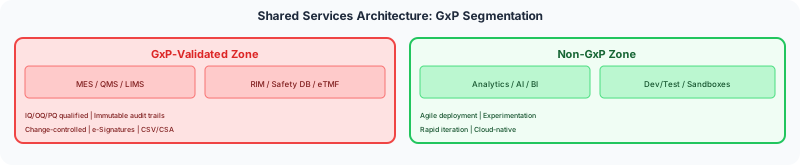
A critical architectural pattern in pharma is environment segmentation.
GxP Environment Characteristics
- Strict change control
- Documented validation
- Limited deployment windows
- Controlled configuration management
Non-GxP Environment Characteristics
- Flexible experimentation
- Agile development
- Rapid iteration
Architecture must define:
- Data promotion controls
- Controlled integration interfaces
- Environment boundary policies
- Automated compliance checkpoints
This dual-speed architecture allows innovation without destabilizing validated systems.
7.9 Cybersecurity in a Regulated Context
Cybersecurity is increasingly viewed as a compliance issue.
Authorities expect:
- System vulnerability management
- Secure access control
- Incident response documentation
- Data breach mitigation procedures
In manufacturing environments, OT/IT convergence increases risk exposure.
Architecture must implement:
- Network segmentation
- Zero-trust access models
- Continuous monitoring
- Incident logging and retention
Cybersecurity failures can become regulatory findings.
7.10 Architectural Implications of Compliance
Regulatory & Compliance Architecture influences:
- Application design
- Infrastructure patterns
- DevOps practices
- Data governance models
- Identity management strategies
- Vendor selection decisions
It increases complexity — but also increases discipline.
Organizations that treat compliance as an architectural dimension rather than a bureaucratic burden achieve:
- Faster inspections
- Reduced remediation costs
- Higher system reliability
- Stronger regulator trust
Closing Perspective
In pharmaceuticals, compliance is not a constraint to work around — it is a structural characteristic of the enterprise.
Regulatory & Compliance Architecture ensures that:
- Innovation does not compromise safety
- Digital transformation does not weaken control
- Data remains defensible evidence
- Systems remain inspection-ready
With Business Architecture defined — including capabilities, value streams, operating model, and compliance foundation — we now move into the next major domain:
Data Architecture, where information becomes the regulated backbone of the pharmaceutical enterprise.
Part III – Data Architecture
8. Pharma Data Domains
If compliance defines the guardrails of the pharmaceutical enterprise, data defines its backbone.
In pharma, data is not just an operational asset — it is regulated evidence. Every clinical observation, manufacturing batch record, and safety report may eventually be reviewed by authorities such as the U.S. Food and Drug Administration or the European Medicines Agency.
Enterprise Architecture must therefore structure data deliberately, consistently, and traceably across the entire drug lifecycle.
This section defines the primary data domains of a pharmaceutical enterprise and their architectural implications.
8.1 Why Data Domains Matter in Pharma
A data domain is a logical grouping of related data that supports specific business capabilities.
Defining clear data domains enables:
- Ownership and stewardship assignment
- Governance clarity
- System alignment
- Master data harmonization
- Regulatory traceability
- Lifecycle continuity
Without structured data domains, organizations face:
- Fragmented clinical datasets
- Inconsistent product definitions
- Regulatory submission inconsistencies
- Duplicate master data
- Compliance findings
In pharma, poorly governed data can delay approvals or trigger inspection observations.
8.2 Core Pharma Data Domains
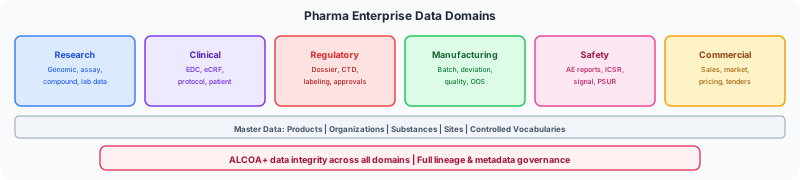
Below are the primary enterprise-level data domains typically found in pharmaceutical organizations.
4
1. Research & Preclinical Data
This domain includes:
- Target identification data
- Molecular structures
- Compound screening results
- Experimental lab data
- Toxicology results
Characteristics:
- High volume
- Semi-structured or unstructured
- Research-focused
- Less regulated initially, more controlled as compounds progress
Architectural Considerations:
- Scalable storage
- Metadata tagging
- Version control
- Research-to-clinical data promotion controls
2. Clinical Data
This is one of the most critical regulated domains.
Includes:
- Study protocols
- Patient demographics
- Investigational site data
- Electronic Case Report Forms (eCRF)
- Adverse event reports
- Biostatistical outputs
Often structured according to standards from the International Council for Harmonisation of Technical Requirements for Pharmaceuticals for Human Use and CDISC frameworks.
Characteristics:
- Highly regulated (GCP)
- Long retention periods
- Strict auditability
- Strong anonymization requirements
Architectural Implications:
- Data lineage tracking
- Controlled access
- Validation controls
- Secure integration with CRO partners
3. Regulatory Data
Regulatory data represents compiled evidence prepared for submission.
Includes:
- Dossier documents
- Structured content (eCTD modules)
- Labeling data
- Authority correspondence
- Submission tracking metadata
Characteristics:
- Highly structured
- Version-controlled
- Long-term archival
- Legally defensible
Architecture must ensure:
- Document lifecycle management
- Metadata consistency
- Traceability to source systems
- Controlled content reuse
4. Manufacturing & Quality Data
This domain supports GMP processes.
Includes:
- Batch production records
- Equipment calibration logs
- Environmental monitoring data
- Deviation and CAPA records
- Release certifications
Characteristics:
- Real-time operational data
- High integrity requirements
- Audit trail mandatory
- OT/IT integration
Architectural Considerations:
- High availability
- Tamper-evident storage
- Time synchronization
- Integration with ERP and supply chain systems
5. Pharmacovigilance & Safety Data
This domain covers post-market surveillance.
Includes:
- Adverse event reports
- Safety signals
- Risk management plans
- Periodic safety reports
Characteristics:
- Continuous inflow of global data
- Cross-regional reporting obligations
- Privacy-sensitive
Architecture must support:
- Near real-time intake
- Automated reporting
- Signal detection analytics
- Secure global data exchange
6. Commercial & Market Data
Includes:
- Sales data
- CRM interactions
- Pricing and reimbursement data
- Real-world evidence datasets
- Market analytics
Characteristics:
- Often less regulated than GxP data
- Integrated with safety monitoring
- Regionally segmented
Architectural Needs:
- Advanced analytics platforms
- Integration with supply chain and safety systems
- Privacy controls for patient-level insights
8.3 Master Data Domains
Master data acts as the connective tissue across all other domains.
Key master entities include:
- Product
- Substance
- Study
- Site
- Investigator
- Manufacturing Site
- Supplier
- Customer
- Patient (pseudonymized where required)
Master data challenges are common in pharma:
- Inconsistent product definitions across regions
- Duplicate investigator records
- Divergent manufacturing site codes
Architecture must implement:
- Master Data Management (MDM) platforms
- Clear data ownership
- Global data standards
- Cross-domain synchronization
Master data consistency directly impacts regulatory submissions and manufacturing traceability.
8.4 Data Domain Boundaries & Intersections
Pharma data domains are not isolated — they intersect heavily.
Examples:
- Clinical data feeds regulatory submissions.
- Manufacturing data feeds quality reporting.
- Safety data feeds regulatory updates.
- Commercial data may generate new safety signals.
The most critical architectural risks occur at these boundaries.
Enterprise Architecture must define:
- Standardized data exchange models
- API-based integration
- Controlled ETL processes
- Metadata lineage tracking
8.5 Data Lifecycle Across Domains
Pharma data follows long lifecycles:
- Creation
- Processing
- Review
- Submission
- Archival
- Retrieval (during inspection)
Retention requirements may extend decades beyond product launch.
Architecture must therefore ensure:
- Long-term archival strategies
- Format sustainability
- Secure storage
- Efficient retrieval mechanisms
Data lifecycle management is inseparable from regulatory architecture.
8.6 Domain Ownership & Stewardship
Each data domain requires:
- Business owner
- Data steward
- Technical custodian
- Governance framework
Clear accountability prevents:
- Orphaned datasets
- Inconsistent definitions
- Compliance gaps
Data domains without ownership become regulatory risks.
8.7 Architectural Implications of Domain Modeling
Well-defined data domains enable:
- Clear platform alignment
- Risk-based validation scoping
- Controlled integration
- Data quality measurement
- Capability mapping
They also allow transformation programs to focus investments where risk and value intersect.
For example:
- Modernizing the Clinical Data Domain may directly accelerate submission timelines.
- Improving Manufacturing Data Integrity may reduce inspection findings.
Data domains provide architectural clarity in a complex regulatory ecosystem.
Closing Perspective
In pharmaceuticals, data is not simply stored — it is defended.
Each data domain represents a regulated body of evidence supporting patient safety and product quality. Clear domain modeling ensures:
- Accountability
- Traceability
- Integration
- Compliance
- Long-term sustainability
With data domains defined, the next step is to establish how they are governed and protected.
In the next section, we move into Data Governance & Data Integrity, where policy meets architecture.
9. Data Governance & Data Integrity
If data domains define what data exists in the enterprise, data governance defines who owns it, how it is controlled, and how its integrity is ensured over time.
In pharmaceuticals, data governance is not optional. It is a regulatory expectation. During inspections, authorities such as the U.S. Food and Drug Administration and the European Medicines Agency routinely examine how organizations ensure data accuracy, traceability, and protection.
This section defines the structural, organizational, and architectural foundations of Data Governance in a pharmaceutical enterprise.
9.1 Why Data Governance Is Critical in Pharma
In regulated industries, poor data governance can result in:
- Regulatory warning letters
- Submission delays
- Manufacturing batch rejections
- Product recalls
- Loss of trust
Pharma data must be:
- Accurate
- Complete
- Traceable
- Secure
- Available for decades
Unlike consumer industries where data errors may cause inconvenience, in pharma, data errors can affect patient safety and regulatory compliance.
Data governance therefore becomes a strategic capability — not a technical afterthought.
9.2 The ALCOA+ Framework
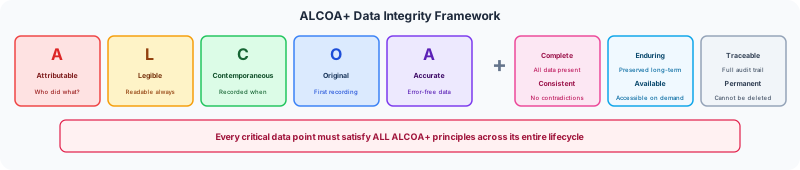
Data integrity expectations are commonly summarized under the ALCOA+ principles.
4
ALCOA+ requires data to be:
- Attributable – Who created or modified it
- Legible – Readable and understandable
- Contemporaneous – Recorded at the time of activity
- Original – Preserved in its initial form or certified copy
- Accurate – Free from errors
Plus:
- Complete
- Consistent
- Enduring
- Available
Enterprise Architecture must enforce these principles across:
- Applications
- Databases
- Integration layers
- Infrastructure
- Archival systems
ALCOA+ is not a policy — it is an architectural requirement.
9.3 Data Governance Operating Model
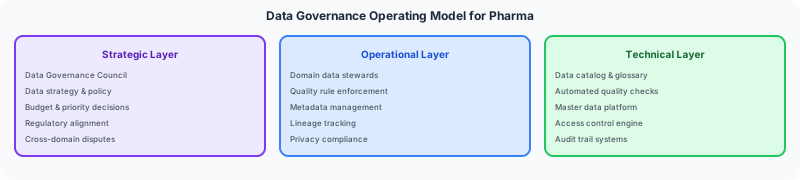
Effective governance requires clear structure.
Key Roles
Data Owner
- Accountable for data quality and policy compliance
- Typically a senior business leader
Data Steward
- Operationally responsible for data standards and definitions
Data Custodian (IT)
- Responsible for technical implementation and controls
Compliance & Quality Representatives
- Ensure regulatory alignment
Governance Bodies
- Data Governance Council
- Domain-Specific Working Groups
- Enterprise Architecture Board
Architecture must reflect this model through:
- Role-based access control (RBAC)
- Workflow enforcement
- Ownership tagging in metadata
- Auditability of governance decisions
9.4 Data Lifecycle Management
Pharma data has long retention requirements, sometimes extending decades beyond product discontinuation.
The lifecycle typically includes:
- Creation
- Processing
- Review & Approval
- Submission
- Archival
- Retrieval
Architecture must ensure:
- Version control
- Secure archival storage
- Format sustainability
- Disaster recovery
- Efficient retrieval during inspections
Lifecycle policies must be automated wherever possible to reduce human error.
9.5 Metadata & Data Lineage
Regulatory defensibility depends on traceability.
Organizations must be able to answer:
- Where did this data originate?
- Which system generated it?
- Who modified it?
- Which submission or batch relied on it?
Architecture must support:
- Metadata repositories
- Data catalog platforms
- Lineage tracking across ETL pipelines
- Controlled transformations
Lineage tracking becomes particularly critical when data moves:
- From research to clinical
- From clinical to regulatory submission
- From manufacturing to quality reporting
Without lineage, traceability collapses.
9.6 Data Quality Management
Data quality in pharma is not a cosmetic issue — it is a regulatory expectation.
Key quality dimensions include:
- Accuracy
- Completeness
- Consistency
- Timeliness
- Uniqueness
Architecture must enable:
- Automated validation rules
- Exception reporting dashboards
- Controlled data correction workflows
- Audit trails for data changes
Data quality monitoring should be proactive, not reactive.
9.7 Master Data Governance
Master data inconsistencies are among the most common root causes of regulatory issues.
Critical master entities include:
- Product
- Substance
- Study
- Site
- Investigator
- Manufacturing facility
Master data governance requires:
- Central Master Data Management (MDM) platforms
- Golden record definition
- Synchronization rules
- Clear ownership assignment
Architecture must prevent:
- Regional duplication
- Conflicting identifiers
- Inconsistent naming conventions
Master data alignment is essential for global regulatory submissions.
9.8 Data Privacy & Protection
Pharma organizations handle highly sensitive data, including patient-level clinical information.
Compliance frameworks such as GDPR and HIPAA require:
- Data minimization
- Pseudonymization or anonymization
- Controlled cross-border data transfers
- Secure storage
- Breach detection and response
Architecture must implement:
- Encryption at rest and in transit
- Identity & access management
- Logging & monitoring
- Data masking in non-production environments
Privacy is both a regulatory and ethical obligation.
9.9 Governance in Hybrid & Cloud Environments
As pharma organizations adopt cloud platforms, governance complexity increases.
Key challenges include:
- Multi-region data residency
- Shared responsibility models
- Cloud provider validation documentation
- Environment segregation
Architecture must define:
- Cloud governance frameworks
- Infrastructure-as-Code controls
- Automated policy enforcement
- Centralized logging across environments
Cloud adoption does not reduce governance — it increases the need for structured oversight.
9.10 Integrating Governance into DevOps
Modern pharma organizations seek agility without compromising compliance.
To achieve this, governance must integrate into:
- CI/CD pipelines
- Automated testing
- Validation documentation generation
- Change control systems
Rather than slowing development, governance should be embedded into the workflow.
This approach reduces:
- Manual validation overhead
- Audit preparation time
- Deployment risk
9.11 Measuring Data Governance Effectiveness
Governance must be measurable.
Key indicators include:
- Data quality scorecards
- Audit findings related to data
- Time to retrieve inspection evidence
- Master data duplication rates
- Incident response times
Architecture should enable real-time governance dashboards.
Closing Perspective
In pharmaceuticals, data governance is inseparable from enterprise architecture.
It ensures that:
- Data remains defensible evidence
- Regulatory expectations are consistently met
- Innovation does not compromise integrity
- Digital transformation does not erode control
Data domains define structure. Data governance defines discipline.
Together, they create the foundation for trustworthy pharmaceutical operations.
In the next section, we explore Interoperability & Industry Standards, where structured data exchange becomes critical for global compliance and collaboration.
10. Interoperability & Industry Standards
If data domains define structure and governance ensures integrity, interoperability ensures continuity.
In pharmaceuticals, interoperability is not simply about technical integration. It is about ensuring that data can move seamlessly — and defensibly — across systems, partners, regions, and regulators without losing meaning, context, or compliance validity.
A clinical dataset collected in one country must be interpretable by regulators in another. A manufacturing batch record must align with global serialization requirements. A safety signal must be reportable across jurisdictions in standardized formats.
This section defines the critical industry standards and architectural patterns that enable interoperability in pharma.
10.1 Why Interoperability Is Mission-Critical in Pharma

Pharma organizations operate in a deeply interconnected ecosystem:
- Clinical sites
- Contract Research Organizations (CROs)
- Contract Manufacturing Organizations (CMOs)
- Health authorities
- Serialization networks
- Healthcare providers
Without standardized interoperability:
- Regulatory submissions are delayed
- Data transformation introduces errors
- Traceability breaks
- Compliance risk increases
Enterprise Architecture must ensure semantic, structural, and technical interoperability.
10.2 Clinical Data Standards

Clinical development is one of the most standardized domains in pharma.
The International Council for Harmonisation of Technical Requirements for Pharmaceuticals for Human Use promotes harmonized regulatory expectations across regions.
In addition, the Clinical Data Interchange Standards Consortium (CDISC) defines standards widely used in regulatory submissions.
Key CDISC Standards
- SDTM (Study Data Tabulation Model)
- ADaM (Analysis Data Model)
- CDASH (Clinical Data Acquisition Standards Harmonization)
Architectural Implications
- Clinical systems must align with CDISC structures
- Transformation pipelines must preserve traceability
- Metadata repositories must capture dataset lineage
- Submission packages must remain reproducible
Interoperability at the clinical level directly impacts approval timelines.
10.3 Healthcare Data Exchange Standards
As pharma integrates more closely with healthcare ecosystems and real-world evidence platforms, healthcare interoperability standards become essential.
The Health Level Seven International (HL7) defines widely adopted healthcare exchange standards.
Key Standards
- HL7 v2/v3 messaging
- FHIR (Fast Healthcare Interoperability Resources)
FHIR is increasingly used for:
- Real-world evidence ingestion
- Patient data exchange
- Digital therapeutics integration
Architectural Considerations
- API-first integration
- Standardized resource models
- Controlled mapping to internal data domains
- Secure patient-level data exchange
FHIR-based APIs are becoming a cornerstone for ecosystem connectivity.
10.4 Regulatory Identification Standards
Global product identification requires harmonized definitions.
The International Organization for Standardization (ISO) supports standards adopted within regulatory frameworks.
One critical regulatory standard is:
- IDMP (Identification of Medicinal Products)
IDMP ensures standardized definitions of:
- Substances
- Products
- Organizations
- Referentials
Architectural Implications
- Master data alignment
- Product identifier harmonization
- Consistent data models across regions
- Integration with Regulatory Information Management (RIM) systems
IDMP compliance requires strong master data governance.
10.5 Serialization & Supply Chain Standards

Global anti-counterfeiting regulations require serialization.
The GS1 defines standards used for:
- Product identifiers (GTIN)
- Barcoding
- Supply chain tracking
Serialization laws in various regions mandate:
- Unique serial numbers
- Aggregation tracking
- Reporting to national repositories
Architectural Requirements
- Integration between ERP, MES, and serialization systems
- Real-time data exchange with authorities
- Global traceability
- Scalable high-volume data handling
Failure in serialization interoperability can result in shipment blocks.
10.6 Structured Content & Submission Standards
Regulatory submissions follow structured electronic formats such as:
- eCTD (electronic Common Technical Document)
These formats define:
- Document structure
- Metadata tagging
- Submission lifecycle
Architecture must support:
- Structured content authoring
- Modular document reuse
- Automated publishing workflows
- Versioned submission archives
Submission interoperability ensures that regulators can process applications efficiently.
10.7 Semantic Interoperability
Technical integration alone is insufficient. Systems must share meaning.
For example:
- “Product” must mean the same entity across manufacturing, regulatory, and commercial domains.
- “Adverse Event” definitions must align across safety and clinical systems.
Semantic interoperability requires:
- Enterprise data dictionaries
- Ontologies
- Controlled vocabularies
- Reference data harmonization
Without semantic alignment, integration creates hidden inconsistencies.
10.8 API-First & Event-Driven Patterns
Modern interoperability increasingly relies on:
- RESTful APIs
- Event-driven architectures
- Message brokers
- Streaming platforms
These approaches enable:
- Near real-time data flow
- Reduced batch dependencies
- Decoupled system design
- Better traceability
Architecture must define:
- Standard API governance
- Authentication protocols
- Monitoring & logging
- Version management
Integration standards should be centrally governed to avoid fragmentation.
10.9 Cross-Border Data Exchange
Pharma enterprises operate globally, creating cross-border data challenges:
- Data residency requirements
- Cross-region regulatory reporting
- Privacy compliance (e.g., GDPR alignment)
Architecture must ensure:
- Regional data partitioning
- Secure replication
- Controlled data export workflows
- Encryption and access monitoring
Interoperability must respect both technical and legal boundaries.
10.10 Interoperability Risks & Mitigation
Common risks include:
- Inconsistent standard implementation
- Manual data transformation errors
- Partner system incompatibility
- Uncontrolled API proliferation
- Lack of semantic governance
Mitigation strategies include:
- Central integration platforms
- Standard mapping repositories
- Governance boards for integration standards
- Automated validation of data exchanges
Interoperability must be governed, not improvised.
Architectural Implications of Industry Standards
Industry standards influence:
- Data models
- Application design
- Integration patterns
- Master data governance
- Validation scope
- Cloud architecture
Organizations that adopt standards early benefit from:
- Faster regulatory submissions
- Reduced integration cost
- Simplified partner onboarding
- Lower compliance risk
Closing Perspective
Interoperability transforms isolated systems into a connected enterprise.
Standards ensure that:
- Clinical data is submission-ready
- Products are globally identifiable
- Safety signals are consistently reportable
- Supply chains remain traceable
In pharmaceuticals, interoperability is not only technical — it is regulatory, semantic, and strategic.
With data structured, governed, and interoperable, the next logical step is to unlock value from it.
In the next section, we move into Analytics, AI & Advanced Insights, where data becomes intelligence.
11. Analytics, AI & Advanced Insights
If interoperability ensures that data can move, analytics ensures that data can think.
Pharmaceutical enterprises generate enormous volumes of structured and unstructured data across research, clinical development, manufacturing, safety monitoring, and commercial operations. The real competitive advantage no longer lies only in collecting data — but in extracting actionable, compliant, and defensible insights from it.
However, in pharma, analytics and AI must operate within strict regulatory boundaries. Models cannot simply be powerful — they must be explainable, traceable, and auditable.
This section defines how advanced analytics and AI fit into the Pharma Enterprise Architecture.
11.1 The Strategic Role of Analytics in Pharma
Analytics in pharma supports three major objectives:
- Accelerating drug discovery
- Improving operational efficiency
- Enhancing patient safety and outcomes
Unlike many industries, pharma analytics impacts regulatory submissions, patient risk assessments, and product lifecycle decisions. Therefore, analytical platforms must meet both innovation and compliance expectations.
Enterprise Architecture must provide:
- Scalable data platforms
- Controlled experimentation environments
- Secure integration with GxP systems
- Governance frameworks for model lifecycle management
11.2 AI in Drug Discovery
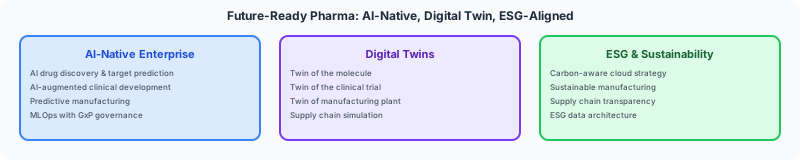
Artificial intelligence is transforming early-stage research.
4
Applications include:
- Target identification
- Molecular structure prediction
- Compound screening optimization
- Protein folding simulation
- Predictive toxicology
AI accelerates hypothesis generation and reduces experimental cost.
Architectural Implications
- High-performance computing environments
- Research data lakes
- Large-scale model training pipelines
- MLOps frameworks
- Segregated exploratory environments
Because research models may eventually influence regulatory submissions, architecture must ensure:
- Reproducibility
- Data versioning
- Model traceability
Innovation must remain scientifically defensible.
11.3 Clinical Trial Analytics
Clinical development generates highly structured and regulated datasets.
Analytics supports:
- Patient recruitment optimization
- Site performance monitoring
- Risk-based monitoring
- Statistical analysis
- Adaptive trial design
Standards promoted by the Clinical Data Interchange Standards Consortium enable consistent analysis structures.
Architectural Requirements
- Structured clinical data repositories
- Secure integration with CRO systems
- Metadata lineage tracking
- Statistical computing environments
- Role-based access control
Analytics outputs used in submissions must remain reproducible and traceable.
11.4 Real-World Evidence (RWE) & Post-Market Analytics
Beyond clinical trials, real-world data increasingly influences regulatory decisions and commercial strategies.
Sources include:
- Electronic health records
- Wearables
- Claims data
- Patient registries
Standards from Health Level Seven International (HL7) and FHIR facilitate data exchange.
Architectural Considerations
- API-based ingestion
- Privacy-preserving data processing
- De-identification pipelines
- Advanced analytics platforms
- Signal detection engines
RWE must integrate safely with pharmacovigilance systems while respecting privacy laws.
11.5 Predictive Manufacturing & Quality Analytics
Manufacturing environments increasingly use predictive models for:
- Equipment maintenance
- Yield optimization
- Deviation detection
- Quality forecasting
This involves integration between:
- Manufacturing Execution Systems (MES)
- IoT sensors
- Quality Management Systems
Architectural Implications
- Edge-to-cloud data pipelines
- Near real-time analytics
- Secure OT/IT integration
- High-availability infrastructure
Predictive insights must not compromise GMP compliance. Any model influencing batch release decisions may require validation.
11.6 Commercial & Forecasting Analytics
Commercial analytics supports:
- Demand forecasting
- Market access modeling
- Pricing simulations
- Sales performance analysis
Integration between commercial and supply chain systems ensures:
- Inventory optimization
- Reduced stockouts
- Improved launch planning
Architecture must balance flexibility with security, especially when commercial data intersects with patient-level information.
11.7 MLOps in Regulated Environments
Traditional machine learning workflows are insufficient in pharma.
Pharma requires regulated MLOps, including:
- Model version control
- Dataset lineage tracking
- Training environment segregation
- Approval workflows for production deployment
- Audit logging
When AI outputs influence regulated decisions, organizations must demonstrate:
- Model validation
- Risk assessment
- Explainability
- Bias mitigation
Enterprise Architecture must embed governance into the model lifecycle.
11.8 Explainable & Ethical AI
AI used in clinical or regulatory contexts must be explainable.
Regulators expect:
- Transparent methodology
- Reproducible outputs
- Controlled input datasets
- Bias evaluation
Black-box models present regulatory risk if they influence safety or efficacy decisions.
Architecture must support:
- Model documentation repositories
- Experiment tracking systems
- Controlled feature engineering pipelines
Ethical AI is not optional — it protects both patients and regulatory standing.
11.9 Analytics Platform Architecture
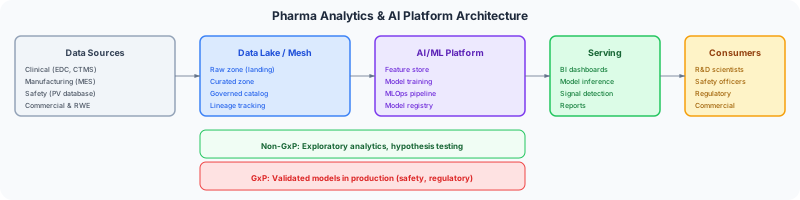
A modern pharma analytics architecture typically includes:
- Enterprise data lake or lakehouse
- Data warehouse for structured reporting
- Real-time streaming pipelines
- MLOps platform
- Governance & metadata layer
- Secure API gateway
Segmentation is critical:
- Exploratory research analytics (flexible)
- GxP-influencing analytics (controlled)
Controlled promotion pathways must exist between these environments.
11.10 Risks & Governance Challenges
Common risks include:
- Model drift
- Inconsistent data transformations
- Shadow analytics environments
- Unvalidated AI influencing regulated processes
- Privacy violations
Mitigation requires:
- Central analytics governance
- Standardized tooling
- Continuous monitoring
- Automated documentation generation
- Clear separation between exploratory and validated environments
Analytics must remain disciplined, not chaotic.
Architectural Implications of Advanced Analytics
Analytics and AI influence every architecture domain:
- Business Architecture – Enables new capabilities
- Data Architecture – Requires scalable, governed platforms
- Application Architecture – Introduces advanced services
- Technology Architecture – Demands cloud scalability and HPC
- Governance – Requires AI lifecycle management
Organizations that integrate AI responsibly achieve:
- Faster discovery cycles
- More efficient trials
- Predictive manufacturing
- Stronger safety monitoring
Those that ignore governance risk regulatory findings.
Closing Perspective
Analytics transforms pharmaceutical enterprises from reactive to predictive.
However, in regulated environments, intelligence must remain:
- Traceable
- Explainable
- Governed
- Secure
AI in pharma is not just about algorithms — it is about trust.
With data domains, governance, interoperability, and analytics defined, we now move to the next major architectural layer:
Application Architecture, where capabilities and data are implemented through systems and platforms.
Part IV – Application Architecture
12. Core Pharma Application Landscape
If data is the backbone of the pharmaceutical enterprise, applications are its nervous system.
Applications execute regulated processes, capture critical data, enforce controls, and enable collaboration across research, clinical, manufacturing, regulatory, and commercial domains.
In pharma, the application landscape is rarely simple. It is often:
- Layered across decades
- Partially modernized
- Regionally fragmented
- Vendor-diverse
- Highly regulated
Enterprise Architecture must bring structure, rationalization, and standardization to this complexity — without disrupting validated systems.
This section defines the core application domains in a pharmaceutical enterprise and their architectural implications.
12.1 Application Architecture Principles in Pharma
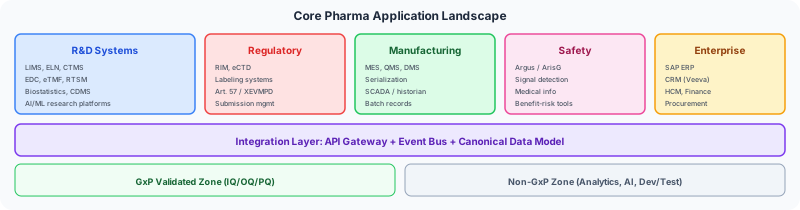
Before examining system categories, several guiding principles apply:
- Capability Alignment – Every major system must map clearly to business capabilities.
- GxP Segmentation – Regulated and non-regulated systems must be clearly separated.
- Platform over Proliferation – Standardize enterprise platforms where possible.
- Validation Awareness – Minimize unnecessary customization to reduce validation burden.
- Integration by Design – Avoid isolated application silos.
Applications in pharma are not just IT tools — they are compliance-critical assets.
12.2 R&D Application Landscape
Research and development environments demand flexibility and scientific rigor.
4
Common R&D Systems
Electronic Lab Notebook (ELN)
- Captures experimental documentation
- Supports GLP compliance
Laboratory Information Management System (LIMS)
- Manages samples and lab workflows
- Tracks results and metadata
Clinical Trial Management System (CTMS)
- Oversees study operations
- Tracks sites and milestones
Electronic Data Capture (EDC)
- Collects structured patient data
Architectural Characteristics
- High data volume
- Integration with analytics platforms
- CRO connectivity
- Metadata lineage requirements
- Strict audit trails (for GxP systems)
R&D systems must balance innovation speed with regulatory traceability.
12.3 Regulatory Information Management (RIM) Systems
Regulatory applications manage submission lifecycle and authority interactions.
Core Functions:
- Dossier compilation
- Structured content management
- Submission tracking
- Labeling management
- Authority correspondence
These systems align with frameworks influenced by the International Council for Harmonisation of Technical Requirements for Pharmaceuticals for Human Use.
Architectural Considerations
- Tight integration with clinical and manufacturing data
- Strong document version control
- Metadata consistency
- Long-term archival
RIM systems are mission-critical for inspection readiness and lifecycle management.
12.4 Manufacturing & Quality Systems
Manufacturing environments operate under strict GMP controls.
Core Systems
Manufacturing Execution System (MES)
- Manages production processes
- Generates electronic batch records
Quality Management System (QMS)
- Tracks deviations, CAPAs, audits
Laboratory Systems (QC LIMS)
- Quality control testing
Architectural Characteristics
- High availability requirements
- OT/IT integration
- Strict change control
- Audit logging
- Time synchronization
Manufacturing systems are among the most validation-intensive in the enterprise.
12.5 ERP & Enterprise Systems
Enterprise Resource Planning (ERP) systems provide foundational operational support.
Typical Scope:
- Finance
- Procurement
- Inventory management
- Supply chain planning
- Serialization integration
ERP platforms often act as the integration hub between:
- Manufacturing
- Distribution
- Commercial systems
Architecture must ensure that ERP customizations are minimized to reduce validation scope.
12.6 Pharmacovigilance Systems
Safety monitoring applications manage post-market surveillance.
Core Capabilities:
- Adverse event intake
- Case processing
- Signal detection
- Regulatory reporting
These systems must integrate with:
- Clinical systems
- Commercial systems
- Global regulatory authorities
Safety platforms require strong:
- Privacy controls
- Audit trails
- Reporting automation
12.7 Commercial & CRM Systems
Commercial platforms support:
- Sales force automation
- Customer relationship management
- Market access data
- Forecasting
While typically non-GxP, these systems may interact with safety reporting and real-world evidence data, requiring careful governance.
Architecture must enforce:
- Secure data exchange
- Controlled patient-level information handling
- Regionally compliant data storage
12.8 Application Segmentation: GxP vs Non-GxP
A critical architectural pattern in pharma is segmentation.
GxP Applications
- CTMS
- EDC
- MES
- QMS
- RIM
Characteristics:
- Validated
- Strict change control
- Limited deployment frequency
Non-GxP Applications
- HR systems
- Internal collaboration tools
- Non-regulated analytics platforms
Characteristics:
- Agile updates
- Flexible configuration
Enterprise Architecture must define clear integration and promotion rules between these environments.
12.9 Application Rationalization

Many pharma organizations suffer from:
- Duplicate regional systems
- Legacy platforms
- Over-customized solutions
- Vendor sprawl
Application rationalization aims to:
- Consolidate platforms
- Reduce validation cost
- Standardize integrations
- Improve data consistency
Capability-based mapping helps identify redundant systems.
12.10 Integration Patterns Across Applications
Applications in pharma cannot operate in isolation.
Typical integration flows include:
- Clinical → Regulatory
- Manufacturing → Quality → ERP
- Commercial → Safety
- Research → Analytics
Architecture should promote:
- API-first integration
- Event-driven messaging
- Central integration platforms
- Standardized data contracts
Uncontrolled point-to-point integrations create compliance risk and fragility.
12.11 Cloud Adoption in Application Landscape
Cloud-based SaaS platforms are increasingly common in:
- Clinical systems
- RIM platforms
- CRM systems
- Analytics platforms
However, cloud adoption requires:
- Vendor validation documentation
- Shared responsibility clarity
- Data residency control
- Strong identity integration
Enterprise Architecture must ensure cloud adoption aligns with compliance requirements.
Architectural Implications of the Application Landscape
The pharma application landscape influences:
- Validation scope
- Integration complexity
- Data governance
- Cybersecurity posture
- Operational resilience
Standardized application platforms reduce:
- Regulatory risk
- Operational cost
- Audit findings
- Technical debt
Fragmented landscapes increase them.
Closing Perspective
Applications are the execution layer of pharmaceutical capabilities.
A well-structured application architecture ensures:
- Regulatory defensibility
- Operational resilience
- Data integrity
- Scalable innovation
With the core application domains defined, the next critical layer is how these systems communicate.
In the next section, we move into Integration Architecture, where APIs, events, and controlled data flows connect the pharmaceutical enterprise end-to-end.
13. Integration Architecture
If applications are the nervous system of the pharmaceutical enterprise, integration is the connective tissue that ensures signals travel accurately, securely, and reliably.
In pharma, integration failures are not merely operational inconveniences — they can delay submissions, disrupt manufacturing, compromise safety reporting, or introduce compliance risks.
Integration Architecture must therefore be:
- Standardized
- Governed
- Traceable
- Secure
- Validation-aware
This section defines how systems should be connected in a regulated pharmaceutical environment.
13.1 Why Integration Is High-Risk in Pharma
Pharma enterprises operate across tightly connected domains:
- Clinical → Regulatory
- Manufacturing → Quality → ERP
- Commercial → Safety
- Research → Analytics
At each boundary, data must remain:
- Complete
- Consistent
- Traceable
- Tamper-resistant
Authorities such as the U.S. Food and Drug Administration expect organizations to demonstrate that integrated systems preserve data integrity.
Uncontrolled point-to-point integrations create:
- Hidden data transformations
- Inconsistent definitions
- Weak audit trails
- Validation complexity
Integration architecture must prevent this fragmentation.
13.2 Integration Patterns in Pharma
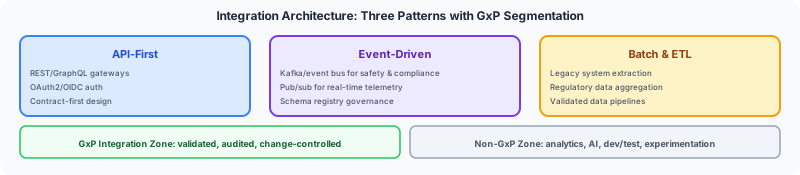
Modern integration architecture typically combines several patterns.
4
1. API-First Integration
- RESTful APIs
- Version-controlled endpoints
- Central API gateway
- Strong authentication & authorization
Benefits:
- Controlled data contracts
- Reduced coupling
- Easier governance
2. Event-Driven Architecture
- Message brokers
- Streaming platforms
- Publish-subscribe models
Use cases:
- Manufacturing event updates
- Safety signal triggers
- Real-time inventory changes
Event-driven integration enables near real-time responsiveness while maintaining system decoupling.
3. Batch & ETL Integration
Still common in:
- Clinical data aggregation
- Regulatory reporting compilation
- Enterprise data warehouse loads
Must include:
- Transformation traceability
- Logging
- Validation checkpoints
13.3 GxP vs Non-GxP Integration Segmentation
Integration across regulated and non-regulated systems requires strict boundary control.
GxP → GxP Integration
- Fully validated
- Strict change control
- Documented interface specifications
GxP → Non-GxP Integration
- Controlled data export
- Masking or anonymization where required
- Clear documentation of transformation logic
Architecture must ensure:
- Data promotion checkpoints
- Controlled API exposure
- Validation scope documentation
Integration design impacts regulatory validation scope.
13.4 Integration Governance
Integration should not be implemented project by project without oversight.
A mature pharma integration governance framework includes:
- Central Integration Standards Catalog
- API Design Guidelines
- Canonical Data Models
- Versioning Policies
- Logging & Monitoring Standards
Enterprise Architecture must enforce:
- Review of new interfaces
- Reuse of standard integration services
- Documentation in architecture repositories
Without governance, integration becomes chaotic and untraceable.
13.5 Canonical Data Models
To reduce complexity, many pharma enterprises adopt canonical data models.
Instead of mapping each system to every other system:
- Systems map to a shared canonical structure
- Transformations are standardized
- Semantic consistency improves
For example:
- A standardized “Product” entity
- A harmonized “Adverse Event” structure
- Unified “Batch Record” representation
Canonical models support:
- Regulatory alignment
- Data consistency
- Reduced duplication
However, they must be carefully governed to avoid rigidity.
13.6 Partner & Ecosystem Integration
Pharma enterprises integrate with:
- CROs
- CMOs
- Serialization networks
- Regulatory submission portals
Standards promoted by organizations such as Health Level Seven International and GS1 often shape these integrations.
Architecture must ensure:
- Secure B2B connectivity
- Role-based access control
- Encrypted data exchange
- Clear responsibility boundaries
- Audit logging across external interactions
External integration is a major inspection focus area.
13.7 Cloud & Hybrid Integration
As pharma adopts hybrid and multi-cloud environments, integration complexity increases.
Challenges include:
- Cross-region data flows
- Cloud-to-on-prem connectivity
- Identity federation
- Monitoring across platforms
Architecture must define:
- Secure connectivity standards
- Centralized logging
- Cloud integration gateways
- Shared responsibility documentation
Cloud integration must align with validation requirements.
13.8 Monitoring & Observability
Integration failures must be detected immediately.
Integration architecture should include:
- Real-time monitoring dashboards
- Alerting mechanisms
- Log aggregation
- Data reconciliation reports
- Automated exception handling
For regulated interfaces, monitoring evidence may be required during inspections.
Observability supports:
- Operational resilience
- Compliance defensibility
- Root cause analysis
13.9 Reducing Integration Risk
Common integration risks include:
- Hardcoded transformations
- Inconsistent master data
- Lack of version control
- Unvalidated interface changes
- Shadow integrations
Mitigation strategies:
- Central API management
- Automated contract testing
- Strict change management
- Integration documentation repositories
- Continuous monitoring
Integration should be treated as a governed platform capability — not a series of ad hoc connections.
13.10 Architectural Implications of Integration
Integration Architecture influences:
- Data integrity
- Validation scope
- Cybersecurity posture
- Cloud strategy
- Business agility
- Partner collaboration
Well-designed integration reduces:
- Time-to-market
- System redundancy
- Compliance risk
- Operational fragility
Poor integration increases all of them.
Closing Perspective
In pharmaceuticals, integration is where complexity concentrates.
It connects:
- Capabilities
- Applications
- Data domains
- Operating models
- External ecosystems
Integration Architecture ensures that this connectivity remains:
- Controlled
- Transparent
- Secure
- Auditable
With applications connected through governed integration, the next step is expanding outward — beyond internal systems.
In the next section, we examine Digital Platforms & Ecosystem Integration, where the pharmaceutical enterprise becomes a connected network within a global health ecosystem.
14. Digital Platforms & Ecosystem Integration
If Integration Architecture connects internal systems, Digital Platforms & Ecosystem Integration connect the enterprise to the outside world.
Modern pharmaceutical companies no longer operate as closed organizations. They function within a global ecosystem that includes:
- Contract Research Organizations (CROs)
- Contract Manufacturing Organizations (CMOs)
- Health authorities
- Healthcare providers
- Serialization networks
- Patients
- Technology partners
Enterprise Architecture must therefore extend beyond internal boundaries and support secure, compliant, and scalable digital collaboration.
14.1 The Pharma Ecosystem Landscape
Pharma’s ecosystem is multi-layered and globally distributed.
4
At a high level, ecosystem participants include:
- Clinical partners (CROs, trial sites)
- Manufacturing partners (CMOs)
- Regulatory authorities
- Distributors & wholesalers
- Healthcare providers
- Patients
- Data & AI partners
Digital integration across this ecosystem must be:
- Secure
- Traceable
- Standards-based
- Governed
In pharma, ecosystem integration is often inspected as closely as internal systems.
14.2 CRO Integration
Clinical development frequently relies on external CROs.
Integration Requirements
- Secure data exchange
- Controlled access to clinical systems
- Role-based authorization
- Audit logging across organizational boundaries
- Clear sponsor accountability
Regulators such as the U.S. Food and Drug Administration hold the sponsor accountable even when processes are outsourced.
Architectural Implications
- Identity federation
- API-based connectivity
- Controlled data export
- Secure document repositories
- Centralized monitoring
CRO integration must balance collaboration with regulatory control.
14.3 CMO & Manufacturing Partner Integration
Many pharma companies outsource manufacturing.
Integration between sponsor and CMO must support:
- Batch record exchange
- Quality documentation
- Deviation reporting
- Serialization data
- Audit documentation
Architectural Requirements
- Secure B2B integration gateways
- Encryption in transit and at rest
- Interface validation documentation
- Continuous monitoring
Manufacturing data integrity is critical to GMP compliance.
14.4 Health Authority Connectivity
Regulatory submissions are increasingly digital.
Submission standards influenced by the International Council for Harmonisation of Technical Requirements for Pharmaceuticals for Human Use define structured electronic formats such as eCTD.
Architectural Capabilities Needed
- Structured content authoring
- Submission publishing automation
- Secure transmission protocols
- Authority response tracking
- Long-term archival
Architecture must support multi-region submissions, including different timelines and regulatory nuances.
Health authority integration must be reliable, auditable, and reproducible.
14.5 Serialization & Supply Chain Networks
Anti-counterfeiting regulations require integration with national and regional serialization repositories.
Standards from GS1 enable product identification and tracking.
Key Integration Points
- ERP ↔ Serialization platform
- Serialization ↔ National repositories
- Manufacturing ↔ Distribution networks
Architecture must handle:
- High transaction volumes
- Real-time validation
- Global identifier synchronization
- Exception handling workflows
Serialization failures can stop product distribution.
14.6 Healthcare & Real-World Evidence Integration
Modern pharma increasingly integrates with healthcare data sources.
Standards from Health Level Seven International (HL7, FHIR) facilitate structured data exchange.
Use cases include:
- Real-world evidence collection
- Patient registries
- Digital therapeutics monitoring
- Outcome tracking
Architectural Considerations
- API-first design
- Privacy-preserving pipelines
- Cross-border data compliance
- Consent management systems
Ecosystem integration must always align with privacy regulations.
14.7 Patient Engagement Platforms
Pharma organizations are moving closer to patients through:
- Companion apps
- Digital adherence tools
- Patient portals
- Support program platforms
These platforms require:
- Secure identity management
- Privacy compliance
- Integration with safety systems
- Data anonymization
Architecture must ensure that patient-facing systems do not compromise regulated data integrity.
14.8 Platform Strategy for Ecosystem Enablement
Rather than creating custom integrations for each partner, mature pharma enterprises adopt platform strategies:
- API gateways
- Partner portals
- Standardized onboarding workflows
- Identity federation platforms
- Central integration hubs
Platform thinking reduces:
- Integration duplication
- Security inconsistency
- Compliance gaps
- Vendor lock-in
It also accelerates onboarding of new partners.
14.9 Governance Across Organizational Boundaries
Ecosystem integration introduces new governance challenges:
- Who owns shared data?
- Who validates interfaces?
- Who monitors access?
- How are breaches handled?
Architecture must enforce:
- Data sharing agreements
- Clear responsibility matrices
- Standardized SLAs
- Continuous monitoring
Governance cannot stop at the enterprise boundary.
14.10 Architectural Risks in Ecosystem Integration
Common risks include:
- Shadow integrations
- Inconsistent security standards
- Manual data transfers
- Lack of end-to-end traceability
- Overexposed APIs
Mitigation strategies:
- Centralized API governance
- Zero-trust architecture
- Automated audit logging
- Continuous compliance checks
- Standardized onboarding controls
External integration often represents the highest cybersecurity exposure.
Architectural Implications of Ecosystem Connectivity
Digital ecosystem integration impacts:
- Security architecture
- Data governance
- Validation scope
- Identity management
- Monitoring infrastructure
- Cloud architecture
Organizations that manage ecosystem integration well achieve:
- Faster trial execution
- Efficient manufacturing outsourcing
- Strong regulator trust
- Improved patient engagement
Organizations that manage it poorly face compliance findings and operational disruption.
Closing Perspective
The pharmaceutical enterprise is no longer a standalone organization — it is a digitally connected ecosystem.
Enterprise Architecture must ensure that this connectivity remains:
- Secure
- Standardized
- Auditable
- Scalable
With Business, Data, Application, Integration, and Ecosystem layers defined, we now move deeper into the foundation that supports them all:
Technology Architecture, where infrastructure, cloud strategy, resilience, and operational stability are defined.
Part V – Technology Architecture
15. Infrastructure Architecture
If applications execute capabilities and integration connects systems, infrastructure provides the foundation that keeps the pharmaceutical enterprise running — securely, reliably, and compliantly.
In pharma, infrastructure decisions directly affect:
- Regulatory validation scope
- Data integrity
- System availability
- Cybersecurity posture
- Inspection readiness
Infrastructure is not just a technical layer. It is a compliance-critical layer.
This section defines the architectural principles and patterns for infrastructure in a regulated pharmaceutical environment.
15.1 Infrastructure as a Compliance Enabler
Unlike many industries, infrastructure in pharma must support:
- GxP validation requirements
- Audit logging retention
- Secure data archival
- Long-term system stability
- Time synchronization across systems
Authorities such as the U.S. Food and Drug Administration expect that underlying infrastructure does not compromise data integrity or system reliability.
Infrastructure therefore becomes part of the validated ecosystem.
15.2 Hybrid Cloud Strategy in Pharma
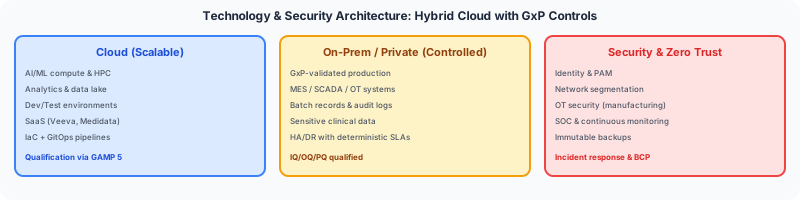
Most pharmaceutical enterprises operate hybrid infrastructures:
- On-premise environments (often for legacy or highly sensitive GxP systems)
- Private cloud environments
- Public cloud platforms
4
Why Hybrid?
- Regulatory conservatism in certain regions
- Legacy validated systems
- Data residency requirements
- Gradual modernization strategies
Architectural Considerations
- Secure connectivity between environments
- Centralized identity management
- Unified logging
- Consistent backup strategies
- Cloud validation documentation
Cloud adoption does not remove compliance responsibility — it redistributes it under a shared responsibility model.
15.3 GxP Infrastructure Segmentation
A key architectural principle in pharma is segmentation between:
- GxP infrastructure
- Non-GxP infrastructure
GxP Infrastructure Characteristics
- Strict configuration management
- Documented validation
- Limited patching windows
- Controlled deployment processes
- Detailed logging retention
Non-GxP Infrastructure Characteristics
- Greater flexibility
- Faster patch cycles
- Agile deployment patterns
Segmentation reduces risk and simplifies validation scope.
Architecture must clearly define:
- Network boundaries
- Access controls
- Environment promotion pathways
15.4 High Availability & Disaster Recovery
Manufacturing systems, clinical platforms, and safety databases often require near-continuous availability.
Infrastructure must provide:
- Redundant servers
- Failover clusters
- Multi-region disaster recovery
- Backup automation
- Regular recovery testing
Downtime in:
- Manufacturing → Can halt production
- Safety systems → Can delay reporting
- Regulatory systems → Can disrupt submissions
Disaster recovery plans must be documented and periodically tested to satisfy compliance expectations.
15.5 Data Storage & Archival
Pharma data retention periods can extend decades beyond product lifecycle.
Infrastructure must support:
- Long-term archival storage
- Tamper-evident preservation
- Secure offsite backup
- Format sustainability
Archival systems must ensure that data remains:
- Accessible
- Legible
- Traceable
- Secure
Improper archival strategies can create inspection risks years later.
15.6 Infrastructure as Code (IaC) & Automation
Modern infrastructure increasingly relies on automation.
Infrastructure as Code (IaC) enables:
- Reproducible environments
- Version-controlled configurations
- Reduced manual errors
- Faster environment provisioning
In pharma, IaC must integrate with:
- Change management systems
- Validation documentation
- Audit logging
Automation must be governed — not uncontrolled.
15.7 Edge & Smart Factory Infrastructure
Manufacturing environments increasingly integrate:
- IoT sensors
- Edge computing devices
- Real-time analytics
This introduces convergence between:
- Operational Technology (OT)
- Information Technology (IT)
Architectural Requirements
- Network segmentation
- Secure gateway controls
- Monitoring of OT systems
- Controlled firmware updates
OT/IT convergence increases cybersecurity exposure and requires specialized governance.
15.8 Identity & Access Infrastructure
Infrastructure must integrate with centralized identity systems to ensure:
- Role-based access control
- Multi-factor authentication
- Privileged access management
- Segregation of duties
Identity controls are foundational to:
- Data integrity
- Audit readiness
- Cybersecurity resilience
Unauthorized access to validated systems is a major compliance risk.
15.9 Monitoring & Observability
Infrastructure monitoring must support:
- System health dashboards
- Log aggregation
- Real-time alerting
- Audit trail retention
- Performance monitoring
Monitoring systems themselves may fall under validation scope if they influence regulated operations.
Observability ensures both operational stability and inspection readiness.
15.10 Cybersecurity Infrastructure Foundations
Infrastructure must implement:
- Network segmentation
- Firewalls & intrusion detection
- Encryption in transit and at rest
- Endpoint protection
- Vulnerability scanning
Cybersecurity incidents increasingly attract regulatory scrutiny.
Infrastructure must therefore align with both IT risk management and regulatory expectations.
Architectural Implications of Infrastructure Design
Infrastructure Architecture impacts:
- Application validation scope
- Data governance enforcement
- Integration reliability
- Security posture
- Disaster recovery readiness
- Cloud adoption strategy
Well-designed infrastructure enables:
- Stable regulated operations
- Agile innovation environments
- Secure partner connectivity
- Scalable analytics platforms
Poor infrastructure design amplifies every other architectural risk.
Closing Perspective
Infrastructure in pharma is not invisible plumbing — it is a regulated, inspectable layer of the enterprise.
It must be:
- Resilient
- Secure
- Segmented
- Documented
- Governed
With infrastructure foundations defined, the next critical layer is ensuring that this foundation is protected.
In the next section, we examine Security & Risk Architecture, where cybersecurity, privacy, and enterprise risk management converge in a regulated pharmaceutical environment.
16. Security & Risk Architecture
In pharmaceuticals, security is not only about protecting intellectual property — it is about protecting patients, ensuring regulatory trust, and safeguarding global supply chains.
Cybersecurity incidents can lead to:
- Manufacturing shutdowns
- Data integrity violations
- Regulatory findings
- Delayed submissions
- Reputational damage
Security Architecture in pharma must therefore integrate:
- Regulatory compliance
- Enterprise risk management
- Cyber resilience
- Privacy protection
- Operational continuity
This section defines how Security & Risk Architecture should be structured in a regulated pharmaceutical enterprise.
16.1 Security as a Regulatory Expectation
Regulatory authorities such as the U.S. Food and Drug Administration and the European Medicines Agency increasingly expect pharmaceutical companies to demonstrate:
- System integrity protection
- Access control enforcement
- Incident response capability
- Cybersecurity risk assessments
Cybersecurity failures can become compliance findings, especially if they compromise data integrity or patient safety.
Security is therefore both a technical and regulatory obligation.
16.2 Zero Trust in Regulated Environments
Traditional perimeter-based security is insufficient in modern pharma ecosystems.
Zero Trust principles include:
- Never trust, always verify
- Continuous authentication
- Least privilege access
- Network micro-segmentation
4
Architectural Implications
- Identity-centric security models
- Role-based access control (RBAC)
- Multi-factor authentication (MFA)
- Micro-segmented networks
- Centralized monitoring
Zero Trust is particularly critical in environments integrating:
- Cloud platforms
- CROs & CMOs
- Manufacturing OT systems
- Remote access endpoints
16.3 Identity & Access Management (IAM)
Identity controls are foundational in pharma.
Security Architecture must implement:
- Centralized identity directories
- Single sign-on (SSO)
- Multi-factor authentication
- Privileged Access Management (PAM)
- Segregation of duties controls
GxP systems require:
- Unique user identification
- Secure electronic signatures
- Access logging
- Controlled role changes
Identity mismanagement is one of the most common inspection risk areas.
16.4 Data Protection & Privacy
Pharma organizations process:
- Patient-level clinical data
- Adverse event reports
- Investigator information
- Commercial data
Privacy regulations such as GDPR and HIPAA require:
- Data minimization
- Pseudonymization
- Encryption
- Access control
- Breach notification procedures
Architectural Controls
- Encryption at rest and in transit
- Data masking in non-production environments
- Consent management systems
- Secure API gateways
Security Architecture must align privacy compliance with operational efficiency.
16.5 OT Security in Manufacturing
Manufacturing environments introduce unique risks.
Operational Technology (OT) systems include:
- PLCs
- SCADA systems
- Industrial sensors
- Manufacturing Execution Systems (MES)
OT/IT convergence increases exposure to cyber threats.
Architectural Safeguards
- Network segmentation between OT and IT
- Controlled gateway access
- Patch management governance
- Continuous monitoring
- Incident response drills
Cyber attacks on manufacturing can disrupt supply chains and attract regulatory attention.
16.6 Security Monitoring & SOC Integration
Security Architecture must support:
- Security Operations Center (SOC) integration
- Centralized log aggregation
- Real-time anomaly detection
- SIEM platforms
- Automated alerting
Monitoring must extend across:
- Cloud environments
- On-prem infrastructure
- Partner integrations
- OT networks
Logs may be required as inspection evidence, particularly if incidents affect regulated systems.
16.7 Incident Response & Business Continuity
Security incidents must be handled systematically.
A mature architecture includes:
- Documented incident response playbooks
- Defined escalation paths
- Regulatory notification procedures
- Forensic logging capabilities
- Disaster recovery integration
Pharma organizations must demonstrate that incidents:
- Do not compromise data integrity
- Are contained rapidly
- Are documented thoroughly
Incident response readiness is part of compliance maturity.
16.8 Risk Management Framework
Security must align with enterprise risk management.
A structured risk approach includes:
- Risk identification
- Risk assessment
- Risk mitigation
- Risk monitoring
- Risk documentation
Systems should be classified by:
- Patient safety impact
- Regulatory criticality
- Data sensitivity
- Operational dependency
Risk-based segmentation ensures proportional security controls.
16.9 Cloud Security Governance
Cloud adoption introduces shared responsibility challenges.
Security Architecture must define:
- Cloud configuration standards
- Infrastructure-as-Code security checks
- Identity federation
- Encryption key management
- Continuous compliance monitoring
Cloud misconfiguration is a common modern risk.
Governed automation reduces this exposure.
16.10 Third-Party & Supply Chain Risk
Pharma enterprises rely on:
- SaaS vendors
- CROs
- CMOs
- Data partners
Security Architecture must include:
- Vendor risk assessments
- Security clauses in contracts
- Access audits
- Continuous monitoring
Supply chain vulnerabilities can impact both compliance and reputation.
Architectural Implications of Security & Risk
Security Architecture influences:
- Infrastructure design
- Integration patterns
- Data governance
- DevOps workflows
- Cloud adoption
- Ecosystem integration
Well-designed security reduces:
- Regulatory findings
- Operational downtime
- Financial risk
- Reputational damage
Security is not an isolated layer — it permeates every architectural domain.
Closing Perspective
In pharmaceuticals, security is inseparable from compliance, safety, and trust.
A mature Security & Risk Architecture ensures that:
- Data integrity is preserved
- Patient information is protected
- Manufacturing remains resilient
- Ecosystem collaboration is secure
With infrastructure and security foundations defined, the next architectural challenge is maintaining agility without compromising compliance.
In the next section, we examine DevOps & Validation in Regulated Environments, where speed meets discipline in pharmaceutical digital transformation.
17. DevOps & Validation in Regulated Environments
Pharmaceutical enterprises face a unique tension:
- The business demands speed, agility, and continuous innovation.
- Regulators demand stability, validation, documentation, and control.
DevOps promises faster delivery and automation. Validation demands discipline and traceability.
The challenge is not choosing one over the other — it is designing an architecture where DevOps and compliance reinforce each other.
This section defines how modern DevOps practices can coexist with GxP validation requirements in a pharmaceutical enterprise.
17.1 The Traditional Conflict: Agility vs. Validation
Historically, regulated environments relied on:
- Manual documentation
- Waterfall development
- Heavy validation reports
- Long release cycles
Meanwhile, modern DevOps emphasizes:
- Continuous integration (CI)
- Continuous delivery (CD)
- Infrastructure as Code
- Automated testing
- Rapid iteration
Without architectural alignment, DevOps can appear incompatible with GxP expectations.
However, modern regulatory thinking increasingly supports risk-based and automated validation approaches, especially when controls are demonstrably robust.
17.2 DevOps in GxP Context
DevOps in pharma must operate under these principles:
- Traceability of requirements
- Automated but controlled testing
- Documented configuration management
- Controlled environment segregation
- Risk-based validation scope
4
A compliant DevOps pipeline typically includes:
- Source control management
- Automated build processes
- Automated unit and integration tests
- Validation documentation generation
- Approval gates
- Controlled deployment
Automation does not remove documentation — it generates it consistently.
17.3 Risk-Based Computer System Validation (CSV)
Modern validation approaches align with guidance influenced by the International Council for Harmonisation of Technical Requirements for Pharmaceuticals for Human Use and evolving industry best practices.
Key principles include:
- Focus validation effort on high-risk functions
- Reduce documentation for low-risk components
- Leverage vendor documentation where appropriate
- Automate evidence generation
Risk-based validation allows organizations to:
- Shorten release cycles
- Reduce redundant documentation
- Focus on patient safety impact
Enterprise Architecture must embed risk classification into system design.
17.4 CI/CD with Compliance Gates
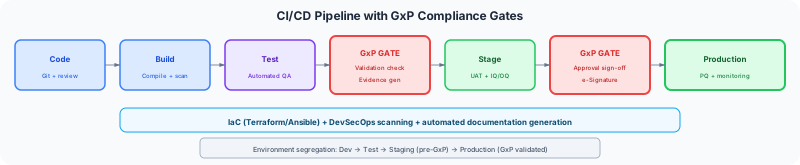
Continuous Integration and Continuous Delivery must include governance checkpoints.
Typical compliance gates include:
- Requirement traceability verification
- Automated test result review
- Security scanning approval
- Change control sign-off
- Validation artifact generation
Each deployment must be:
- Traceable to approved requirements
- Linked to test evidence
- Logged in change management systems
The pipeline becomes the single source of truth for validation documentation.
17.5 Infrastructure as Code (IaC) with Auditability
Infrastructure as Code improves reproducibility and reduces manual configuration errors.
In regulated environments, IaC must support:
- Version control of infrastructure definitions
- Documented change approvals
- Automated configuration validation
- Environment drift detection
Each infrastructure deployment should produce:
- Timestamped logs
- Version references
- Approval records
Infrastructure changes must be treated with the same rigor as application changes in GxP environments.
17.6 Environment Segmentation
DevOps architecture must define clear environment tiers:
- Development
- Testing
- Validation
- Production (GxP)
Key controls include:
- Controlled promotion pathways
- Data masking in non-production environments
- Role-based access restrictions
- Immutable production configurations
Segmentation prevents uncontrolled experimentation from impacting validated environments.
17.7 Automated Testing & Documentation
Automated testing reduces manual validation burden.
Testing layers include:
- Unit testing
- Integration testing
- Performance testing
- Security scanning
- User acceptance validation
Test results should automatically generate:
- Validation summaries
- Audit-ready evidence
- Traceability matrices
Automation increases consistency and reduces inspection stress.
17.8 DevSecOps in Pharma
Security must be embedded into DevOps workflows.
DevSecOps practices include:
- Static code analysis
- Dependency vulnerability scanning
- Container security validation
- Infrastructure security scanning
Security findings must integrate into:
- Risk management systems
- Change management workflows
- Audit logs
Security automation strengthens both compliance and resilience.
17.9 SaaS & Cloud Validation Considerations
Cloud and SaaS platforms introduce additional considerations:
- Vendor qualification documentation
- Shared responsibility clarity
- Continuous monitoring
- Configuration control
Architecture must define:
- Vendor assessment processes
- Evidence storage repositories
- Standard onboarding controls
Cloud speed must not compromise regulatory defensibility.
17.10 Organizational Implications
DevOps transformation requires cultural alignment.
Key shifts include:
- Collaboration between IT, QA, and Compliance
- Shared accountability
- Cross-functional governance
- Automation literacy
Architecture must support these shifts through:
- Standard toolchains
- Central governance platforms
- Clear role definitions
Technology alone cannot solve the agility-compliance tension — governance alignment is essential.
Architectural Implications of DevOps in Pharma
DevOps & Validation Architecture influences:
- Application lifecycle management
- Infrastructure provisioning
- Security enforcement
- Audit readiness
- Release management
- Cloud strategy
Organizations that implement compliant DevOps achieve:
- Faster innovation
- Reduced validation overhead
- Lower audit preparation time
- Higher deployment confidence
Organizations that separate DevOps from compliance create risk.
Closing Perspective
In pharmaceuticals, agility and compliance are not opposing forces — they are complementary when architecture is designed correctly.
DevOps in regulated environments must be:
- Automated
- Governed
- Traceable
- Risk-based
- Secure
With DevOps practices aligned to validation, the enterprise becomes both innovative and defensible.
Having defined Business, Data, Application, Integration, Infrastructure, Security, and DevOps layers, we now move into the transformation layer of the blueprint:
Architecture Governance & Transformation, where strategy becomes structured execution across the enterprise.
Part VI – Architecture Governance & Transformation
18. Architecture Governance
Designing a Pharma Enterprise Architecture Blueprint is only the beginning. Without governance, architecture becomes documentation. With governance, architecture becomes a control system for transformation, compliance, and risk.
In pharmaceuticals, Architecture Governance is not optional. It is closely intertwined with quality systems, regulatory expectations, and enterprise risk management.
This section defines how architecture must be governed to remain effective, enforceable, and inspection-ready.
18.1 Why Architecture Governance Is Critical in Pharma
Pharma enterprises operate under:
- Strict regulatory oversight
- Long product lifecycles
- High validation costs
- Complex global operations
Without governance:
- Systems proliferate
- Integrations fragment
- Validation scope increases
- Compliance risk grows
- Technical debt accelerates
Authorities such as the U.S. Food and Drug Administration may indirectly assess governance maturity by examining change control, validation processes, and system oversight.
Architecture Governance ensures that standards are applied consistently across the enterprise.
18.2 Governance Structure & Roles
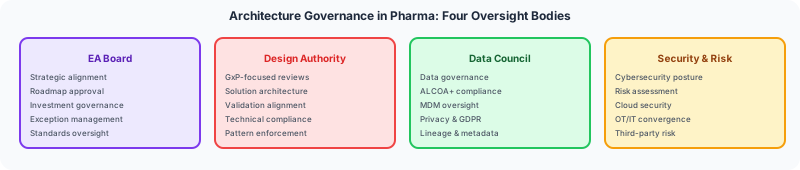
A mature pharma organization typically includes layered governance bodies.
4
1. Enterprise Architecture Board (EAB)
- Defines standards
- Approves architectural decisions
- Reviews major initiatives
- Aligns with business strategy
2. Design Authority (GxP Focused)
- Reviews regulated system designs
- Ensures compliance alignment
- Evaluates validation impact
3. Data Governance Council
- Oversees master data
- Approves data standards
- Monitors data quality metrics
4. Security & Risk Committee
- Reviews cybersecurity posture
- Assesses risk classification
- Monitors incident trends
Clear role separation prevents governance overlap and confusion.
18.3 Architecture Review Process

Architecture must be reviewed systematically.
Typical triggers for review:
- New system acquisition
- Major system upgrade
- Cloud migration
- Integration with external partners
- Significant change in regulatory scope
Review criteria may include:
- Capability alignment
- Data integrity impact
- Validation scope
- Security compliance
- Integration standard adherence
- Infrastructure impact
Documented review outcomes become part of governance evidence.
18.4 Standards Management
Architecture Governance requires a living standards catalog covering:
- Technology standards
- Integration standards
- Security policies
- Data modeling conventions
- Cloud adoption guidelines
Standards must be:
- Documented
- Version-controlled
- Regularly reviewed
- Enforced through architecture reviews
Unmanaged standards quickly become outdated or ignored.
18.5 Exception & Waiver Management
In complex pharma environments, exceptions are inevitable.
A mature governance framework defines:
- Formal exception requests
- Risk assessment documentation
- Time-bound waivers
- Mitigation plans
- Review and renewal cycles
Without structured exception management, temporary deviations become permanent fragmentation.
Governance must balance flexibility with control.
18.6 Compliance Integration with Architecture Governance
Architecture Governance must integrate with:
- Quality Management Systems (QMS)
- Change control processes
- Computer System Validation (CSV)
- Risk management frameworks
Architectural decisions that affect GxP systems must trigger:
- Validation impact assessments
- Risk evaluations
- Updated documentation
Governance must ensure alignment across architecture, quality, and compliance.
18.7 Portfolio Alignment & Investment Control
Architecture Governance ensures that investment decisions align with:
- Strategic capabilities
- Risk reduction priorities
- Standardization goals
- Technical debt reduction
This requires:
- Capability heatmaps
- Application rationalization analysis
- Risk exposure dashboards
- Technology lifecycle tracking
Governance transforms architecture into a strategic planning tool.
18.8 Metrics & Performance Monitoring
Governance effectiveness must be measurable.
Key indicators may include:
- Percentage of projects reviewed architecturally
- Standards compliance rate
- Reduction in duplicate applications
- Integration standard adoption
- Audit findings related to systems
- Technical debt trends
Architecture without measurable impact loses credibility.
18.9 Governance in Global Pharma Organizations
Global enterprises face additional challenges:
- Regional autonomy
- Local regulatory variations
- Distributed IT teams
- Cultural differences
Governance must define:
- Global standards
- Regional adaptation rules
- Escalation paths
- Cross-region review processes
Central control with regional flexibility is essential.
18.10 Governance Anti-Patterns
Common governance failures include:
- Overly bureaucratic review processes
- Inconsistent enforcement
- Lack of executive sponsorship
- Architecture isolated from delivery teams
- Governance detached from risk management
Governance must enable transformation — not slow it unnecessarily.
Architectural Implications of Governance
Architecture Governance influences:
- Technology selection
- Cloud strategy
- Integration patterns
- Security enforcement
- Validation scope
- Digital transformation sequencing
Well-governed architecture results in:
- Reduced compliance findings
- Lower validation cost
- Faster onboarding of new initiatives
- Stronger strategic alignment
Poor governance results in fragmentation and risk accumulation.
Closing Perspective
Architecture Governance transforms blueprint into discipline.
It ensures that:
- Standards are applied consistently
- Risk is managed proactively
- Investments align with capability strategy
- Compliance remains embedded
With governance in place, the enterprise can execute structured transformation.
In the next section, we move into Roadmapping & Transition Architectures, where long-term strategy becomes phased, actionable transformation.
19. Roadmapping & Transition Architectures
A blueprint without a roadmap is aspiration without execution.
Pharmaceutical enterprises cannot transform overnight. Systems are validated, products have long lifecycles, and regulatory stability must be preserved. Transformation must therefore be phased, risk-aware, and capability-driven.
This section defines how to translate the Pharma Enterprise Architecture Blueprint into practical, structured transformation through roadmaps and transition architectures.
19.1 From Target State to Transition States

The Architecture Vision defines the future state. Roadmapping defines the journey.
In pharma, transformation must balance:
- Innovation speed
- Validation constraints
- Regulatory timelines
- Budget cycles
- Operational continuity
4
Instead of a single leap, organizations define:
- Current State (Baseline Architecture)
- Transition Architecture 1
- Transition Architecture 2
- Target Architecture
Each transition state must be stable, compliant, and operable.
19.2 Capability-Based Planning
- Transformation in pharma should be capability-driven — not tool-driven.
- Rather than asking:
- “Which system should we replace?”
- The better question is:
- “Which capability must improve, and why?”
- For example:
- Improve Clinical Data Integration → Modernize data platform
- Improve Batch Quality Oversight → Enhance MES & QMS integration
- Improve Regulatory Submission Efficiency → Implement structured content management
Capability heatmaps help prioritize investment based on:
- Maturity
- Risk exposure
- Strategic importance
- Regulatory impact
This approach aligns transformation with business outcomes.
19.3 Managing Legacy Modernization
Pharma organizations often operate legacy systems that are:
- Highly customized
- Deeply integrated
- Expensive to validate
- Business-critical
Legacy modernization must consider:
- Validation effort
- Data migration risk
- Integration complexity
- User retraining impact
- Inspection readiness
Common strategies include:
- Encapsulation (wrap legacy with APIs)
- Gradual module replacement
- Data platform decoupling
- Cloud migration in controlled phases
Big-bang replacement rarely works in regulated environments.
19.4 Cloud Migration Strategy
Cloud adoption in pharma must be deliberate.
Migration categories include:
- Lift-and-shift (low change, limited optimization)
- Replatforming (partial modernization)
- Re-architecting (cloud-native redesign)
Key considerations:
- GxP impact assessment
- Vendor validation documentation
- Data residency requirements
- Identity federation
- Monitoring consistency
Each migration wave must include:
- Risk assessment
- Validation documentation
- Rollback planning
Cloud roadmaps must align with compliance governance.
19.5 Data Platform Transformation
Modern pharma increasingly consolidates fragmented data landscapes into enterprise platforms:
- Data lakes or lakehouses
- Master Data Management platforms
- Central metadata repositories
Transition strategy must include:
- Controlled data migration
- Dual-run periods
- Lineage preservation
- Quality verification
Data transformation carries high regulatory risk if traceability is lost.
19.6 Integration Consolidation
Many enterprises accumulate:
- Point-to-point integrations
- Inconsistent APIs
- Unmonitored data flows
Roadmaps often include:
- Central integration platform implementation
- API governance rollout
- Event-driven architecture adoption
- Decommissioning legacy interfaces
Integration rationalization reduces operational fragility and compliance exposure.
19.7 Validation-Aware Release Sequencing
Transformation sequencing must consider:
- Validation cycles
- Regulatory submission timelines
- Manufacturing campaigns
- Inspection schedules
For example:
- Avoid major system upgrades before inspections
- Align manufacturing system changes with low-production windows
- Coordinate regulatory system upgrades outside submission peaks
Enterprise Architecture must collaborate closely with Quality and Regulatory functions.
19.8 Funding & Portfolio Alignment
Transformation must align with:
- Annual budget cycles
- Portfolio governance processes
- Strategic therapeutic priorities
Architecture roadmaps should map initiatives to:
- Capability improvements
- Risk mitigation objectives
- Technical debt reduction
- Compliance enhancement
This strengthens executive support and funding approval.
19.9 Measuring Roadmap Progress
Roadmaps must be measurable.
Key progress indicators include:
- Capability maturity improvement
- Reduction in legacy systems
- Cloud adoption percentage
- Integration standard adoption
- Reduction in validation cycle time
- Audit finding trends
Architecture roadmaps should be reviewed annually and adjusted as strategy evolves.
19.10 Avoiding Transformation Pitfalls
Common roadmap risks include:
- Overambitious timelines
- Underestimated validation effort
- Ignoring organizational readiness
- Technology-first planning
- Lack of stakeholder buy-in
Pharma transformation must be incremental, structured, and governed.
Architecture must ensure that each step forward strengthens compliance rather than weakens it.
Architectural Implications of Roadmapping
Roadmapping influences:
- Application lifecycle management
- Infrastructure modernization
- Data governance evolution
- Integration standardization
- Security enhancements
Well-designed roadmaps enable:
- Controlled modernization
- Reduced compliance risk
- Improved operational resilience
- Sustainable innovation
Poorly designed roadmaps create disruption and regulatory exposure.
Closing Perspective
In pharmaceuticals, transformation is a marathon — not a sprint.
Transition Architectures provide:
- Stability between states
- Compliance continuity
- Risk control
- Executive clarity
With roadmapping defined, the next step is ensuring that investments and priorities remain aligned with enterprise strategy.
In the next section, we explore Portfolio & Investment Alignment, where architecture becomes a decision-making instrument at the executive level.
20. Portfolio & Investment Alignment
Enterprise Architecture only delivers value when it influences decisions. In pharmaceutical organizations, those decisions are often multi-million-euro investments affecting regulated systems, patient safety, and global operations.
Portfolio & Investment Alignment ensures that architectural direction, regulatory priorities, and business strategy converge into disciplined funding decisions.
This section explains how architecture becomes a strategic instrument at the executive level.
20.1 Why Portfolio Alignment Is Critical in Pharma
Pharma organizations face competing pressures:
- Accelerate drug development
- Maintain regulatory compliance
- Modernize legacy systems
- Control costs
- Strengthen cybersecurity
Without alignment:
- High-risk capabilities remain underfunded
- Redundant systems persist
- Compliance investments are reactive
- Technical debt grows silently
Portfolio governance must therefore integrate architecture insight into funding decisions.
20.2 Linking Capabilities to Investment

Capability-based planning (introduced earlier) becomes actionable through portfolio management.
4
Each investment initiative should clearly map to:
- A specific business capability
- Identified maturity gaps
- Risk exposure level
- Strategic objectives
For example:
- Improving Regulatory Submission Management → Invest in structured content platform
- Strengthening Manufacturing Data Integrity → Upgrade MES infrastructure
- Enhancing Clinical Analytics → Expand governed data platform
This traceability ensures investments are outcome-driven, not vendor-driven.
20.3 Regulatory-Driven Investments
In pharma, some investments are non-negotiable.
Regulatory drivers may include:
- New serialization laws
- Data protection regulations
- Updated guidance from the U.S. Food and Drug Administration
- Harmonization initiatives promoted by the International Council for Harmonisation of Technical Requirements for Pharmaceuticals for Human Use
Architecture must classify investments into:
- Mandatory compliance investments
- Risk mitigation investments
- Strategic innovation investments
- Efficiency optimization initiatives
This categorization improves transparency and executive clarity.
20.4 Risk-Based Prioritization
Not all architectural gaps are equal.
Investment prioritization should consider:
- Patient safety impact
- Regulatory exposure
- Data integrity risk
- Operational dependency
- Cybersecurity vulnerability
High-risk, high-impact capabilities should receive priority funding.
Risk dashboards aligned with enterprise risk management help decision-makers understand urgency.
20.5 Balancing Innovation and Stability
Pharma must invest in both:
- Innovation platforms (AI, analytics, digital therapeutics)
- Stability platforms (MES, RIM, safety systems)
Over-investment in innovation without strengthening core compliance platforms creates regulatory vulnerability. Over-investment in stability without innovation creates competitive stagnation.
Architecture provides the balancing framework.
20.6 Managing Technical Debt
Technical debt in pharma is particularly costly because:
- Validation effort increases
- Integration complexity grows
- Security exposure widens
- System upgrades become disruptive
Architecture governance should maintain a technical debt register, including:
- End-of-life technologies
- Unsupported software
- Over-customized platforms
- Redundant systems
Investment planning must allocate budget for structured debt reduction.
Ignoring technical debt eventually becomes a compliance risk.
20.7 Cloud & Modernization Investment Strategy
Cloud adoption often competes with other funding priorities.
Portfolio decisions must consider:
- Long-term operational savings
- Validation simplification
- Scalability for analytics
- Cybersecurity posture
Migration initiatives should be justified through:
- Risk reduction
- Capability improvement
- Operational resilience
- Reduced infrastructure maintenance
Architecture ensures modernization is strategic — not trend-driven.
20.8 Measuring Architectural Value
Architecture must demonstrate tangible value.
Key performance indicators may include:
- Reduction in audit findings
- Decrease in system redundancy
- Faster submission preparation
- Reduced validation cycle time
- Improved integration standard adoption
- Lower infrastructure operating costs
Architecture maturity models can track progress across domains.
When architecture contributes measurable value, it gains executive credibility.
20.9 Executive Communication & Transparency
Enterprise Architecture must translate technical insight into executive language:
- Risk exposure
- Financial impact
- Regulatory implications
- Strategic alignment
Portfolio dashboards should visually link:
- Capabilities
- Systems
- Investments
- Risk levels
- Roadmap milestones
Transparency strengthens governance and funding approval.
20.10 Anti-Patterns in Investment Governance
Common failures include:
- Vendor-driven investments
- Project-by-project budgeting without architecture oversight
- Ignoring cross-domain dependencies
- Funding innovation without compliance alignment
- Short-term cost cutting that increases long-term validation burden
Architecture governance prevents these misalignments.
Architectural Implications of Portfolio Alignment
Portfolio & Investment Alignment ensures that:
- Strategic priorities drive system decisions
- Compliance risks are proactively funded
- Transformation is phased and sustainable
- Technical debt is controlled
- Innovation is structured
Architecture becomes a decision-support discipline — not merely documentation.
Closing Perspective
In pharmaceuticals, investment decisions shape regulatory posture, operational resilience, and competitive strength.
Enterprise Architecture provides the framework to ensure that:
- Every major investment strengthens capabilities
- Compliance remains embedded
- Risk is reduced, not accumulated
- Digital transformation remains disciplined
With governance and portfolio alignment defined, we now transition into the future-facing dimension of the blueprint:
AI-Native & Future-Ready Pharma Architecture, where emerging technologies reshape the pharmaceutical enterprise.
Part VII – Future-Ready Pharma Architecture
21. AI-Native Pharma Enterprise
Artificial Intelligence is no longer an experimental capability in pharmaceuticals — it is becoming a structural layer of the enterprise.
An AI-Native Pharma Enterprise is not defined by isolated machine learning projects. It is defined by architecture where AI is:
- Embedded across value streams
- Governed within regulatory boundaries
- Traceable and reproducible
- Secure and explainable
- Strategically aligned with capabilities
In pharma, AI cannot operate as a black box. It must withstand regulatory scrutiny, preserve data integrity, and protect patient safety.
This section defines how Enterprise Architecture must evolve to support an AI-Native pharmaceutical organization.
21.1 From Digital Enterprise to AI-Native Enterprise
Traditional digital transformation focused on:
- Cloud migration
- System integration
- Data platform consolidation
- Process automation
An AI-Native enterprise goes further. It uses AI to:
- Accelerate molecule discovery
- Optimize clinical trials
- Enhance regulatory preparation
- Predict manufacturing deviations
- Detect safety signals in real time
- Improve demand forecasting
AI becomes a horizontal capability spanning R&D, Clinical, Regulatory, Manufacturing, Safety, and Commercial domains.
4
Architecturally, this requires a unified AI platform rather than scattered models embedded in isolated systems.
21.2 AI in Drug Discovery & Research
Early-stage research is one of the most transformative AI domains.
Applications include:
- Generative molecule design
- Protein structure prediction
- Target identification
- Predictive toxicology
- Literature intelligence summarization
AI dramatically reduces hypothesis generation time and experimental iteration cycles.
Architectural Implications
- High-performance computing (GPU-enabled environments)
- Secure research data lakes
- Experiment tracking platforms
- Model version control repositories
- Dataset lineage management
Research environments must allow experimentation while ensuring that models influencing regulated processes later can be traced and reproduced.
Segmentation between exploratory and regulated environments remains essential.
21.3 AI-Augmented Clinical Development
Clinical AI focuses on:
- Patient recruitment optimization
- Site performance analytics
- Risk-based monitoring
- Adaptive trial design simulation
- Statistical anomaly detection
Clinical datasets aligned with standards from the Clinical Data Interchange Standards Consortium must remain structured and traceable.
Architectural Requirements
- Secure patient data handling
- Pseudonymization pipelines
- Federated learning capabilities
- Controlled deployment into GxP contexts
- Reproducible statistical environments
Any AI model influencing submission data must be explainable and documented.
21.4 AI in Regulatory Affairs
AI is increasingly used to support:
- Regulatory intelligence scanning
- Automated content drafting
- Submission consistency checks
- Authority query preparation
Submission structures influenced by the International Council for Harmonisation of Technical Requirements for Pharmaceuticals for Human Use require strict format compliance.
Architectural Controls
- Human-in-the-loop validation workflows
- Prompt and output versioning
- Model traceability records
- Secure content repositories
- Audit-ready archival
AI can accelerate preparation — but accountability remains human.
21.5 Predictive & Autonomous Manufacturing
Manufacturing AI enables:
- Predictive maintenance
- Yield optimization
- Deviation detection
- Environmental anomaly monitoring
Integration with MES and quality systems must preserve GMP integrity.
Architectural Considerations
- Edge-to-cloud data pipelines
- Real-time streaming analytics
- Model monitoring for drift
- Secure OT/IT segmentation
- Controlled deployment gates
If AI influences batch release decisions, validation requirements increase significantly.
21.6 AI in Pharmacovigilance
Safety monitoring benefits from AI through:
- Automated case intake
- Natural language processing of adverse event reports
- Signal detection algorithms
- Risk trend forecasting
These systems must integrate with global safety databases and comply with regulatory expectations from authorities such as the U.S. Food and Drug Administration.
Architectural Safeguards
- Explainable AI outputs
- Traceable data sources
- Secure privacy controls
- Human review checkpoints
- Automated reporting audit logs
Patient safety cannot rely solely on algorithmic decisions.
21.7 Enterprise AI Platform Architecture
A mature AI-Native Pharma Enterprise requires a centralized AI platform with:
- Data ingestion pipelines
- Feature engineering layers
- Model training environments
- Model registry & version control
- Deployment orchestration
- Monitoring & observability
- Governance & compliance layer
Segmentation must exist between:
- Research experimentation
- Validated production models
Controlled promotion pathways ensure compliance continuity.
21.8 MLOps in Regulated Environments
MLOps must incorporate:
- Model lifecycle documentation
- Dataset version control
- Risk classification
- Validation checkpoints
- Continuous performance monitoring
- Bias detection
Models must be:
- Reproducible
- Explainable
- Risk-assessed
- Auditable
Regulated MLOps becomes an extension of Computer System Validation principles.
21.9 Ethical & Explainable AI
AI governance must address:
- Algorithmic bias
- Transparency
- Accountability
- Data provenance
- Human oversight
Explainability is critical when AI influences:
- Clinical decisions
- Regulatory content
- Manufacturing quality
- Safety risk assessments
Black-box models present regulatory and ethical risks.
Architecture must support:
- Model interpretability tooling
- Decision traceability
- Audit documentation repositories
Trust is fundamental in pharma.
21.10 Organizational & Governance Implications
Becoming AI-Native requires:
- Cross-functional AI governance boards
- Data science standards
- Clear ownership of models
- Training & skill development
- Risk-based AI classification frameworks
Enterprise Architecture must define:
- AI standards catalog
- Model validation guidelines
- Deployment governance
- Monitoring responsibilities
AI cannot operate outside governance structures.
Architectural Implications of AI-Native Transformation
AI impacts every architecture domain:
- Business Architecture → New predictive capabilities
- Data Architecture → Scalable, governed platforms
- Application Architecture → AI-enabled services
- Integration Architecture → Real-time inference APIs
- Infrastructure Architecture → HPC and cloud scaling
- Security Architecture → Model protection & data privacy
- Governance Architecture → AI lifecycle management
Organizations that embed AI responsibly gain:
- Faster discovery cycles
- Smarter clinical operations
- Predictive manufacturing
- Proactive safety monitoring
- Competitive advantage
Organizations that deploy AI without governance accumulate regulatory risk.
Closing Perspective
An AI-Native Pharma Enterprise is not defined by algorithms — it is defined by architecture.
It combines:
- Innovation
- Discipline
- Explainability
- Compliance
- Security
- Strategic alignment
AI must enhance trust, not erode it.
In the next section, we move from intelligence to simulation — exploring Digital Twin & Smart Pharma Architecture, where virtual models mirror physical and clinical realities.
22. Digital Twin & Smart Pharma
If AI enables prediction, Digital Twins enable simulation.
A Digital Twin is a virtual representation of a physical or biological system that continuously synchronizes with real-world data. In pharmaceuticals, digital twins can represent:
- A molecule
- A clinical trial
- A manufacturing plant
- A supply chain network
For a regulated industry, digital twins are not futuristic abstractions — they are becoming practical tools for reducing risk, accelerating validation, and optimizing performance.
This section defines how Digital Twin architecture fits into the Pharma Enterprise Architecture Blueprint.
22.1 What Is a Digital Twin in Pharma?
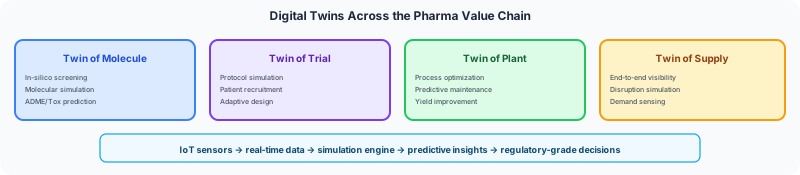
A Digital Twin combines:
- Real-time data ingestion
- Simulation models
- Predictive analytics
- Scenario testing
- Visualization layers
4
Unlike static dashboards, a digital twin:
- Simulates behavior under different conditions
- Predicts outcomes
- Optimizes decisions
- Tests changes before implementation
In pharma, this capability directly impacts safety, compliance, and cost efficiency.
22.2 Digital Twin of the Molecule
In early research, a molecule’s digital twin may include:
- Structural models
- Binding simulations
- Toxicology predictions
- Stability simulations
- Manufacturing feasibility analysis
Benefits include:
- Reduced wet-lab experimentation
- Faster compound optimization
- Improved candidate selection
Architectural Implications
- Integration with AI research platforms
- High-performance computing environments
- Version-controlled simulation models
- Dataset traceability
If simulation outputs influence regulatory documentation, traceability becomes essential.
22.3 Digital Twin of the Clinical Trial
Clinical digital twins simulate:
- Patient recruitment scenarios
- Protocol variations
- Dropout probability
- Site performance
- Safety signal trends
This enables:
- Adaptive trial design
- Reduced trial duration
- Risk-based monitoring strategies
Architectural Requirements
- Secure integration with CTMS and EDC systems
- Privacy-preserving patient data modeling
- Federated learning capabilities
- Model reproducibility
Simulation models influencing submission data must remain auditable and explainable.
22.4 Digital Twin of Manufacturing Plants
Manufacturing digital twins simulate:
- Equipment performance
- Environmental conditions
- Batch yield variability
- Energy consumption
- Quality deviation risk
They combine real-time IoT data with predictive models.
Architectural Components
- Edge computing integration
- Real-time data streaming
- Integration with MES and QMS
- Secure OT/IT segmentation
- Monitoring and alerting platforms
Digital twins reduce downtime and improve GMP compliance by identifying risks before they occur.
22.5 Supply Chain Digital Twin
Global supply chains are vulnerable to disruption.
A supply chain digital twin models:
- Inventory levels
- Distribution routes
- Serialization events
- Regional demand forecasts
- Transportation risks
Benefits include:
- Predictive inventory management
- Reduced stockouts
- Better launch readiness
- Risk mitigation planning
Integration with serialization standards from GS1 ensures traceability continuity.
22.6 Simulation-Driven Regulatory Strategy
Digital twins can support regulatory readiness by simulating:
- Submission timelines
- Authority query response workflows
- Manufacturing capacity impacts
- Labeling variations
When aligned with structured submission frameworks influenced by the International Council for Harmonisation of Technical Requirements for Pharmaceuticals for Human Use, simulations help anticipate regulatory bottlenecks.
Architecture must ensure:
- Scenario modeling traceability
- Version-controlled simulations
- Clear separation between predictive and official submission data
22.7 Architecture of a Digital Twin Platform
A robust Digital Twin architecture includes:
- Data ingestion layer (IoT, enterprise systems, APIs)
- Real-time streaming platform
- Simulation engine
- AI/ML integration layer
- Visualization & decision-support dashboards
- Governance & audit layer
Segmentation must exist between:
- Exploratory simulations
- Validated, decision-impacting models
Controlled promotion mechanisms prevent unvalidated simulations from influencing regulated outcomes.
22.8 Governance & Validation Considerations
Digital twins influencing regulated processes may fall under validation scope.
Governance must address:
- Model validation
- Data source integrity
- Version control
- Change management
- Explainability
Documentation must capture:
- Simulation assumptions
- Model parameters
- Dataset versions
- Approval workflows
Digital twin models must be auditable like software systems.
22.9 Risks & Mitigation
Key risks include:
- Overreliance on unvalidated models
- Data synchronization errors
- Security vulnerabilities in IoT networks
- Model drift
- Poor explainability
Mitigation requires:
- Continuous monitoring
- Secure infrastructure
- Role-based access control
- Automated model performance tracking
- Clear human oversight policies
Simulation must augment decision-making — not replace accountability.
Architectural Implications of Digital Twin Adoption
Digital twins influence:
- Data architecture (real-time ingestion)
- Infrastructure architecture (edge + cloud convergence)
- Security architecture (IoT protection)
- AI governance (model lifecycle control)
- Integration architecture (high-frequency data exchange)
Organizations that adopt digital twins effectively achieve:
- Faster innovation cycles
- Reduced operational risk
- Improved compliance confidence
- Predictive operational control
Organizations that deploy them without governance increase regulatory exposure.
Closing Perspective
Digital Twins bring simulation into the pharmaceutical enterprise.
They allow organizations to:
- Test before acting
- Predict before failing
- Optimize before scaling
However, in a regulated environment, simulation must remain:
- Controlled
- Traceable
- Secure
- Explainable
With AI and Digital Twins defined, we now move into the final future-facing dimension:
Sustainable & ESG-Aligned Architecture, where environmental, social, and governance considerations become embedded into enterprise design.
23. Sustainable & ESG-Aligned Architecture
Pharmaceutical enterprises are increasingly evaluated not only on innovation and compliance — but also on environmental, social, and governance (ESG) performance.
Sustainability is no longer a reporting exercise. It is becoming a structural requirement influencing:
- Manufacturing operations
- Supply chain transparency
- Cloud strategy
- Data governance
- Investment decisions
Enterprise Architecture must therefore evolve to embed ESG considerations directly into system design, data models, and governance processes.
This section defines how Sustainability and ESG principles integrate into the Pharma Enterprise Architecture Blueprint.
23.1 Why ESG Matters in Pharma
Pharmaceutical companies face rising expectations from:
- Regulators
- Investors
- Patients
- Governments
- Global health organizations
ESG drivers include:
- Carbon reduction targets
- Sustainable manufacturing mandates
- Ethical sourcing requirements
- Transparent supply chain reporting
- Diversity & governance accountability
Architecture must enable measurable, auditable ESG reporting — not manual spreadsheet consolidation.
4
23.2 ESG Data Architecture

Sustainability reporting requires integrated data from:
- Manufacturing systems
- Energy consumption monitoring
- Supply chain logistics
- Procurement platforms
- HR systems
- Governance and risk platforms
Architecture must support:
- Central ESG data lake or warehouse
- Standardized sustainability metrics
- Data lineage tracking
- Automated reporting dashboards
- Audit-ready archival
ESG reporting must be as traceable and defensible as regulatory submissions.
23.3 Sustainable Manufacturing Systems
Manufacturing contributes significantly to environmental impact.
Smart manufacturing platforms should monitor:
- Energy consumption
- Water usage
- Waste generation
- Emissions levels
- Resource efficiency
Integration with MES and IoT sensors enables:
- Real-time sustainability tracking
- Predictive energy optimization
- Waste reduction analytics
Sustainability metrics should be embedded into operational dashboards — not treated separately.
23.4 Carbon-Aware Cloud Strategy
Cloud infrastructure contributes to environmental footprint.
Enterprise Architecture must consider:
- Data center energy efficiency
- Regional carbon intensity
- Workload optimization
- Automated resource scaling
- Serverless architectures
Carbon-aware workload scheduling and infrastructure optimization can reduce environmental impact while maintaining compliance.
Sustainability must be factored into cloud vendor selection and architecture design.
23.5 Supply Chain Transparency
Pharma supply chains are global and complex.
Architecture must enable:
- Traceable sourcing
- Supplier sustainability scoring
- Serialization integration
- Transportation emissions tracking
Standards promoted by GS1 support product traceability across regions.
Digital platforms must provide visibility across:
- Raw material suppliers
- Contract manufacturers
- Distribution networks
Supply chain transparency strengthens both ESG performance and regulatory compliance.
23.6 Governance & Social Responsibility
Beyond environmental impact, ESG includes governance and social dimensions:
- Ethical AI governance
- Clinical trial diversity
- Data privacy protection
- Ethical sourcing practices
- Transparent risk reporting
Architecture must support:
- Governance dashboards
- Risk and compliance integration
- Audit trails for ESG decisions
- Automated policy enforcement
Strong governance reduces reputational and regulatory risk.
23.7 Integrating ESG with Enterprise Risk Management
Sustainability risks increasingly intersect with enterprise risk management.
Examples:
- Climate-related supply chain disruption
- Regulatory penalties for environmental non-compliance
- Data privacy violations
- Ethical AI failures
Architecture must integrate ESG indicators into:
- Risk dashboards
- Board reporting tools
- Strategic planning processes
ESG should not be siloed from enterprise governance.
23.8 Measuring ESG Performance
Architecture should enable measurable sustainability metrics such as:
- Carbon footprint per product
- Energy intensity per manufacturing batch
- Waste reduction percentage
- Supplier compliance rate
- Diversity indicators
Automated metrics reduce reliance on manual reporting and improve audit confidence.
23.9 Architectural Implications of ESG Alignment
Sustainability influences:
- Infrastructure selection
- Manufacturing modernization
- Supply chain integration
- Data governance expansion
- AI governance frameworks
- Portfolio investment prioritization
Organizations embedding ESG into architecture achieve:
- Improved investor confidence
- Stronger regulatory alignment
- Operational efficiency
- Long-term resilience
Ignoring ESG increases reputational and regulatory risk.
Closing Perspective
Sustainable & ESG-Aligned Architecture ensures that pharmaceutical innovation remains responsible, transparent, and resilient.
It integrates:
- Environmental monitoring
- Supply chain traceability
- Ethical governance
- Carbon-aware infrastructure
- Risk transparency
Sustainability is not separate from architecture — it is an architectural dimension.
With ESG defined, we now transition into the final part of the blueprint:
Practical Implementation Toolkit, where structured templates, deliverables, and real-world guidance make the architecture actionable.
Part VIII – Practical Implementation Toolkit
24. Pharma Reference Architecture Templates
After strategy, governance, roadmaps, AI, digital twins, and ESG, we now move from conceptual architecture to practical implementation tools.
A Pharma Enterprise Architecture Blueprint only becomes valuable when it is:
- Repeatable
- Structured
- Standardized
- Reusable across programs
This section provides reference architecture templates that organizations can adapt to accelerate design, ensure consistency, and maintain compliance alignment.
These templates are not vendor-specific. They are structural blueprints designed to support regulated pharmaceutical environments.
24.1 Pharma Capability Map Template
The Capability Map is the backbone of Business Architecture.
Template Structure
Level 1 – Capability Domains
- Research & Development
- Clinical Development
- Regulatory Affairs
- Manufacturing & Quality
- Supply Chain
- Commercial & Market Access
- Pharmacovigilance
- Corporate & Shared Services
Level 2 – Core Capabilities
- Clinical Data Management
- Batch Quality Release
- Regulatory Submission Management
- Serialization Management
- Safety Signal Detection
Level 3 – Sub-Capabilities
- eCRF Design
- Electronic Batch Record Review
- Dossier Publishing
- Serialization Event Reporting
How to Use the Template
- Map applications to capabilities
- Assess maturity levels
- Identify duplication
- Align investments
- Link risks to capability gaps
24.2 Data Domain Model Template
A structured Data Domain Model ensures clarity of ownership and traceability.
Core Domain Categories
- Research Data
- Clinical Data
- Regulatory Data
- Manufacturing Data
- Safety Data
- Commercial Data
- Master Data
Template Components
- Domain definition
- Business owner
- Data steward
- Critical data elements
- Regulatory impact classification
- Data retention requirements
- Associated systems
This template supports:
- Data governance enforcement
- Master data alignment
- Validation scoping
- Interoperability mapping
24.3 Application Interaction Template
Applications in pharma must be mapped clearly and consistently.
Template Structure
For each application:
- Supported capabilities
- GxP classification (Yes/No)
- Data domains involved
- Integration interfaces
- Validation status
- Hosting environment
- Vendor dependency
- End-of-life timeline
Interaction Mapping
- API endpoints
- Event flows
- Batch integrations
- Data transformation logic
- Security controls
This template reduces shadow integrations and improves inspection readiness.
24.4 Integration Architecture Template
Integration complexity is a major compliance risk.
Template Components
- Canonical data model reference
- API governance standards
- Message broker configuration
- Interface validation status
- Monitoring and alerting configuration
- Logging & audit trail location
For each interface:
- Source system
- Target system
- Data classification
- Frequency
- Security controls
- Validation impact
Structured integration documentation reduces operational fragility.
24.5 Infrastructure & Cloud Architecture Template
Infrastructure must be documented consistently.
Template Sections
- Environment segmentation (Dev/Test/Prod/GxP)
- Network architecture
- Identity integration
- Backup & disaster recovery design
- Monitoring tools
- Security layers
- Cloud region strategy
- Shared responsibility documentation
This ensures traceability for audits and cloud governance clarity.
24.6 AI & Model Governance Template
For AI-Native enterprises, structured model governance is essential.
Template Includes
- Model name & purpose
- Business owner
- Data sources
- Risk classification
- Training dataset version
- Validation documentation
- Deployment environment
- Monitoring metrics
- Review cycle
This template ensures explainability and regulatory defensibility.
24.7 Risk Classification Template
Risk-based prioritization is fundamental in pharma.
Risk Dimensions
- Patient safety impact
- Regulatory exposure
- Data integrity impact
- Cybersecurity risk
- Operational dependency
Each system or initiative should be classified as:
- High Risk
- Medium Risk
- Low Risk
Risk classification informs:
- Validation depth
- Security controls
- Monitoring intensity
- Investment priority
24.8 Architecture Review Checklist Template
Each major initiative should pass a structured architecture review.
Review Areas
- Capability alignment
- Data governance compliance
- Integration standards adherence
- Security alignment
- Cloud policy compliance
- ESG impact consideration
- Validation scope impact
Standardized review checklists increase consistency and reduce subjective decision-making.
24.9 Roadmap Template
Transformation requires phased planning.
Roadmap Structure
- Current State Summary
- Target State Definition
- Transition Architecture 1
- Transition Architecture 2
- Target Implementation
Each phase should include:
- Capabilities improved
- Systems impacted
- Validation scope
- Risk assessment
- Budget allocation
- Timeline
Roadmaps should be reviewed annually.
24.10 Repository & Documentation Standards
All templates should be maintained in:
- Central architecture repositories
- Version-controlled systems
- Accessible governance portals
Documentation must be:
- Structured
- Searchable
- Linked across domains
- Audit-ready
Architecture repositories become institutional memory.
Architectural Impact of Standardized Templates
Standardized templates enable:
- Consistency across regions
- Faster onboarding of new projects
- Reduced documentation duplication
- Stronger compliance alignment
- Clear executive communication
They convert architecture from conceptual diagrams into operational governance tools.
Closing Perspective
Reference Architecture Templates transform theory into practice.
They ensure that:
- Capabilities remain aligned
- Data remains governed
- Applications remain controlled
- AI remains explainable
- Integration remains standardized
- Infrastructure remains secure
With structured templates in place, we now move to the final operational component of the blueprint:
Architecture Deliverables Checklist, where we define the concrete artifacts every pharma architecture program should produce.
25. Architecture Deliverables Checklist
A strong Enterprise Architecture function is not measured by the number of diagrams it produces — but by the clarity, traceability, and usefulness of its deliverables.
In pharmaceuticals, architecture deliverables must satisfy multiple audiences:
- Executive leadership
- Program managers
- Quality & compliance teams
- Regulators
- Auditors
- Technical delivery teams
They must also support inspection readiness and long-term traceability.
This section defines the essential deliverables every Pharma Enterprise Architecture program should produce.
25.1 Architecture Vision Document
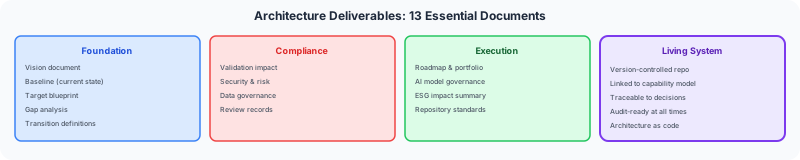
This is the strategic foundation.
Must Include:
- Business drivers
- Strategic objectives
- Regulatory context
- Target architecture principles
- Scope & boundaries
- High-level domain view (Business, Data, Application, Technology, Security)
The Vision Document aligns stakeholders and secures executive sponsorship.
It should clearly explain how architecture supports:
- Innovation
- Compliance
- Risk reduction
- Operational efficiency
25.2 Baseline Architecture (Current State)
Before transforming, the enterprise must understand its starting point.
Business Baseline
- Capability maturity assessment
- Value stream mapping
Data Baseline
- Domain mapping
- Data quality assessment
- Governance gaps
Application Baseline
- Application portfolio inventory
- GxP classification
- Redundancy identification
Technology Baseline
- Infrastructure landscape
- Cloud adoption status
- Security posture
The baseline creates objective clarity and reveals risk concentration areas.
25.3 Target Architecture Blueprint
This defines the future state.
4
Must Include:
- Capability map
- Data domain model
- Application reference architecture
- Integration architecture model
- Infrastructure & cloud model
- Security architecture layers
- AI & analytics reference architecture
The Target Blueprint must be:
- Technology-agnostic where possible
- Standards-driven
- Governable
- Measurable
25.4 Gap Analysis & Impact Assessment
Gap analysis connects current state to target state.
Should Identify:
- Capability gaps
- System redundancies
- Data governance weaknesses
- Security exposure
- Technical debt
- Validation risks
Impact assessments must also include:
- Regulatory implications
- Patient safety considerations
- Integration complexity
- Migration risk
Gap analysis drives roadmap prioritization.
25.5 Transition Architecture Definitions
For each roadmap phase, produce:
- Defined scope
- Impacted systems
- Integration changes
- Validation scope
- Risk mitigation plan
- Rollback strategy
Transition architectures ensure that transformation remains stable and compliant at every stage.
25.6 Validation Impact Assessment
For GxP environments, every architectural change must evaluate:
- System validation scope
- Test documentation requirements
- Change control updates
- Data migration validation
- Vendor qualification updates
This document aligns Architecture with Quality and Compliance teams.
25.7 Security & Risk Assessment
Security assessments should accompany architectural initiatives.
Must Address:
- Identity & access changes
- Data classification impacts
- Cybersecurity exposure
- Third-party integration risks
- Cloud configuration changes
Risk classification must align with enterprise risk frameworks.
25.8 Data Governance & Integrity Assessment
Each major initiative should include:
- Data ownership confirmation
- Master data alignment
- ALCOA+ impact review
- Metadata updates
- Retention & archival implications
Data governance must remain embedded, not optional.
25.9 Architecture Review Records
Every major initiative should produce:
- Architecture review decision
- Compliance alignment confirmation
- Exception approvals (if any)
- Risk documentation
- Version-controlled design artifacts
These records become inspection evidence if required.
25.10 Roadmap & Portfolio Alignment Documentation
Roadmaps should include:
- Capability improvement mapping
- Investment alignment
- Budget tracking
- Timeline sequencing
- KPI tracking
Portfolio alignment documents help executive leadership understand architectural value.
25.11 AI & Model Governance Documentation (If Applicable)
For AI-enabled systems:
- Model purpose definition
- Data source traceability
- Risk classification
- Validation approach
- Monitoring plan
- Bias & explainability documentation
AI governance artifacts must be inspection-ready.
25.12 ESG & Sustainability Impact Summary
For large initiatives:
- Carbon footprint impact
- Energy consumption considerations
- Supply chain transparency alignment
- Governance reporting integration
Sustainability documentation ensures ESG alignment remains structured.
25.13 Repository & Traceability Requirements
All deliverables must be:
- Stored in centralized repositories
- Version-controlled
- Cross-referenced
- Searchable
- Linked to change management systems
Traceability across:
- Requirements
- Design decisions
- Validation evidence
- Deployment records
Is essential in regulated environments.
Architectural Value of Structured Deliverables
Structured deliverables ensure:
- Transparency
- Repeatability
- Audit readiness
- Risk mitigation
- Executive clarity
They transform architecture from abstract models into operational governance instruments.
Closing Perspective
Architecture Deliverables are the tangible outputs that prove discipline, structure, and strategic alignment.
They demonstrate that the organization:
- Understands its current state
- Knows its target state
- Controls its transitions
- Governs its risks
- Preserves compliance
- Enables innovation
With deliverables defined, we now arrive at the final chapter of the blueprint:
Common Pitfalls in Pharma Enterprise Architecture, where we examine the patterns that undermine even well-designed strategies.
26. Common Pitfalls in Pharma Enterprise Architecture
A well-designed Enterprise Architecture Blueprint can still fail in execution.
In pharmaceuticals, failure is rarely caused by lack of intelligence or technology. It is usually caused by misalignment, over-complexity, governance gaps, or underestimating regulatory realities.
This final chapter highlights the most common pitfalls observed in Pharma Enterprise Architecture initiatives — and how to avoid them.
26.1 Over-Engineering Compliance
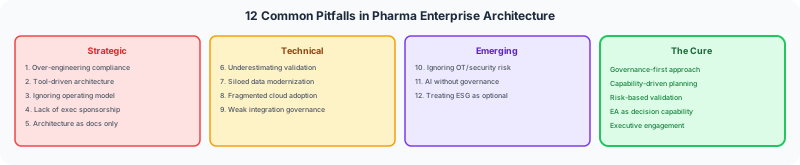
One of the most frequent mistakes is turning compliance into bureaucracy.
Symptoms include:
- Excessive documentation beyond regulatory necessity
- Validation of low-risk systems with disproportionate effort
- Manual controls that could be automated
- Slow change cycles due to rigid governance
While compliance is foundational, over-engineering it:
- Slows innovation
- Increases cost
- Reduces agility
- Frustrates business teams
How to Avoid It
- Apply risk-based validation
- Automate evidence generation
- Classify systems by regulatory impact
- Embed compliance into DevOps pipelines
Compliance must be structured — not paralyzing.
26.2 Tool-Driven Architecture
Another common failure is allowing vendors or platforms to dictate architecture.
Symptoms:
- Selecting tools before defining capabilities
- Over-customizing ERP or MES systems
- Lock-in to proprietary ecosystems
- Fragmented integration approaches
Architecture must define structure first. Tools must support strategy — not replace it.
Prevention Strategy
- Start with capability mapping
- Define target architecture principles
- Evaluate tools against architectural standards
- Avoid unnecessary customization
Vendor influence without governance creates long-term technical debt.
26.3 Ignoring the Operating Model
Architecture that ignores the organizational reality will fail.
Symptoms:
- Centralized platforms imposed on decentralized organizations
- Lack of clarity in data ownership
- Governance boards without enforcement authority
- Shadow IT growth
Enterprise Architecture must align with:
- Organizational structure
- Decision rights
- Regional autonomy
- Quality & compliance governance
Misalignment between architecture and operating model leads to resistance and fragmentation.
26.4 Underestimating Validation Effort
Pharma organizations often underestimate:
- Validation documentation effort
- Change control impact
- Data migration verification
- Inspection readiness requirements
This results in:
- Delayed releases
- Compliance risk
- Frustration between IT and Quality teams
Avoidance Measures
- Include validation impact assessment in every major initiative
- Engage Quality early in design
- Maintain reusable validation templates
- Align DevOps automation with compliance requirements
Validation must be planned — not discovered late.
26.5 Siloed Data Modernization
Data platform initiatives sometimes focus only on analytics, ignoring regulated continuity.
Symptoms:
- Data lakes disconnected from source systems
- Loss of lineage
- Inconsistent master data
- Parallel reporting systems
In pharma, losing traceability is a regulatory risk.
Mitigation
- Define clear data domains
- Maintain lineage tracking
- Align modernization with governance policies
- Avoid “analytics-only” thinking
Data modernization must preserve defensibility.
26.6 Fragmented Cloud Adoption
Cloud migration without architectural discipline creates:
- Multiple disconnected cloud platforms
- Inconsistent security standards
- Duplicate tooling
- Compliance uncertainty
Cloud adoption must align with:
- Infrastructure segmentation
- Identity governance
- Security standards
- Validation frameworks
Cloud is an enabler — not a shortcut around governance.
26.7 Weak Integration Governance
Uncontrolled integrations are a silent risk multiplier.
Symptoms:
- Point-to-point interfaces
- Inconsistent APIs
- Hardcoded transformations
- Poor monitoring
Integration failures often surface during audits.
Prevention
- Central integration platform
- API governance standards
- Canonical data models
- Monitoring and observability tools
Integration must be governed as a platform capability.
26.8 Ignoring Security & OT Risk
Manufacturing environments are increasingly targeted by cyber threats.
Ignoring:
- OT/IT segmentation
- Vulnerability management
- Access control governance
Can result in:
- Production disruption
- Compliance findings
- Safety risk
Security must remain embedded across architecture domains.
26.9 AI Without Governance
AI initiatives launched without structured governance can lead to:
- Black-box decision-making
- Unvalidated model deployment
- Bias risk
- Regulatory exposure
In pharma, AI must be:
- Explainable
- Version-controlled
- Risk-classified
- Continuously monitored
AI experimentation must never bypass compliance controls.
26.10 Architecture as Documentation Only
Perhaps the most dangerous pitfall is reducing Enterprise Architecture to static diagrams.
Symptoms:
- No link to portfolio decisions
- No governance enforcement
- No measurable impact
- No executive engagement
Architecture must influence:
- Investment decisions
- Technology standards
- Risk management
- Compliance governance
If architecture does not shape decisions, it loses authority.
26.11 Lack of Executive Sponsorship
Pharma transformation is complex and long-term.
Without executive backing:
- Standards are ignored
- Exceptions multiply
- Projects bypass governance
- Architecture becomes advisory only
Executive sponsorship ensures enforcement and alignment.
26.12 Treating ESG as Optional
Sustainability and ESG are increasingly linked to:
- Investor expectations
- Regulatory reporting
- Supply chain risk
Ignoring ESG in architecture planning leads to reactive and fragmented reporting.
Sustainability must be embedded early.
Final Perspective: What Makes Pharma EA Succeed
Successful Pharma Enterprise Architecture is:
- Capability-driven
- Risk-aware
- Compliance-embedded
- Data-governed
- Secure by design
- Incrementally transformed
- Executive-supported
It balances:
- Innovation and stability
- Agility and validation
- Global standardization and local flexibility
- Technology modernization and regulatory continuity
When architecture remains disciplined, governed, and strategically aligned, it becomes a competitive advantage — not a constraint.
Closing the Blueprint
The Pharma Enterprise Architecture Blueprint has now covered:
- Strategic context
- Business architecture
- Data architecture
- Application & integration architecture
- Infrastructure & security
- DevOps & validation
- Governance & transformation
- AI, digital twins, and ESG
- Practical templates and pitfalls
This blueprint is designed not merely to describe architecture — but to enable structured, compliant, and future-ready pharmaceutical enterprises.
Appendix
A. Glossary of Pharma & Enterprise Architecture Terms
This glossary defines key pharmaceutical and enterprise architecture terms used throughout this blueprint.
Pharmaceutical & Regulatory Terms
ALCOA+ A data integrity principle meaning data must be Attributable, Legible, Contemporaneous, Original, Accurate, plus Complete, Consistent, Enduring, and Available.
Batch Record Documentation of the manufacturing history of a specific production batch.
CRO (Contract Research Organization) An external organization contracted to conduct clinical trial activities.
CMO (Contract Manufacturing Organization) An external partner responsible for manufacturing pharmaceutical products.
CSV (Computer System Validation) A documented process ensuring that a computerized system performs as intended in a regulated environment.
CTMS (Clinical Trial Management System) A system used to manage operational aspects of clinical trials.
EDC (Electronic Data Capture) A system for collecting clinical trial data electronically.
ELN (Electronic Lab Notebook) A digital system for documenting laboratory research activities.
GCP (Good Clinical Practice) International quality standard for designing and conducting clinical trials.
GLP (Good Laboratory Practice) Quality system governing non-clinical laboratory studies.
GMP (Good Manufacturing Practice) Regulations ensuring pharmaceutical products are consistently produced and controlled.
GxP General term covering regulated practices (GMP, GCP, GLP, GDP).
ICH (International Council for Harmonisation) Global body harmonizing pharmaceutical regulatory standards.
LIMS (Laboratory Information Management System) System managing laboratory samples and test workflows.
MES (Manufacturing Execution System) System managing and monitoring manufacturing operations.
Pharmacovigilance (PV) Monitoring and assessing adverse drug reactions post-approval.
RIM (Regulatory Information Management) Systems managing regulatory submission data and authority interactions.
- Serialization Unique identification of pharmaceutical products for traceability.
- Enterprise Architecture Terms
- Baseline Architecture The current-state architecture of the enterprise.
- Target Architecture The desired future-state architecture.
Transition Architecture An intermediate architecture between baseline and target states.
Capability Map A structured representation of what the organization must be able to do.
Value Stream End-to-end flow of activities delivering value to stakeholders.
Data Domain Logical grouping of related data entities.
Reference Architecture Reusable architectural pattern or template.
Integration Pattern Standardized method of system interaction (API, event-driven, batch).
MLOps Operational discipline governing machine learning lifecycle management.
DevSecOps Integration of development, security, and operations practices.
Digital Twin Virtual representation of a physical or biological system.
Technical Debt Accumulated architectural inefficiencies that increase long-term cost or risk.
B. Reference Standards & Frameworks
Pharma Enterprise Architecture must align with international regulatory and architectural standards.
Regulatory & Industry Standards
International Council for Harmonisation of Technical Requirements for Pharmaceuticals for Human Use Defines harmonized global regulatory requirements (eCTD, GCP alignment, stability guidelines).
U.S. Food and Drug Administration Regulatory authority governing pharmaceutical approval and compliance in the U.S.
European Medicines Agency European regulatory authority for medicinal products.
Clinical Data Interchange Standards Consortium Defines structured clinical data standards (SDTM, ADaM).
Health Level Seven International Develops healthcare interoperability standards (HL7, FHIR).
- GS1 Defines global product identification and serialization standards.
- Enterprise Architecture & Governance Frameworks
- The Open Group Publisher of TOGAF.
- TOGAF Architecture Development Method (ADM) lifecycle.
- COBIT IT governance and control framework.
- ISO 27001 Information security management standard.
- ISO 9001 Quality management systems standard.
- ITIL IT service management framework.
- C. Mapping to TOGAF ADM Phases
- This blueprint aligns structurally with the TOGAF ADM lifecycle.
4
This mapping ensures structured transformation rather than ad-hoc evolution.
D. Suggested Diagram Types per Chapter
To support clarity and consistency, each chapter should include standardized diagram types.
Strategy & Governance Chapters
- Enterprise Context Diagram
- Stakeholder Map
- Governance Structure Diagram
- Architecture Principles Matrix
Business Architecture
- Capability Map (Layered)
- Value Stream Diagram
- Organizational Interaction Model
Data Architecture
- Data Domain Model
- Master Data Relationship Diagram
- Data Lineage Flow
- Data Governance Responsibility Matrix
Application & Integration Architecture
- Application Portfolio Map
- Application Interaction Diagram
- API Reference Model
- Event Flow Diagram
- System Context Diagram
Infrastructure & Security
- Layered Infrastructure Diagram
- Cloud Deployment Architecture
- Identity & Access Flow
- OT/IT Segmentation Model
- Security Control Matrix
DevOps & Validation
- CI/CD Pipeline Diagram
- Validation Lifecycle Flow
- Environment Segmentation Diagram
- MLOps Lifecycle Model
AI & Digital Twin
- AI Platform Architecture
- Model Lifecycle Diagram
- Digital Twin Simulation Flow
- Data Ingestion & Feedback Loop Model
ESG & Sustainability
- ESG Data Flow Architecture
- Carbon Monitoring Architecture
- Supply Chain Transparency Map
Final Note
This appendix ensures that the Pharma Enterprise Architecture Blueprint is:
- Terminologically precise
- Standards-aligned
- Framework-mapped
- Diagrammatically consistent
It transforms the blueprint from conceptual narrative into a structured, reference-grade architecture guide suitable for regulated pharmaceutical enterprises.
For expert guidance on pharmaceutical enterprise architecture, explore our enterprise architecture consulting, architecture capability development, and Sparx EA consulting. Get in touch.
Frequently Asked Questions
What is enterprise architecture?
Enterprise architecture is a discipline that aligns an organisation's strategy, business operations, information systems, and technology infrastructure. It provides a structured framework for understanding how an enterprise works today, where it needs to go, and how to manage the transition.
How is ArchiMate used in enterprise architecture practice?
ArchiMate is used as the standard modeling language in enterprise architecture practice. It enables architects to create consistent, layered models covering business capabilities, application services, data flows, and technology infrastructure — all traceable from strategic goals to implementation.
What tools are used for enterprise architecture modeling?
Common enterprise architecture modeling tools include Sparx Enterprise Architect (Sparx EA), Archi, BiZZdesign Enterprise Studio, LeanIX, and Orbus iServer. Sparx EA is widely used for its ArchiMate, UML, BPMN and SysML support combined with powerful automation and scripting capabilities.