⏱ 5 min read
Enterprise Architecture KPIs and Metrics That Actually Matter
Executive Overview
Pharmaceutical enterprises operate within one of the most complex, regulated, and capital-intensive environments in the global economy. Every molecule entering development represents billions in potential investment. Every delay in submission can translate into hundreds of millions in lost revenue. Every regulatory observation can erode trust and market value.
Against this backdrop, digital transformation is no longer optional. It is structural.
Artificial intelligence is reshaping drug discovery. Digital twins are transforming manufacturing. Decentralized clinical trials are redefining patient engagement. Real-world evidence platforms are influencing regulatory submissions and reimbursement strategies.
Enterprise Architecture (EA) sits at the center of this transformation. It governs how systems connect, how data flows, how platforms scale, and how risk is controlled. Sparx EA best practices
Yet in many pharmaceutical organizations, EA is measured through activity metrics rather than value metrics.
This paper defines Enterprise Architecture KPIs and metrics that truly matter in pharmaceutical enterprises, structured around measurable business outcomes. free Sparx EA maturity assessment
1. The Pharmaceutical Complexity Imperative
Pharmaceutical organizations face structural complexity across long innovation cycles, regulatory intensity, validation requirements, global manufacturing networks, high M&A frequency, and fragmented data landscapes.
If unmanaged, complexity produces:
- Increased validation cost
- Extended release cycles
- Regulatory inspection findings
- Inconsistent master data
- Limited AI scalability
- Excessive technical debt
Measuring EA effectiveness is therefore a strategic necessity.
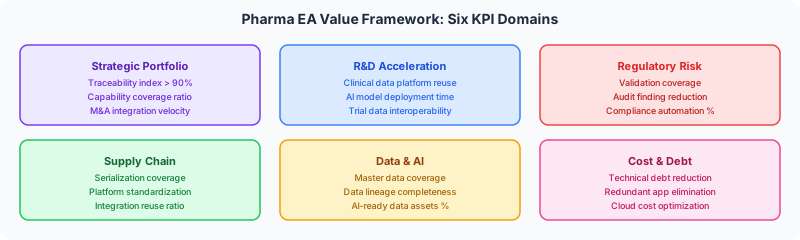
2. The Pharma Enterprise Architecture Value Framework
Enterprise Architecture delivers measurable value across six domains:
- Strategic Portfolio Alignment
- R&D and Clinical Acceleration
- Regulatory & Compliance Risk Reduction
- Manufacturing & Supply Chain Resilience
- Data Governance & AI Enablement
- Cost Optimization & Technical Debt Management
Each domain contains executive-level KPIs.
3. Strategic Portfolio Alignment Metrics
Strategic Traceability Index
Initiatives aligned to strategy ÷ Total active initiatives × 100 Target: > 90%
Capability Coverage Ratio
Percentage of defined business capabilities mapped to applications, data, and integrations. integration architecture diagram
M&A Integration Velocity
Average months required to integrate acquired systems into core platforms.
4. R&D and Clinical Acceleration KPIs
Clinical Interoperability Index
Measures API-driven integration maturity across EDC, CTMS, eTMF, safety systems, and data platforms.
Data Reconciliation Cycle Time
Average time required to reconcile clinical data discrepancies.
CDISC Adoption Rate
Percentage of systems compliant with CDISC standards.
Validation Automation Ratio
Automated validation scripts ÷ Total validation tests × 100
Research Data Accessibility Index
Percentage of discovery datasets accessible via governed platforms.
5. Regulatory & Compliance Risk Metrics
GxP Validation Currency Rate
Percentage of regulated systems with up-to-date validation documentation.
Data Integrity Compliance Index
Measures adherence to ALCOA+, audit trails, electronic signatures, and access control standards.
Regulatory Change Lead Time
Time required to implement system updates after regulatory changes.
Audit Finding Recurrence Rate
Repeat findings ÷ Total findings × 100
6. Manufacturing & Supply Chain Resilience KPIs
MES--ERP Synchronization Accuracy
Percentage of batches with consistent data across systems.
Electronic Batch Record Digitization Ratio
Digital batch records ÷ Total batch records × 100
Serialization Coverage Rate
Percentage of products covered by end-to-end serialization tracking.
Architecture-Induced Downtime
Hours of production downtime caused by system integration failures.
7. Data Governance & AI Enablement Metrics
Data Ownership Coverage
Percentage of data domains with named owner, steward, classification, and lifecycle policy.
Master Data Consistency Index
Alignment across product, material, clinical, and supplier master data.
AI Model Governance Compliance
Measures documentation completeness, bias testing, validation traceability, and reproducibility.
Secure Data Platform Adoption Rate
Percentage of research data hosted on secure governed cloud platforms. enterprise cloud architecture patterns
8. Cost Optimization & Technical Debt Metrics
Application Redundancy Index
Number of systems supporting identical capabilities.
Technical Debt Exposure Score
Weighted score considering legacy stack usage, unsupported software, manual integrations, spreadsheet reliance, and vulnerabilities.
Cloud Readiness Score
Percentage of systems that are containerized, API-enabled, stateless, and cloud-compliant. hybrid cloud architecture
Infrastructure Standardization Ratio
Systems running on approved technology stack ÷ Total systems × 100
Conclusion
In pharmaceutical enterprises, Enterprise Architecture is a strategic enabler of faster innovation, stronger compliance, operational resilience, secure AI adoption, and sustainable cost structures.
KPIs that matter are those that reduce time-to-market, quantify regulatory risk, improve manufacturing reliability, strengthen data governance, and control technical debt.
When measured properly, Enterprise Architecture becomes a measurable accelerator of pharmaceutical innovation and patient safety.
For expert guidance on enterprise architecture, explore our enterprise architecture consulting, architecture capability development, and Sparx EA consulting. Get in touch.
Frequently Asked Questions
What is enterprise architecture?
Enterprise architecture is a discipline that aligns an organisation's strategy, business operations, information systems, and technology infrastructure. It provides a structured framework for understanding how an enterprise works today, where it needs to go, and how to manage the transition.
How is ArchiMate used in enterprise architecture practice?
ArchiMate is used as the standard modeling language in enterprise architecture practice. It enables architects to create consistent, layered models covering business capabilities, application services, data flows, and technology infrastructure — all traceable from strategic goals to implementation.
What tools are used for enterprise architecture modeling?
Common enterprise architecture modeling tools include Sparx Enterprise Architect (Sparx EA), Archi, BiZZdesign Enterprise Studio, LeanIX, and Orbus iServer. Sparx EA is widely used for its ArchiMate, UML, BPMN and SysML support combined with powerful automation and scripting capabilities.