⏱ 21 min read
Most enterprise architecture decks lie by omission.
They show neat boxes, straight arrows, and a fantasy that the enterprise is a stable machine whose parts can be labeled once a year and governed forever. But real enterprises do not behave like neat box diagrams. They behave like cities. Streets get rerouted. Informal paths appear where the official ones were too slow. Old buildings are never really demolished; they become basements for newer ones. And every critical business capability ends up depending on something nobody wanted to admit was critical.
That is why graph-based architecture views matter.
Not because graphs are fashionable. Not because databases with “graph” in the name suddenly appeared in procurement conversations. But because the enterprise itself is a graph: capabilities depend on processes, processes invoke applications, applications exchange events, services rely on teams, teams own domains, domains share master data, controls apply to flows, and outages spread through dependency chains like cracks through old concrete.
A graph view does one thing exceptionally well: it tells the truth about connectedness.
And in enterprise architecture, connectedness is where the pain lives.
This article argues for graph-based architecture views as a practical way to understand large organizations, guide migration, expose hidden coupling, and reconcile domain semantics across distributed systems. We will look at where graphs help, where they mislead, how they fit with domain-driven design, and why they become especially useful in Kafka-heavy and microservices-heavy estates. We will also look at failure modes, tradeoffs, and the cases where a graph is a very expensive way to draw a simple picture. event-driven architecture patterns
Context
Traditional enterprise architecture has long leaned on layered models: business, application, data, technology. Those layers remain useful. They provide governance boundaries and a common language for portfolio and platform decisions. EA governance checklist
But they have a weakness: they flatten relationships.
A capability map tells you what the business does. An application catalog tells you what software exists. A data model tells you what entities are managed. An integration inventory tells you what connects to what. Each is useful in isolation. Yet the architectural questions executives actually care about live between those artifacts:
- What customer journeys depend on the product master?
- Which applications become unstable when the pricing domain changes?
- Where does “customer” mean legal entity versus account holder versus consumer?
- Which regulatory controls apply to event streams crossing regions?
- What can we retire if we replace the order orchestration core?
- Which migration step reduces risk instead of just moving boxes around?
These are graph questions.
A graph-based architecture view treats architecture as nodes and relationships with explicit semantics. Nodes may represent business capabilities, bounded contexts, applications, APIs, events, teams, datasets, platforms, or controls. Edges represent meaningful relationships such as depends on, publishes, consumes, owns, reconciles with, governs, derives from, and replaces.
The key point is not the notation. The point is semantic richness.
A graph view works best when it reflects the language of the business, not just the plumbing of IT. This is where domain-driven design becomes central. Without domain semantics, a graph becomes a wiring diagram. With domain semantics, it becomes an architectural instrument.
Problem
Most enterprises suffer from an architectural blind spot: they know their assets, but not their relationships.
This sounds subtle. It is not. It is the reason transformations stall.
The typical enterprise can produce:
- a CMDB full of stale infrastructure records
- an application inventory no one trusts
- PowerPoint landscapes by division
- process models disconnected from runtime systems
- data lineage diagrams built only for audit season
Yet when asked a serious question—“What happens if we split customer onboarding into separate domains?”—the room goes quiet.
Why? Because architecture knowledge is fragmented across repositories and teams. Integration teams know interfaces. Domain experts know exceptions. platform teams know deployment paths. Security knows control points. Finance knows vendor contracts. Nobody sees the whole dependency topology at once.
This gets worse in modern estates.
Microservices increase the number of edges dramatically. Kafka and event streaming shift communication from direct calls to temporal coupling and asynchronous propagation. SaaS platforms hide internal models while exposing APIs that become de facto enterprise contracts. Data products emerge without consistent ownership. “Customer 360” programs quietly create a second shadow architecture of reconciled facts. Then leadership asks for agility.
Agility is not the hard part. Seeing the consequences is.
A graph-based architecture view addresses this by making dependencies queryable, traversable, and analyzable. But only if the graph is built from meaningful architecture semantics, not just harvested metadata.
Forces
There are several forces pulling enterprises toward graph-based views, and they are not all friendly.
1. Domain complexity beats technical simplicity
In most large organizations, the hardest problem is not service deployment. It is semantic drift.
“Order” in commerce is not “order” in fulfillment. “Customer” in billing is not “customer” in CRM. “Product” in a product information management system is not “product” in finance. Architecture diagrams often erase these differences in the name of simplification. That simplification later returns as integration pain, reconciliation logic, and brittle reporting.
Graph views let us model these distinctions explicitly. Not one node called Customer, but multiple domain-specific concepts linked by relationships such as maps to, reconciles with, or is projected from.
That matters. Names are not labels. Names are commitments.
2. Distributed systems create hidden coupling
Synchronous service calls expose dependencies visibly. Event-driven systems often hide them.
Kafka makes this both better and worse. Better, because event backbones reduce direct API dependency and support decoupling. Worse, because consumers proliferate quietly. A team publishes an event for one purpose; six months later five more teams depend on it, each interpreting the schema a little differently. Now a “small change” becomes a negotiation across half the estate.
A graph view helps reveal blast radius: which services publish or consume which events, under what contracts, with what SLA and ownership.
3. Transformation requires migration visibility
Enterprises do not rebuild from scratch. They migrate under load.
That means every strategic architecture is also a migration architecture. The path matters as much as the target. Strangler patterns, anti-corruption layers, dual writes, event-carried state transfer, data replication, reconciliation jobs—these are not implementation details. They are first-class architectural mechanisms.
A graph can represent current-state, transition-state, and target-state relationships simultaneously. That alone is worth a lot in boardroom conversations.
4. Governance needs evidence, not posters
Architecture governance often degenerates into standards catalogs and review boards. Useful, but insufficient. Modern governance needs machine-readable relationships: ArchiMate for governance
- Which critical flows cross trust boundaries?
- Which personally identifiable data feeds are derived from source systems outside approved domains?
- Which applications depend on unsupported middleware?
- Which bounded contexts share a supposedly private database?
Graph-based views can answer these operationally rather than rhetorically.
Solution
The solution is not “use a graph database.” That is a tooling choice.
The real solution is to establish graph-based architecture views as a semantic model of the enterprise, grounded in domain-driven design and used actively for planning, migration, and operational reasoning.
At a practical level, that means defining:
- Node types that matter to the enterprise
- Relationship types with explicit meaning
- Viewpoints for different stakeholder concerns
- Rules for ownership and update
- Queries that support decision-making
A useful enterprise architecture graph typically includes some combination of:
- Business nodes: capability, value stream, product, market, regulation
- Domain nodes: bounded context, aggregate, canonical concept, policy
- Application nodes: system, microservice, SaaS platform, integration component
- Data nodes: dataset, event, topic, master record, projection, report
- Platform nodes: cluster, cloud account, runtime, database, gateway
- Organization nodes: team, vendor, owner, support group
- Control nodes: policy, control objective, risk, SLA, region
And then the relationships:
- supports
- depends on
- owns
- publishes
- consumes
- reconciles with
- derives from
- replaces
- governed by
- deployed on
- exposes
- maps to
- synchronized with
This is not mere modeling hygiene. It changes architectural behavior. Instead of discussing whether “the CRM integrates with order management,” you can ask:
- Does the customer profile context publish customer status events consumed by the order policy context?
- Is the profile model authoritative or reconciled?
- Which capabilities break if the customer identity topic is delayed?
- Where does semantic translation happen?
That is architecture with teeth.
A simple conceptual graph
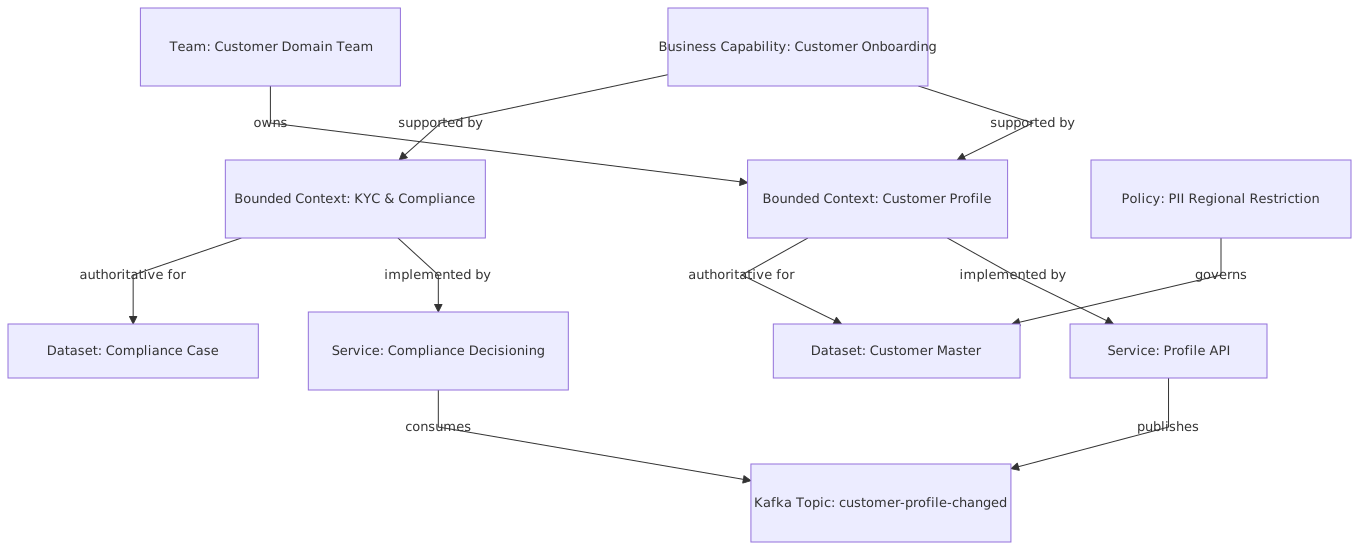
A graph like this is not trying to replace every detailed model. It is creating a navigable semantic spine through them.
Architecture
The architecture of graph-based views has two layers: the metamodel and the operating model.
The metamodel
The metamodel defines the kinds of things and relationships your enterprise cares about. Get this wrong and everything downstream becomes muddy.
This is where domain-driven design helps enormously. DDD teaches us to respect bounded contexts, ubiquitous language, and explicit translation between models. In a graph-based architecture view, that means resisting the temptation to invent an enterprise-wide fake canonical model too early.
A common mistake is to create a graph that says:
- Customer
- Order
- Product
- Invoice
with relationships between them.
That is not architecture. That is a business glossary pretending semantics are settled.
A better model distinguishes:
- Retail Customer
- Billing Account Holder
- Legal Party
- Delivery Recipient
and records how those concepts relate. Some may overlap. Some may reconcile probabilistically. Some may map through a customer identity service. The graph should preserve that ambiguity rather than hide it.
The operating model
The operating model determines how the graph stays alive.
Because the graveyard of enterprise architecture is full of repositories that were accurate for one glorious quarter.
A working operating model usually includes:
- federated ownership by domain or platform teams
- automated ingestion from service catalogs, API gateways, Kafka schema registries, cloud inventories, and CI/CD metadata
- curated semantic relationships maintained by architects and domain stewards
- review workflows for high-value edge types like authoritative source, replaces, and reconciles with
- query and visualization tooling tuned to use cases, not just generic exploration
Automation can discover technical edges. Humans must define semantic edges. Confuse those and the graph becomes noise.
Domain semantics and reconciliation
This is where graph views become truly valuable.
In real enterprises, some information is authoritative in one context but only usable in another after reconciliation. That distinction matters.
Consider customer data:
- CRM may be authoritative for engagement preferences
- ERP may be authoritative for billing party
- Identity platform may be authoritative for login credentials
- Data warehouse may host a reconciled customer golden record for analytics
Without modeling these distinctions, teams build accidental truth systems. The graph should explicitly mark:
- source of authority
- downstream projections
- reconciliation pipelines
- confidence or matching rules where appropriate
- consumers depending on reconciled versus transactional views
That gives architecture a much more honest picture of the enterprise information landscape.
Event-driven architecture in the graph
Kafka belongs here because event streams are relationship multipliers.
You should model:
- producers and consumers
- topics and schemas
- ownership of event contracts
- compatibility policies
- replay dependencies
- critical event chains supporting business capabilities
Events are not just transport. They are business facts in motion. A graph view can show whether an “OrderPlaced” event is a domain event, an integration event, or a reporting convenience masquerading as one. Those distinctions decide whether consumers are safely decoupled or dangerously entangled.
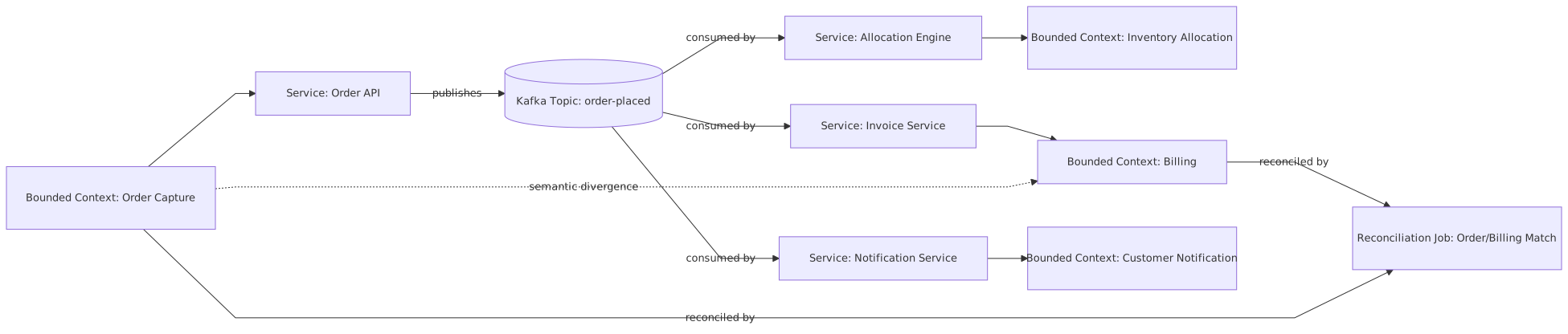
That dashed semantic divergence line is not decoration. It is where enterprise incidents are born.
Migration Strategy
The most underrated use of graph-based architecture views is migration planning.
Target-state architecture is cheap. Migration architecture is where adults earn their salaries.
A graph lets you model not only what exists and what should exist, but what must coexist temporarily. This is essential in progressive strangler migration.
Progressive strangler migration
Suppose a monolithic order management platform is being decomposed into domains:
- order capture
- pricing
- fulfillment orchestration
- invoicing
The old system still runs. Some flows are routed to new services, others remain in the monolith. Data is copied, events are emitted, and reconciliation exists because migration is reality, not doctrine.
A graph-based view can mark:
- legacy nodes and target nodes
- replacement relationships
- anti-corruption layers
- temporary dual-write paths
- synchronization jobs
- event bridges
- cutover checkpoints
That matters because migrations fail less often from bad target design than from underestimating transition complexity.
Reconciliation as a first-class migration concern
In a strangler migration, reconciliation is not a housekeeping detail. It is the safety rail.
If order capture writes to a new service while billing still reads from the monolith, someone must prove records agree. That may involve:
- event-based propagation
- nightly reconciliation jobs
- exception queues
- conflict resolution policies
- business sign-off thresholds
A graph-based architecture view should model these explicitly. If a migration depends on reconciliation but the reconciliation process is unowned, opaque, or manual, that is not a migration plan. That is optimism.
A migration graph view
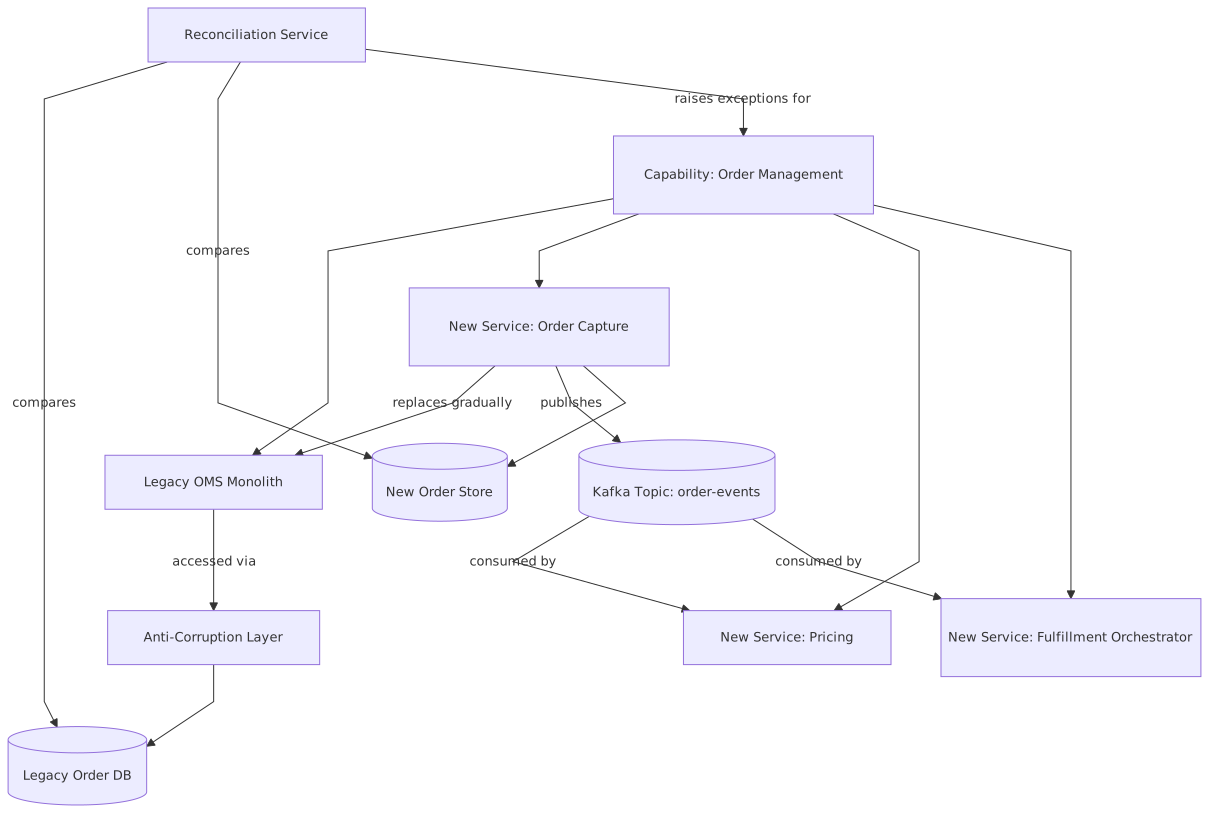
This kind of view is useful because it shows not only the destination, but the temporary architecture that absorbs risk. Temporary architecture is still architecture. Ignore it and it will punish you.
Migration reasoning
A graph also helps sequence migration.
For example:
- remove low-dependency edges first
- isolate bounded contexts with clear ownership
- replace read-only consumers before write-heavy core systems
- establish event contracts before consumer split
- introduce anti-corruption layers before domain extraction
- migrate domains with high semantic cohesion but low external coupling
These are not universal rules, but they become visible through graph analysis. You can identify centrality, blast radius, and dependencies that would otherwise stay hidden in documents.
Enterprise Example
Consider a large multinational insurer modernizing its policy administration estate.
Like many insurers, it had grown through acquisition. There were multiple policy systems by product line and geography, several customer databases, a shared document platform, a CRM, and a reporting stack that had become the unofficial truth engine. Executives wanted “a customer-centric platform.” Which is often executive shorthand for “please make decades of conflicting semantics disappear.”
The architecture team did not start by drawing a target microservices landscape. That would have been theater. microservices architecture diagrams
Instead, they built graph-based architecture views around a few high-value concepts:
- business capabilities such as quote, bind, endorse, claim, billing
- bounded contexts such as policy issuance, customer interaction, party identity, commission, and claims intake
- systems and services
- event topics in Kafka
- datasets and authoritative sources
- ownership by teams and regions
- controls for data residency and regulated processing
The breakthrough came when they modeled the word customer honestly.
They discovered at least five materially different meanings:
- prospect in CRM
- policyholder in policy admin
- payer in billing
- claimant in claims
- legal party in compliance screening
The old architecture treated these as one concept because integration teams had always mapped them behind the scenes. The graph made the divergence visible. That changed the strategy.
Instead of trying to create one canonical customer service, they created:
- a party identity bounded context for cross-system identity and linkage
- explicit domain concepts for policyholder, payer, claimant, and prospect
- mapping and reconciliation services rather than forced semantic unification
- Kafka events for identity linkage changes and profile updates
- anti-corruption layers around acquired regional policy platforms
This was not purist DDD. It was enterprise DDD. Messy, negotiated, and much more useful.
The migration then followed a progressive strangler approach:
- Customer-facing digital channels were routed to new interaction services.
- Policy systems remained in place, wrapped with anti-corruption APIs.
- Kafka propagated business events from modernized services.
- A reconciliation layer compared identity links and billing relationships across systems.
- Claims and policy domains evolved independently, consuming shared identity resolution rather than a fake universal customer schema.
The result was not one perfect graph-shaped architecture. It was something better: an architecture that made tradeoffs explicit. Teams could finally answer:
- what depended on whom
- where semantics diverged
- what was authoritative
- what was merely reconciled
- what could be migrated next with tolerable risk
That is a real enterprise win. Not elegance. Clarity.
Operational Considerations
Graph-based architecture views are not just strategic artifacts. They become operationally valuable when connected to living systems.
Metadata ingestion
Some architecture facts can be harvested:
- services from internal developer platforms
- APIs from gateways
- Kafka topics and schemas from registry and broker metadata
- cloud resources from infrastructure inventories
- deployment relationships from CI/CD pipelines
- incident and SLA relationships from observability platforms
This gives breadth. It does not give truth by itself.
A service named “customer-service” tells you little about whether it owns customer identity, profile preferences, or just a read model. Semantic curation remains essential.
Query use cases
The graph becomes useful when stakeholders can ask pointed questions:
- Which business capabilities depend on Oracle instances due for retirement?
- Which services consume customer events but are not schema-version compatible?
- Which reconciled datasets feed regulatory reporting?
- Which domains own PII crossing regional boundaries?
- What is the blast radius if the identity topic is delayed for 30 minutes?
If nobody asks the graph hard questions, it becomes wall art.
Governance and stewardship
The graph needs stewardship by:
- domain architects for semantic relationships
- platform architects for runtime dependencies
- data stewards for authority and lineage
- security and risk teams for policy relationships
This is not centralization. It is federated accountability. The enterprise graph should mirror the operating model of the enterprise.
Visualization discipline
One warning: graph visualizations are intoxicating and often useless.
A graph with 8,000 nodes on a screen tells you only that your enterprise is large. Useful views are filtered by purpose:
- domain interaction view
- migration cutover view
- event dependency view
- control and compliance view
- operational blast-radius view
Graphs are powerful because they are traversable. Visualization is just one access pattern.
Tradeoffs
Graph-based architecture views are powerful, but not free.
Tradeoff 1: semantic richness versus maintainability
The richer the model, the more useful the graph. Also the harder it is to keep accurate.
A graph with five node types may be maintainable but shallow. A graph with forty node types may be intellectually satisfying and operationally abandoned. The sweet spot is usually smaller than architects first imagine.
Tradeoff 2: federated truth versus consistency
Federated ownership reflects reality. It also creates uneven quality. One domain updates its metadata religiously; another ignores it for six months. The graph then mirrors enterprise politics as much as architecture.
That is not necessarily bad. In fact, neglected graph areas often reveal neglected operational responsibilities. But do not expect perfect uniformity.
Tradeoff 3: exploration versus decision support
Generic graph browsing is interesting. Decision support is valuable.
Many programs spend too much time building beautiful ontologies and too little time supporting actual decisions like decommission sequencing, schema governance, or risk analysis.
Tradeoff 4: domain fidelity versus executive simplicity
Executives often want one-page simplification. Domain reality resists it. A graph can preserve nuance, but your communication still needs layers of abstraction. The answer is not to erase complexity. It is to present the right slice.
Failure Modes
There are several predictable ways this goes wrong.
1. Building a graph without domain semantics
If your graph consists mostly of servers, databases, and application names, you have built an enriched infrastructure map. That can still be useful, but it is not an enterprise architecture graph in the deeper sense.
2. Treating the graph as a universal canonical model
This is a classic enterprise mistake. A graph should model semantic differences, not dissolve them prematurely. If every domain term is collapsed into one enterprise concept, integration pain is merely hidden until implementation.
3. Over-automating truth
Tool vendors love to imply that discovery equals architecture knowledge. It does not. Discovered interfaces tell you that two systems talk. They do not tell you whether the conversation is semantically healthy, redundant, transitional, or compensating for a broken domain boundary.
4. Ignoring transition-state architecture
Many architecture repositories model current and target state but skip the migration state. That omission is lethal in large transformations. Temporary edges—dual writes, replication, anti-corruption translation, reconciliation feeds—must be modeled because they often create the highest risk.
5. Turning the graph into governance theater
If updates are performed only before architecture review boards, the graph becomes ceremonial. Living architecture means continuous use in planning, change management, incident response, and investment decisions.
When Not To Use
Let us be blunt. Not every architecture problem needs a graph.
Do not use graph-based architecture views when:
- the estate is small and relationships are simple
- the main need is a straightforward process diagram or system context
- semantic boundaries are already trivial and stable
- no one is willing to own the model
- the organization lacks the maturity to distinguish domain relationships from technical discovery
- the intended use is purely decorative executive reporting
A graph is especially unnecessary when you are trying to avoid doing harder architecture work. Some teams reach for graph tooling because they hope it will produce clarity automatically. It will not. It will amplify the clarity you already have—or expose that you do not have any.
If your core problem is unresolved domain ownership, weak platform engineering, or undocumented integration contracts, a graph will reveal the mess but not clean it.
Sometimes a simple C4 model, a capability map, or a bounded context map is enough. Architecture should use the lightest effective tool. Graphs are compelling, not compulsory.
Related Patterns
Graph-based architecture views sit well alongside several established patterns.
Bounded Context Mapping
Directly aligned with DDD. The graph can represent upstream/downstream relationships, conformist dependencies, customer-supplier patterns, and anti-corruption layers.
Strangler Fig Pattern
Particularly valuable for migration-state graph modeling. Replacement relationships, temporary routing, and reconciliation processes can all be visualized and queried.
Event-Driven Architecture
Kafka topics, producers, consumers, schemas, replay dependencies, and event contracts fit naturally into graph views. This is one of the strongest use cases.
Data Lineage and Data Product Mapping
Especially helpful when reconciled datasets and analytical projections depend on multiple operational domains.
Service Dependency Mapping
Useful, but should be treated as one slice of the graph rather than the whole thing.
Anti-Corruption Layer
A critical relationship in migration and domain protection. It deserves explicit modeling, not a footnote.
Summary
Graph-based architecture views matter because enterprises are not stacks of boxes. They are webs of meaning, responsibility, dependency, and change.
Used well, a graph lets enterprise architecture do what it too rarely does: speak honestly about connectedness. It can show where domain semantics diverge, where authoritative data actually lives, where event-driven systems are truly decoupled and where they are merely asynchronously entangled, where migrations need reconciliation, and where transformation risk really sits.
The best graph-based views are grounded in domain-driven design. They respect bounded contexts. They make semantic translation visible. They model migration as a first-class architecture concern, especially in progressive strangler journeys. They treat Kafka topics, APIs, datasets, teams, and controls as part of one connected enterprise picture.
But there is a catch. There is always a catch.
A graph is not a shortcut to understanding. It is a discipline for representing understanding. Without semantic care, it becomes decorative complexity. Without federated ownership, it decays. Without real operational questions, it turns into architecture wallpaper.
Still, for large enterprises in the middle of platform modernization, microservices expansion, data reconciliation, and domain realignment, graph-based architecture views are one of the most practical ways to see the enterprise as it really is.
And architecture that sees clearly makes better bets.
That is the whole game.
Frequently Asked Questions
What is enterprise architecture?
Enterprise architecture aligns strategy, business processes, applications, and technology in a coherent model. It enables impact analysis, portfolio rationalisation, governance, and transformation planning across the organisation.
How does ArchiMate support architecture practice?
ArchiMate provides a standard language connecting strategy, business operations, applications, and technology. It enables traceability from strategic goals through capabilities and services to infrastructure — making architecture decisions explicit and reviewable.
What tools support enterprise architecture modeling?
The main tools are Sparx Enterprise Architect (ArchiMate, UML, BPMN, SysML), Archi (free, ArchiMate-only), and BiZZdesign. Sparx EA is the most feature-rich, supporting concurrent repositories, automation, scripting, and Jira integration.