⏱ 21 min read
Most architecture arguments are not really about technology. They are custody battles.
Who gets to own the business rules? The workflow engine? The UI? The API gateway? The database triggers? The service layer? The so-called “domain service” that became a junk drawer for everything nobody wanted to classify? Teams rarely say it that directly, but that is the fight. And like most custody battles, the children suffer.
Business rules are where an enterprise reveals what it actually values. Credit limits, underwriting decisions, discount eligibility, shipment holds, cancellation windows, tax handling, fraud checks, renewal logic, entitlement calculations—these are not implementation details. They are the operational grammar of the business. Put them in the wrong place and the architecture starts lying. It says one thing in diagrams, another in code, and a third in production behavior.
This is why rule placement matters far more than most architecture decks admit. Rule location determines whether a system can change safely, whether domain semantics remain coherent, whether teams can reason about behavior, and whether a modernization effort becomes a controlled migration or a long expensive reenactment of archaeology.
The central idea is simple: business rules should live as close as possible to the domain concepts they govern, and no closer to technical convenience than absolutely necessary. But simple ideas get mangled in enterprise life. Real systems have channels, integration points, event streams, legacy packages, reporting stores, vendor platforms, and compliance controls. “Put rules in the domain” is right, but not enough. We need sharper distinctions: which rules belong in entities, which in aggregates, which in domain services, which in process orchestration, which at policy boundaries, and which should stay outside the domain entirely.
That is the terrain of this article.
Context
In a healthy domain architecture, rules are not scattered like glitter after a school project. They are concentrated around domain meaning. That sounds obvious, yet many enterprises inherit systems where rules are distributed across:
- web forms and mobile clients
- BPM or workflow engines
- API composition layers
- service methods
- stored procedures and triggers
- batch jobs
- Kafka consumers
- integration adapters
- BI or reconciliation scripts
- spreadsheet models living on shared drives with names like
pricing-final-v7-USETHIS.xlsx
This happens for understandable reasons. Teams optimize locally. Front-end teams put eligibility checks in the UI to improve responsiveness. Integration teams add validation in middleware “for safety.” Data teams enforce state changes in the database because they mistrust application consistency. Event consumers reimplement rules because they only receive facts, not meaning. Before long, the enterprise has several systems that all “know” the same rule, each in a slightly different dialect.
Domain-driven design has always pushed back against this sprawl. The point is not merely object modeling. The point is aligning software structure with domain semantics: bounded contexts, aggregates, invariants, ubiquitous language, policies, and explicit models of behavior. Rule placement is one of the most practical consequences of that way of thinking.
If your architecture cannot answer the question “where does this rule live, and why there?”, then your design is not finished.
Problem
The problem is not that rules exist in multiple places. Some duplication is inevitable and even healthy. The problem is authoritative ambiguity.
When an order can be canceled in the customer portal for 30 minutes, in the call-center tool for 45 minutes, through an API only if no invoice exists, and in the warehouse service until pick-pack has started, the issue is not duplication alone. The issue is that nobody can state the actual business policy with confidence. Rule placement has failed because the enterprise lost a single semantic center of gravity.
A few recurring symptoms give the game away:
- changing one rule requires edits in five systems
- identical requests produce different outcomes by channel
- teams argue whether a failure is “validation,” “policy,” or “workflow”
- Kafka consumers compensate for events that should never have been emitted
- reconciliation jobs become the only reliable expression of truth
- architecture diagrams imply domain ownership, but production behavior is owned by integration glue
This is especially dangerous in a microservices environment. Microservices make boundaries explicit, which is useful. They also make bad rule placement easier to institutionalize. A service can become “owner” of a rule simply because it happens to receive the request first. The result is accidental authority. microservices architecture diagrams
And there is another trap: many enterprises confuse decision location with execution location. A rule may be enforced in several places for speed, UX, fraud reduction, or operational resilience. But one place should still be recognized as the source of domain authority. If that distinction is blurred, drift is inevitable.
Forces
Rule placement is hard because several forces pull in different directions.
Domain integrity
The strongest force is preserving business meaning. Domain invariants—things that must never be violated—belong inside the model that owns the concept. If an Account must never exceed a credit exposure limit under certain policy conditions, that rule belongs where Account behavior is decided, not merely where requests arrive.
User experience
Teams want immediate feedback. So they replicate rules in the UI or edge services. This is often sensible. Nobody wants a round trip to discover that a contract end date precedes its start date. But fast feedback can quickly turn into semantic drift if edge logic becomes the de facto rule engine.
Process orchestration
Some rules are not about a single domain object. They span time, actors, and systems. “If payment clears and inventory is reserved and export control passes, release shipment” is a process rule. Those belong in orchestrators, sagas, or workflow components—not hidden in an Order aggregate. The aggregate should own its own invariants; the process should own coordination.
Data gravity and legacy platforms
Mainframes, ERP suites, and large relational systems often already encode critical rules in stored procedures, triggers, package customizations, or job streams. Pretending those rules don’t exist is not architecture. It is denial. During migration, the practical question is not “where should rules live in greenfield perfection?” but “how do we move authority without breaking the business?”
Event-driven autonomy
Kafka and event streaming encourage loose coupling. Good. But events are not magic. If services consume events and infer domain policy independently, rules fracture. Event-driven systems need clear ownership of command-side decisions and carefully designed published facts.
Governance and compliance
Some industries require transparent decision trails: why a loan was declined, why a claim was flagged, why a trade was blocked. This pushes architecture toward explicit policy components, decision models, auditable rule evaluation, and immutable event histories.
Delivery pressure
Finally, the oldest force of all: deadlines. Rule placement is often sacrificed to whatever team can ship fastest. The invoice service checks subscription entitlement because nobody wants to wait for the subscription team. The warehouse service applies customer priority because “it was only two lines.” Six months later there are seven versions of “priority customer.”
That is how architecture debt is born: not from malice, but from convenience repeated.
Solution
The practical solution is to place rules according to semantic ownership, then deliberately decide where secondary enforcement is allowed.
A useful taxonomy helps.
1. Input validation rules
These check shape, syntax, and basic sanity.
Examples:
- required fields
- date format
- quantity is positive
- email has valid structure
These can live at the edge: UI, API layer, schema validation, adapters. They are not the heart of the domain. They prevent nonsense from entering the system.
2. Domain invariants
These are rules that must always hold true for a domain concept.
Examples:
- an insurance policy cannot be activated without underwriting approval
- an order cannot be shipped once canceled
- a claim cannot pay more than covered amount under policy terms
- a contract renewal must preserve regulatory cooling-off rules
These belong inside the aggregate or domain model responsible for that concept. Not in the controller. Not just in the database. Certainly not only in a Kafka consumer. event-driven architecture patterns
3. Domain policies
These are business decisions that may involve calculation, classification, or policy evaluation beyond a single entity’s internal state.
Examples:
- discount eligibility based on customer tier, margin floor, campaign, and channel
- credit decisioning using exposure, payment history, region, and product risk
- claims fraud scoring thresholds
These often belong in domain services or policy objects within the bounded context. They should still speak the ubiquitous language of the domain, not technical jargon.
4. Process rules
These govern coordination across aggregates or services over time.
Examples:
- reserve inventory before charging payment
- open manual review if KYC fails after order capture
- retry settlement before reversing authorization
- if partner acknowledgment is missing for 24 hours, trigger reconciliation flow
These belong in workflow, orchestration, saga, or process manager components.
5. Integration rules
These adapt between bounded contexts or external systems.
Examples:
- map internal customer risk level to ERP hold code
- translate shipment status to partner-specific message formats
- split one domain event into multiple downstream integration events
These belong in anti-corruption layers and integration adapters.
6. Analytical or advisory rules
These support reporting, recommendation, forecasting, and anomaly detection. They should not quietly mutate operational truth unless explicitly promoted into operational policy.
This classification sounds fussy. It isn’t. It is the difference between a business architecture and a heap of code with invoices.
Here is the core placement model.
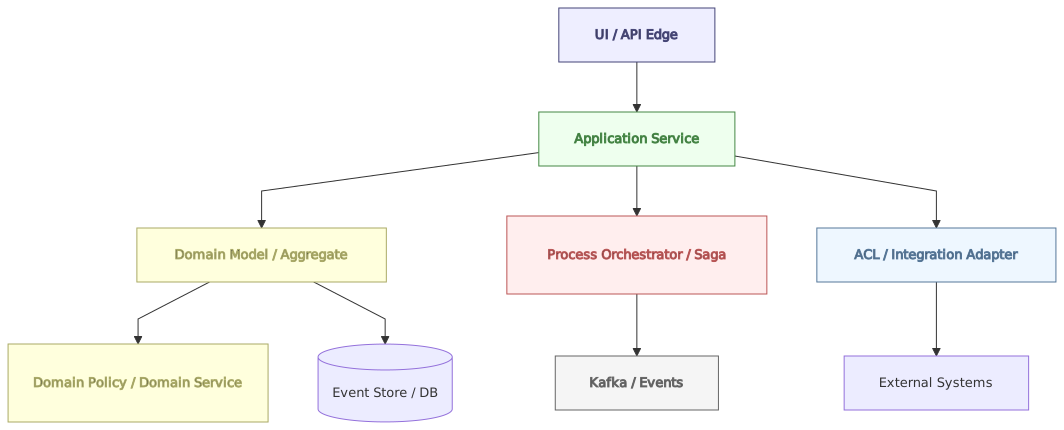
A blunt rule of thumb:
- Validate early
- Decide in the domain
- Coordinate in the process layer
- Translate at the boundary
- Replicate carefully for experience, never for authority
That last line matters. You may duplicate a rule at the edge for responsiveness, but the domain remains the authority.
Architecture
Let’s make this concrete in a service-oriented and event-driven enterprise architecture.
The command side
A request enters through an application service. The application service authenticates, authorizes, loads the aggregate, and invokes domain behavior. It does not contain the business rule itself unless the “rule” is really orchestration.
If the rule belongs to the Order aggregate, the Order aggregate decides. If the rule depends on pricing policy, then a PricingPolicy domain service participates, but still within the ordering bounded context if that context owns the decision. If the decision spans fulfillment and billing over hours or days, then the saga decides next steps, not the aggregate.
The event side
After a domain decision is made and persisted, events are published. Those events announce facts: OrderPlaced, CreditReserved, ShipmentReleased, ClaimFlaggedForReview. Downstream services react according to their own bounded contexts.
This is where many teams get sloppy. They publish low-level CRUD noise or partial status changes, and consumers rebuild domain meaning through guesswork. Then business rules leak into every consumer. The cure is designing events around domain semantics, not table mutations.
Bounded contexts and rule authority
Rule authority belongs inside the bounded context that owns the language and outcomes. If Pricing defines “promotional eligibility,” then Sales should not independently compute it. Sales may cache it, request it, or surface it, but it should not author it.
Reconciliation as first-class architecture
In enterprise systems, reconciliation is not an embarrassment. It is a necessity. Distributed decisions, asynchronous messaging, legacy coexistence, and external partners guarantee occasional divergence. The mistake is treating reconciliation as a back-office afterthought.
Reconciliation rules should be explicit:
- what is the system of record for each decision?
- what constitutes a mismatch?
- which mismatches can auto-heal?
- which require human intervention?
- how are compensations generated?
- how long can systems remain inconsistent?
This matters especially with Kafka-based architectures. Event-driven flow gives resilience and decoupling, but it also introduces duplicate events, out-of-order delivery, consumer lag, replay side effects, and partial downstream failure. If your rule placement assumes the stream is always clean, your production system will eventually teach you humility.
Here is a view of rule location by architectural layer.
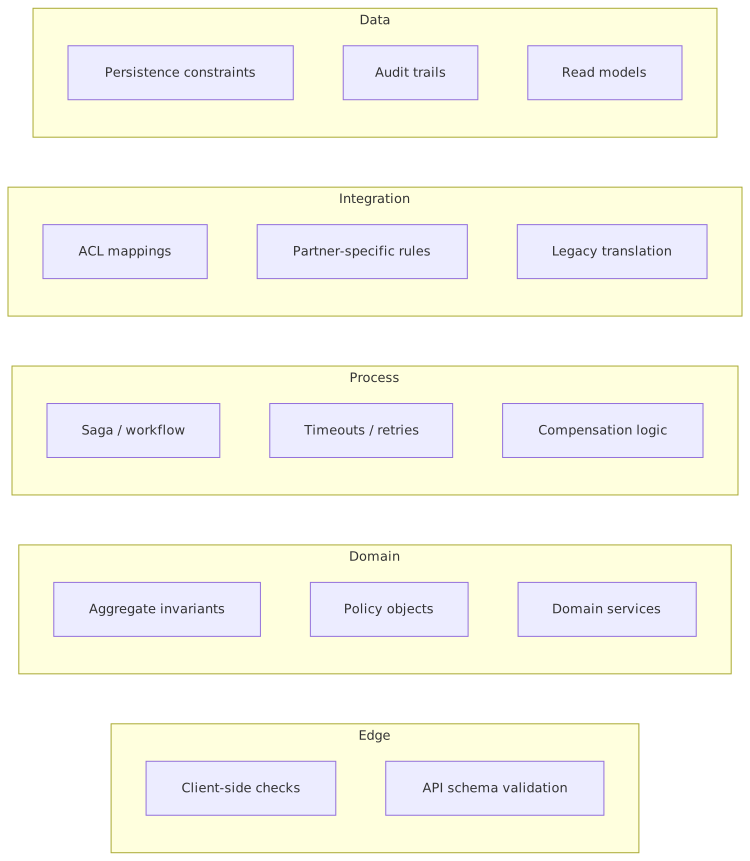
Persistence constraints deserve a special note. Database constraints are excellent for protecting structural integrity: uniqueness, referential integrity, non-null fields, legal enum ranges. They are poor homes for evolving domain policy, especially when multiple applications share the database or when policy requires contextual information not present in a row. Use the database as a backstop, not as the primary expression of business meaning.
Migration Strategy
No serious enterprise starts from a clean slate. Rule placement questions are usually asked in the middle of modernization, after years of layered sediment.
The right migration strategy is usually a progressive strangler, not a big-bang rewrite. But strangling functionality is easier than strangling rule authority. Function can move while the old system still decides. Or the reverse. The architecture work is choosing the transfer order carefully.
Step 1: Inventory and classify the rules
Start by finding them. This sounds trivial. It is not. Business rules are often hidden in:
- code branches
- batch parameters
- stored procedures
- report filters
- message routing conditions
- screen enablement logic
- operational runbooks
- manual exception handling
Classify them using the taxonomy above: validation, invariant, policy, process, integration, analytical.
Step 2: Identify the current system of decision
For each important rule, ask:
- who currently makes the authoritative decision?
- who duplicates it?
- who relies on it?
- what evidence exists for why the decision happened?
This reveals whether you have one decision point or ten.
Step 3: Establish a target bounded context map
Not every rule should move. Some belong in ERP until the ERP capability is actually replaced. Some should remain at the boundary because they are partner-specific. Domain-driven design is not a theological command to rewrite all policy into Java or C# classes. It is a method for assigning ownership properly.
Step 4: Extract decision services before full object migration when needed
In legacy modernization, it is often safer to extract a policy decision first rather than uproot an entire domain model. For example, you may expose “discount eligibility” or “credit hold decision” as a domain policy service while the legacy order management platform still executes fulfillment. This narrows semantic authority before structural replacement.
Step 5: Use dual-run and reconciliation
For important rules, run old and new decision paths in parallel. Compare outputs. Build a reconciliation dashboard. Investigate mismatches. This is especially valuable for financial, regulatory, pricing, and underwriting rules where “mostly right” is not right.
Step 6: Shift command authority, then retire duplicates
Once confidence is high, route commands to the new domain authority. Keep edge validation and advisory copies where useful, but retire old authoritative implementations decisively. Half-retired rules are dangerous.
A strangler view often looks like this:
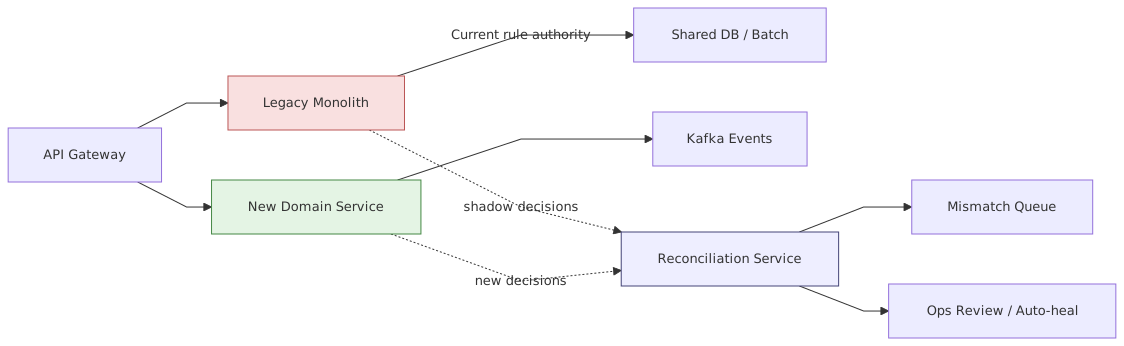
Migration reasoning
There is a sequencing truth many teams resist: move the meaning before you move all the code. If you first establish where the business decision ought to live, you can tolerate temporary structural ugliness. If you move code without moving semantic ownership, you simply distribute confusion more efficiently.
Enterprise Example
Consider a global insurer modernizing claims processing across property, auto, and travel lines.
The legacy landscape looks familiar:
- a mainframe policy system
- a packaged claims platform
- regional web portals
- a call-center application
- a fraud screening engine
- nightly reconciliation jobs
- Kafka introduced recently to publish operational events into downstream analytics and customer-notification services
A deceptively simple rule causes constant trouble:
“A claim may be fast-tracked for auto-payment if it meets low-risk criteria and no manual review triggers apply.”
Sounds manageable. In reality, versions of this rule are spread across:
- portal UI for immediate customer messaging
- claims platform workflow to route tasks
- fraud engine integration layer to determine whether to call screening
- payment service to decide whether to disburse immediately
- data warehouse SQL used by finance to identify “exceptions”
- regional call-center script notes because some geographies have carve-outs
The symptoms are ugly:
- customers see “approved” in the portal but payment is later blocked
- regional differences emerge without governance
- fraud and claims teams disagree on the exact trigger set
- operations spend hours on reconciliation between claims statuses and payment events
- Kafka consumers infer “fast-tracked” from event sequences rather than from an explicit domain event
The modernization team applies domain-driven design properly.
Bounded contexts
- Claims owns claim lifecycle and adjudication semantics
- Fraud owns fraud assessment
- Payments owns disbursement and settlement
- Policy owns coverage facts and entitlements
- Customer Channels owns experience, not decisions
Rule placement
- claim completeness and basic input checks remain at the edge
- the invariant “claim cannot be paid before coverage and liability conditions are satisfied” is enforced in Claims
- the policy “fast-track eligibility” becomes a Claims policy object, evaluated from claim facts, product type, region, and fraud indicators
- the process rule “obtain fraud result before auto-payment if threshold conditions require it” is implemented in a Claims saga
- the payment service no longer re-decides fast-track eligibility; it consumes an explicit
ClaimApprovedForAutoPaymentevent - the portal still shows immediate messaging, but as advisory UX until domain confirmation arrives
Kafka event design
Instead of broadcasting status noise such as ClaimUpdated, the claims context publishes:
ClaimSubmittedClaimEligibilityValidatedManualReviewRequestedClaimApprovedForAutoPaymentClaimPaymentBlockedClaimReopened
That one change reduces downstream rule reimplementation dramatically. Consumers no longer infer policy from technical deltas.
Reconciliation
A reconciliation service compares:
- approved claims in Claims
- initiated payments in Payments
- fraud hold outcomes in Fraud
- region-specific exceptions
Mismatch classes are explicit:
- approval without payment initiation
- payment initiated for manually reviewed claim
- conflicting fraud override state
- duplicate auto-payment event replay
Some mismatches auto-heal. Others open operational cases.
The result is not “perfect consistency.” That is a fairy tale. The result is clear authority, explainable outcomes, and manageable inconsistency. In enterprise terms, that is victory.
Operational Considerations
Rule placement does not end at code structure. Operations will test every assumption you make.
Observability
If a rule is important, instrument it. Log decision inputs carefully, capture outputs, expose counters, and tag events with decision version where appropriate. You need to answer:
- what rule fired?
- based on which facts?
- under which policy version?
- what downstream actions followed?
Without this, production incidents become ghost hunting.
Versioning
Some policies change frequently. Pricing, promotions, eligibility, compliance thresholds—these can evolve weekly. Version policy objects explicitly. For event-driven systems, include enough context to support replay and audit. A replay under today’s rule may not match yesterday’s legal decision.
Idempotency and duplicates
Kafka consumers will see duplicates eventually. If rule outcomes trigger side effects, make command handling idempotent and keep emitted events semantically stable. “At least once” delivery is not a footnote. It is a design constraint.
Time
Many business rules are temporal. End-of-day cutoffs, settlement windows, cooling-off periods, grace periods, SLAs, business calendars, region-local holidays. Time should be modeled explicitly, not hidden in utility methods spread across services. Temporal policy drift is one of the quietest enterprise failures.
Human overrides
Real businesses allow exceptions. That does not mean bypassing the domain model. Model overrides as first-class domain actions with authorization, audit, rationale, and expiration where needed. If “manual override” means editing database fields in production, your architecture has already surrendered.
Tradeoffs
There is no universal perfect placement. There are only better compromises.
Rich domain model vs simpler services
Placing rules deeply in aggregates and policy objects improves semantic integrity. It can also feel heavier than procedural service code, especially for teams unfamiliar with DDD. The answer is not to abandon the model. The answer is to keep the model focused on real domain complexity, not ceremony.
Central authority vs edge responsiveness
A single decision authority prevents drift. Edge duplication improves responsiveness. Good architecture allows advisory checks at the edge while preserving command-side authority centrally.
Domain ownership vs team autonomy
Strong bounded-context ownership reduces semantic confusion. It can also slow teams that want to move independently. That friction is healthy when the alternative is three teams redefining “eligible customer.”
Event-driven decoupling vs interpretive chaos
Kafka and event streaming decouple services nicely. They also tempt consumers to reconstruct business meaning from event patterns. Publish domain-significant events or expect downstream policy sprawl.
Database enforcement vs domain flexibility
Database constraints are excellent backstops. They are brittle places for evolving policy. If every rule change requires trigger surgery and release coordination with five apps, your architecture is paying interest on old convenience.
Failure Modes
This topic has some classic ways to go wrong.
The anemic domain with a fat service layer
Everything is in application services. Entities are data bags. Rules become transaction scripts scattered across methods. This is common because it feels straightforward. It also decays rapidly as policy complexity grows.
The god domain service
Teams hear “put policy in domain services” and create one giant BusinessRulesService. That is not a model. It is a landfill. Policy objects need names that reflect real business language and bounded context ownership.
Workflow engine as business brain
Workflow tools are useful for long-running coordination. But when every rule is encoded in BPMN boxes and decision tables disconnected from the domain model, you get process-driven semantics instead of domain-driven semantics. The workflow becomes the truth, and the domain becomes a puppet. BPMN training
Rule duplication without authority markers
A UI check, an API check, a domain check, and a database check can all coexist. Fine. But if nobody knows which one is authoritative, production behavior will diverge under stress.
Event consumers making upstream decisions retroactively
A consumer sees OrderPlaced and independently decides whether the customer was entitled to order. That decision should have been made upstream. Downstream reinterpretation is one of the fastest routes to inconsistency.
Migration by copy-paste
Legacy rules are copied into new services without clarifying semantics. Teams preserve bugs, preserve ambiguity, and then call it modernization. It is not modernization. It is fossil relocation.
When Not To Use
A rich domain-centric rule placement strategy is not always the right tool.
Do not over-engineer this approach when:
- the application is mostly CRUD with trivial policy
- rules are stable, simple, and unlikely to evolve
- the domain has little semantic complexity
- the system is short-lived or departmental
- a commercial package already owns the domain decisions and customization should stay minimal
- the main problem is operational throughput, not domain ambiguity
In those cases, a simpler transactional service design may be enough. Not every internal app needs aggregates, policy objects, sagas, and event choreography. Architecture should earn its complexity.
Also be careful in analytics-heavy or ML-led domains. Predictive models can support operational decisions, but they should not silently become domain authority without governance, explainability, and fallback policy. “The model said so” is not a domain design. EA governance checklist
Related Patterns
Several patterns sit naturally alongside proper rule placement.
Aggregate
Best for protecting invariants within a transactional consistency boundary.
Domain Service
Useful for policies that do not belong naturally inside a single entity but still belong to the bounded context.
Specification
Good for expressing combinable business predicates, eligibility checks, and classification criteria.
Policy Object
A pragmatic way to model explicit business decision logic with clear names and versioning.
Saga / Process Manager
Essential when rules coordinate multiple services or long-running workflows.
Anti-Corruption Layer
Critical in migration and integration scenarios so legacy semantics do not infect the new model.
Event Sourcing
Sometimes helpful when rule auditability and replay are vital. But do not use it casually; it increases operational and modeling complexity.
Strangler Fig Pattern
The right mental model for migrating rule authority progressively from legacy systems.
Summary
Business rules are the living constitution of an enterprise system. Put them in the wrong place and the architecture loses the plot.
The practical discipline is this:
- keep syntax and shape checks at the edge
- enforce invariants in the domain model
- place policies in domain services or policy objects within the owning bounded context
- manage cross-service coordination in sagas or workflow
- isolate integration-specific rules in anti-corruption layers
- treat reconciliation as a designed capability, not an apology
- in Kafka and microservices environments, publish domain-significant events so consumers do not invent policy
- migrate rule authority progressively using strangler techniques, dual-run, and explicit mismatch handling
The deepest lesson is not technical. It is semantic. Software architecture works when it reflects how the business actually thinks. Rule placement is where that promise becomes concrete.
And when it is done well, something rare happens in enterprise systems: the code stops arguing with the organization.
Frequently Asked Questions
What is enterprise architecture?
Enterprise architecture aligns strategy, business processes, applications, and technology in a coherent model. It enables impact analysis, portfolio rationalisation, governance, and transformation planning across the organisation.
How does ArchiMate support architecture practice?
ArchiMate provides a standard language connecting strategy, business operations, applications, and technology. It enables traceability from strategic goals through capabilities and services to infrastructure — making architecture decisions explicit and reviewable.
What tools support enterprise architecture modeling?
The main tools are Sparx Enterprise Architect (ArchiMate, UML, BPMN, SysML), Archi (free, ArchiMate-only), and BiZZdesign. Sparx EA is the most feature-rich, supporting concurrent repositories, automation, scripting, and Jira integration.