⏱ 20 min read
Most microservice estates do not fail because teams picked the wrong message broker. They fail because nobody can still explain, with confidence, who depends on whom, which call path matters, and where one harmless-looking API change will set the building on fire.
That is the dirty secret of distributed systems in large enterprises. The architecture diagram on the wall says “loosely coupled services.” Production says otherwise. A pricing service calls customer profile, which calls entitlement, which synchronously checks contract rules, which in turn reaches into an old ERP-backed API with a ten-second timeout and a habit of dying on quarter-end. On paper, each service is bounded. In reality, the estate behaves like a plate of spaghetti with JSON sauce.
This is where an API dependency heatmap earns its keep.
Not as a pretty picture. Not as another dashboard people admire during architecture review and ignore the next day. But as a working instrument for understanding operational coupling, domain coupling, migration risk, and the actual shape of your microservice architecture. A good heatmap tells you where change is dangerous, where latency accumulates, where ownership is muddled, and where your “independent deployments” are little more than theater. microservices architecture diagrams
The heatmap becomes especially powerful when you stop treating dependencies as purely technical edges and start reading them as domain signals. In domain-driven design terms, every dependency says something about bounded contexts, upstream/downstream relationships, published language, and whether one team has quietly leaked its model into everybody else’s code. If you build and use the heatmap properly, it is not just an operational tool. It is a map of your organizational design mistakes.
That sounds dramatic. It should. Because the cost of not seeing these dependencies is usually paid in migration delays, brittle releases, reconciliation jobs, Kafka topics that nobody trusts, and incident bridges full of people asking the same question in different ways: “Why does changing this one API break six apparently unrelated customer journeys?” event-driven architecture patterns
Let’s get practical.
Context
In a modern enterprise, microservices rarely arrive on a blank page. They grow out of something older: a monolith, a service-oriented architecture, an ERP-centered landscape, or a tangle of channel applications with duplicated business logic. Teams split systems into services to gain speed, autonomy, and clearer ownership. Over time, they add REST APIs, events on Kafka, asynchronous workflows, and a growing number of integration adapters.
At first, this feels clean. The customer domain gets a service. Orders get a service. Payments get a service. Inventory gets a service. Teams draw boundaries, publish OpenAPI specs, and talk about event-driven architecture. It looks modern.
Then scale arrives.
Not just traffic scale. Organizational scale. Ten teams become forty. A handful of APIs becomes hundreds. The original bounded context definitions blur as business pressure mounts. One service needs a small piece of customer data, so it reaches into the customer API. Another service needs “just one rule” from pricing. The mobile channel wants a composite endpoint, so an aggregation service appears. Legacy systems remain because migrations are never finished on schedule. New use cases demand analytics, auditability, SLA reporting, and omnichannel consistency.
What emerges is a dependency network, not a service catalog.
And that network has temperature. Some paths are cold and rarely used. Some are warm but manageable. Some are dangerously hot: high traffic, high business criticality, high fan-in, high fan-out, high change frequency, and low resilience. Those hot spots are where your architecture stops being a design and starts becoming a liability.
An API dependency heatmap makes that temperature visible.
Problem
The core problem is not simply “too many dependencies.” Enterprises can live with many dependencies if they are explicit, stable, and aligned with the domain. The real problem is unmanaged dependency intensity.
There are a few recurring symptoms.
First, teams do not know the true blast radius of change. They know the direct consumers of an API because they can look at gateway logs or service registry metadata. But they do not know the transitive impact across call chains, event consumers, orchestrators, and reporting extracts. A schema change appears local until some downstream reconciliation process silently starts dropping records.
Second, synchronous dependencies accumulate in customer journeys. A checkout request that should be one business interaction becomes a relay race across six services and two legacy adapters. Latency rises. Retry storms appear. Circuit breakers trigger. Nobody can tell whether the issue is technical or conceptual because the domain flow itself has become fragmented.
Third, domain semantics leak. A service exposes data structures designed for its internal model, and other services begin depending on those internals. Over time, the organization converges on accidental shared models rather than intentional published language. This is the classic domain-driven design failure mode: bounded contexts exist in diagrams but not in behavior.
Fourth, migrations stall. The team wants to strangle the legacy order platform, but every new service still depends on some legacy-owned API for reference data, customer state, or fulfillment status. Without a clear picture of dependency heat, teams migrate low-risk edges and avoid the hotspots. The hard part remains untouched.
Fifth, operational ownership gets murky. An API is “owned” by one team, but the real customer experience depends on half a dozen teams and one Kafka topic maintained by a platform group. During incidents, ownership follows the path of least political resistance rather than architectural reality.
A dependency heatmap addresses these problems by shifting the question from “What APIs do we have?” to “Which dependencies define and threaten the system?”
That is a much better question.
Forces
Architecture is always a negotiation among forces. Here, the important ones are not subtle.
Team autonomy versus enterprise coherence
Microservices promise independent teams and local decision-making. Good. But enterprises still need coherent business flows, consistent customer outcomes, and manageable risk. A dependency heatmap exposes where autonomy has become hidden coupling.
Domain purity versus delivery pressure
In DDD, bounded contexts should protect local models and express clear upstream/downstream relationships. In delivery reality, teams often bypass proper integration patterns and take direct dependencies for speed. The heatmap reveals where those shortcuts have hardened into structural debt.
Synchronous simplicity versus asynchronous resilience
A direct API call is easy to understand and easy to demo. An event-driven flow with Kafka, outbox, idempotency, and reconciliation is harder. But synchronous chains fail noisily and often at the worst possible time. The heatmap helps decide where to preserve synchronous interactions and where to move to asynchronous propagation.
Changeability versus operational predictability
The more often a service changes, the more dangerous high fan-in dependencies become. A stable but central API may be manageable. A volatile central API is a live grenade. Heatmaps work best when they incorporate both dependency structure and change frequency.
Migration ambition versus legacy gravity
Every enterprise wants progressive modernization. Few appreciate how strongly legacy systems pull new services back into old dependency shapes. You do not migrate by drawing a target state. You migrate by cooling the hottest dependencies, one business capability at a time.
Solution
An API dependency heatmap is a model and a visualization that ranks service dependencies by architectural significance and operational risk.
That sounds simple. It is not.
A proper heatmap should combine multiple signals, not just call counts. If all you measure is traffic, your authentication service will always look “hot,” but that tells you very little about migration design. Instead, the heatmap should consider dimensions such as:
- request volume
- latency contribution
- error rate
- business criticality
- fan-in and fan-out
- change frequency
- transitive dependency depth
- domain boundary crossings
- coupling type: sync API, async event, shared database, file transfer
- ownership dispersion across teams
- dependency on legacy platforms
- recoverability and reconciliation cost
In effect, the heatmap is a weighted view of dependency risk.
Here is a simple conceptual representation.
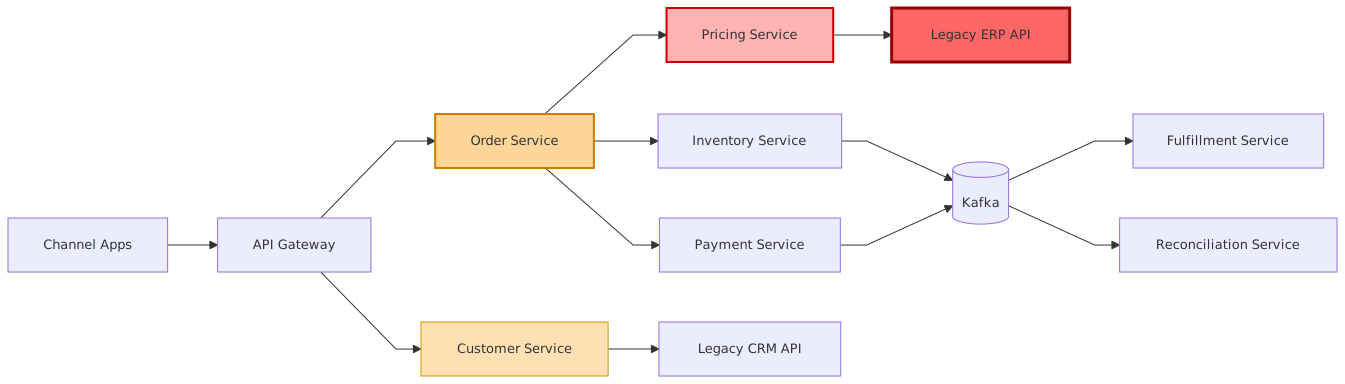
In this landscape, the dependency from Pricing to the legacy ERP is hotter than its raw traffic might suggest, because it sits inside the order path, crosses a context boundary, relies on a fragile upstream, and constrains migration. That is the point of the heatmap: reveal significance, not just noise.
The heatmap can be rendered as a matrix, graph, or layered view. In practice, enterprises need all three:
- a matrix for portfolio-level analysis
- a graph for architectural reasoning
- a journey-specific overlay for customer-impact analysis
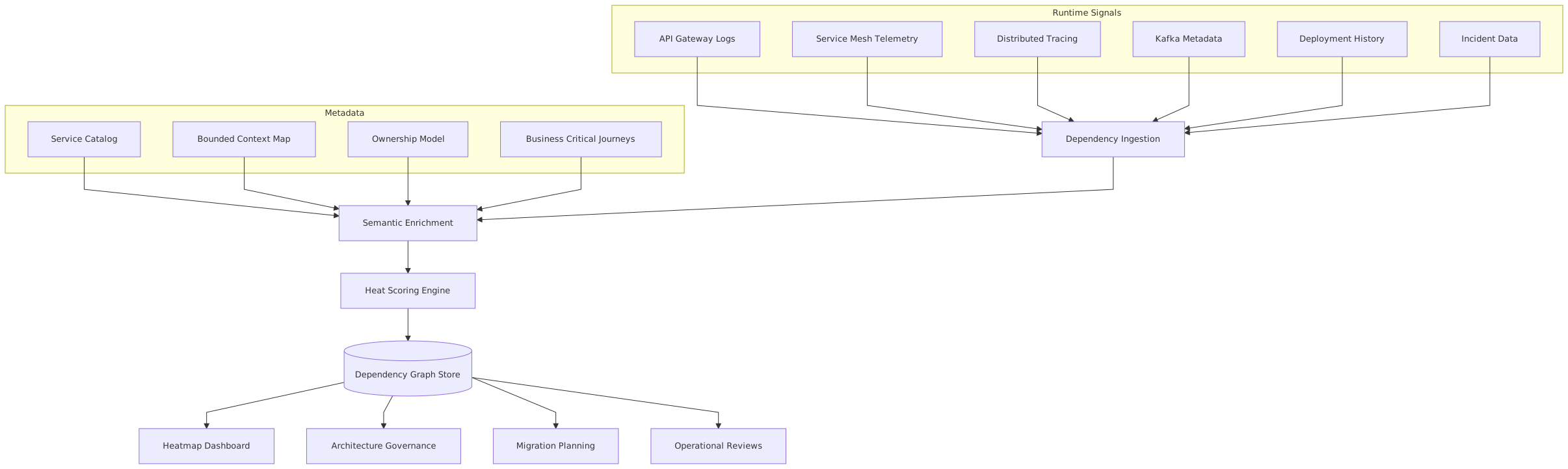
The most useful implementation pattern is to maintain the model in a graph store or analytics layer fed by:
- API gateway logs
- service mesh telemetry
- distributed tracing
- Kafka consumer group metadata
- CI/CD deployment and change history
- CMDB or service catalog ownership data
- incident history
- domain classification metadata
This should not become an ivory-tower exercise. The output must help teams answer real questions:
- Which APIs are too central to change casually?
- Which synchronous dependencies should be replaced with event propagation?
- Which legacy edges block strangler migration?
- Which services violate bounded context boundaries?
- Where is reconciliation mandatory because consistency is no longer guaranteed inline?
If the heatmap does not change design conversations, it is decoration.
Architecture
The architecture of the heatmap capability itself matters. Many firms try to build one by scraping logs into a reporting tool and calling it done. That produces statistics, not insight.
A stronger architecture has five parts:
- Dependency observation
Collect service-to-service API calls, asynchronous topic flows, and non-API integrations like batch file exchanges where possible.
- Semantic enrichment
Annotate dependencies with domain context, business capability, service owner, critical journeys, and legacy affiliation.
- Risk scoring
Compute a composite score that reflects operational and architectural heat.
- Visualization
Provide matrix and graph views, plus journey overlays.
- Decision integration
Feed architecture governance, migration planning, incident response, and API review. EA governance checklist
A simplified architecture looks like this:
Domain semantics are not optional
This is the part many technical articles skip, and they should not. An API dependency heatmap without domain semantics is like a city map that shows roads but not neighborhoods.
You need to know which service belongs to which bounded context. You need to understand whether a dependency is upstream/downstream in the DDD sense, whether it uses a published language, and whether it crosses a context boundary that should perhaps be mediated by an anti-corruption layer.
For example:
- An Order service reading Customer profile data for display may be acceptable through a dedicated customer summary API.
- An Order service depending on Customer’s internal risk categorization rules may indicate domain leakage.
- A Payment service synchronously querying Inventory to validate stock is often not a technical issue but a business modeling mistake. Stock reservation and payment authorization are separate concerns with different consistency needs.
The heatmap should therefore surface semantic temperature, not just technical temperature. A low-volume dependency can still be extremely hot if it violates context boundaries and blocks local evolution.
Include asynchronous dependencies
Microservice environments increasingly rely on Kafka or similar event platforms. Good. But asynchronous does not mean decoupled in all the ways that matter.
Topics create their own dependency graph:
- schema dependencies
- timing dependencies
- consumer lag risks
- replay behavior
- ordering assumptions
- duplicate handling
- data retention constraints
If a downstream service cannot operate without a specific event arriving within two seconds, you have a temporal dependency even if no synchronous API call exists. The heatmap must represent that honestly.
Migration Strategy
This is where the dependency heatmap becomes strategically valuable.
Most progressive strangler migrations fail in one of two ways. Either teams try to replace the legacy core in one heroic program, which collapses under complexity, or they peel off easy edges while the central business flows remain chained to the old platform. Both approaches waste time.
A better migration strategy starts with dependency heat.
You identify:
- the hottest business journeys
- the legacy edges that dominate those journeys
- the APIs with high fan-in and low change tolerance
- the areas where asynchronous replication and reconciliation can reduce runtime coupling
- the places where anti-corruption layers are needed to prevent model pollution during transition
Then you strangle progressively, but not randomly.
Step 1: Map current-state dependency heat
Start with production reality, not intended design. The old estate may route through gateways, ESBs, direct calls, nightly jobs, and Kafka. Capture all of it.
Step 2: Overlay bounded contexts and business capabilities
Now determine whether the hot dependencies align with the domain. Some will. Many will not. This tells you whether you are dealing with technical scaling issues or conceptual boundary problems.
Step 3: Choose a migration seam
A seam should be:
- business meaningful
- operationally observable
- narrow enough to control
- valuable enough to justify effort
Customer profile is often a good seam. Core pricing logic often is not, because everything depends on it and hidden rule complexity is usually worse than expected.
Step 4: Introduce anti-corruption and replication patterns
Where new services still need legacy data, replicate what is needed rather than preserve permanent chatty runtime calls. This is where Kafka becomes useful. Use change data capture, outbox, or domain events to propagate state into the new bounded context.
But be honest: replication creates inconsistency windows. That means reconciliation is not a side concern. It is part of the design.
Step 5: Reconcile relentlessly
In migration, data disagreement is not a bug. It is an expected condition to be managed. Build reconciliation capabilities early:
- compare counts and aggregates
- detect missing events
- reprocess dead-lettered messages
- run compensating workflows
- expose mismatch dashboards to operations and business users
Teams that postpone reconciliation are really postponing reality.
Step 6: Cool the hot path before cutting over
Do not switch traffic just because the new service passes functional tests. Switch when dependency heat has dropped enough that the path is operationally survivable.
A migration view might look like this:
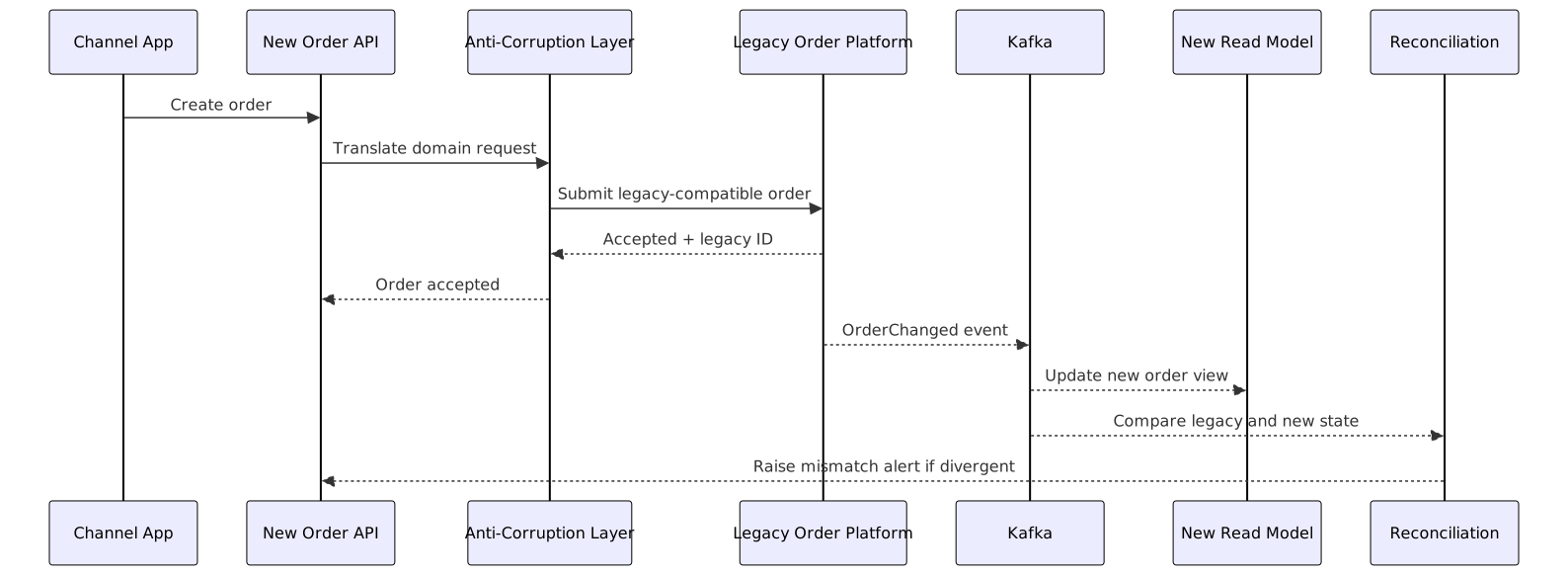
This is classic strangler thinking, but with more realism. During transition, the legacy platform still executes critical behavior. The new estate gains control incrementally through translation, replicated state, and reconciliation. The dependency heatmap helps decide when to move the next slice.
Enterprise Example
Consider a global retailer modernizing its commerce platform.
The retailer had:
- a legacy order management system in the data center
- a CRM package for customer profiles
- a pricing engine embedded in ERP
- new digital channels built as microservices on Kubernetes
- Kafka for event distribution
- an API gateway in front of channel and partner traffic
On paper, the target architecture was clean: Order, Customer, Catalog, Pricing, Payment, Fulfillment, and Notification services, each with clear ownership. In production, the digital order flow still depended synchronously on the ERP pricing API and a customer eligibility API that itself orchestrated calls into CRM and contract systems. During seasonal peaks, checkout latency spiked. Incident reviews showed that the “Order Service” was effectively a conductor for half the enterprise.
They built an API dependency heatmap using gateway telemetry, distributed tracing, Kafka lineage, and deployment metadata. The findings were uncomfortable.
The hottest dependency was not the order API itself. It was the dependency chain from Order to Pricing to ERP promotions rules. Why? Because it had:
- high traffic during peak commerce periods
- high business criticality
- long transitive call depth
- quarterly rule changes
- strong coupling to legacy domain semantics
- no graceful degradation path
The second hotspot was a lower-volume customer eligibility dependency. It crossed three bounded contexts, had multiple owners, and caused frequent silent mismatches between channel displays and backend fulfillment acceptance.
This changed the migration plan.
Originally, the retailer planned to move fulfillment first because it seemed operationally isolated. The heatmap showed that the real architecture risk sat earlier in the customer journey. So they pivoted.
They introduced:
- a dedicated Pricing Context with a published pricing response model
- an anti-corruption layer in front of ERP pricing
- Kafka-based replication of relevant customer eligibility state into a Customer Decision service
- a reconciliation service comparing eligibility decisions between legacy and new paths
- heat-based release gates for APIs with high consumer concentration
The result was not immediate simplicity. In fact, the estate became temporarily more complex. That is the honest part people omit from modernization stories. During migration, you often add translation and reconciliation before you can remove old coupling.
But six months later, they had materially cooled the checkout path:
- average call depth dropped
- peak latency improved
- dependency on live ERP pricing reduced for common scenarios
- eligibility mismatches were visible and recoverable
- teams could change pricing adapters without forcing changes on order consumers
Most importantly, architecture discussions stopped being abstract. The heatmap gave teams a common language to discuss risk, ownership, and migration sequencing.
Operational Considerations
A heatmap is useful only if it remains current and trusted.
Data freshness
If the model is a month old, it is already lying. Dependency patterns shift quickly. Update daily at minimum, and near real time for major paths if possible.
Scoring transparency
Do not hide the scoring logic in a black box. Teams need to know why a dependency is marked hot. Otherwise they will challenge the tool instead of addressing the issue.
Journey context
Portfolio heat matters, but customer-journey heat matters more. A service may be globally moderate yet extremely hot in checkout, onboarding, or claims handling.
Operational runbooks
During incidents, use the heatmap to identify likely transitive blast radius, fallback paths, and owner groups. Integrate it into incident tooling if you can.
Reconciliation operations
If migration or event-driven propagation is involved, treat reconciliation as a first-class operational process. This includes:
- mismatch thresholds
- automated replay
- dead-letter monitoring
- manual correction workflows
- audit trails
API lifecycle governance
High-heat APIs deserve stronger versioning discipline, consumer communication, and contract testing. Not every API needs enterprise-grade ceremony. The hot ones do.
Tradeoffs
Let’s be blunt: the heatmap is not free.
Building and maintaining it takes investment. You need telemetry, metadata discipline, ownership mapping, and enough domain understanding to annotate dependencies properly. Many firms are weak in exactly those areas.
There is also a cultural tradeoff. The heatmap exposes awkward truths. It reveals where “independent” teams are tightly coupled, where domain boundaries are fiction, and where a supposedly temporary legacy dependency has become strategic. Some stakeholders will resist it for that reason alone.
There is a risk of over-centralization too. If every design decision starts requiring a review of heat scores by a central architecture group, you will slow teams down and turn a useful instrument into bureaucracy. The heatmap should inform local decisions, not replace them.
And the scoring itself is subjective. Weight business criticality too heavily and everything in payments turns red. Weight call volume too heavily and foundational platform services dominate the chart. You need calibration and iteration.
Still, these are good tradeoffs. They are the price of seeing your system as it actually behaves.
Failure Modes
There are predictable ways this goes wrong.
Heatmap as vanity dashboard
Leaders love colorful diagrams. If nobody uses the heatmap in migration planning, API reviews, or incidents, it becomes wallpaper.
Purely technical modeling
If you ignore domain semantics, you will optimize around traffic instead of business design. That leads to the wrong fixes.
Missing async and batch dependencies
Many enterprises still have critical dependencies outside REST calls. Ignore event streams, file drops, ETL jobs, and CDC flows, and your map will be dangerously incomplete.
Static ownership assumptions
Ownership changes. Teams split and merge. Platforms move. If ownership metadata is stale, escalation paths and governance decisions will be wrong. ArchiMate for governance
No reconciliation strategy
When teams cool synchronous dependencies by introducing Kafka and replicated state, they often underestimate reconciliation. Then they discover too late that eventual consistency needs active management.
Treating all heat as bad
Some hot dependencies are natural. Identity, payment authorization, and inventory reservation may be central by design. The goal is not zero heat. The goal is understood and survivable heat.
When Not To Use
Do not over-engineer this pattern.
If you run a small estate with a handful of services, a dependency heatmap may be unnecessary. A simple graph and good team communication are enough.
If your architecture is still one well-structured monolith, you have a different problem set. A heatmap of internal module dependencies might be useful, but a microservice-oriented API heatmap is premature.
If the organization lacks basic telemetry, service ownership, and traceability, do not start by demanding a sophisticated scoring engine. First establish observability and a service catalog. A heatmap built on guesswork will destroy trust.
And if the main issue is not dependency complexity but poor domain modeling, the heatmap will only diagnose the pain. It will not cure it. You still need to redraw boundaries, define published language, and stop leaking models across contexts.
Related Patterns
This pattern sits well beside several others.
- Context Mapping from domain-driven design, to understand upstream/downstream relationships and translation needs.
- Strangler Fig Migration, for progressive replacement of legacy capabilities.
- Anti-Corruption Layer, to shield new bounded contexts from legacy models.
- Outbox Pattern, to publish reliable domain events into Kafka.
- Saga or Process Manager, for long-running distributed workflows.
- Contract Testing, especially for high-heat APIs with many consumers.
- Bulkhead and Circuit Breaker, where hot synchronous dependencies cannot yet be eliminated.
- CQRS and Read Model Replication, where consumer needs should not force runtime calls into upstream domains.
- Reconciliation Services, to detect and correct divergence across asynchronous or migrated flows.
The key is not to use all of them. It is to use them where the heatmap tells you dependency intensity is worth the complexity.
Summary
An API dependency heatmap is one of those tools that sounds cosmetic until you build a good one. Then it becomes hard to imagine operating without it.
In microservices, the real architecture is not your service list. It is the dependency network formed by APIs, events, ownership lines, domain boundaries, and legacy gravity. The heatmap makes that network visible in a way architects, engineers, and operations teams can use.
Its real power comes from combining operational telemetry with domain semantics. That is the difference between a chart of API traffic and a map of architectural risk. With DDD thinking, the heatmap shows where bounded contexts are healthy, where models are leaking, and where a service has become too central to evolve safely. With migration thinking, it shows where to place strangler seams, where to introduce anti-corruption layers, and where Kafka-based replication plus reconciliation can cool a dangerous synchronous path. With enterprise pragmatism, it gives incident responders and planners a common picture of what matters.
Use it to make better tradeoffs. Use it to challenge comforting myths. Use it to migrate based on real heat, not political convenience.
Because in distributed systems, unseen dependency is not just complexity. It is risk accumulating in the dark.
Frequently Asked Questions
What is a service mesh?
A service mesh is an infrastructure layer managing service-to-service communication. It provides mutual TLS, load balancing, circuit breaking, retries, and observability without each service implementing these capabilities. Istio and Linkerd are common implementations.
How do you document microservices architecture for governance?
Use ArchiMate Application Cooperation diagrams for the service landscape, UML Component diagrams for internal structure, UML Sequence diagrams for key flows, and UML Deployment diagrams for Kubernetes topology. All views can coexist in Sparx EA with full traceability.
What is the difference between choreography and orchestration in microservices?
Choreography has services react to events independently — no central coordinator. Orchestration uses a central workflow engine that calls services in sequence. Choreography scales better but is harder to debug; orchestration is easier to reason about but creates a central coupling point.