⏱ 20 min read
Let me start with the opinion most people are too polite to say out loud: TOGAF is not the problem. Bad architecture behavior is the problem.
I’ve seen teams blame TOGAF for everything—slow decisions, giant slide decks, architecture review theater, endless “current state / future state” diagrams nobody reads. But TOGAF didn’t create that mess. People did. Usually by treating it like a compliance ritual instead of a thinking tool.
And here’s the other uncomfortable truth: in a lot of enterprises, especially large banks and regulated organizations, you do need some kind of common architecture method. Not because frameworks are beautiful. Because without one, every architect invents their own language, their own process, their own templates, and their own version of “strategy.” That gets expensive fast.
So if you’re asking, what is TOGAF? The simple answer is this:
> TOGAF is an enterprise architecture framework that helps organizations design, plan, govern, and evolve business, data, application, and technology architecture in a structured way.
That’s the SEO-friendly version. Accurate enough. But honestly, it’s also too clean.
In real life, TOGAF is best understood as a shared operating model for architecture work. It gives architects a way to answer recurring enterprise questions:
- Where are we now?
- Where do we need to go?
- What capabilities are missing?
- Which systems should change?
- What standards matter?
- What should be governed centrally, and what should be left to teams?
- How do we move from idea to roadmap without creating chaos?
If you use it that way, it’s useful. If you use it as a giant process machine, it becomes architecture wallpaper.
This article is a practical guide, not a certification cram sheet. I’ll explain what TOGAF is, what parts actually matter, how it applies in real architecture work, where architects go wrong, and how it looks in a banking example involving cloud, Kafka, and IAM. ArchiMate in TOGAF ADM
TOGAF in plain English
TOGAF stands for The Open Group Architecture Framework.
At its core, TOGAF gives you:
- A method for developing architecture
- A set of architecture domains to think across the enterprise
- A governance approach for making architecture decisions stick
- A vocabulary so architects, delivery teams, and leaders stop talking past each other
That’s it. It’s bigger on paper, sure. But those are the parts that matter.
The heart of TOGAF is the ADM—the Architecture Development Method. This is the part everyone references. It’s a cycle for moving from business need to architecture definition to implementation oversight.
The ADM is useful because enterprise architecture work is rarely linear. You don’t gather all requirements, design the perfect target state, and then calmly execute. That fantasy belongs in vendor presentations. Real architecture is messy. Priorities shift. Compliance appears halfway through. Mergers happen. Funding changes. A cloud platform decision made by one team breaks another team’s assumptions. TOGAF at least acknowledges that architecture is iterative.
Why TOGAF still matters
A lot of architects love to sound modern by dismissing TOGAF.
They’ll say things like:
- “TOGAF is too heavyweight.”
- “We’re agile, we don’t need enterprise frameworks.”
- “We just do product-centric architecture.”
- “We use domain-driven design and platform engineering now.”
Fine. Good. Use all of that. I do too.
But none of those things replace enterprise architecture. They solve different problems.
Agile helps teams deliver incrementally.
DDD helps model business domains.
Platform engineering improves developer experience.
Cloud architecture changes infrastructure assumptions.
None of them, by themselves, answer questions like:
- Should customer identity be centralized or federated across business units?
- What is the target integration pattern across core banking, payments, fraud, and digital channels?
- How do we reduce 17 overlapping IAM tools?
- Which workloads can move to cloud under regulatory constraints?
- How do we govern event streaming so Kafka doesn’t turn into a distributed junk drawer?
- What capabilities are strategic, and which should be bought or retired?
That is enterprise architecture territory. And TOGAF, despite all its imperfections, still gives a decent structure for that work.
My strong view: TOGAF is most valuable in large organizations where architecture has to coordinate across business units, regulation, legacy systems, and multiple delivery teams. In a startup, it’s overkill. In a global bank, insurer, telecom, or government agency, it can be a lifesaver—if used with restraint.
The core of TOGAF: the ADM
If you only remember one thing about TOGAF, remember the ADM.
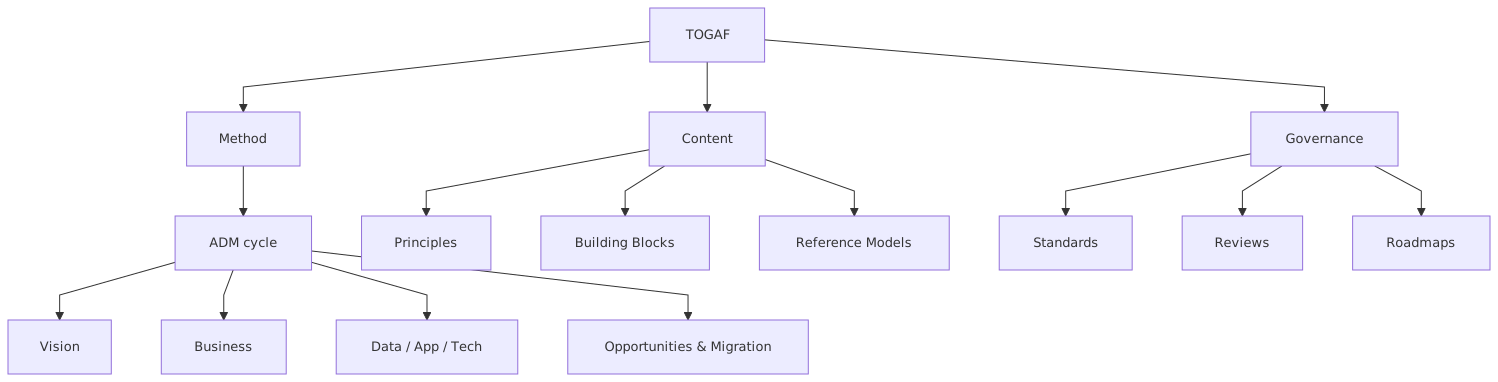
The ADM is usually shown as a cycle with phases. People often memorize the letters and then forget what the phases are actually for. Here’s the practical version.
That looks neat in a table. Real work is not neat.
In practice, most architects bounce between Vision, Business, Application/Data, Technology, and Roadmap. Governance runs in parallel. Requirements never stop changing. And if you work in a large bank, compliance and risk stakeholders will insert themselves into every phase whether the diagram says so or not.
Still, the ADM is useful because it forces some discipline:
- Don’t jump to technology before understanding the business problem.
- Don’t produce target-state diagrams with no migration path.
- Don’t approve delivery designs that violate enterprise principles without a conscious waiver.
- Don’t assume architecture is finished once the PowerPoint is done.
That alone eliminates a lot of bad architecture behavior.
The four architecture domains that actually matter
TOGAF organizes architecture into four domains:
- Business architecture
- Data architecture
- Application architecture
- Technology architecture
This sounds obvious. It is obvious. That’s partly why it works.
1. Business architecture
This is the domain many technical architects skip too quickly. Big mistake.
Business architecture is about capabilities, value streams, business processes, organizational responsibilities, and strategic intent. In plain terms: what the business is trying to do, and how it operates.
If you don’t understand this, your architecture becomes technical decoration.
Example: A bank says it wants “real-time customer engagement.” Nice phrase. Worthless unless you unpack it. Does that mean:
- fraud alerts within seconds?
- personalized offers in the mobile app?
- real-time credit decisioning?
- branch and digital channel consistency?
- event-driven servicing workflows?
Different business goals produce very different architecture choices.
2. Data architecture
This covers data entities, ownership, flows, lifecycle, quality, integration, and governance. ArchiMate for governance
In many enterprises, data architecture is where truth goes to die. Everyone says data is strategic. Then nobody agrees on canonical definitions, data ownership, retention rules, or event semantics.
If your bank has five different definitions of “active customer,” your architecture problem is not Kafka or cloud. It’s data architecture.
3. Application architecture
This is the structure of applications, services, interactions, dependencies, and application portfolio decisions.
This domain matters because most enterprises have too many systems doing overlapping things. TOGAF helps force portfolio thinking:
- Which apps are strategic?
- Which are duplicate?
- Which should be modernized?
- Which should be wrapped?
- Which should be retired?
- Which integration patterns are acceptable?
4. Technology architecture
This covers infrastructure, platforms, networks, security technologies, cloud services, runtime environments, and operational foundations.
This is where cloud, Kubernetes, observability, IAM tooling, Kafka platforms, and resilience patterns usually show up. It’s important, but it should not lead the conversation by default.
A lot of architecture teams are really just technology architecture teams pretending to do enterprise architecture. There’s a difference.
How TOGAF applies in real architecture work
This is where most articles become useless. They explain the framework and stop before the hard part: how it changes daily work.
Here’s how TOGAF is actually useful when you’re doing enterprise architecture for real.
It gives structure to ambiguity
In enterprise environments, the initial ask is often vague:
- “We need to modernize identity.”
- “We need an event-driven architecture.”
- “We need to move more workloads to cloud.”
- “We need better customer data.”
- “We need to simplify core banking integration.”
Without a method, teams jump into solutions immediately. They start comparing vendors, drawing target platforms, and debating patterns before they’ve clarified the business problem.
TOGAF helps slow that down just enough.
Not bureaucratically. Intellectually.
You ask:
- What business outcomes are we after?
- What capabilities are involved?
- Which stakeholders matter?
- What is in scope and out of scope?
- What constraints are fixed?
- What principles apply?
- What transition states are realistic?
That is architecture work.
It forces cross-domain thinking
A common failure in enterprises is local optimization.
The IAM team optimizes identity.
The cloud team optimizes landing zones.
The integration team optimizes Kafka.
The app team optimizes delivery speed.
The security team optimizes control.
And the enterprise gets worse.
TOGAF pushes you to connect domains. For example:
- A cloud migration is not just technology architecture. It affects security controls, operating model, cost governance, data residency, IAM federation, and application decomposition.
- A Kafka adoption is not just an integration decision. It affects event ownership, data contracts, observability, retention, compliance, and domain boundaries.
- An IAM transformation is not just a security project. It affects customer experience, channel consistency, fraud controls, workforce productivity, and application onboarding.
That integrated view is where enterprise architects earn their keep.
It helps convert architecture into roadmaps
The biggest gap in many architecture teams is not design quality. It’s migration realism.
Architects love target states. Delivery teams live in transition states.
TOGAF is useful because it explicitly asks: what are the opportunities, work packages, and migration steps? That matters.
A target architecture that says “all applications will use centralized IAM, event-driven integration, cloud-native platforms, and shared customer data services” is not a roadmap. It’s a wish list.
A real roadmap says:
- first centralize workforce identity federation
- then onboard high-risk customer channels to a shared authentication service
- then externalize authorization policies
- then rationalize legacy directory dependencies
- then retire duplicate IAM products
That’s architecture with consequences.
A real enterprise example: bank modernization with Kafka, IAM, and cloud
Let’s make this concrete.

Imagine a mid-to-large retail bank. It has:
- legacy core banking platforms
- digital channels in web and mobile
- branch systems
- separate fraud and payments platforms
- multiple identity stores
- point-to-point integrations
- some workloads in cloud, most still on-prem
- pressure to improve customer experience and operational resilience
Leadership says:
“We want real-time customer servicing, better security, and faster product delivery.”
Classic enterprise ask. Sounds simple. It isn’t.
What bad architecture looks like
A weak architecture response would be:
- buy an enterprise IAM product
- deploy Kafka as the integration standard
- move customer-facing apps to cloud
- declare a target-state architecture
- ask delivery teams to align over three years
This fails because it confuses technology selection with architecture.
What a TOGAF-informed approach looks like
Phase A: architecture vision
The architect starts by clarifying the business outcomes:
- reduce customer authentication friction
- improve fraud response times
- enable near real-time event propagation across channels
- reduce integration complexity
- meet regulatory and resilience requirements
- accelerate onboarding of new digital services
Already this changes the conversation. We’re not “doing Kafka” or “doing cloud.” We’re solving enterprise problems.
Business architecture
Next, map the business capabilities involved:
- customer identity and access
- customer servicing
- fraud detection and response
- payments processing
- customer communications
- digital channel operations
Then identify pain points:
- different channels use inconsistent identity flows
- fraud events are not propagated quickly enough
- customer profile changes update downstream systems with delays
- onboarding new applications into IAM takes months
- integration dependencies are brittle and unclear
This is where architects often discover the real issue isn’t old technology alone. It’s fragmented ownership and inconsistent operating model.
Data and application architecture
Now define candidate architecture patterns:
- customer domain events published to Kafka
- standardized event contracts with ownership by domain teams
- shared IAM services for authentication, token issuance, federation, and policy-based authorization
- API mediation for synchronous interactions, events for asynchronous propagation
- customer profile mastered in a designated system with clear downstream consumption patterns
- application portfolio rationalization around identity-related services
And this is the important part: not everything becomes an event. Some architects get religious about Kafka and try to force every integration into streaming. That’s amateur behavior. Use events where they fit. Use APIs where request-response is needed. Use batch where economics and timing justify it. Architecture is trade-offs, not ideology.
Technology architecture
Now the cloud and platform decisions come in:
- Kafka platform deployed with clear tenancy and governance model
- IAM services split by workforce and customer identity concerns where necessary
- cloud landing zones with security controls, logging, and network segmentation
- secrets management and certificate automation
- zero-trust aligned access patterns
- observability standards across event and IAM flows
- DR and resilience patterns aligned to regulatory expectations
Again, note the sequence: technology follows architectural intent.
Opportunities, solutions, and migration
A realistic roadmap might be:
That is how TOGAF helps. Not by giving you a magic answer, but by forcing architectural coherence across business, application, data, technology, and migration.
Common mistakes architects make with TOGAF
This is the part that matters most, because TOGAF itself is usually not what hurts organizations. Misuse does.
1. Treating TOGAF like a documentation factory
This is probably the most common mistake.
Architects produce giant architecture definition documents, capability maps, principles, standards catalogs, and governance templates. Everything is technically complete. Nothing is useful. EA governance checklist
The test is simple: did the architecture improve decision-making?
If not, it’s noise.
A good TOGAF practitioner knows when a one-page decision record is better than a 70-page architecture pack.
2. Starting with technology, not business need
This happens constantly with cloud, Kafka, and IAM.
- “We need a Kafka strategy.”
- “We need a cloud-native target architecture.”
- “We need to standardize on one IAM platform.”
Maybe. But why?
If you don’t tie those choices to business capability needs and operational outcomes, you end up with expensive architecture programs searching for a reason to exist.
3. Confusing target state with roadmap
A target-state picture is easy. A migration plan is hard.
Architects often define a beautiful future architecture and then skip the ugly middle. But enterprises live in the middle for years.
If your architecture does not define transition architectures, sequencing, dependencies, and risk trade-offs, it is incomplete.
4. Ignoring organizational reality
This is a big one.
TOGAF can tempt people into thinking architecture is a rational design exercise. It isn’t. It’s partly a political exercise, partly an economic exercise, partly a governance exercise. architecture decision record template
If your target architecture assumes five teams will suddenly share ownership cleanly, or that a business unit will willingly retire its custom IAM stack, or that developers will adopt Kafka standards without support, you’re not doing architecture. You’re writing fiction.
5. Over-standardizing
Enterprise architects love standards. Sometimes too much.
Not everything needs a central standard. Some things should be governed tightly—identity, security controls, event contract quality, cloud guardrails. Other things should be left to teams.
The best architects know where to be strict and where to allow variation.
My opinion: centralize what reduces enterprise risk and duplication; decentralize what improves delivery speed without creating structural damage.
6. Using TOGAF as authority theater
This is the ugliest mistake.
Some architects use frameworks to sound important. They hide weak thinking behind process language. They weaponize governance. They become blockers instead of enablers.
If your architecture board mainly says “no,” your architecture practice is probably failing.
Architecture should increase clarity, not hierarchy.
TOGAF and agile: enemies? Not really
People still ask whether TOGAF works with agile. Yes, of course it does. The conflict is mostly fake.
The real issue is not TOGAF versus agile. It’s enterprise coordination versus local team autonomy.
Agile teams need freedom to deliver. Enterprises need coherence across identity, data, security, platforms, and integration. Both are true.
TOGAF can work well with agile if you use it to provide:
- principles, not micromanagement
- guardrails, not giant stage gates
- roadmaps, not rigid long-term locks
- reference architectures, not mandatory copy-paste designs
- governance for meaningful risks, not every implementation detail
For example, an agile product team building a new banking service should not need a six-week architecture review just to expose an API. But if that service is introducing a new customer authentication flow, publishing regulated data to Kafka, or deploying to cloud outside approved landing zones, then yes—enterprise architecture involvement is appropriate.
That’s not anti-agile. That’s basic adult supervision.
What parts of TOGAF matter most in practice?
If you’re overwhelmed by the size of TOGAF, here’s the practical answer.
The most useful parts are:
- ADM thinking
- Architecture domains
- Principles
- Governance
- Roadmapping and transition architectures
- Repository of reusable patterns and standards
The less useful parts—at least in many organizations—are the parts that encourage ceremonial completeness. You do not need to instantiate every artifact in the framework to get value.
I’ll be blunt: most enterprise architecture teams should use about 30% of TOGAF very well instead of pretending to use 100% of it badly.
That 30% can transform architecture quality.
A practical way to use TOGAF without becoming bureaucratic
Here’s a lightweight model I’ve seen work.
Use TOGAF for five questions
For any major architecture initiative, ask:
- What business outcome are we solving for?
- What capabilities, data, applications, and technologies are affected?
- What principles and constraints apply?
- What target state are we aiming for?
- What realistic transition path gets us there?
That’s basically TOGAF without the ceremony.
Keep outputs lean
For many initiatives, the architecture pack can be:
- one-page context and drivers
- business capability impact view
- current vs target architecture view
- key decisions and principles
- roadmap with dependencies
- risks, assumptions, and governance checkpoints
Not every initiative needs a textbook.
Build reusable architecture assets
This is where enterprise architecture scales.
Instead of re-arguing the same things every quarter, create reusable assets such as:
- cloud reference architectures
- IAM patterns for workforce and customer identity
- Kafka event governance standards
- integration decision trees
- API security patterns
- data classification and residency controls
That’s where TOGAF becomes operationally useful.
My honest view: when TOGAF helps, and when it doesn’t
TOGAF helps when:
- the enterprise is large and fragmented
- architecture decisions span multiple domains and teams
- governance matters due to regulation, risk, or scale
- legacy complexity is high
- roadmaps require multi-year coordination
- different architects need a shared language
TOGAF hurts when:
- it is imposed mechanically
- architects prioritize artifacts over outcomes
- the organization is too small to need formal enterprise architecture
- governance becomes detached from delivery
- the framework is treated as a substitute for judgment
That last one is important. No framework replaces judgment.
A good architect can use TOGAF lightly and create value. A bad architect can use TOGAF extensively and create drag.
Final takeaway
So, what is TOGAF?
It is a structured enterprise architecture framework for understanding where an organization is, defining where it wants to go, and guiding the change needed across business, data, applications, and technology.
But that definition, while correct, misses the real point.
In practice, TOGAF is useful because it helps architects do three things that enterprises desperately need:
- connect strategy to technology
- make cross-domain decisions coherently
- turn target-state thinking into realistic change roadmaps
That’s why it still matters.
Not because the framework is perfect. It isn’t.
Not because every artifact is valuable. They aren’t.
Not because architects need more process. They definitely don’t.
It matters because large organizations need architecture discipline, shared language, and decision structure. TOGAF can provide that—if architects use it with pragmatism, restraint, and a bit of courage.
And maybe that’s the real lesson.
The value of TOGAF is not in following it faithfully.
The value is in using it intelligently.
If you remember that, you’ll avoid most of the nonsense people associate with enterprise architecture.
FAQ
1. Is TOGAF still relevant in cloud-native and agile organizations?
Yes, especially in large enterprises. Cloud and agile do not remove the need for enterprise-level coordination. They actually increase it in areas like IAM, security guardrails, shared platforms, data governance, and integration patterns. The trick is to apply TOGAF lightly, not turn it into a delivery bottleneck.
2. Is TOGAF too heavyweight for real-world architecture?
It can be, if used badly. That’s the honest answer. But TOGAF itself does not require huge documentation or slow governance. Most organizations should use a practical subset: ADM thinking, architecture principles, domain views, roadmaps, and lean governance.
3. How does TOGAF help with technologies like Kafka and IAM?
TOGAF helps by putting those technologies in business context. Instead of asking “Should we implement Kafka?” you ask “Which business capabilities need event-driven patterns, what data ownership model is required, and what governance prevents topic chaos?” Same with IAM: TOGAF helps connect identity decisions to business risk, customer experience, operating model, and migration planning.
4. What is the biggest mistake architects make with TOGAF?
Treating it like a documentation standard instead of a decision-making framework. The second biggest mistake is jumping to technology choices before understanding business outcomes and transition constraints. Both mistakes are common. Both create expensive architecture theater.
5. Do you need TOGAF certification to use TOGAF effectively?
No. Certification can help you learn the terminology and structure, and in some enterprises it helps credibility. But some of the best architects I’ve worked with were only lightly certified or not certified at all. What matters more is whether you can apply the thinking in real situations—especially messy ones involving legacy systems, cloud, Kafka, IAM, and organizational politics.
Frequently Asked Questions
What is TOGAF used for?
TOGAF (The Open Group Architecture Framework) provides a structured approach to developing, governing, and managing enterprise architecture. Its Architecture Development Method (ADM) guides architects through phases from architecture vision through business, information systems, and technology architecture to migration planning and governance.
What is the difference between TOGAF and ArchiMate?
TOGAF is a process framework — it defines how to develop, govern, and manage enterprise architecture. ArchiMate is a modeling language — it defines how to represent and communicate architecture content. They are designed to work together: TOGAF provides the method, ArchiMate provides the notation for producing TOGAF deliverables.
Is TOGAF certification worth it?
TOGAF certification (Foundation and Practitioner) is widely recognised by employers and is particularly valued in consulting, financial services, government, and large enterprise environments. Foundation validates understanding of TOGAF concepts; Practitioner validates the ability to apply them. Combined with ArchiMate and tool skills (Sparx EA), it significantly strengthens an enterprise architect's profile.