⏱ 5 min read
Mapping TM Forum eTOM to TOGAF: A Deep Technical Guide for Telecom Enterprise Architecture
Telecommunications is one of the most structurally complex industries in enterprise architecture. Unlike many sectors where IT supports business operations, in telecom the network is the business. Services, infrastructure, operational processes, customer lifecycle management, regulatory compliance, and partner ecosystems are tightly interwoven.

To manage this complexity, two frameworks are widely adopted:
- TM Forum's Business Process Framework (eTOM)
- TOGAF (The Open Group Architecture Framework)
Each serves a distinct purpose:
- eTOM defines what telecom operators do
- TOGAF defines how enterprise architecture is structured and evolved
When properly integrated, they form a disciplined, transformation-ready architectural backbone for telecom organizations.
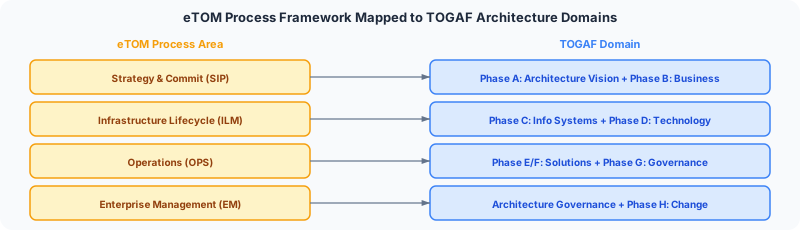
1. Structural Foundations
1.1 TM Forum eTOM Overview
ETOM provides a hierarchical process classification framework structured into Level 0 domains:
- Strategy, Infrastructure & Product (SIP)
- Operations
- Enterprise Management
These decompose into Level 1--4 process areas such as:
- Customer Relationship Management
- Service Management & Operations
- Resource Management & Operations
- Supplier/Partner Relationship Management
- Billing & Revenue Management
ETOM is not a workflow tool. It is:
- A taxonomy
- A standard vocabulary
- A decomposition structure
- A process reference architecture
It provides operational clarity across telecom lifecycle domains: Customer, Service, Resource, and Product.
1.2 TOGAF Overview
TOGAF structures enterprise architecture across domains: ArchiMate in TOGAF ADM
- Business Architecture
- Data Architecture
- Application Architecture
- Technology Architecture
At its core is the Architecture Development Method (ADM), which governs:
- Architecture Vision
- Baseline and Target Architectures
- Gap Analysis
- Migration Planning
- Governance
- Change Management
TOGAF provides method and governance. It does not provide industry-specific process models.
That is where eTOM becomes critical.
2. Conceptual Alignment: What vs How
| Dimension | eTOM | TOGAF |
|---|---|---|
| Purpose | Process classification | Architecture method |
| Scope | Telecom-specific | Industry-agnostic |
| Focus | Operational structure | Transformation governance |
| Level of abstraction | Process taxonomy | Architecture lifecycle |
ETOM defines business operational semantics. TOGAF defines architectural control and transformation discipline.
3. Mapping eTOM to TOGAF Business Architecture
TOGAF Business Architecture includes:
- Capabilities
- Value streams
- Organizational structure
- Governance
- Business services
- Processes
3.1 Capability Mapping
A practical approach:
- Map eTOM Level 1 domains → Enterprise capabilities
- Map Level 2 processes → Capability breakdown
- Map Level 3 processes → Operational process design
Example: eTOM Domain: Service Management & Operations → Capability: Service Fulfillment → Sub-capability: Service Configuration & Activation
This ensures capability models are telecom-aligned rather than generic abstractions.
3.2 Value Stream Alignment
ETOM lifecycle views naturally support value streams:
- Lead-to-Order
- Order-to-Activate
- Trouble-to-Resolve
- Usage-to-Cash
Mapping lifecycle views to value streams provides traceability between:
Customer experience → Business process → Supporting applications → Infrastructure.
4. Mapping to Information Systems Architecture
TOGAF splits Information Systems Architecture into:
- Data Architecture
- Application Architecture
4.1 Application Architecture Mapping
Example mapping:
| eTOM Process Area | Typical Systems |
|---|---|
| Customer Relationship Management | CRM |
| Service Order Management | Order Management |
| Resource Provisioning | OSS Provisioning |
| Fault Management | Assurance Systems |
| Billing & Revenue Management | Charging/Billing Platforms |
Architects derive applications from:
Process → Business Service → Application Service → Application Component.
4.2 Data Architecture Mapping
ETOM processes define operational data entities:
- Customer
- Product
- Service
- Resource
- Order
- Trouble Ticket
- Usage Record
Mapping approach:
- Identify data entities per Level 2 process
- Classify ownership domains
- Define system-of-record principles
- Establish canonical data models
5. Mapping to Technology Architecture
Technology Architecture must support:
- Application workloads
- Operational reliability
- Network scalability
- Performance and SLA commitments
Mapping approach:
Resource Process → Application Platform → Technology Node → Infrastructure Layer.
Example:
Service Configuration Process → Orchestration Application → Kubernetes Cluster → Cloud Infrastructure enterprise cloud architecture patterns
6. Embedding eTOM in the ADM Lifecycle
Architecture Vision
Use eTOM Level 1 domains to define enterprise capability heatmaps and transformation priorities.
Business Architecture
Model baseline processes using eTOM and define target maturity.
Information Systems Architecture
Map processes to applications and define integration principles. integration architecture diagram
Technology Architecture
Align infrastructure with telecom resource processes.
Migration Planning
Define transition architectures driven by process gaps.
Implementation Governance
Ensure systems support defined processes and avoid duplication.
7. Practical Transformation Scenario
Baseline issues:
- Multiple inventory systems
- Duplicate order management platforms
- Manual activation workflows
Transformation steps:
- Identify impacted Level 2 processes
- Consolidate capabilities
- Rationalize applications
- Design domain-aligned target architecture
- Execute phased migration under ADM governance
Outcome:
- Reduced operational cost
- Improved service activation time
- Clear domain ownership boundaries
8. Governance and Operating Model Alignment
ETOM supports:
- Process ownership
- KPI alignment
- Functional accountability
TOGAF supports:
- Architecture Review Board
- Compliance assessment
- Repository governance
- Change management
Integrated governance ensures architectural consistency over time.
9. Strategic Benefits
- Telecom-specific capability modeling
- Structured OSS/BSS modernization
- Reduced redundancy
- Regulatory traceability
- Cloud-native transformation alignment
- Faster service rollout
Final Reflection
Telecom enterprise architecture is deeply operational. Process, data, service, and infrastructure are inseparable. Sparx EA best practices
ETOM anchors architecture in telecom operational reality. TOGAF ensures disciplined and governed transformation.
Together, they provide enterprise architecture maturity tailored for telecom. free Sparx EA maturity assessment
For expert guidance on enterprise architecture, explore our enterprise architecture consulting, architecture capability development, and Sparx EA consulting. Get in touch.
Frequently Asked Questions
What is TOGAF used for?
TOGAF (The Open Group Architecture Framework) is used to structure and manage enterprise architecture programmes. It provides the Architecture Development Method (ADM) for creating architecture, a content framework for deliverables, and an enterprise continuum for reuse.
How does ArchiMate relate to TOGAF?
ArchiMate and TOGAF are complementary. TOGAF provides the process framework (ADM phases, governance, deliverables) while ArchiMate provides the notation for creating the architecture content. Many organisations use TOGAF as their EA method and ArchiMate as the modeling language within each ADM phase.
What is the TOGAF Architecture Development Method (ADM)?
The ADM is a step-by-step process for developing enterprise architecture. It consists of a Preliminary phase and phases A through H: Architecture Vision, Business Architecture, Information Systems Architecture, Technology Architecture, Opportunities and Solutions, Migration Planning, Implementation Governance, and Architecture Change Management.