⏱ 19 min read
Most TOGAF articles make the same mistake: they explain the framework like it’s the product.
It isn’t.
TOGAF is not your enterprise architecture. It is not strategy. It is not leadership. And it definitely is not a magic machine that turns messy organizations into well-governed digital platforms. It’s a toolbox. A decent one. Sometimes a very useful one. But a toolbox all the same.
That matters, because a lot of architecture teams quietly fail by treating TOGAF like a religion. They learn the terminology, build the diagrams, run the ADM phases, create repositories full of artifacts nobody reads — and still can’t answer the one question executives care about:
“How does this help us make better decisions, faster?”
So let’s keep this simple.
TOGAF, in plain English
TOGAF stands for The Open Group Architecture Framework. It is a widely used framework for designing, planning, implementing, and governing enterprise architecture.
That’s the SEO-friendly definition. Fine. But here’s the version that matters in real life:
TOGAF gives architects a structured way to understand a business, map technology to business needs, and guide change across the enterprise.
It helps answer questions like:
- What business capabilities matter most?
- What systems support them today?
- Where are the gaps, risks, duplication, and technical debt?
- What should the target architecture look like?
- How do we move there without breaking the bank or the business?
That’s it. That’s the useful part.
If you work in a bank, insurer, retailer, public sector agency, or any large company with too many systems and too many opinions, TOGAF can help create order. Not perfect order. Just enough order to make better decisions. ArchiMate in TOGAF ADM
And honestly, that’s the real job of enterprise architecture.
Why TOGAF exists
Large organizations are messy by default.
Different departments buy different tools. Integration is bolted on later. Security is interpreted differently in every program. Cloud adoption happens in six directions at once. One team wants Kafka for event streaming, another still exports CSVs overnight, and IAM gets treated as somebody else’s problem until the audit team arrives.
This is the natural state of the enterprise.
TOGAF exists because architecture work needs a repeatable method. Without one, architects become diagram artists with strong opinions but weak influence. With too much framework, they become process administrators.
TOGAF tries to sit in the middle. It gives you:
- a method
- a vocabulary
- a set of architecture domains
- governance ideas
- a way to think about target states and roadmaps
That structure is helpful, especially in organizations where architecture has to work across business, data, application, and technology teams.
The problem is not TOGAF itself. The problem is how people use it.
The core idea: architecture as a change discipline
A lot of people think TOGAF is about documenting the current estate. That’s only partly true.
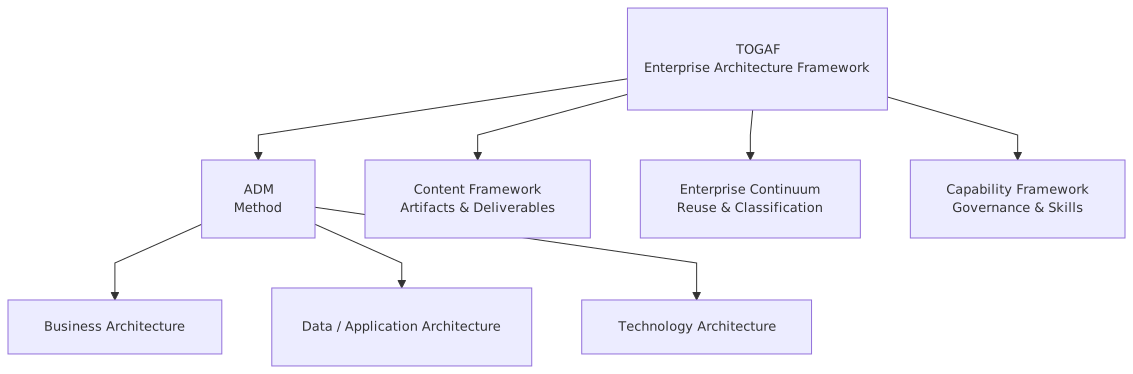
TOGAF is really about managing enterprise change.
It helps you move from:
- fragmented systems to coherent platforms
- local decisions to enterprise decisions
- tactical delivery to strategic direction
- isolated projects to coordinated transformation
That’s why the framework matters. Not because it produces neat artifacts. Because it creates a disciplined way to make change less chaotic.
In practice, enterprise architects use TOGAF to connect:
- business strategy
- operating model
- capabilities
- processes
- applications
- data flows
- integration patterns
- security controls
- technology platforms
- migration roadmaps
- governance decisions
If that sounds broad, it is. Enterprise architecture is broad. Anyone telling you architecture is only about technology is either a solution architect, a vendor, or slightly confused.
The main parts of TOGAF
You do not need to memorize the whole framework to use it well. In fact, many architects who can recite TOGAF from memory are not especially effective.
The most useful parts are these:
1. The ADM (Architecture Development Method)
This is the heart of TOGAF.
The ADM is a step-by-step cycle for developing and governing architecture. It includes phases like:
- Preliminary
- Architecture Vision
- Business Architecture
- Information Systems Architecture
- Technology Architecture
- Opportunities and Solutions
- Migration Planning
- Implementation Governance
- Architecture Change Management
In real terms, this means:
- understand the context
- define the problem and vision
- map the business
- map the data, apps, and tech
- identify gaps
- design target state
- plan the transition
- govern delivery
- adapt as things change
The ADM is useful because it forces architects to think beyond the target diagram. A target architecture without a migration path is just wishful thinking.
2. The architecture domains
TOGAF typically breaks architecture into four domains:
This is one of the most practical things TOGAF gives you. It reminds teams that architecture is not just “apps and infrastructure.”
3. Building blocks
TOGAF talks about architecture building blocks and solution building blocks. The language can sound clunky, but the concept is useful.
- Architecture building blocks are logical capabilities or components
- Solution building blocks are actual implemented products or services
Example:
- “Identity and access management” is an architecture building block
- “Microsoft Entra ID integrated with PingFederate and SailPoint” is a solution building block set
That distinction helps prevent premature product decisions.
4. Governance and repository concepts
TOGAF also pushes architects to think about governance, standards, principles, and reusable assets. ArchiMate for governance
That’s good. Because architecture without governance is just advisory theater. EA governance checklist
Still, this is where teams often overdo it. More on that later.
What TOGAF is not
Let’s be blunt.
TOGAF is not:
- a detailed implementation manual
- a cloud architecture framework
- a product selection method
- an agile delivery method
- a substitute for engineering judgment
- a guarantee of business alignment
And maybe the strongest opinion in this article:
TOGAF certification does not make someone a good architect.
It proves they studied TOGAF. That’s all.
I’ve seen excellent enterprise architects who barely mention TOGAF. I’ve also seen fully certified teams produce architecture packs so abstract they were useless to engineering, security, and operations.
Framework literacy is fine. But architecture credibility comes from helping the enterprise make hard choices.
How TOGAF applies in real architecture work
This is where many articles get vague. So let’s make it concrete.
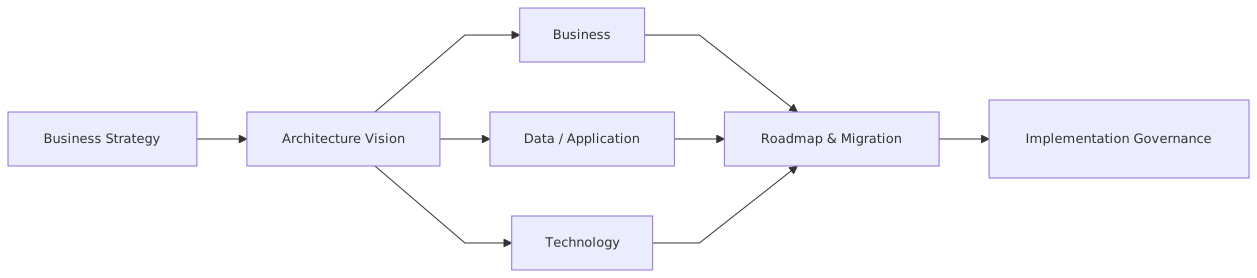
Scenario: a bank modernizing customer onboarding
Imagine a mid-sized bank. It has:
- separate onboarding journeys for retail, SME, and wealth customers
- duplicate customer data across CRM, core banking, and channel platforms
- inconsistent IAM controls across web, mobile, branch, and partner channels
- event integration done partly with batch jobs and partly with Kafka
- a cloud strategy that says “cloud first,” except most critical workloads still sit on-prem
- regulatory pressure around KYC, AML, auditability, and operational resilience
This is normal enterprise complexity. Not even extreme.
An enterprise architect using TOGAF would not start by drawing a giant target-state picture and calling it transformation.
They would start by asking:
- What business outcomes are we trying to improve?
- Which capabilities are involved?
- Where are the control failures and bottlenecks?
- Which systems are authoritative for customer identity?
- How are onboarding events published and consumed?
- Where do IAM policies break across channels?
- Which parts belong in cloud now, later, or maybe never?
Then the work usually unfolds something like this.
Step 1: Define the architecture vision
The bank wants to reduce onboarding time from days to minutes for low-risk retail customers, improve KYC control consistency, and create a reusable onboarding platform across business lines.
That’s a real vision. Notice it is not “become digital” or “modernize architecture.” Those are slogans.
Step 2: Understand the business architecture
The architect maps the onboarding value stream and capabilities:
- identity proofing
- customer due diligence
- sanctions screening
- consent capture
- account creation
- channel authentication
- case management
- audit and reporting
This often exposes the first hard truth: the problem isn’t one application. It’s fragmented capability ownership.
Step 3: Analyze data and application architecture
Now the architect maps:
- where customer data is created
- which system is the system of record
- how KYC status is propagated
- how events move through Kafka
- where APIs exist versus file transfers
- how IAM is enforced for internal users, customers, and third parties
This is where architecture gets real. Because now you can see the duplication, latency, and control gaps.
For example:
- CRM says customer verified
- core banking says pending
- mobile app sees incomplete status
- branch system overrides manually
- Kafka topic naming is inconsistent and poorly governed
- IAM roles differ between branch ops and digital servicing
- cloud-native onboarding service has better audit logs than the legacy case management platform
That is not a technology problem alone. It is an enterprise design problem.
Step 4: Design the target architecture
The target state might include:
- a shared onboarding capability model across business lines
- a canonical customer identity domain
- event-driven integration using Kafka for onboarding status and compliance events
- centralized IAM policy patterns for workforce and customer access
- API-based orchestration for onboarding services
- cloud deployment for digital onboarding components
- retained on-prem core banking systems with controlled integration boundaries
- enterprise logging and audit aligned with regulatory requirements
Now TOGAF is helping structure the conversation. It is not prescribing Kafka or cloud or any IAM product. It is helping the architect organize the decisions.
Step 5: Create a transition roadmap
This is the part weak architecture teams skip.
A real roadmap might say:
- Phase 1: standardize onboarding process and IAM policy model
- Phase 2: establish Kafka event contracts and customer identity master rules
- Phase 3: launch cloud-native retail onboarding service
- Phase 4: integrate SME onboarding and retire duplicate verification tools
- Phase 5: rationalize case management and improve resilience controls
This is architecture in the real world: sequencing, trade-offs, dependency management, and governance. architecture decision record template
Not posters.
A practical TOGAF view of Kafka, IAM, and cloud
Let’s go deeper, because these are exactly the areas where enterprise architecture either earns respect or gets ignored.
Kafka in enterprise architecture
A lot of architects talk about event-driven architecture as if saying “Kafka” solves integration.
It doesn’t.
In TOGAF terms, Kafka belongs mostly in application and technology architecture, but its real value only appears when tied to business and data architecture.
Questions a good architect should ask:
- Which business events matter?
- Who owns the event definitions?
- Which domains publish and subscribe?
- What is the retention policy?
- What is the replay strategy?
- How are schema changes governed?
- Which events are operationally critical?
- How are audit and compliance needs met?
In banking, for example, onboarding events might include:
- customer-identity-verified
- kyc-screening-completed
- account-opened
- onboarding-case-escalated
If every team publishes whatever they want to Kafka with no enterprise event model, you haven’t built architecture. You’ve built distributed confusion.
TOGAF helps because it forces architects to connect event design to capability maps, data ownership, and governance.
IAM in enterprise architecture
IAM is one of the clearest examples of why enterprise architecture matters.
Without enterprise architecture, IAM becomes a patchwork of:
- local directory decisions
- inconsistent role models
- duplicate identity stores
- weak joiner-mover-leaver processes
- bolted-on MFA
- customer identity separated from workforce identity with no coherent trust model
TOGAF gives architects a way to frame IAM properly across domains:
- Business architecture: who needs access and why
- Data architecture: identity attributes, ownership, lifecycle
- Application architecture: authentication and authorization patterns
- Technology architecture: identity providers, federation, PAM, directory services
For a bank moving to cloud, this matters a lot. If every cloud workload invents its own authorization pattern, the audit findings write themselves.
Cloud in enterprise architecture
Cloud architecture is where TOGAF gets unfair criticism.
People say TOGAF is too slow or too generic for cloud. Sometimes that criticism is deserved. But often the real issue is architects trying to apply TOGAF mechanically.
Cloud decisions still need enterprise structure:
- Which workloads move and why?
- What is the landing zone standard?
- How are shared services managed?
- What are the IAM and network guardrails?
- Which data classes can move?
- What resilience patterns are required?
- How do platform teams and product teams divide responsibilities?
That is architecture. TOGAF can absolutely support it.
The trick is not to turn cloud transformation into a 14-month documentation exercise. Use the framework to shape decisions, not delay them.
Common mistakes architects make with TOGAF
This is where I’ll be slightly contrarian.
A lot of the criticism aimed at TOGAF is really criticism of bad architects hiding behind TOGAF.
Here are the most common mistakes.
1. Treating the ADM like a waterfall project plan
The ADM is a method, not a prison.
Good architects iterate. They revisit domains. They refine target states as delivery learns more. They use enough structure to stay coherent, but not so much that architecture becomes slower than the business problem.
If you run TOGAF like a giant sequential stage gate, engineering teams will route around you. And they’ll be right to do it.
2. Producing artifacts nobody uses
This is epidemic.
Architecture principles, catalogs, matrices, viewpoints, repositories — all potentially useful. But if nobody making delivery, funding, risk, or platform decisions uses them, they are dead artifacts.
A good rule:
Every architecture artifact should help someone make a decision.
If it doesn’t, stop producing it.
3. Confusing completeness with value
You do not need every TOGAF deliverable. You need enough architecture to reduce ambiguity and improve decisions.
That means sometimes a capability map, target state, transition roadmap, and a few standards are enough.
Architects who insist on complete framework coverage usually create delay, not clarity.
4. Ignoring politics and operating model reality
TOGAF can make architecture look rational and linear. Enterprises are neither.
In real organizations:
- data ownership is contested
- platform teams defend their territory
- security has veto power
- business units optimize locally
- cloud budgets get centralized after the spend shock
- nobody agrees on who owns customer identity
If your architecture method does not account for organizational reality, your target state will stay on slides.
5. Going too abstract
This is a classic enterprise architect failure mode.
The architect says:
“We need a strategic target architecture aligned to capability-based planning and domain-oriented service enablement.”
Fine. But can you answer these questions?
- Should onboarding publish Kafka events or call APIs synchronously?
- Where should authorization decisions live?
- Which systems remain authoritative for customer profile data?
- What moves to cloud in year one?
If not, you’re not helping enough.
6. Letting governance become bureaucracy
Architecture governance should improve decision quality. It should not become a committee ritual where every design waits three weeks for approval.
In high-performing organizations, governance is:
- lightweight where risk is low
- strict where risk is high
- embedded into delivery
- tied to standards and guardrails
- focused on exceptions, not universal control theater
TOGAF supports governance. It does not require bureaucracy. That part is on us.
A real enterprise example: bank onboarding transformation
Let me pull the pieces together into one realistic example.
A regional bank wanted to unify customer onboarding across retail and SME banking. It had grown through acquisition. Which meant, predictably:
- three customer databases
- two IAM stacks
- separate KYC vendors
- branch onboarding manually rekeying data from digital channels
- batch integration into core banking
- emerging Kafka adoption in the digital platform
- a cloud migration program disconnected from business transformation
The architecture team was asked to “define the target state.”
That request sounds sensible. It usually isn’t enough.
What the architecture team did right
First, they used a TOGAF-style structure to frame the work:
- business architecture: onboarding capabilities and value stream
- data architecture: customer identity, KYC, account status, audit records
- application architecture: CRM, onboarding engine, case management, IAM, core banking, event platform
- technology architecture: cloud landing zone, Kafka, IAM federation, API gateway, observability stack
Second, they focused on decision points, not documentation volume.
They identified four architectural decisions that mattered most:
Third, they created a migration roadmap tied to delivery funding.
That mattered. Because architecture only becomes real when it enters the investment process.
What they nearly got wrong
They almost made the classic mistake of pushing for a full customer master replacement before fixing onboarding orchestration and identity policy.
That would have created a giant multi-year dependency and delayed business value.
Instead, they split the roadmap:
- stabilize customer identity rules first
- introduce event contracts in Kafka
- implement IAM policy alignment
- modernize onboarding workflow in cloud
- defer full master data rationalization until later
That is what mature enterprise architecture looks like. Not perfect architecture. Sequenced architecture.
The result
The bank reduced low-risk retail onboarding time significantly, improved audit traceability, and created reusable patterns for SME onboarding.
Was TOGAF the reason? Not exactly.
TOGAF helped structure the work. Good architecture judgment made it successful.
That distinction matters.
Is TOGAF still relevant?
Yes — but with a condition.
TOGAF is relevant if you use it as a pragmatic framework for enterprise decision-making.
It becomes irrelevant the moment it turns into:
- certification theater
- artifact collection
- rigid process
- architecture disconnected from delivery
- language that only architects understand
Some people dismiss TOGAF because it isn’t modern enough. I think that criticism is half true and half lazy.
The framework is broad and sometimes heavy. Yes. It doesn’t hand you cloud-native reference patterns out of the box. Fine. It can sound dated. Also true.
But large enterprises still need:
- architecture methods
- domain thinking
- governance
- target-state planning
- migration roadmaps
- cross-functional alignment
TOGAF still helps with those things.
The real issue is not whether TOGAF is modern. It’s whether the architects using it are.
How to use TOGAF without becoming unbearable
Here’s my practical advice.
Use TOGAF to ask better questions
Don’t start with templates. Start with decisions.
Keep the business architecture real
Capabilities should connect to outcomes, costs, controls, and customer journeys.
Make data architecture concrete
Who owns the data? What is authoritative? How does it move? Where is quality measured?
Tie application and technology architecture to delivery
If your application map cannot influence API design, event contracts, or IAM standards, it’s decorative.
Build roadmaps, not fantasies
Target states matter. Transition states matter more.
Govern by exception
Set standards for cloud, IAM, integration, and observability. Then spend governance energy on deviations and high-risk designs.
Stay close to engineers
The best enterprise architects I know can discuss business capabilities in one meeting and Kafka partition strategy or federated identity flows in the next. Not because they do engineering work for the teams, but because they understand enough to make architecture credible.
That’s the bar now.
A simple definition to remember
If you remember one thing from this article, let it be this:
TOGAF is a framework that helps enterprise architects structure change across business, data, applications, and technology.
That is the simple answer.
The deeper answer is that TOGAF is useful only when it helps people make hard enterprise decisions with more clarity and less chaos.
Everything else is secondary.
Final thought
I don’t love TOGAF in the abstract. I love what disciplined architecture can do in difficult enterprises.
If TOGAF helps your team untangle banking onboarding, standardize IAM, govern Kafka properly, or create a sane cloud transition roadmap, use it.
If it’s just creating more slides and slowing down delivery, stop pretending the framework is the value.
The value is better decisions.
Always was.
1. What is TOGAF in simple terms?
TOGAF is an enterprise architecture framework. In simple terms, it gives architects a structured way to understand how a business works, how systems support it, what the target state should be, and how to move there in a controlled way.
2. Is TOGAF only for large enterprises?
Mostly, it’s most useful in medium to large organizations with complex systems, multiple business units, regulatory pressure, or major transformation programs. A small company usually doesn’t need full TOGAF. It may need architectural thinking, yes. Full framework overhead, probably not.
3. How does TOGAF help with cloud migration?
TOGAF helps by structuring cloud migration decisions across business, data, application, and technology domains. It can guide workload assessment, target platform design, IAM guardrails, integration strategy, and migration roadmap planning. It does not replace cloud engineering patterns, but it helps coordinate them at enterprise level.
4. Can TOGAF be used with agile and DevOps?
Yes, and it should be. But only if used pragmatically. TOGAF should provide direction, standards, and governance without becoming a slow stage-gate process. Good architects use it to support agile delivery, not block it.
5. What are the biggest mistakes people make with TOGAF?
The biggest mistakes are over-documenting, treating the ADM like waterfall, focusing on certification over outcomes, creating artifacts nobody uses, and staying too abstract to influence real technical decisions like IAM models, Kafka event governance, or cloud platform standards.
TOGAF at a glance
How TOGAF guides architecture work
Frequently Asked Questions
What is TOGAF used for?
TOGAF (The Open Group Architecture Framework) provides a structured approach to developing, governing, and managing enterprise architecture. Its Architecture Development Method (ADM) guides architects through phases from architecture vision through business, information systems, and technology architecture to migration planning and governance.
What is the difference between TOGAF and ArchiMate?
TOGAF is a process framework — it defines how to develop, govern, and manage enterprise architecture. ArchiMate is a modeling language — it defines how to represent and communicate architecture content. They are designed to work together: TOGAF provides the method, ArchiMate provides the notation for producing TOGAF deliverables.
Is TOGAF certification worth it?
TOGAF certification (Foundation and Practitioner) is widely recognised by employers and is particularly valued in consulting, financial services, government, and large enterprise environments. Foundation validates understanding of TOGAF concepts; Practitioner validates the ability to apply them. Combined with ArchiMate and tool skills (Sparx EA), it significantly strengthens an enterprise architect's profile.