⏱ 20 min read
Most TOGAF programs fail for a boring reason: they confuse framework adoption with architecture improvement.
That’s the uncomfortable truth. A company buys training, certifies a few architects, creates a repository, draws a capability map, maybe even launches an Architecture Review Board. Everyone feels productive. Nothing important changes. Delivery teams still bypass standards. Security still shows up late. IAM is still fragmented. Kafka clusters appear in five different business units with five different operating models. Cloud spend goes up, not value. And six months later someone says, “TOGAF is too theoretical.”
No. Bad implementation is too theoretical.
TOGAF itself is not the problem. The problem is when people treat it like a compliance exercise instead of a decision-making system. In real enterprise architecture work, TOGAF only matters if it helps leaders make better trade-offs across business, data, application, technology, and risk. If it doesn’t change funding, governance, delivery patterns, or platform choices, then it’s just wallpaper. ArchiMate in TOGAF ADM
So let’s say it simply, early, because this is the part most people search for:
TOGAF implementation consulting is the practical work of turning the TOGAF framework into operating architecture inside a real company — governance, principles, target states, roadmaps, standards, solution guardrails, and delivery engagement. Not training slides. Not generic ADM diagrams. Real decisions. Real constraints. Real politics.
That is the job.
And if you’re doing this in a bank, an insurer, a retailer, or any large enterprise with cloud, IAM complexity, event streaming, regulatory pressure, and too many legacy systems, then “from theory to practice” means one thing: make architecture useful to delivery without letting delivery destroy coherence.
That balance is where most architecture teams struggle.
What TOGAF is actually useful for
I’ll be blunt. TOGAF is not magic. It’s not even particularly elegant. Parts of it are verbose, parts are dated in tone, and plenty of consultants hide behind the ADM because they don’t know how to lead difficult enterprise decisions. But despite all that, TOGAF remains useful for one reason:
It gives structure to architecture thinking at enterprise scale.
That matters more than people admit.
In a small company, architecture can live in the heads of a few strong engineers. In a large enterprise, it can’t. You need repeatable ways to move from strategy to target state to transition planning to implementation governance. You need shared language. You need artifacts that survive staff turnover. You need a way to discuss why one business capability deserves modernization first, why IAM centralization is not just an infrastructure project, why Kafka is a strategic integration platform in one context and a terrible idea in another.
TOGAF helps with that if you use it pragmatically.
Here’s the simple model I use with clients:
- TOGAF gives you the process skeleton
- Enterprise architects provide judgment
- Delivery teams provide realism
- Governance provides consequences
Remove any one of those and the whole thing turns into theater.
The mistake is believing TOGAF tells you what architecture should be. It doesn’t. It tells you how to think through architecture and organize the work. The actual architecture still depends on industry constraints, business ambition, technical debt, risk appetite, and organizational maturity.
A bank with a fragmented IAM landscape, on-prem core systems, and a growing Kafka estate needs a very different architecture approach than a digital-native SaaS business. The framework is the same. The implementation is not.
The gap between ADM theory and actual enterprise work
On paper, the ADM looks neat. Requirements flow in. Phases happen. Baselines and target states are developed. Gaps are identified. Roadmaps emerge. Governance ensures alignment. ARB governance with Sparx EA
In real life, it’s messier.
Architecture work rarely starts with a clean Phase A. It usually starts with one of these:
- “The regulator found identity control gaps.”
- “Our cloud migration is stalling because every platform team uses different patterns.”
- “We have six integration tools and no event strategy.”
- “The cost of onboarding applications to IAM is too high.”
- “The merger created duplicate customer platforms.”
- “Data is inconsistent across channels and operations.”
That’s where implementation consulting earns its money. Not by reciting TOGAF. By translating disorder into an architecture operating model that can handle the disorder.
A practical TOGAF implementation usually has to do five things quickly:
- Define what architecture is responsible for
- Establish minimum viable governance
- Prioritize business-critical domains
- Create consumable standards and patterns
- Tie architecture to funding and delivery decisions
If you don’t do these first, the rest gets academic.
A lot of architecture teams start with repositories and taxonomies. Wrong order. If nobody is using architecture to approve, reject, shape, or sequence investments, your repository is just an expensive graveyard.
What TOGAF implementation consulting looks like in practice
Real implementation work is less about “rolling out TOGAF” and more about building an architecture function around TOGAF concepts.
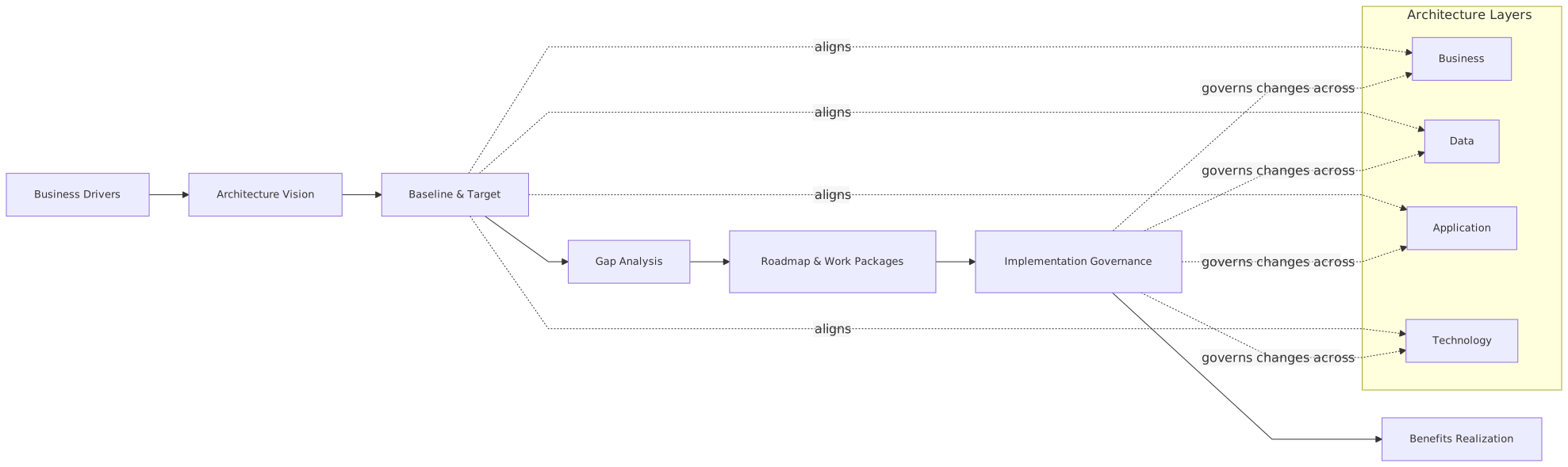
That includes:
1. Architecture scope and mandate
This sounds obvious. It isn’t. Many architecture teams are unclear whether they exist to govern technology, shape business transformation, support programs, define standards, or review solutions. Usually they try to do all of it and do none well.
A practical implementation starts by deciding:
- Which domains are in scope now
- Which decisions require architecture approval
- What level of design architects own versus influence
- How architecture interacts with product, security, risk, data, and engineering
- What artifacts are mandatory and which are optional
Strong opinion: if your architecture function cannot say no to bad enterprise decisions, it is not architecture. It is advisory decoration.
Not every decision needs approval. But some absolutely do:
- IAM strategy choices
- cloud landing zone deviations
- master data ownership decisions
- Kafka platform operating model
- cross-business API standards
- critical vendor platform selections
Those are enterprise decisions, not local team preferences.
2. Tailoring the ADM
This is where many consultants get lazy. They present the ADM as if every initiative should walk through every phase in a linear way. That’s not how modern delivery works.
In practice, you tailor the method by initiative type:
- Strategic transformation: full business/data/application/technology architecture treatment
- Platform modernization: focus on baseline, target state, standards, transition architecture, governance
- Regulatory remediation: requirements-heavy, risk-driven, often accelerated
- Product delivery support: lightweight architecture checkpoints and reusable patterns
- M&A integration: capability overlap analysis, target operating model, integration roadmap
The point is not to force every effort through TOGAF ceremony. The point is to make sure the right architectural thinking happens.
For example, if a bank is consolidating IAM platforms after an acquisition, you do not need a giant generic architecture pack. You need:
- baseline identity flows
- target IAM service model
- application onboarding patterns
- role and entitlement principles
- cloud and on-prem federation design guardrails
- phased migration roadmap
- risk and control traceability
That is TOGAF in practice, even if nobody says “we are in Phase C.”
3. Governance that helps delivery instead of slowing it
Architecture governance has a bad reputation because architects often make it painful. Endless review boards. Massive documents. Vague feedback. Last-minute escalations. Zero accountability for turnaround time.
That’s amateur hour.
Good TOGAF implementation consulting creates governance with service levels, clear decision rights, and reusable standards. The goal is not more meetings. The goal is faster, better decisions. EA governance checklist
A decent governance model usually includes:
- architecture principles
- reference architectures
- technology standards
- exception management
- lightweight review checkpoints
- escalation paths for major deviations
- measurable compliance where it matters
And yes, some of this should be automated. If cloud teams are deploying infrastructure that violates landing zone patterns, policy-as-code should catch part of it. Governance by PowerPoint is obsolete. architecture decision record template
4. Architecture content people can actually use
Nobody building systems wants to read a 90-page architecture vision document full of polished nonsense.
Useful architecture content is:
- short
- opinionated
- visual
- specific
- linked to delivery choices
For Kafka, that means answers like:
- when to use event streaming vs synchronous APIs
- who owns topic lifecycle
- what schema governance model applies
- what security and IAM integration is required
- how multi-region resilience works
- when not to use Kafka at all
For cloud, it means:
- approved landing zones
- identity integration patterns
- network segmentation standards
- observability baseline
- data residency controls
- approved PaaS patterns
- cost management guardrails
For IAM, it means:
- identity sources of truth
- federation standards
- privileged access principles
- application integration patterns
- entitlement model guidance
- lifecycle process ownership
That is architecture content. Not abstract definitions.
Where TOGAF gets misused
Let’s get contrarian for a minute.
A lot of TOGAF consulting is performative. It produces an architecture bureaucracy that feels mature because it has process boxes, but the enterprise gets less adaptive, not more. The framework becomes a shield for indecision.
Here are the common mistakes architects make.
Common mistakes architects make with TOGAF
Mistake 1: Treating the framework as the outcome
This is the classic one. The team focuses on ADM compliance instead of business outcomes. They can tell you which phase they are in, but not whether customer onboarding improved, IAM risk reduced, or cloud delivery accelerated.
If the business cannot feel the architecture, you are doing framework theater.
Mistake 2: Over-documenting and under-deciding
Architects love documents because documents feel like progress. But architecture value comes from decisions and constraints, not from page count.
I’ve seen banks produce hundreds of pages on target-state architecture while still failing to decide:
- which identity provider is strategic
- whether Kafka is enterprise-managed or domain-managed
- which cloud regions are approved for regulated workloads
- which customer systems own golden records
That is not architecture maturity. That is avoidance.
Mistake 3: Ignoring operating model realities
You cannot define a beautiful target architecture and ignore who will run it.
Example: a company declares Kafka as the strategic event backbone. Fine. But who operates it? A central platform team? Shared services? Domain teams? What are the onboarding SLAs? Who governs topics, retention, schema evolution, lineage, access controls, DR, cost allocation?
If those answers don’t exist, your target architecture is fantasy.
Same with IAM. Centralized identity strategy sounds great until you realize application owners won’t refactor integrations, HR data is poor quality, and no one owns role modeling. Then the architecture stalls.
Mistake 4: Confusing standards with architecture
Standards matter. But standards alone are not enterprise architecture.
A technology standards catalog tells people what is allowed. Architecture explains why, where, when, and how those choices support business change.
If your architecture team mainly updates approved product lists, you’re running a standards office, not an architecture practice.
Mistake 5: Being too polite
This one is rarely said out loud. Architects are often too diplomatic. They soften bad news, avoid conflict, and accept local exceptions that slowly destroy enterprise coherence.
Sometimes the right answer is:
- no, that IAM workaround creates audit risk
- no, your team does not need its own Kafka cluster
- no, this cloud pattern violates control objectives
- no, buying another workflow platform is architectural debt
- no, your “temporary” integration will become permanent
Architecture requires backbone. Not arrogance. Backbone.
A real enterprise example: bank modernization with IAM, Kafka, and cloud
Let’s ground this in something real.
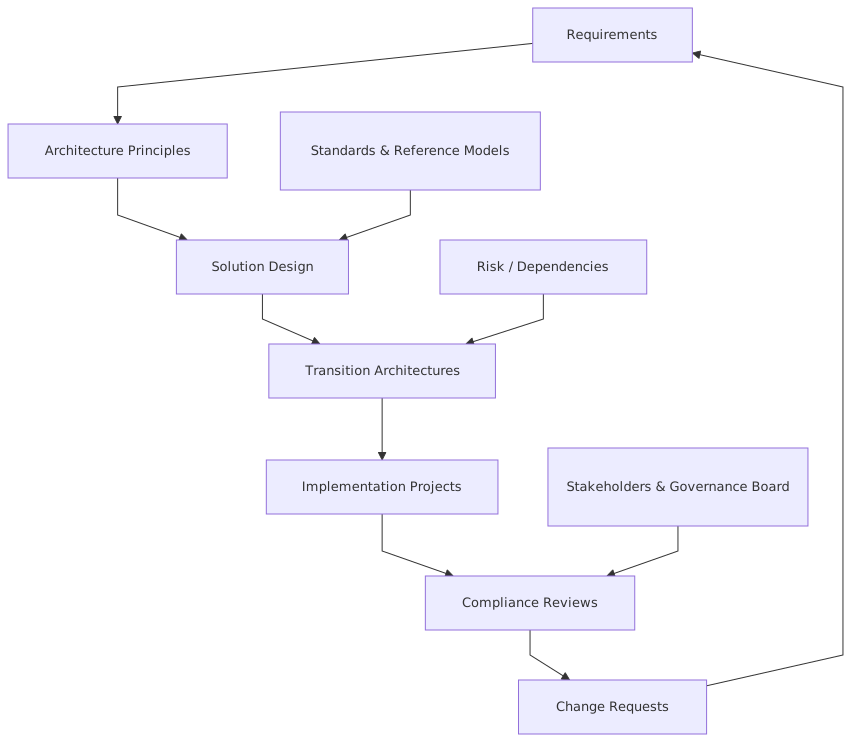
A large regional bank — call it NorthRiver Bank — had grown through acquisition. It had:
- three customer channels with inconsistent identity experiences
- multiple Active Directory forests
- two major IAM products plus custom authentication code
- several on-prem integration platforms
- a fast-growing Kafka deployment started by one digital program
- an executive cloud migration mandate
- increasing regulatory pressure around access governance and resiliency
The bank’s architecture team had TOGAF-certified people. They had architecture principles. They had a repository. What they did not have was a working architecture operating model tied to transformation.
The initial symptoms
From the outside, the bank looked busy. Internally, the architecture issues were obvious:
- every program defined its own target state
- IAM was treated as a security project, not enterprise infrastructure
- Kafka adoption was spreading without ownership clarity
- cloud migrations were lifted and shifted without identity or integration redesign
- architecture reviews happened too late to matter
- reference architectures were generic and ignored by delivery teams
This is common. The company had architecture artifacts, but not architecture control.
What changed
The TOGAF implementation effort did not start by “rolling out the ADM.” It started with three enterprise priorities:
- Reduce identity and access risk
- Create a controlled event-driven integration model
- Accelerate cloud migration with enforceable patterns
Those priorities became the backbone for tailoring architecture work.
Step 1: Establish domain-led architecture governance
The bank created clear domain ownership:
- business architecture for customer and operations capabilities
- enterprise information architecture for customer, account, and access data
- IAM architecture as a formal enterprise domain
- integration/event architecture with Kafka as a governed platform
- cloud platform architecture with landing zone authority
- solution architecture embedded in strategic programs
This mattered. Before that, too many decisions were floating.
Step 2: Create target states that were specific, not aspirational
For IAM, the target state included:
- a strategic identity provider for workforce and customer federation
- centralized authentication patterns
- role and entitlement governance tied to authoritative data sources
- privileged access integration
- standard application onboarding patterns for SaaS, cloud-native, and legacy apps
For Kafka, the target state included:
- enterprise-managed multi-tenant Kafka platform
- standard event taxonomy and naming
- schema governance and contract ownership
- IAM-integrated access control model
- clear use cases: event streaming, not generic queue replacement
- reference patterns for core banking event publication
For cloud, the target state included:
- standardized landing zones
- mandatory identity federation
- network and observability baseline
- approved deployment patterns by workload class
- resilience requirements for regulated services
These were not giant conceptual diagrams. They were practical target architectures tied to delivery constraints.
Step 3: Build transition architectures around funding cycles
This is where TOGAF gets very practical and very political.
The bank could not replace IAM, rationalize integration, and modernize cloud operations in one move. So architects built transition states aligned to budget and program capacity.
For example:
- Transition 1: federate new SaaS applications through strategic IAM, while legacy apps continue through existing mechanisms
- Transition 2: onboard digital channels to centralized authentication and customer identity services
- Transition 3: publish event streams from selected systems of record into Kafka, while retaining existing point-to-point integrations elsewhere
- Transition 4: move specific customer-facing services to cloud landing zones with standard observability and identity controls
This sequencing was crucial. Architecture became executable.
Step 4: Tie governance to exceptions and delivery metrics
The bank changed architecture review from a late-stage document review into a staged decision model:
- concept approval
- solution pattern alignment
- pre-build design check
- production readiness architecture sign-off for critical systems
Exceptions were time-bound. Teams could deviate, but only with explicit risk acceptance and transition plans.
That one move changed behavior. Architecture became part of delivery economics.
The outcome
Within 18 months, the bank did not become magically “transformed.” Let’s not exaggerate. But several real things happened:
- new cloud workloads followed a consistent landing zone model
- IAM onboarding time for standard applications dropped significantly
- duplicate identity patterns were reduced
- Kafka use became more disciplined and strategically valuable
- architecture reviews became faster and more relevant
- business and technology roadmaps were finally connected
That is what TOGAF implementation consulting should do. Not create a perfect enterprise architecture. Create a better one that can actually move.
How this applies in real architecture work
This is the part many articles skip. So let’s make it explicit.
In day-to-day architecture work, TOGAF implementation shows up as practical decisions like these:
In a banking program
A lending modernization initiative wants to build customer notifications through Kafka. The architect asks:
- is this event-driven use case justified or just trend-following?
- what system owns the event?
- what schema contract applies?
- how will IAM control producer and consumer access?
- does the event include regulated data?
- what cloud and resilience pattern is required?
That is TOGAF domain thinking in a delivery conversation.
In an IAM transformation
A business unit wants to keep its own identity store because migration is hard. The architect asks:
- does that violate enterprise identity principles?
- what risk and audit implications exist?
- is there a transition architecture that reduces immediate disruption?
- which business capability depends on identity consistency?
- what roadmap dependency does this create?
Again, practical architecture. Not theory.
In cloud adoption
A platform team proposes a custom landing zone because the central one feels restrictive. The architect asks:
- which enterprise controls are unmet by the standard pattern?
- is the requirement real or preference-driven?
- can the reference architecture evolve instead of fragmenting?
- who will operate and secure the custom pattern?
- what precedent does this create?
That is where architecture earns trust — by understanding trade-offs, not by quoting standards.
A useful way to structure TOGAF implementation
Here is a practical model I’ve used or adapted in large enterprises.
That table looks simple. It is simple. The implementation work is hard because each row involves politics, ownership, and trade-offs.
Strong opinions that matter here
A few views from experience.
TOGAF should be invisible to most delivery teams
Delivery teams do not need to care about the framework name. They need clear patterns, quick decisions, and architects who understand engineering realities. If your implementation requires every team to learn TOGAF terminology, you’ve already over-rotated into process.
Architecture repositories are overrated
Useful, yes. Central to success, no. A mediocre repository with strong governance is better than a beautiful repository with no decision power.
Reference architectures should be sharper and fewer
Most enterprises produce too many. Better to have ten heavily used patterns than fifty polished PDFs.
Architecture principles are often too vague
“Reuse before buy before build” is not a principle. It’s a slogan. A useful principle changes decisions under pressure.
If cloud, IAM, and integration are fragmented, business architecture won’t save you by itself
I say this because some architecture practices lean heavily into capability mapping while ignoring the platform realities that actually constrain transformation. Business architecture matters. But in many enterprises, the real blockers are identity, data, integration, and platform inconsistency.
Architects need to understand finance more than they think
Roadmaps happen through funding. If architecture is not influencing investment sequencing, it is not influencing change.
Making TOGAF work in modern enterprises
The best TOGAF implementation consulting is not framework-heavy. It is enterprise-heavy.
It recognizes that modern architecture has to deal with:
- product operating models
- agile and DevOps delivery
- cloud platforms
- event-driven integration
- zero trust and IAM complexity
- regulatory controls
- data governance
- vendor sprawl
- AI experimentation, increasingly
TOGAF can still work here, but only if adapted.
That means:
- shorter artifact cycles
- architecture decisions captured as reusable patterns
- governance built into delivery flow
- clear enterprise domains
- transition planning tied to release and funding cycles
- measurable architecture outcomes
The old world assumed architecture sat above delivery. That world is over.
Today, good enterprise architecture sits across strategy, platform, risk, and delivery. It is connective tissue. It is not just a review function. It is not just a design function either. It is a decision function.
And that is why implementation matters more than certification.
Final thought
TOGAF is not too theoretical. People are too timid with it.
Used badly, it creates process overhead and fake maturity.
Used well, it gives an enterprise a disciplined way to make hard architectural choices over time.
That’s the real shift from theory to practice:
- from artifacts to decisions
- from target states to transition states
- from review boards to delivery influence
- from standards catalogs to operating models
- from “alignment” language to actual trade-offs
If you’re implementing TOGAF in a bank, or any large enterprise with cloud ambitions, Kafka growth, IAM complexity, and too much legacy, don’t start by asking how to adopt the framework.
Start by asking where the enterprise is currently making expensive, inconsistent, high-risk decisions without architectural control.
That’s where TOGAF should go to work.
FAQ
1. What does TOGAF implementation consulting actually include?
Usually: architecture operating model design, governance setup, ADM tailoring, reference architecture development, repository structure, standards alignment, roadmap support, and coaching for architects and delivery teams. In good consulting, it also includes executive alignment and decision-rights clarity.
2. Is TOGAF still relevant for cloud-native and agile environments?
Yes, but not in a rigid, document-heavy form. TOGAF is relevant when tailored into lightweight governance, reusable patterns, transition planning, and domain architecture. If implemented as a waterfall architecture process, it will fail.
3. How long does a real TOGAF implementation take?
A basic architecture operating model can be established in 8–16 weeks. A meaningful enterprise implementation — where governance, standards, roadmaps, and delivery behavior actually change — often takes 6–18 months. Longer in heavily regulated sectors like banking.
4. What are the biggest mistakes in TOGAF adoption?
The big ones are over-documenting, under-deciding, failing to tailor the ADM, making governance too slow, and not tying architecture to funding and delivery. Another common mistake is treating IAM, integration, and cloud as separate technical concerns instead of enterprise architecture domains.
5. How do you measure whether TOGAF implementation is working?
Look for practical outcomes: faster architecture decisions, fewer uncontrolled exceptions, more reuse of approved patterns, reduced platform fragmentation, shorter IAM onboarding cycles, more consistent cloud deployments, and better linkage between investment roadmaps and target architecture. If none of those improve, the implementation is probably cosmetic.
Frequently Asked Questions
What is TOGAF used for?
TOGAF (The Open Group Architecture Framework) provides a structured approach to developing, governing, and managing enterprise architecture. Its Architecture Development Method (ADM) guides architects through phases from architecture vision through business, information systems, and technology architecture to migration planning and governance.
What is the difference between TOGAF and ArchiMate?
TOGAF is a process framework — it defines how to develop, govern, and manage enterprise architecture. ArchiMate is a modeling language — it defines how to represent and communicate architecture content. They are designed to work together: TOGAF provides the method, ArchiMate provides the notation for producing TOGAF deliverables.
Is TOGAF certification worth it?
TOGAF certification (Foundation and Practitioner) is widely recognised by employers and is particularly valued in consulting, financial services, government, and large enterprise environments. Foundation validates understanding of TOGAF concepts; Practitioner validates the ability to apply them. Combined with ArchiMate and tool skills (Sparx EA), it significantly strengthens an enterprise architect's profile.