⏱ 6 min read
Recommended Reading
Executive summary
TOGAF rarely “fails” because its concepts are wrong; it fails because organizations implement TOGAF as documentation bureaucracy rather than as an operating model that produces decisions, standards, and measurable outcomes. The Open Group frames TOGAF as a proven enterprise architecture methodology and framework, and TOGAF governance includes explicit practices such as architecture compliance review and executive-level architecture boards.
The failure mode arises when compliance reviews are heavy, unclear, or disconnected from delivery workflows, causing teams to route around governance. Fixes include: tailoring governance to risk, using lightweight decision capture (ADR), integrating repository tooling (e.g., EA) to make governance evidence-based, and building reusable reference architectures that reduce friction. EA governance checklist
- Fixes: guardrails and exception-based governance
- Operationalization: architecture board + compliance review rhythm
- Tooling support: baselines/audits/reviews for evidence
- Pitfalls and metrics
- TOGAF standard overview (Open Group).
- Compliance review concept (TOGAF).
- Architecture Board definition.
- Architecture governance framework deck (Open Group).
- ADR practice.
The four failure patterns — and their fixes

TOGAF is the most widely adopted enterprise architecture framework — and the most frequently blamed for failed EA programs. But TOGAF itself rarely causes failure. The failures come from how organizations implement it. Four patterns account for the vast majority of TOGAF disappointments. ArchiMate in TOGAF ADM
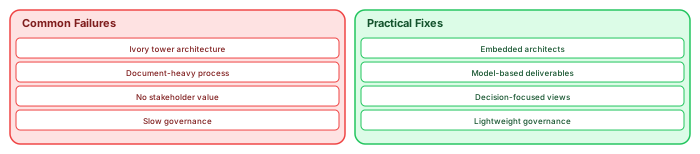
Failure 1: The Ivory Tower. Architects sit in a central team, disconnected from delivery. They produce architecture artifacts that nobody requested and nobody uses. The architecture function becomes an overhead cost that project managers learn to route around. Fix: Embed architects in delivery teams. Every architect should spend at least 50% of their time in project or product teams, producing architecture content that directly supports delivery decisions. The central team focuses on standards, governance, and cross-cutting concerns — not on producing architecture in isolation.
Failure 2: The Document Factory. TOGAF's ADM produces deliverables. Organizations interpret this as "produce documents" — 100-page architecture descriptions that are outdated before they are finished. Nobody reads them. Nobody maintains them. Fix: Replace documents with living models. ArchiMate views in a shared repository are queryable, maintainable, and always current. A 2-page architecture view that answers a specific question is infinitely more valuable than a 100-page document that answers every question poorly.
Failure 3: Governance That Blocks. The architecture review board becomes a bottleneck — every project must wait weeks for approval, creating resentment and workarounds. Teams learn to avoid architecture review entirely. Fix: Lightweight governance with automated checks. Use model-based compliance validation (scripts that check standards conformance) for routine changes. Reserve board review for significant architectural changes that affect multiple domains. Target: 80% of reviews completed within 5 business days.
Failure 4: Framework Worship. Organizations implement TOGAF literally — every phase, every deliverable, every artifact catalog item. The framework becomes the goal rather than the means. Fix: Tailor ruthlessly. Adopt the ADM phases that match your organization's decision cycle. Produce only the deliverables that stakeholders actually use. Skip phases and artifacts that add no value. TOGAF explicitly encourages tailoring — yet most organizations ignore this guidance.
What successful TOGAF implementations look like
Organizations that succeed with TOGAF share common characteristics: architecture is embedded in delivery (not isolated), deliverables are model-based (not document-based), governance is lightweight and fast (not bureaucratic), the framework is tailored to the organization (not implemented literally), and architecture value is measured (reduced change cost, faster delivery, better risk management) rather than assumed.
The single most important success factor: architecture must visibly help someone make a better decision within the first 90 days. If the EA program cannot point to a concrete decision it improved within three months, it is on the path to failure — regardless of which framework it uses.
Tailoring TOGAF for practical results
TOGAF's strength is its comprehensiveness. Its weakness is also its comprehensiveness — organizations that try to implement every phase, every deliverable, and every governance mechanism simultaneously create a process that is too heavy to sustain. The most successful TOGAF implementations start small and expand based on demonstrated value.
Begin with Phase A (Architecture Vision) and Phase G (Architecture Governance). Vision ensures that architecture work is aligned with business strategy. Governance ensures that architecture decisions are reviewed, recorded, and enforced. These two phases provide immediate value: stakeholders see architecture alignment with their goals, and delivery teams see clear standards to follow.
Add Phases B through D incrementally as the architecture practice matures. Phase B (Business Architecture) adds capability maps and value stream models. Phase C (Information Systems Architecture) adds application portfolio views and data architecture. Phase D (Technology Architecture) adds infrastructure topology and platform design. Each phase produces ArchiMate views in the repository — not documents in a folder. ArchiMate layers explained
Skip Phases E and F (Opportunities and Migration Planning) initially. Replace them with ArchiMate Migration views that show plateaus (stable architecture states) and work packages (projects that move from one plateau to the next). This achieves the same outcome with less process overhead. ArchiMate relationship types
If you’d like hands-on training tailored to your team — Sparx Enterprise Architect, BPMN, SysML, Apache Kafka or the Archi tool — or modelling coaching in ArchiMate and TOGAF-aligned governance, you can reach us via our contact page.
Frequently Asked Questions
What is TOGAF used for?
TOGAF (The Open Group Architecture Framework) is used to structure and manage enterprise architecture programmes. It provides the Architecture Development Method (ADM) for creating architecture, a content framework for deliverables, and an enterprise continuum for reuse.
How does ArchiMate relate to TOGAF?
ArchiMate and TOGAF are complementary. TOGAF provides the process framework (ADM phases, governance, deliverables) while ArchiMate provides the notation for creating the architecture content. Many organisations use TOGAF as their EA method and ArchiMate as the modeling language within each ADM phase.
What is the TOGAF Architecture Development Method (ADM)?
The ADM is a step-by-step process for developing enterprise architecture. It consists of a Preliminary phase and phases A through H: Architecture Vision, Business Architecture, Information Systems Architecture, Technology Architecture, Opportunities and Solutions, Migration Planning, Implementation Governance, and Architecture Change Management.