⏱ 22 min read
Architecture is often sold as a box-and-line problem. Draw the services, pick the cloud, sprinkle in Kafka, and declare victory. But that is not how large organizations actually succeed or fail. event-driven architecture patterns
They fail because people run out of headroom.
A system can be technically elegant and still be organizationally doomed if the teams operating it are carrying too much cognitive weight. The architecture may be “clean” in theory, yet in practice it asks ordinary product teams to understand message semantics, distributed transactions, identity propagation, observability internals, data lineage, and three flavors of deployment topology before they can ship a button change. At that point, the architecture is not serving the business. The business is serving the architecture.
This is where Team Topologies becomes more than a management book. It becomes an architectural lens. The shape of software should reflect the load-bearing limits of teams. Not just their capacity to code, but their capacity to reason. Good architecture is not merely modular. It is merciful.
And the most useful instrument here is a cognitive load map: an explicit view of which domains, systems, dependencies, and operational concerns a team must hold in its head to do its job safely. Once you start mapping that load, a hard truth appears. Most “architecture problems” are really mismatches between domain boundaries, delivery flow, and team understanding.
That is the heart of this article: how cognitive load should influence architecture in a Team Topologies model, how domain-driven design helps establish sane boundaries, where Kafka and microservices help or hurt, and how to migrate without detonating the organization. Because migration is never only a technical exercise. It is a redistribution of complexity, and complexity rarely disappears. It just moves. microservices architecture diagrams
Context
Modern enterprises live in a permanent state of partial change. A core platform built ten years ago still processes real revenue. New digital channels keep arriving. Regulations mutate. Acquisitions dump new systems into the estate. Data teams want event streams. Product teams want autonomy. Risk teams want control. Everyone wants speed.
So enterprises split into teams. Stream-aligned teams own customer journeys or product capabilities. Platform teams reduce operational burden. Enabling teams spread specialist knowledge. Complicated-subsystem teams isolate hard technical domains. This is the Team Topologies picture, and it is useful because it starts with a blunt reality: software delivery is constrained by communication paths and by what teams can understand well enough to change.
The phrase “cognitive load” gets thrown around casually, but in architecture it deserves more discipline. Not all load is equal.
- Intrinsic cognitive load comes from the domain itself. Tax calculation is hard because tax is hard.
- Extraneous cognitive load comes from poor tooling, weak boundaries, leaky abstractions, and architectural vanity.
- Germane cognitive load is the useful learning required to become effective in a domain.
Architects should protect intrinsic load where it belongs, remove extraneous load aggressively, and invest in the right germane load. That is the real job.
A cognitive load map makes this visible. It shows not only systems and interfaces, but the conceptual burden on each team: business rules, integration protocols, deployment concerns, data semantics, compliance constraints, reconciliation rules, and operational responsibilities. If six teams all need to understand the same messy semantics to deliver anything, then the architecture has failed at boundary design.
This is why domain-driven design belongs in this conversation. DDD gives language to the problem: bounded contexts, ubiquitous language, context mapping, and explicit relationships between domains. Team Topologies gives organizational shape. Put together, they answer a practical question: what should a team have to know, and what should it be spared from knowing?
Problem
Most enterprise architecture drifts into one of two bad extremes.
The first is the big central platform fantasy. Every cross-cutting concern is abstracted into a shared layer. Teams are told they no longer need to understand infrastructure, messaging, identity, workflow, or data movement. In reality, they now need to understand the platform’s opinions, extension points, failure semantics, release calendar, and exception process. The complexity was not removed. It was wrapped in branded documentation.
The second is the microservice independence myth. Every capability becomes a service, every service gets its own datastore, Kafka topics are introduced as the bloodstream of the enterprise, and each stream-aligned team is told it owns its destiny. Soon they own too much of it. They need to understand schema evolution, replay behavior, poison-message handling, duplicate delivery, consumer lag, trace correlation, and eventually consistency side effects. The architecture promises local autonomy while demanding distributed systems expertise from every team.
Both fail for the same reason: they ignore team cognitive limits.
A team that should focus on order management ends up reasoning about event versioning and reconciliation windows. A payments team becomes the accidental steward of customer identity semantics because authorization tokens carry business meaning. A supposedly autonomous team cannot make a change without consulting five neighboring teams because the domain boundaries were drawn around systems, not around business concepts.
The result is predictable:
- lead time increases
- defects cluster at boundaries
- on-call fatigue rises
- architecture standards become ritualistic
- teams avoid changing risky areas
- “temporary” manual reconciliation becomes permanent operations
When people say “the architecture is too complex,” they usually mean this: the architecture requires too many people to understand too many things at once.
Forces
A good architecture article should name the competing forces plainly. Here they are.
1. Business domains are not evenly difficult
Some domains are naturally simple. Product catalog browsing is not the same as billing dispute resolution. A team topology that treats all domains as equivalent will overload some teams and underutilize others. DDD helps by distinguishing core domains, supporting domains, and generic subdomains. You do not allocate team structure and architecture the same way across all three.
2. Autonomy has a cost curve
Every time you increase team autonomy, you usually increase local responsibility. That can be good. But after a point, autonomy becomes isolation, and isolation becomes duplicated expertise. Ten teams each solving event idempotency is not empowerment. It is waste.
3. Platforms can reduce load or become a tax
A platform team should shrink the surface area teams must think about. If adopting the platform requires deep knowledge of internal frameworks, ticket-based rituals, or compliance choreography, then the platform is adding extraneous load while claiming to remove it.
4. Event-driven architecture amplifies semantic mistakes
Kafka is powerful because it decouples in time and scale. It is dangerous because it tempts organizations to publish facts they do not properly understand. Events are not magic integration dust. They are durable business statements. If the domain language is muddy, Kafka will preserve the mud at high throughput.
5. Consistency never vanishes; it becomes explicit
Once you break apart a monolith or core platform, synchronization and reconciliation become architectural concerns. Orders, payments, shipments, entitlements, and invoices do not politely stay aligned on their own. If teams are not designed around these semantics, reconciliation work leaks everywhere.
6. Regulation and audit increase cognitive burden
In banking, insurance, healthcare, telecom, and public sector, the architecture must support traceability, retention, access control, and explainability. A team can only own a domain safely if it can also reason about the compliance consequences of changing it.
These forces do not point to a single universal design. They point to a discipline: architecture must be shaped around the minimum effective cognitive load per team.
Solution
The solution is not “simplify everything.” Real enterprises are irreducibly complex. The solution is to place complexity where it can be understood and operated safely.
A useful pattern is this:
- Use domain-driven design to identify bounded contexts and domain semantics.
- Assign ownership to teams such that the heaviest domain reasoning sits with stream-aligned teams that are close to the business.
- Move repeatable technical burden into a platform, but only where the abstraction is genuinely consumable.
- Isolate truly hard technical areas into complicated-subsystem teams when the expertise is specialized and not worth spreading.
- Use enabling teams to transfer knowledge during transitions rather than creating permanent dependency.
- Build a cognitive load map and treat it as an architectural artifact, not a workshop exercise that dies in a slide deck.
The key move is to distinguish domain complexity from implementation complexity.
A team owning Claims Adjudication should carry claims semantics. That is intrinsic. It should not need to become experts in Kafka partition strategy, OpenTelemetry internals, IAM token exchange, and bespoke deployment scripts just to deliver adjudication changes. That is extraneous.
Likewise, a platform should not erase domain semantics. It should erase plumbing burden.
A cognitive load map helps decide whether the current architecture fits the team structure. You can score load roughly across dimensions such as:
- domain rules and decision complexity
- number of upstream and downstream dependencies
- integration mode variety: REST, Kafka, files, batch, CDC
- operational burden: on-call, SLOs, incidents, runbooks
- data semantics and reconciliation requirements
- compliance and audit obligations
- deployment and environment complexity
- frequency of cross-team coordination required for change
The point is not false precision. The point is visibility.
A practical cognitive load map
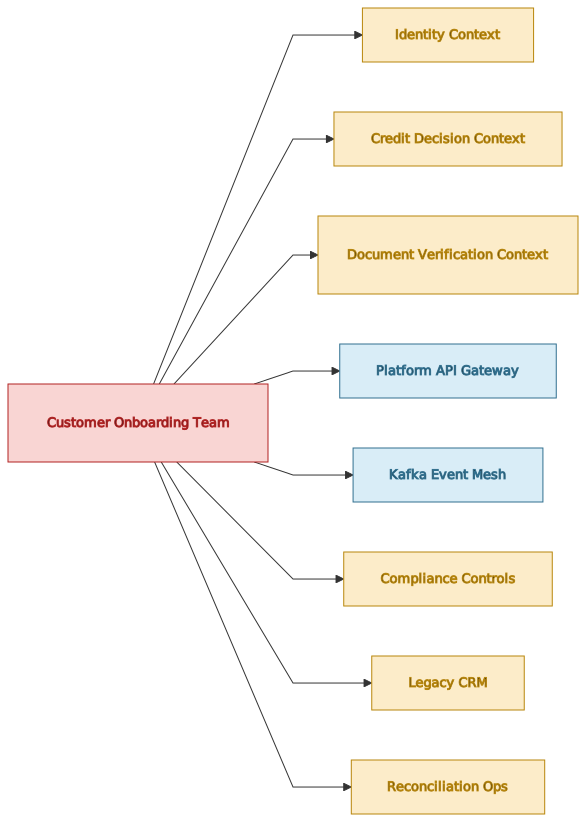
This kind of diagram tells a story quickly. The onboarding team is carrying too much breadth: identity semantics, credit rules, document workflows, platform dependencies, compliance, legacy coupling, and reconciliation. That is not a “busy team.” That is an architectural smell.
Architecture
The architecture that best supports manageable cognitive load is usually not a pure monolith and not a naive service sprawl. It is a domain-aligned architecture with selective decoupling.
That phrase matters. Selective decoupling means we only split where the domain boundary is meaningful and the team can absorb ownership. We do not carve by technical layers. We do not split just because the cloud bill justifies a conference talk.
Start with bounded contexts, not services
In DDD terms, bounded contexts define where a model is valid. Customer identity is not the same thing as customer billing profile. An order in commerce is not an invoice in finance. Those distinctions are semantic first, technical second.
Once bounded contexts are clear, team ownership becomes more rational:
- Stream-aligned teams own business capabilities and their domain language.
- Platform teams provide paved roads for deployment, observability, security, and standard integration mechanisms.
- Complicated-subsystem teams own specialized areas such as pricing engines, optimization algorithms, fraud scoring, or mainframe protocol gateways.
- Enabling teams help others adopt patterns like event design, SRE practices, or domain modeling.
Use Kafka where the business benefits from asynchronous facts
Kafka is useful when domains need to react to durable business events, when scale or fan-out matters, or when temporal decoupling is valuable. Examples include order lifecycle updates, payment captured, shipment dispatched, customer preference changed.
But Kafka should not be the default for every interaction. If one domain needs an immediate answer from another to complete a user transaction, a synchronous API may be the better fit. Event-first ideology often creates fake decoupling and very real debugging pain.
Events must be named in the language of the business:
OrderPlacedPaymentAuthorizedClaimSubmittedPolicyRenewed
Not:
OrderServiceUpdatedDbRowChangedCustomerTopicV4
One set speaks domain. The other speaks plumbing. Plumbing events create cognitive load because every consumer must reverse-engineer business meaning from implementation trivia.
Reconciliation is part of the architecture, not an embarrassment
In distributed enterprise systems, discrepancies happen. Messages are delayed. APIs timeout after success. a downstream system rejects a valid business event due to stale reference data. Human corrections occur in back-office systems. The question is not whether reconciliation is needed. The question is whether it is designed.
A mature architecture includes:
- explicit source-of-truth per domain
- replay or compensation strategy
- idempotent message handling
- dead-letter and recovery policies
- reconciliation dashboards
- business-level discrepancy models, not just technical error queues
If teams are discovering reconciliation ad hoc during incidents, then the architecture has offloaded cognitive load into operations.
A reference topology
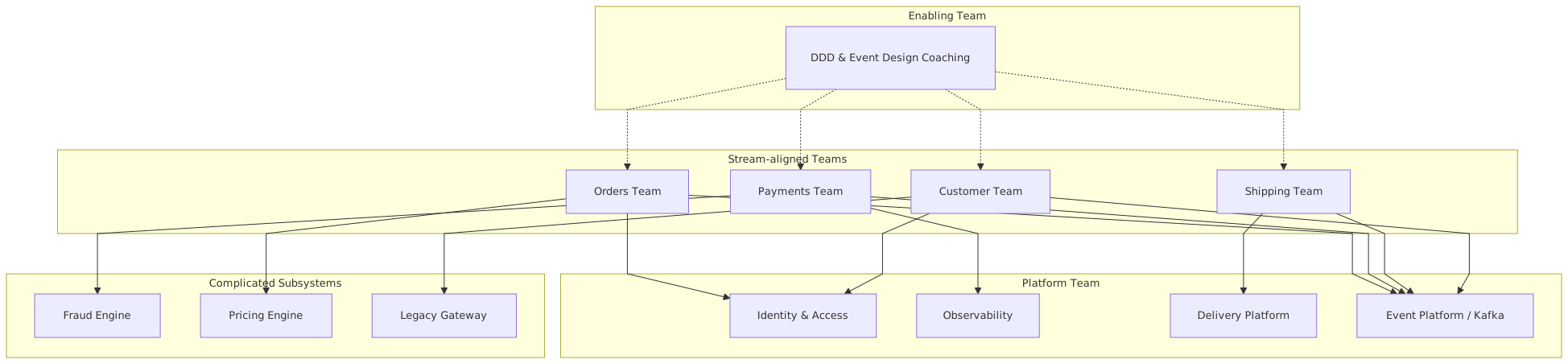
This is healthy when the platform removes plumbing burden without owning business logic, and when complicated subsystems isolate expertise that would otherwise overload multiple teams.
It becomes unhealthy when stream-aligned teams need deep internal knowledge of Kafka operations, custom IAM choreography, or pricing engine internals just to deliver routine changes.
Migration Strategy
Enterprises do not get to redraw the map on a blank sheet. They inherit a monolith, a mainframe, packaged applications, brittle ETL, and hard-won operational folk wisdom. So migration must be progressive. Anything else is theater.
The right migration strategy is usually a progressive strangler aligned to domain boundaries and team maturity.
Principle 1: Strangle business capabilities, not technical tiers
Do not start by extracting a “customer service” because the code folder is large. Start where there is a meaningful bounded context, a team ready to own it, and a clear business outcome. Good candidates usually have:
- stable domain language
- clear source-of-truth or at least a path to one
- high change frequency
- painful coordination costs in the current state
- manageable data synchronization scope
Principle 2: Preserve semantics before optimizing topology
During migration, organizations are tempted to improve everything at once: new data model, new event contracts, new CI/CD, new observability, new team ownership. That is how migrations stall. First preserve business semantics and operational continuity. Then improve internals.
Principle 3: Introduce anti-corruption layers
Legacy systems rarely speak the language you want. They speak account codes, status flags, overloaded tables, and twenty-year-old batch assumptions. Put an anti-corruption layer between legacy and the new bounded context. Let the new team work in clean domain terms without importing old semantic debt.
Principle 4: Design for coexistence and reconciliation
For a while, both old and new worlds will be true enough to matter. You need dual reads, selective dual writes, event translation, discrepancy reporting, and clear rollback options. Coexistence is not a temporary inconvenience; it is the migration architecture.
Progressive strangler flow

That reconciliation service is not decorative. It is how you survive the ambiguous middle.
A migration sequence that works
- Map domain semantics and current cognitive load.
Identify where teams are overloaded by mixed concerns, hidden dependencies, and unclear ownership.
- Choose one bounded context with high business leverage.
Something painful enough to matter, but not so entangled it becomes a political trench war.
- Create an anti-corruption layer over the legacy system.
Translate old representations into clean domain language.
- Stand up a stream-aligned team with platform support.
Give them enough autonomy to own the domain, but not the burden of inventing every operational pattern.
- Publish business events from the new context.
Keep contracts explicit, versioned, and semantically meaningful.
- Introduce reconciliation reporting early.
Before cutover, not after the first audit issue.
- Migrate consumers incrementally.
Some via APIs, some via Kafka subscriptions, some via batch feed replacement.
- Retire legacy responsibilities one slice at a time.
Shut off old flows deliberately, with observability and rollback.
This is slower than executive decks like to admit. It is also how real enterprises avoid becoming migration cautionary tales.
Enterprise Example
Consider a global insurer modernizing claims processing.
The legacy estate consisted of a core claims platform, a document management product, a fraud engine, a customer CRM, and nightly reconciliation jobs feeding finance. Changes to the claims journey required coordination across six teams and two vendors. A simple product rule change could take eight weeks because no one team understood the full path from claim submission to payout. Cognitive load was spread everywhere and owned nowhere.
At first, the organization tried a classic microservices program. They created services for intake, validation, policy lookup, fraud referral, reserves, payment, and notifications. Kafka was introduced as the event backbone. On paper, autonomy improved. In reality, stream-aligned teams were soon drowning in integration semantics:
- which claim state was authoritative
- whether
ClaimUpdatedcould be emitted before document verification completed - how duplicate fraud referrals were prevented
- what happened when payment success arrived after reserve adjustment failed
- how finance reconciled claims reserves with payout events across cutover periods
This is the sort of mess that architecture diagrams conveniently omit.
The reset came when the enterprise reframed the work using Team Topologies and DDD. They defined bounded contexts more carefully:
- Claim Intake
- Claim Assessment
- Fraud Decisioning
- Settlement
- Customer Communication
- Financial Posting
Then they restructured teams.
A stream-aligned Claim Assessment Team owned the lifecycle and language of assessment. A Settlement Team owned payout and settlement semantics. The fraud engine remained a complicated subsystem because the scoring models and vendor integration were specialized. A platform team took responsibility for Kafka provisioning, standard observability, identity integration, and deployment templates. An enabling team coached event design and context mapping for the first six months.
The real breakthrough was not the team chart. It was semantic discipline.
Instead of emitting technical “service updated” messages, teams published domain events such as ClaimSubmitted, AssessmentCompleted, FraudReviewRequested, SettlementApproved, and SettlementPaid. They established a source-of-truth matrix. They built a reconciliation service that compared settlement events with financial postings and surfaced discrepancies by business entity, not by topic offset.
Lead time fell because teams no longer needed to understand the entire claims ecosystem to make routine changes. They needed to understand their bounded context, their event contracts, and the platform’s paved road. That is manageable. Not easy. Manageable.
This is the difference that matters.
Operational Considerations
Architects sometimes discuss cognitive load as if it ends at deployment. It does not. Operations is where bad boundaries collect interest.
Observability must match team ownership
If a team owns a bounded context, they need domain-relevant observability:
- business event throughput
- latency by customer journey step
- reconciliation discrepancy counts
- compensation rates
- SLA and SLO indicators
- dependency health in terms they can act on
Do not hand teams raw infrastructure dashboards and call it empowerment. A stream-aligned team needs to know “claims stuck awaiting fraud decision for over 30 minutes,” not only “consumer lag in partition 7.”
Runbooks should encode failure semantics
Teams should know:
- what to replay
- what not to replay
- which events are safe to process twice
- when to compensate rather than retry
- when to escalate to manual operations
- how audit evidence is captured
Without this, on-call engineers end up reconstructing architecture from logs at 2 a.m., which is one of the purest forms of enterprise waste.
Data governance matters more in event-driven estates
As Kafka adoption grows, topic sprawl and semantic drift become real. You need governance, but not bureaucracy. Lightweight standards help: EA governance checklist
- naming based on business events
- schema versioning rules
- event ownership and lifecycle
- retention policies
- PII handling and masking
- lineage for downstream reporting and analytics
Again, this is about reducing extraneous load. Teams should not negotiate basic event hygiene from scratch every quarter.
Tradeoffs
There are no free architectures. Only choices with invoices.
Team-aligned boundaries improve flow but may duplicate capability
Multiple teams may need similar patterns for state management, API composition, or event handling. Some duplication is healthy if it preserves team autonomy and keeps boundaries clean. Chasing perfect reuse often creates shared dependencies that cost more than they save.
Kafka decouples runtime but complicates reasoning
Asynchronous systems reduce direct coupling and improve resilience at scale. They also make temporal behavior harder to understand. Debugging business outcomes across services, topics, retries, and compensations is not trivial. If the business process requires immediate consistency and low semantic ambiguity, synchronous interaction may be simpler.
Platforms reduce burden but can centralize power badly
A strong internal platform can dramatically lower cognitive load. A platform that becomes a mandatory gatekeeper slows delivery and pushes teams into workaround behavior. The test is simple: does the platform make the easy path the right path, or merely the approved path?
Reconciliation improves integrity but adds process
You need reconciliation in distributed enterprise systems. But every reconciliation loop introduces delay, dashboards, support workflows, and sometimes manual intervention. This is acceptable when financial or regulatory correctness matters. It is overkill for disposable or low-value signals.
Failure Modes
Some failure modes are so common they should be treated as architectural weather.
1. Boundaries drawn around org charts instead of domains
Teams inherit arbitrary scopes based on history. The architecture follows, and every change crosses multiple contexts. Domain semantics become fragmented.
2. Event storming without event discipline
Workshops produce colorful boards and vague confidence. Then teams emit poorly defined events with hidden coupling and unstable schemas. Kafka magnifies the confusion.
3. Platform overreach
The platform team starts embedding business workflow assumptions into shared services. Stream-aligned teams lose ownership. The platform becomes a silent monolith.
4. Reconciliation deferred as “phase two”
This is a classic error. During migration, discrepancies are tolerated because “we’ll harden later.” Later arrives as an audit issue, customer impact, or a finance close problem.
5. Cognitive load maps treated as static artifacts
Team load changes as domains evolve, mergers happen, regulations shift, and new dependencies appear. A stale map is comforting and useless.
6. Complicated subsystems become black holes
A specialized team owning pricing, fraud, or optimization can be valuable. But if every change requires them, they become the bottleneck and the rest of the organization stops learning enough to collaborate effectively.
When Not To Use
It is worth saying plainly: not every organization needs a sophisticated team-topologies-driven architecture redesign.
Do not lean heavily into this model when:
- the product is small and can be effectively owned by one or two teams
- the domain is simple and stable
- operational scale is modest
- compliance pressure is low
- the current monolith is well-structured and team cognitive load is manageable
A well-modularized monolith with clear internal boundaries can be a better answer than a fleet of services plus Kafka. If a small number of teams can understand the system end to end, splitting it may increase cognitive load, not reduce it.
Likewise, avoid introducing event-driven integration where consistency needs are immediate, interaction patterns are straightforward, and the organization lacks operational maturity. Kafka is not a substitute for boundary clarity. It is an amplifier of whatever clarity or confusion you already have.
And beware of copying Team Topologies as a taxonomy exercise. Renaming teams does not reduce load. Better boundaries and better abstractions do.
Related Patterns
Several patterns sit naturally beside this approach.
Bounded Contexts
The DDD foundation. Use them to decide where language, rules, and models should be consistent.
Anti-Corruption Layer
Essential in migration when legacy semantics would otherwise contaminate new models.
Strangler Fig Pattern
The right default for enterprise modernization: progressive replacement with coexistence.
Event-Carried State Transfer
Useful when downstream consumers need durable business facts, but dangerous if ownership and semantics are weak.
Saga / Process Manager
Helpful for long-running business workflows across contexts, especially where compensation is needed. Use sparingly and keep domain semantics explicit.
Backstage-style Internal Developer Platforms
Good when they genuinely reduce delivery friction and standardize the boring parts of software operations.
Context Mapping
Crucial for understanding upstream/downstream relationships, shared kernels, and customer-supplier dynamics between teams and systems.
All of these patterns become more effective when viewed through the cognitive load lens. The question is always the same: what complexity is this pattern removing, and where is the remaining complexity going?
Summary
Architecture is not only about the runtime structure of software. It is about the thinking structure of the organization.
If teams must understand too much to make safe changes, the architecture is wrong, however modern it looks. Team Topologies gives a practical way to shape teams around flow and specialization. Domain-driven design gives the semantic discipline to draw sensible boundaries. A cognitive load map connects the two and exposes where complexity is overwhelming the people meant to own it.
The best enterprise architectures do a few things relentlessly well:
- they keep domain semantics explicit
- they align bounded contexts with team ownership
- they remove extraneous technical burden through real platforms, not slogans
- they use Kafka and microservices selectively, where asynchronous facts and scale justify them
- they treat reconciliation as first-class
- they migrate progressively with anti-corruption and strangler patterns
- they revisit cognitive load as the estate evolves
That last point matters most. Cognitive load is not a one-time assessment. It is a living property of the enterprise. New integrations, new controls, new channels, new acquisitions — they all alter what teams must hold in their heads.
A good architect watches that burden carefully. Because systems do not collapse only from technical failure. They collapse when the people responsible for them can no longer think clearly enough to change them.
And that, more than any diagram, is the architecture that matters.
Frequently Asked Questions
What is enterprise architecture?
Enterprise architecture aligns strategy, business processes, applications, and technology in a coherent model. It enables impact analysis, portfolio rationalisation, governance, and transformation planning across the organisation.
How does ArchiMate support architecture practice?
ArchiMate provides a standard language connecting strategy, business operations, applications, and technology. It enables traceability from strategic goals through capabilities and services to infrastructure — making architecture decisions explicit and reviewable.
What tools support enterprise architecture modeling?
The main tools are Sparx Enterprise Architect (ArchiMate, UML, BPMN, SysML), Archi (free, ArchiMate-only), and BiZZdesign. Sparx EA is the most feature-rich, supporting concurrent repositories, automation, scripting, and Jira integration.