⏱ 20 min read
Most financial institutions do not have a scaling problem. They have a design honesty problem.
That sounds harsh, but it’s true. Banks, insurers, payment companies, and capital markets firms often talk about “scalability” as if it’s a pure technology issue. Buy more cloud. Add Kafka. Modernize IAM. Split the monolith. Move to microservices. Done. Except it’s not done. Because the real bottleneck is usually an architecture built on half-decisions: event-driven in PowerPoint, batch in production, zero-trust in policy docs, and shared service accounts everywhere.
Scalable architecture in financial services is not about making every system infinitely elastic. That’s startup thinking applied badly. In a bank, scalable architecture means something more grounded: the ability to grow transaction volumes, product complexity, customer channels, regulatory controls, and operational resilience without turning every release into a political negotiation.
If I had to explain it simply, early and clearly: a scalable financial architecture is one that can handle more customers, more transactions, more integrations, and more controls without collapsing under its own governance or operational overhead.
That sounds obvious. It isn’t. Plenty of institutions can scale one of those dimensions. Very few scale all of them at the same time.
And that’s where architecture work becomes real. Not theoretical. Real. Because in a bank, the architecture is not just software structure. It is also risk posture, identity model, operating model, data movement policy, auditability, and failure containment strategy. Ignore that and you don’t have an enterprise architecture. You have a slide deck.
What “scalable” actually means in a financial institution
A lot of architecture discussions start too deep. So let’s keep it simple first.
For a financial institution, scalability usually means five things:
- Transaction scalability
Can the platform handle increasing payment volumes, API calls, customer sessions, market events, and batch workloads?
- Organizational scalability
Can multiple teams build, change, and support systems without stepping on each other?
- Control scalability
Can security, IAM, compliance, data governance, and audit controls scale with delivery speed? ARB governance with Sparx EA
- Integration scalability
Can new products, partners, fintechs, channels, and internal systems connect without custom spaghetti every time?
- Operational scalability
Can incidents be isolated, recovered, observed, and managed without waking up half the company?
The mistake is assuming these are separate. They aren’t. They are deeply connected.
For example, if your IAM model is weak, your delivery model slows down because access provisioning becomes manual. If your event architecture is sloppy, your reconciliation burden explodes. If your cloud landing zones are inconsistent, every team invents its own security posture. If your core banking integration relies on synchronous calls for everything, your digital channels become hostage to legacy latency.
That’s why scalable architecture in banking is less about one magic platform and more about disciplined boundaries.
The core principle: design for controlled decoupling, not unlimited flexibility
Here’s a contrarian thought: financial institutions do not need maximum flexibility. They need controlled decoupling.
Architects love flexibility. They say things like “future-proofing” and “extensibility” as if those words pay down technical debt. They don’t. In large enterprises, excessive flexibility usually means vague ownership, over-generalized platforms, and integration patterns nobody can govern.
A scalable bank architecture should be intentionally constrained.
That means:
- clear domain boundaries
- explicit ownership
- standard integration patterns
- strong identity controls
- limited exceptions
- boring infrastructure where possible
Boring is underrated. In financial services, boring systems often survive stress better than clever ones.
You do not need twelve messaging patterns. You probably need three.
You do not need every team choosing its own IAM model. You need one enterprise identity strategy with a few tested variants.
You do not need “cloud-first” as a slogan. You need a cloud architecture that understands data residency, encryption boundaries, resilience targets, and shared responsibility.
Scalability comes from reducing architecture entropy.
The architecture layers that matter most
When I look at financial institutions that scale reasonably well, they usually get four layers mostly right:
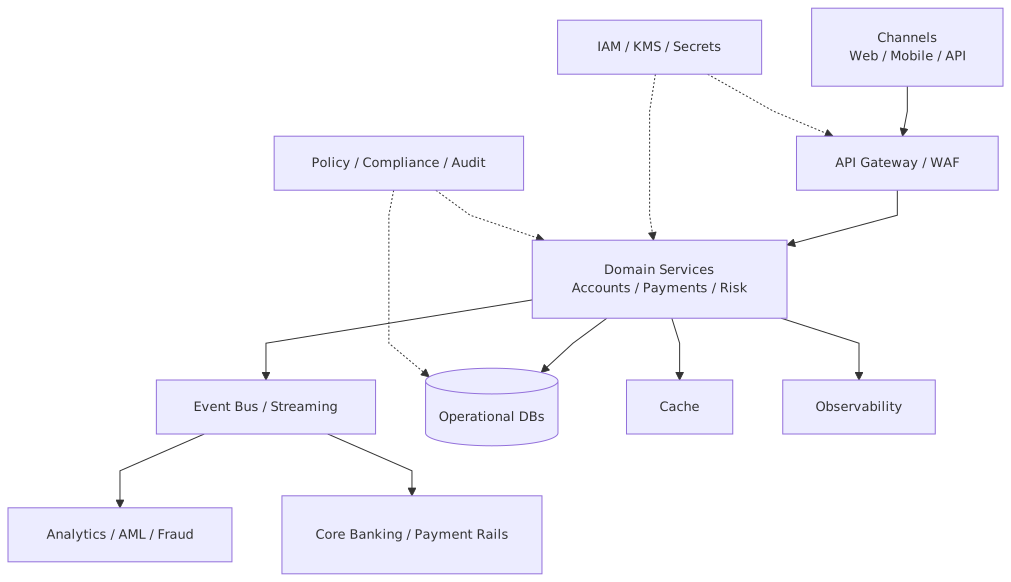
This is where enterprise architecture should spend its energy. Not on drawing abstract capability maps and disappearing. The real work is deciding where standardization is mandatory and where variation is acceptable.
That distinction matters more than most architecture principles documents.
Banking architecture is not e-commerce architecture with more compliance
Another bad habit in the industry: importing patterns from consumer tech without adjusting for financial realities.
Yes, banks should learn from digital-native firms. Yes, cloud-native patterns matter. Yes, event-driven architecture matters. But financial institutions carry burdens that many tech companies don’t:
- strict auditability
- legal entity boundaries
- data residency constraints
- transaction irreversibility concerns
- operational resilience requirements
- legacy core systems that still matter
- regulator scrutiny on outsourcing and concentration risk
So when someone says, “Let’s just break the monolith into microservices,” my first reaction is usually: why? Which problem are we actually solving?
Sometimes microservices are right. Often they are not. A modular monolith with good domain separation can scale perfectly well for many banking capabilities. Especially when the real bottleneck is not code deployment but downstream mainframe dependency, reconciliation cycles, or IAM bottlenecks.
Strong opinion here: many financial institutions adopted microservices before they earned them operationally.
They had no mature platform engineering, weak observability, no event governance, and inconsistent service identity. That is not microservices. That is distributed confusion. EA governance checklist
Kafka in banking: powerful, useful, and very easy to misuse
Kafka has become a default answer in enterprise architecture. Sometimes deservedly. It’s an excellent backbone for event streaming, decoupled integration, and high-throughput data movement. In banking, it can be extremely valuable for things like:
- payment event propagation
- customer profile change distribution
- fraud signal ingestion
- transaction monitoring pipelines
- CDC-based integration from core systems
- real-time analytics feeds
- channel activity streams
But let’s be honest. A lot of Kafka estates in large institutions are architectural theater.
The common fantasy goes like this: “We’ll put Kafka in the middle and everything becomes real-time, decoupled, scalable, and modern.”
No. Kafka does not fix poor domain design. It amplifies it.
If your event model is unclear, Kafka spreads ambiguity faster.
If your source systems have weak data quality, Kafka distributes bad data at scale.
If your consumers depend on undocumented side effects, Kafka turns integration into archaeology.
What Kafka should do in a bank
Kafka works best when it is used for one or more of these purposes:
- event distribution across domains
- stream ingestion for operational or analytical use
- decoupling producers from multiple consumers
- CDC propagation from systems of record
- resilience against temporary consumer unavailability
What Kafka should not become
It should not become:
- your master data strategy
- your transaction consistency strategy
- your excuse for avoiding API design
- an unmanaged enterprise event swamp
- a replacement for proper workflow orchestration where orchestration is required
This is a real architecture issue. I’ve seen banks publish “customer updated” events from five different systems, all with slightly different semantics. Which one is authoritative? Nobody knows. Consumers stitch together their own truth. Then compliance asks for lineage and confidence in the record. Good luck.
Practical rules for Kafka in financial institutions
If you want Kafka to support scalability in a regulated environment, a few rules are non-negotiable:
- Define event ownership by domain
- Use versioned schemas and enforce compatibility
- Separate business events from technical events
- Treat PII propagation as a design decision, not a default
- Create topic naming and retention standards
- Design replay and idempotency deliberately
- Know which events are authoritative and which are informational
That last one matters a lot in banking. Not every event should trigger financial state change. Some events are hints. Some are records. Some are commands disguised as events, which is usually a smell.
IAM is not a side concern. It is a scaling architecture concern
Architects often treat identity and access management as a security workstream. That’s too narrow. In financial institutions, IAM is one of the biggest determinants of whether architecture scales operationally.
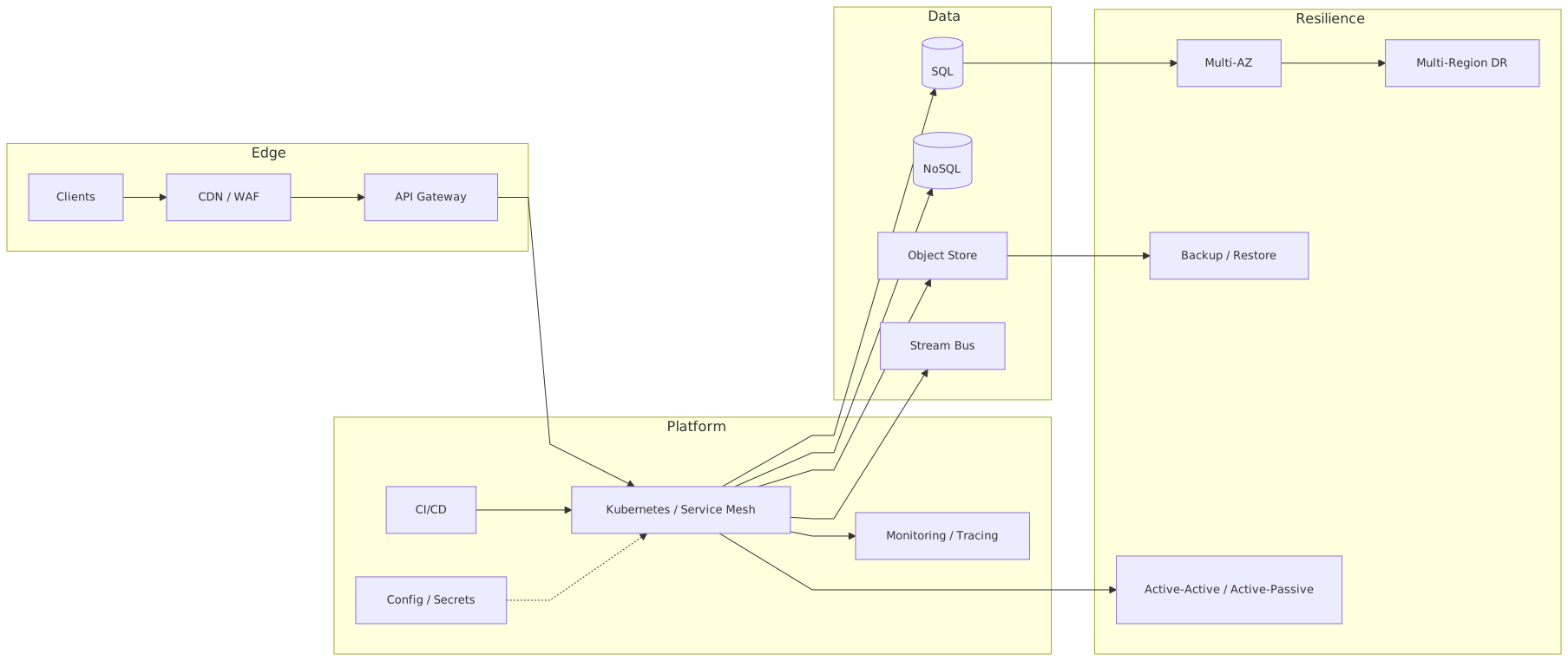
Why? Because every platform, service, API, analyst, operations user, support engineer, and automation process needs access. If the identity model is fragmented, delivery slows, audit pain increases, and risk accumulates quietly.
A scalable architecture for a bank needs IAM to cover at least four dimensions:
- workforce identity
- customer identity
- machine/service identity
- privileged access
And no, one giant “identity platform” does not solve all of that cleanly. Different identity populations have different trust models, lifecycle events, and control expectations.
Common IAM mistakes in financial architecture
These happen constantly:
- designing APIs before deciding service-to-service authentication patterns
- allowing shared service accounts “temporarily” for years
- inconsistent authorization models across channels and backend services
- weak joiner-mover-leaver controls for privileged users
- token sprawl with no clear trust boundary
- no central view of entitlements across cloud and on-prem
- treating IAM integration as an application issue instead of an enterprise design issue
A bank can have world-class fraud tooling and still fail basic access governance. It happens more than people admit. TOGAF roadmap template
What good looks like
Good IAM architecture in a financial institution usually includes:
- centralized identity providers with federated integration patterns
- role and attribute models aligned to business risk
- managed secrets and short-lived credentials for machine identities
- strong MFA and adaptive controls for workforce and privileged access
- policy-based authorization where complexity justifies it
- full audit trails for entitlement changes and access use
- cloud IAM designed with least privilege and platform guardrails
This is not glamorous work. But it is architecture. Real architecture. Because if your IAM model cannot scale, your enterprise cannot change safely.
Cloud in financial services: stop arguing religion, start designing landing zones
Cloud debates in financial institutions are still weirdly ideological. Some teams act like cloud is inherently unsafe. Others act like moving to cloud automatically modernizes architecture. Both are wrong.
Cloud is just a better operating model for many workloads, if you design it properly.
That “if” is doing a lot of work.
In financial institutions, scalable cloud architecture depends less on whether you picked AWS, Azure, or GCP and more on whether you established clear enterprise patterns for:
- account/subscription/project structure
- network segmentation
- IAM and federation
- encryption and key management
- logging and observability
- policy guardrails
- CI/CD controls
- backup and disaster recovery
- data classification and residency
- third-party connectivity
- platform ownership boundaries
If those are immature, cloud adoption simply accelerates inconsistency.
The landing zone problem
A lot of banks claim to have a cloud landing zone. What they actually have is a baseline template and a wiki page. That’s not enough.
A real enterprise landing zone is an operational product. It should provide:
- standardized account provisioning
- preconfigured security controls
- logging integrated with enterprise monitoring/SIEM
- network patterns approved for regulated workloads
- IAM federation and role models
- policy enforcement as code
- deployment patterns teams can actually use
If every delivery team has to negotiate cloud controls from scratch, you are not scaling architecture. You are scaling review meetings.
Contrarian view: not everything should move
Some workloads should stay on-prem for longer than cloud evangelists like to admit. Not forever, but longer. Especially where: ArchiMate in TOGAF ADM
- latency to core systems dominates
- vendor products are cloud-hostile
- legal entity segregation is awkward
- data gravity is real
- operational maturity in cloud is still weak
The goal is not “move everything.” The goal is “create a target architecture where placement is intentional.”
Hybrid is not failure. Bad hybrid is failure.
How this applies in real architecture work
This is the part many articles skip. They stay conceptual. But architecture in financial institutions becomes real in decisions, trade-offs, and governance. architecture decision record template
Here’s what this looks like week to week.
1. Defining domain boundaries with actual consequences
An architect needs to decide whether “customer,” “account,” “payment,” “limits,” “fraud,” and “notifications” are separate domains with independent ownership, or whether they remain bundled. This affects:
- team structure
- API contracts
- event ownership
- data authority
- release dependency
- resilience boundaries
In practice, this means sitting with business, engineering, security, and operations and forcing clarity on who owns what. Not philosophically. Operationally.
2. Choosing where synchronous interaction is acceptable
Banks often overuse synchronous APIs because they feel easier to understand. But synchronous dependency chains create fragility fast.
A real architect asks:
- Does this process require immediate confirmation?
- Can this consumer tolerate eventual consistency?
- What happens when the downstream system is slow?
- Is the dependency on a system of record or a derived view?
- What is the failure mode during peak events?
For example, card authorization absolutely has different response expectations than customer marketing preference updates. Treating them the same is lazy architecture.
3. Designing IAM before integration sprawl happens
When a new digital product launches, architecture should define:
- customer authentication pattern
- workforce support access model
- service-to-service trust
- API gateway integration
- token propagation rules
- authorization ownership
- audit requirements
If this is deferred, teams improvise. And improvised identity becomes permanent architecture.
4. Setting cloud guardrails that teams don’t hate
Good enterprise architects work with platform teams to create patterns that delivery teams can consume with minimal friction. If your standards are so painful that teams bypass them, your architecture failed no matter how elegant the policy looked.
5. Driving resilience design with business impact in mind
Architects should classify systems and interactions by business criticality. Not every system needs active-active multi-region resilience. Some do. Some absolutely do not.
This is where maturity shows. Real architecture avoids both extremes:
- gold-plating everything
- under-designing critical flows
Common mistakes architects make
Let’s be direct. Architects contribute to the mess too. Some of the most common mistakes are self-inflicted.
Mistake 1: Confusing standards with architecture
Writing a 120-page standards document is not architecture. If teams cannot translate it into deployable patterns, it’s shelfware.
Mistake 2: Designing target state without transition reality
Financial institutions live in coexistence states. Legacy, modern, outsourced, cloud, on-prem, acquired systems, regional variants. If your architecture only works after a mythical future transformation, it’s not useful.
Mistake 3: Treating data consistency as somebody else’s problem
In banking, consistency and reconciliation are architecture concerns. If your event model, API design, and persistence choices create ambiguous state, operations will pay for it forever.
Mistake 4: Underestimating IAM complexity
Already said it, but it deserves repeating. Access design is not implementation detail. It changes how systems integrate, how audits work, and how incidents are contained.
Mistake 5: Assuming Kafka equals event-driven maturity
Installing a platform is easy. Establishing event semantics, ownership, contracts, and operational discipline is the hard part.
Mistake 6: Ignoring operational architecture
If your design does not account for monitoring, tracing, failure isolation, support access, runbooks, and recoverability, it is incomplete.
Mistake 7: Over-indexing on patterns from conference talks
A lot of architecture choices sound brilliant in public talks and are terrible in a 150-year-old bank with three cores, two IAM stacks, and 900 vendors.
A real enterprise example
Let’s use a realistic composite example based on patterns I’ve seen in large banks.
Scenario: modernizing payments and customer servicing in a retail bank
A regional retail bank had these problems:
- mobile and web channels were tightly coupled to legacy middleware
- payment initiation relied on synchronous calls through multiple layers
- customer profile updates were replicated in nightly batches
- IAM was split across workforce AD, a legacy customer auth platform, and local service accounts
- cloud adoption existed, but each team had built different security patterns
- incident resolution was painful because nobody had end-to-end observability
The bank wanted faster digital delivery, better resilience, and support for open banking and partner integrations.
What the architecture team did right
They did not start by saying “everything becomes microservices.” Good start.
Instead, they defined a practical target architecture:
Domain boundaries
They separated ownership into:
- customer profile
- payments initiation
- payments processing
- fraud decisioning
- notifications
- channel experience
- identity services
That sounds ordinary, but it immediately reduced ownership confusion.
Kafka used selectively
Kafka was introduced for:
- payment lifecycle events
- customer profile change propagation
- fraud signal ingestion
- downstream analytics feeds
They did not use Kafka for every request-response interaction. Channels still used APIs where immediate confirmation mattered.
IAM modernization
They established:
- a central customer identity provider for digital channels
- federated workforce access for support staff
- service identity via managed workload identities in cloud
- privileged access controls for production support
- API authorization patterns standardized through gateway and token policies
This was one of the biggest operational improvements, even though it was less visible than the payment changes.
Cloud landing zone
Rather than letting each team build infrastructure independently, they created a shared cloud platform with:
- pre-approved network patterns
- centralized logging
- IAM federation
- secrets management
- policy controls
- CI/CD templates
That reduced design drift massively.
What they still got wrong
Let’s not romanticize it.
They made customer events too broad at first. “Customer updated” became a catch-all event with inconsistent downstream interpretations. They had to refactor into more meaningful events and tighten schema governance.
They also underestimated how much legacy core availability would still dominate customer-facing latency. Some digital improvements looked great in architecture diagrams but were constrained by old systems in practice.
And their first attempt at enterprise authorization was too centralized. Every nuanced policy was pushed into one shared service, which became a bottleneck. They had to rebalance with clearer domain-level authorization ownership.
The result
Within 18 months, they achieved:
- reduced release dependency between channel and backend teams
- better resilience during payment spikes
- faster onboarding of new API consumers
- improved access auditability
- clearer operational ownership during incidents
Not perfect. But materially better. And importantly, the architecture became more scalable in both technical and organizational terms.
That’s what success usually looks like in financial services: not a clean-sheet fantasy, but a better system of constraints.
The patterns that tend to work
If you forced me to summarize scalable architecture patterns for financial institutions, I’d pick these:
1. Domain-oriented architecture
Not necessarily pure microservices. But definitely clear business-aligned ownership.
2. API plus event backbone
Use APIs for query and command interactions where immediacy matters. Use Kafka or similar event streaming for propagation, decoupling, and analytical/operational streams.
3. IAM as a platform capability
Identity should be part of core architecture, not bolted on after application design.
4. Cloud guardrails over cloud freedom
Strong platform engineering beats uncontrolled decentralization.
5. Resilience by criticality tier
Design according to business impact, not architecture fashion.
6. Data authority clarity
Every key business entity needs a known source of truth, even in distributed architectures.
7. Transition-state architecture
Design the migration path, not just the destination.
That last one is maybe the most important. Enterprise architecture is judged in the messy middle.
A few hard truths worth saying out loud
- If your architecture requires perfect data quality to work, it will fail in a bank.
- If your IAM model depends on manual exceptions, those exceptions will become the model.
- If every domain publishes events without governance, Kafka becomes a compliance problem.
- If cloud patterns are optional, fragmentation is guaranteed.
- If your resilience strategy ignores people and process, technology redundancy won’t save you.
- If your architects cannot explain trade-offs in plain language, they are not helping delivery.
And one more: legacy is not the enemy; unmanaged dependency is.
There are banks running old systems very predictably. There are also banks running shiny modern stacks that are operationally chaotic. Modernization matters, yes. But disciplined architecture matters more.
Final view
Designing scalable architectures for financial institutions is not about chasing whatever pattern is loudest this year. It is about creating structures that allow growth without multiplying fragility.
That means being opinionated.
It means saying no to unnecessary variation.
It means treating IAM as core architecture.
It means using Kafka with discipline, not worship.
It means building cloud platforms with real guardrails.
It means designing around domains, authority, and failure.
It means caring about transition states, not just target-state artwork.
Most of all, it means accepting that in financial services, scalability is never just a throughput question. It is a control question, an ownership question, and an operational question.
Good enterprise architects know this. The rest are still drawing boxes.
FAQ
1. What is the most important factor in scalable architecture for banks?
Clear domain ownership. Without that, APIs, events, IAM, and cloud patterns all become inconsistent. Technology helps, but ownership scales systems.
2. Is Kafka necessary for modern banking architecture?
Not always, but it is very useful for event distribution, CDC, and real-time integration. The mistake is using Kafka everywhere or without schema and ownership governance.
3. Should financial institutions move everything to the cloud?
No. They should move the right workloads with the right controls. Some systems belong in cloud now, some later, and some may remain hybrid for practical reasons.
4. Why is IAM such a big architecture concern?
Because identity affects every user, service, integration, and audit trail. Weak IAM creates delivery friction, security risk, and operational complexity at enterprise scale.
5. Are microservices the best approach for scalable financial systems?
Sometimes. But not by default. Many banking capabilities scale better with strong modular boundaries first, then selective service decomposition where it actually solves a problem.
Frequently Asked Questions
How is ArchiMate used in banking architecture?
ArchiMate is used in banking to model regulatory compliance (Basel III/IV, DORA, AML), integration landscapes (core banking, payment rails, channels), application portfolio rationalisation, and target architecture for transformation programs. Its traceability capabilities make it particularly valuable for regulatory impact analysis.
What enterprise architecture challenges are specific to banking?
Banking faces unusually complex EA challenges: decades of legacy core systems, strict regulatory change requirements (DORA, Basel IV, PSD2), fragmented post-M&A application landscapes, high-stakes integration dependencies, and the need for real-time operational resilience views. Architecture must be both accurate and audit-ready.
How does Sparx EA support banking enterprise architecture?
Sparx EA enables banking architects to model the full DORA ICT asset inventory, maintain integration dependency maps, track application lifecycle and vendor EOL, and generate compliance evidence directly from the model. Integration with CMDB and Jira keeps the model current without manual maintenance.