⏱ 18 min read
Most enterprise UML models are lying to you. UML modeling best practices
That sounds harsh, but it’s true. The boxes look clean. The arrows are neat. The relationships seem sensible. Everyone nods in the review. And then six months later the delivery team is arguing about whether a customer can hold two active accounts in the same product family, whether a service account is allowed to bypass MFA, or whether an event published to Kafka is valid if the IAM token was issued by a federated identity provider with missing claims.
The model didn’t prevent the confusion. It just drew it nicely.
That is exactly where OCL becomes useful.
Not glamorous. Not trendy. Useful.
If you work in enterprise architecture, especially in banking, identity, integration, or cloud-heavy environments, OCL gives UML something it usually lacks in practice: precision. Not academic precision for the sake of elegance. Operational precision. The kind that prevents expensive ambiguity from leaking into solution design, controls, APIs, event contracts, and implementation decisions. UML for microservices
So let’s say it simply, early: OCL (Object Constraint Language) is a way to add formal rules to UML models. UML shows structure and behavior. OCL says what must always be true. It defines constraints, derivations, preconditions, and postconditions in a way that is more exact than notes on a diagram and less messy than burying business rules in prose.
That’s the simple explanation.
The deeper truth is this: OCL is one of the few tools in enterprise modeling that can force architects to stop hand-waving.
And yes, that’s why many architects avoid it.
Why UML alone is not enough
UML is good at visualizing. It is not naturally good at removing ambiguity.
A class diagram can show that a Customer has Accounts, that an Account belongs to a Product, and that an AccessPolicy is associated with an Identity. Fine. But that tells you almost nothing about the rules that actually matter.
Can a customer have more than one primary account per product category?
Can a dormant account still emit transaction events?
Can an IAM role be active without a valid entitlement approval?
Can a cloud workload identity be linked to multiple owning business services?
Can a Kafka event be published if the source system has not passed required data quality checks?
These are architecture questions, not just developer questions. They affect controls, integration patterns, ownership, resiliency, and compliance. Yet many architecture models leave them out entirely or push them into giant Word documents no one reads after sign-off.
That’s the classic enterprise mistake: we draw the system and document the rules somewhere else. Then we act surprised when the two drift apart.
OCL gives you a way to keep the rules attached to the model.
What OCL actually does
OCL lets you write expressions against UML model elements.
Typically, you use it for things like:
- Invariants: rules that must always hold true
- Preconditions: what must be true before an operation executes
- Postconditions: what must be true after an operation executes
- Derived values: values calculated from other model data
- Queries: precise expressions over model elements
A very simple banking example:
`ocl
context Account
inv OnePrimaryHolder:
self.holders->select(h | h.isPrimary = true)->size() = 1
`
That says every Account must have exactly one primary holder.
Not “usually one.” Not “business expects one.” Exactly one.
Another example in IAM:
`ocl
context AccessAssignment
inv ApprovalRequiredForPrivilegedRole:
self.role.isPrivileged implies self.approval->notEmpty()
`
If a role is privileged, approval must exist.
Again, obvious? Maybe. But “obvious” rules are exactly the ones that get violated when they aren’t stated explicitly.
The uncomfortable truth: most architects under-specify on purpose
Here’s the contrarian view. A lot of enterprise architects say they want clarity, but what they really want is flexibility. And too often “flexibility” is just a more polite word for vagueness.
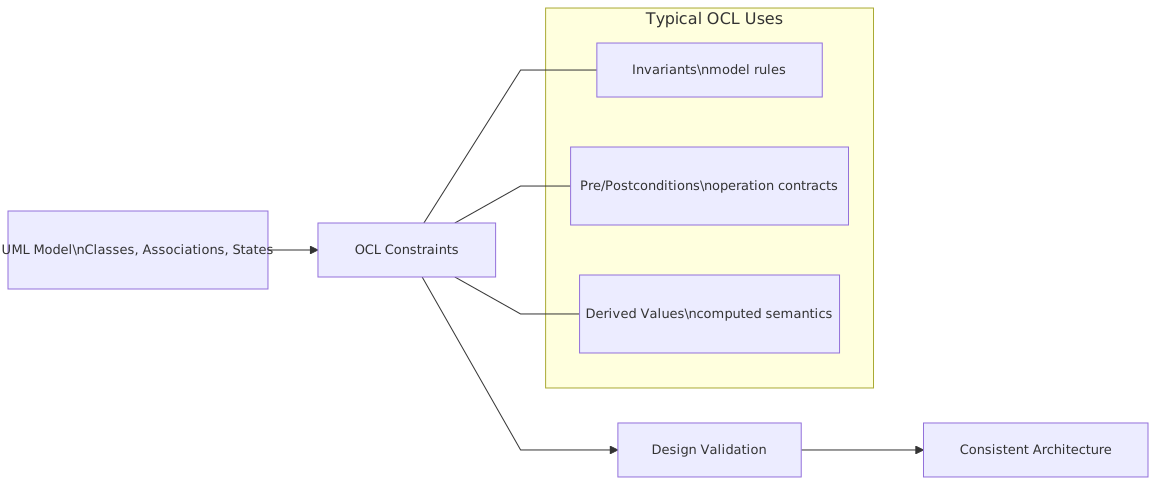
Why? Because vagueness helps in meetings. It keeps stakeholders aligned long enough to get a slide deck approved. It avoids difficult decisions. It lets everyone project their own assumptions onto the model.
OCL ruins that game.
The moment you write a constraint, somebody has to challenge it:
- Is that always true?
- What about exceptions?
- Which system enforces it?
- Is this policy or implementation?
- Does it apply globally or only in retail banking?
- What happens in migration scenarios?
That friction is healthy. It’s architecture doing real work instead of decorative work.
Where OCL fits in real enterprise architecture
Let’s be practical. You are not going to cover every UML model in OCL. You shouldn’t. That would be overkill and frankly annoying.
Use OCL where ambiguity is expensive.
In real architecture work, that usually means:
That’s where OCL pays for itself.
Not in drawing-room purity. In reducing downstream interpretation errors.
A useful mental model: UML shows shape, OCL shows truth
I use this line a lot with teams because it lands well:
- UML shows the shape of the system
- OCL shows the truth conditions of the system
A class diagram says what things exist and how they relate.
OCL says what combinations are valid.
Without OCL, a model is often just a picture of possibilities.
With OCL, it starts becoming a definition of acceptable reality.
That distinction matters enormously in regulated industries like banking.
Banking example: customer, accounts, and product rules
Let’s take a realistic enterprise case.
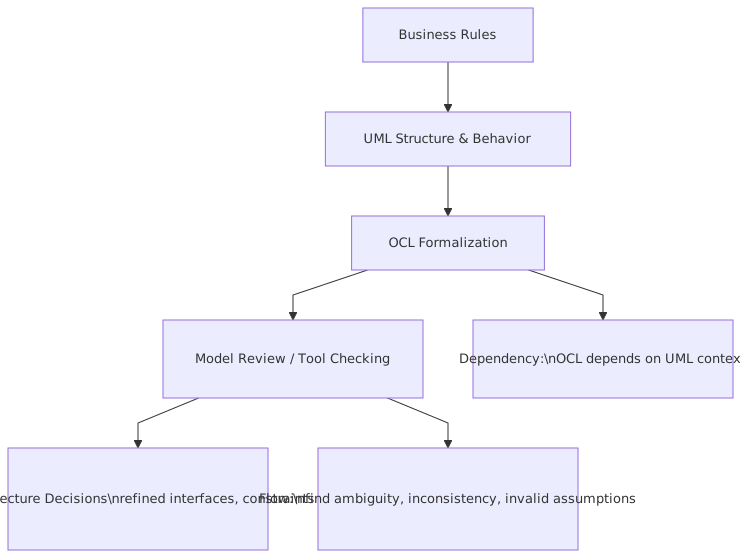
A bank is modernizing retail account servicing. The current estate includes:
- a core banking platform
- CRM
- IAM platform
- Kafka event streaming
- a cloud-based onboarding service
- downstream reporting and fraud systems
The architecture team creates a UML domain model with classes like:
CustomerAccountProductAccountHolderLegalEntityEventAccessAssignment
Looks solid. But then the implementation teams start asking questions:
- Can one customer hold multiple savings accounts of the same product?
- Can a minor be primary holder?
- Can a closed account still produce balance update events during settlement?
- Can staff accounts be created under the same product constraints as customer accounts?
- Can an account exist without a mapped legal entity during migration?
Now we’re in real architecture territory.
Here are the kinds of OCL constraints that help.
Example 1: one primary holder
`ocl
context Account
inv ExactlyOnePrimaryHolder:
self.holders->select(h | h.isPrimary = true)->size() = 1
`
This removes ambiguity immediately.
Example 2: minors cannot be primary holder for certain products
`ocl
context Account
inv MinorCannotBePrimaryForRestrictedProduct:
self.product.requiresAdultPrimaryHolder implies
self.holders->select(h | h.isPrimary = true).customer.age >= 18
`
Maybe your syntax gets tuned depending on tooling and model structure. Fine. The point is the rule is now attached to the model.
Example 3: account must map to one legal entity ledger
`ocl
context Account
inv MustHaveLedgerLegalEntity:
self.ledgerLegalEntity->size() = 1
`
This matters in banking because “we’ll map it later” becomes a reconciliation nightmare.
Example 4: closed accounts cannot emit operational transaction events
`ocl
context Account::publishTransactionEvent()
pre AccountMustBeOperational:
self.status = AccountStatus::Active
`
That one starts affecting event architecture, not just domain modeling.
And this is where OCL gets interesting. It forces alignment between business semantics and technical design. The operation itself may sit conceptually in one place, but the rule ripples into Kafka producers, downstream consumers, monitoring, and audit controls.
OCL and Kafka: yes, this is more relevant than people think
Some architects hear “OCL” and assume it’s only for static class models. That’s too narrow.
In event-driven architecture, especially Kafka-heavy enterprise estates, one of the biggest problems is imprecise event semantics. Teams define event payloads in JSON or Avro, but they still leave core business constraints implicit.
Schema validation is necessary. It is not enough.
A schema can tell you customerId is a string and eventTime is a timestamp. It cannot easily express higher-order business rules like:
- if
eventType = AccountClosed, thenclosureReasonmust exist - if
sourceSystem = LegacyCore, thenmigrationIndicator = true - a
CustomerMergedevent must reference at least two prior customer identifiers - a
PrivilegeGrantedevent must include approver details when role is privileged
Those are semantic constraints. OCL is one good way to define them in the architecture model before they become scattered across producers, validators, stream processors, and wiki pages.
For example:
`ocl
context AccountEvent
inv ClosureReasonRequired:
self.eventType = EventType::AccountClosed implies self.closureReason->notEmpty()
`
Or:
`ocl
context PrivilegeGrantedEvent
inv PrivilegedGrantNeedsApprover:
self.role.isPrivileged implies self.approverId->notEmpty()
`
Now, will Kafka itself execute OCL? Usually no. That misses the point. OCL is not valuable only when directly executable. It is valuable because it creates a precise rule source that can drive:
- schema governance
- validation logic
- API and event contract reviews
- test case generation
- control design
- implementation acceptance criteria
Architects who dismiss OCL because “the runtime doesn’t interpret it” are thinking too narrowly. Enterprise architecture is about governing design intent across multiple implementation layers.
IAM is where OCL earns respect fast
Identity and access management is rule-heavy, exception-heavy, and often modeled badly.
Most IAM diagrams show users, roles, entitlements, groups, applications, approval flows. Fine. But the actual control logic is usually hidden in policy engine configs, spreadsheets, or tribal knowledge. That is dangerous.
OCL helps expose the policy assumptions.
Consider a simple model:
IdentityRoleEntitlementAccessAssignmentApprovalApplicationRiskRating
Now add actual constraints.
`ocl
context AccessAssignment
inv ExpiryRequiredForPrivilegedAccess:
self.role.riskRating = RiskRating::High implies self.expiryDate->notEmpty()
`
`ocl
context AccessAssignment
inv BreakGlassMustBeTimeBound:
self.assignmentType = AssignmentType::BreakGlass implies
self.expiryDate > self.startDate
`
`ocl
context Identity
inv ServiceAccountCannotOwnItself:
self.identityType = IdentityType::ServiceAccount implies
self.owner->notEmpty() and self.owner <> self
`
That last one is exactly the kind of thing people forget. Then six months later you discover hundreds of service accounts with no accountable owner and no recertification path.
Real enterprise architecture work is full of these “small” rules with huge consequences.
Cloud architecture use case: ownership, policy, and deployment boundaries
Cloud programs produce a lot of diagrams and surprisingly little precision.
You’ll see landing zones, subscriptions, VPCs, workloads, clusters, secrets, identities. But ask simple questions and things get fuzzy:
- Does every workload have one accountable service owner?
- Can production workloads deploy without data classification?
- Must every public endpoint be linked to an API product or approved exception?
- Can a workload identity span multiple environments?
- Are encryption requirements attached to data class or workload type?
You can model these in UML. You should. But the constraints matter just as much.
Example:
`ocl
context Workload
inv MustHaveSingleServiceOwner:
self.serviceOwner->size() = 1
`
`ocl
context Workload
inv ProductionRequiresDataClassification:
self.environment = Environment::Production implies
self.dataClassification->notEmpty()
`
`ocl
context SecretStoreBinding
inv SecretStoreMustMatchEnvironment:
self.workload.environment = self.secretStore.environment
`
These aren’t implementation details. They are architecture guardrails. If you leave them out of the model, they end up inconsistently enforced by Terraform modules, policy-as-code, platform engineering conventions, and manual reviews. That fragmentation is one of the reasons enterprise cloud governance becomes painful. ARB governance with Sparx EA
Common mistakes architects make with OCL
Let’s get blunt. OCL itself is not the main problem. The way architects use it is.
Here are the common mistakes I see.
1. They use OCL too late
Some teams only introduce constraints when implementation is already underway and confusion has started. By then OCL becomes a cleanup tool instead of a design tool.
Use it earlier, during domain clarification and architecture decision-making.
2. They write technical constraints instead of business constraints
Bad example: a field length rule that belongs in implementation spec.
Better example: a privileged role assignment requires approval and expiry.
Architects should focus OCL on enterprise semantics and design-critical rules, not random low-level validations.
3. They over-model everything
This is classic architecture theater. Fifty classes, a hundred constraints, no one can maintain it.
Be selective. Model the high-risk, high-value rules.
4. They confuse exception cases with weak rules
A team says, “There are exceptions, so we can’t define the rule.” Wrong.
Usually it means the rule needs to be written properly, with explicit exception modeling.
For example, instead of dropping a rule:
`ocl
context AccessAssignment
inv ApprovalRequired:
self.approval->notEmpty()
`
you may need:
`ocl
context AccessAssignment
inv ApprovalRequiredUnlessEmergency:
self.assignmentMode <> AssignmentMode::Emergency implies self.approval->notEmpty()
`
That is better architecture. Exceptions are visible, not hidden.
5. They write unreadable OCL
If nobody can understand it, nobody will trust it.
Short constraints. Clear names. Good model structure. Don’t try to be clever.
6. They treat OCL as a replacement for prose
It isn’t. OCL complements explanation. A good architecture artifact often includes:
- the UML model
- the OCL constraints
- short narrative explaining intent and implications
You need both precision and readability.
7. They never connect constraints to enforcement
This is a big one. A constraint in a model with no ownership path is just a formalized wish.
Every important OCL rule should raise practical questions:
- Where is this enforced?
- Which system validates it?
- What happens on violation?
- Is it preventive or detective?
- Who owns the control?
That is enterprise architecture, not model collecting.
A real enterprise example: retail banking access and event modernization
Let me give you a realistic composite example. Not a toy one.
A bank is replacing parts of its customer servicing platform. It introduces:
- a cloud-native customer profile service
- Kafka for domain event distribution
- a centralized IAM platform for workforce and service access
- APIs for account servicing
- gradual migration from a legacy core
The architecture board approves a target domain model and event model. At first, the diagrams look fine. But delivery teams interpret key concepts differently:
- The IAM team allows temporary privileged support access without mandatory expiry if approved by a manager.
- The event team publishes
CustomerUpdatedevents even when mandatory KYC status is unknown, assuming consumers will handle it. - The onboarding service creates accounts before legal entity assignment is complete, planning enrichment later.
- The migration team emits account status events from legacy and new core with slightly different semantics for “closed”.
Classic enterprise mess. Sensible local decisions. Broken global coherence.
The architecture team steps in and adds a small but focused set of OCL constraints to the UML model.
Core banking constraints
`ocl
context Account
inv LegalEntityAssigned:
self.legalEntity->size() = 1
`
`ocl
context Account
inv ClosedAccountHasClosureDate:
self.status = AccountStatus::Closed implies self.closureDate->notEmpty()
`
Customer profile event constraints
`ocl
context CustomerUpdatedEvent
inv KYCStatusMandatory:
self.kycStatus->notEmpty()
`
`ocl
context CustomerUpdatedEvent
inv SourceCustomerReferenceMandatory:
self.sourceCustomerId->notEmpty()
`
IAM constraints
`ocl
context AccessAssignment
inv PrivilegedAccessMustExpire:
self.role.isPrivileged implies self.expiryDate->notEmpty()
`
`ocl
context AccessAssignment
inv ManagerApprovalInsufficientForHighRisk:
self.role.riskLevel = RiskLevel::High implies
self.approval->exists(a | a.approverType = ApproverType::ControlOwner)
`
Now notice what happens. The model is not just “cleaner.” It becomes governable.
The consequences are practical:
- API design changes so account creation is blocked until legal entity assignment is complete, except for explicitly modeled migration cases.
- Kafka producer validation adds mandatory checks for KYC status and source references.
- IAM workflows are updated so high-risk access requires control-owner approval, not just line manager approval.
- Test teams derive negative test cases directly from the constraints.
- Audit and risk teams finally see where business rules are represented in architecture rather than buried in implementation tickets.
That is real value.
And no, this does not solve everything. But it narrows the room for contradictory interpretation. In enterprise programs, that is a major win.
How to use OCL without annoying everyone
This matters because adoption fails when architects turn OCL into a purity exercise.
Here’s a practical approach.
Start with business pain, not notation
Don’t open with “we should formalize constraints in OCL.” People’s eyes glaze over.
Start with:
- “We have conflicting interpretations of privileged access.”
- “Our event contracts don’t express validity rules.”
- “Teams keep implementing product eligibility differently.”
Then show how OCL captures those rules precisely.
Use it on a few critical models first
Good candidates:
- customer/account domain model
- IAM access model
- event model for key Kafka topics
- cloud workload governance model
Don’t try to formalize the whole enterprise metamodel in one go. That way lies madness.
Keep a rule catalog
I strongly recommend maintaining a compact table like this alongside the model:
This is one of those simple things architects skip because it feels administrative. It’s not. It is what turns formal constraints into operational architecture assets.
Be explicit about exceptions
If a migration path or emergency mode exists, model it. Don’t leave delivery teams to infer policy exceptions from silence.
Link constraints to ADRs and controls
If an OCL rule reflects an architectural decision, connect it to the architecture decision record. If it reflects a control, connect it to control ownership. That creates traceability people can actually use.
Should OCL be executable?
Another contrarian opinion: executable OCL is nice, but it is not the main point.
Some architecture communities get obsessed with whether OCL can be enforced automatically by specific UML tools, code generators, or validation engines. Useful question, but secondary.
The bigger value is that OCL forces precision in the architecture itself.
If you can also make it executable or translatable into:
- API validation rules
- schema checks
- policy-as-code
- test assertions
- data quality controls
great. Do it.
But if you wait for perfect end-to-end automation before using OCL, you’ll never start.
Architects need to stop using tool limitations as an excuse for conceptual laziness.
When not to use OCL
Let’s be honest. OCL is not always the right answer.
Don’t use it when:
- the model is too unstable and core concepts are still changing daily
- the team has no basic UML discipline at all
- a simple business rule catalog would solve the problem faster
- the rule is purely implementation-specific and belongs in code or schema
- nobody is going to maintain the constraints
Also, don’t force OCL into every stakeholder conversation. Executives don’t need it. Some product people don’t need it. Delivery teams need the implications more than the notation.
Use the right level of formality for the audience. That’s part of being a good architect.
My view: OCL is underrated because it exposes weak architecture
That’s really the heart of it.
OCL is not popular because it makes architecture less comfortable. It reveals where concepts are fuzzy, ownership is unclear, exceptions are unmanaged, and “alignment” was mostly political.
And yet in serious enterprise work, especially where banking, IAM, Kafka, and cloud governance intersect, that is exactly why it matters. EA governance checklist
You do not need dozens of constraints. You need the right ones.
A good OCL-enhanced UML model helps answer:
- What must always be true?
- What is allowed to vary?
- What is forbidden?
- Where do exceptions exist?
- Which system or process enforces the rule?
If your architecture artifacts can’t answer those questions, they are not doing enough.
Not every model needs OCL. But every critical enterprise model needs some mechanism for expressing truth beyond pictures. OCL is still one of the best options we have.
It’s old. A bit unfashionable. Sometimes awkward. Very much worth using.
That combination, by the way, describes quite a few good architecture practices.
FAQ
1. Is OCL too academic for enterprise architecture teams?
No. It becomes academic only when architects use it to impress each other. In practice, a small number of well-written OCL constraints can remove major ambiguity from banking, IAM, event, and cloud models.
2. Do I need special tools to get value from OCL?
Not necessarily. Tool support helps, especially for validation and traceability, but the first value comes from writing precise constraints in the model and using them in reviews, design decisions, and acceptance criteria.
3. How is OCL different from schema validation in Kafka or API contracts?
Schema validation checks structural correctness. OCL is better for semantic rules across model elements and conditions. You usually need both. Schema says the field exists and has the right type. OCL says when it must exist and what business conditions make the event valid.
4. What are the best places to start using OCL?
Start where ambiguity is expensive: account and customer domain models in banking, privileged access and service accounts in IAM, high-value Kafka event contracts, and cloud workload governance models with ownership and classification rules.
5. What’s the biggest mistake when introducing OCL?
Trying to formalize everything at once. Start with a few critical constraints tied to real architecture pain. If the rules matter operationally and people can understand them, OCL will gain credibility fast.
Frequently Asked Questions
What is enterprise architecture?
Enterprise architecture is a discipline that aligns an organisation's strategy, business processes, information systems, and technology. Using frameworks like TOGAF and modeling languages like ArchiMate, it provides a structured view of how the enterprise operates and how it needs to change.
How does ArchiMate support enterprise architecture practice?
ArchiMate provides a standard modeling language that connects strategy, business operations, applications, data, and technology in one coherent model. It enables traceability from strategic goals through business capabilities and application services to the technology platforms that support them.
What tools are used for enterprise architecture modeling?
The main tools are Sparx Enterprise Architect (ArchiMate, UML, BPMN, SysML), Archi (free, ArchiMate-only), and BiZZdesign Enterprise Studio. Sparx EA is the most feature-rich option, supporting concurrent repositories, automation, scripting, and integration with delivery tools like Jira and Azure DevOps.