⏱ 21 min read
Feature flags are often introduced like a harmless screwdriver in a developer’s toolbox. A little switch here, a rollout there, maybe a kill switch for a troublesome release. Then the estate grows, teams multiply, services proliferate, and before long the humble toggle has become a shadow architecture. Decisions about pricing, compliance, user eligibility, failover, experimentation, and risk all start hiding behind if statements. At that point, the question is no longer whether you use feature flags. The real question is whether you understand what kind of decisions they are carrying.
That distinction matters more than most teams admit.
In practice, two families of toggles dominate serious enterprise systems: operational toggles and business toggles. They may look identical in code, and they may even be managed through the same feature flag platform, but architecturally they are not the same creature. One controls system behavior in service of reliability, resilience, safety, and delivery. The other expresses domain policy, commercial rules, customer entitlements, or regulatory distinctions. Treat them as interchangeable and you build a system that is easy to switch but hard to reason about. Worse, you create a platform where production operations can accidentally rewrite business meaning.
That is not a technical nuisance. It is a semantic failure.
This article draws the line clearly. It explains how to classify toggles, where each kind belongs, how they behave in microservices and Kafka-based environments, how to migrate from a tangled flag estate, and where teams get hurt when they blur operational concerns with business policy. The central argument is simple and, in my view, worth being stubborn about: event-driven architecture patterns
> An operational toggle is infrastructure wearing application clothes.
> A business toggle is domain policy that must be treated as a first-class business concept.
If you remember only that sentence, you’ll avoid a surprising amount of pain.
Context
Feature flags became popular because they solved a real delivery problem. They decoupled deployment from release. That was a good thing. Enterprises needed safer rollouts, canary releases, dark launches, and kill switches. In large organizations with weekly release trains, regulatory windows, and fragile integration points, toggles gave teams room to breathe.
Then they started doing more.
Product teams used flags to gate customer segments. Risk teams used them to switch fraud thresholds. Compliance teams wanted country-specific behavior. Sales wanted premium entitlements. Operations wanted emergency degrade modes. Platform teams wanted runtime control over expensive external calls. Architects, predictably, discovered that one mechanism could solve ten unrelated problems. That is where things became interesting.
The problem is not that flags are overused. The problem is that their classification is neglected. Teams name them poorly, place them in the wrong bounded context, replicate them inconsistently across services, and evaluate them without regard to domain semantics. A flag named new_checkout_enabled might mean:
- enable a UI route,
- route traffic to a new orchestration service,
- allow a new payment method,
- launch a promotion for a customer segment,
- comply with a market-specific tax rule,
- or disable a fragile dependency during an incident.
Those are radically different decisions, yet they often get modeled with the same implementation pattern and the same governance. That is architectural laziness disguised as flexibility. EA governance checklist
Domain-driven design gives us a better lens. If a toggle changes the meaning of a business process, customer outcome, legal decision, or entitlement, then it belongs in the domain conversation. If it changes technical execution, resiliency posture, operational routing, or release safety, then it belongs in the operational conversation. The syntax may be the same. The semantics are not.
Problem
The enterprise failure mode usually starts with good intentions.
A platform team introduces a centralized feature flag service. Every service can query flags. Teams can target by environment, tenant, region, or user. Auditing exists. There is a UI. Everyone is happy.
Six months later, the same mechanism is controlling:
- whether checkout uses synchronous or asynchronous inventory reservation,
- whether high-risk loans require manual review,
- whether a premium customer can access cross-border transfers,
- whether a Kafka consumer should pause event ingestion,
- whether fallback pricing is allowed when the rules engine times out,
- whether a regulator-mandated disclosure appears in one market.
These choices are not equivalent.
Operational toggles are usually short-lived, environment-aware, incident-friendly, and owned by delivery or platform teams. They are there to protect the system. Their purpose is not to define business truth but to control system execution.
Business toggles are usually meaning-bearing, customer-visible, often long-lived, and owned by product, risk, pricing, compliance, or domain teams. They affect what the business promises and what the enterprise is accountable for.
When teams fail to distinguish them, several pathologies appear:
- Business policy leaks into operational tooling
A support engineer can flip a “technical” toggle during an incident and accidentally change customer entitlements.
- Operational kill switches become legal liabilities
A flag intended for rollout control silently disables a compliance check because no one recognized it as a business-critical rule.
- Semantic drift across microservices
One service interprets premium_transfer_enabled as UI visibility, another as settlement eligibility, another as fraud bypass. The name stays the same while the meaning fractures.
- Kafka consumers diverge in event interpretation
If a consumer evaluates business flags at processing time instead of using the policy that existed when the event was created, replay and reconciliation become untrustworthy.
- Toggle debt hardens into architecture debt
Temporary operational switches become permanent hidden coupling points. Business toggles become surrogate rule engines. Nobody knows what can be deleted.
This is why toggle classification belongs in architecture, not just engineering hygiene.
Forces
A real architecture article should name the forces honestly. Enterprises don’t make poor toggle decisions because they are careless. They do it because the landscape pushes them there.
1. Speed vs semantic clarity
Teams want one standard mechanism for all runtime decisions. It lowers cognitive load in the short term. But standardizing implementation too early often erases important semantic distinctions. One hammer, many bent screws.
2. Central control vs bounded context autonomy
A centralized flag platform improves visibility and governance. Yet business meaning lives in bounded contexts. Pricing, onboarding, fraud, and settlement may all need “flags,” but those decisions are owned differently and evaluated differently. Centralization helps tooling. It does not replace domain ownership. ArchiMate for governance
3. Runtime flexibility vs historical correctness
Operational toggles are often evaluated “now.” That is fine for traffic shifting or dependency failover. Business toggles are trickier. If a policy changes between command handling and event replay, which truth should prevail? In event-driven systems, historical correctness matters. This is where reconciliation becomes unavoidable.
4. Safety vs simplicity
Operational toggles enable kill switches, circuit-breaking strategies, and graceful degradation. Business toggles may require audit, approval, policy traceability, and customer-level explainability. The more we use a single toggle mechanism for both, the more the platform either becomes too heavy for operations or too weak for policy.
5. Local optimization vs enterprise consistency
A team can easily embed a business flag in service code and move on. But across dozens of microservices, “just one flag” turns into an inconsistent policy mesh. Enterprises need local delivery speed without losing enterprise-wide policy coherence. microservices architecture diagrams
6. Experimentation vs accountability
A/B testing and staged rollout are operationally adjacent to product launches, but not all experiments are harmless. If a toggle affects loan approval criteria, transaction limits, claims processing, or tax logic, then “experiment” is not a free pass. Domain semantics outrank experimentation convenience.
Solution
The solution is not “use separate flag products,” though some organizations eventually do. The solution begins with a clearer classification model and explicit ownership.
Operational toggles
Operational toggles control how the system behaves technically. They typically affect:
- routing,
- rollout percentage,
- canary release,
- kill switch behavior,
- fallback paths,
- retry or timeout policies,
- optional dependency calls,
- asynchronous processing modes,
- degradation strategies,
- maintenance modes.
They are usually:
- short-lived or medium-lived,
- environment-scoped,
- operationally owned,
- safe to evaluate at runtime,
- not part of durable business truth.
Examples:
use_new_fraud_adapterdisable_card_network_xenable_async_document_generationpause_email_dispatchdegrade_search_to_cache
These are not trivial. They can be mission-critical. But they should not decide who is eligible for a mortgage.
Business toggles
Business toggles control what the business means, offers, permits, requires, or forbids. They typically affect:
- product availability,
- customer entitlement,
- pricing and discount policy,
- compliance and legal rules,
- underwriting criteria,
- approval thresholds,
- market-specific capability,
- premium features,
- partner contract behavior.
They are usually:
- longer-lived or policy-lifecycle-driven,
- tenant/customer/market scoped,
- domain-owned,
- auditable as part of business governance,
- tied to domain language,
- often requiring historical traceability.
Examples:
cross_border_transfer_allowed_for_smemanual_review_required_for_high_risk_claimspremium_tier_includes_expedited_settlementmarket_br_requires_tax_disclosure_v2
A useful rule of thumb:
> If a regulator, auditor, product manager, or customer success leader would care about the exact meaning of the switch, it is probably a business toggle.
The architectural move
Do not model all toggles as generic booleans floating outside the domain. Instead:
- Keep operational toggles in technical configuration and release management paths.
- Elevate business toggles into domain concepts, policy services, product catalogs, entitlement models, or rules engines where appropriate.
Sometimes a so-called business toggle is not a toggle at all. It is really a policy rule, eligibility decision, or product configuration. Calling it a feature flag is merely a convenient lie.
That lie becomes expensive.
Architecture
A sound architecture separates toggle evaluation by semantic layer.
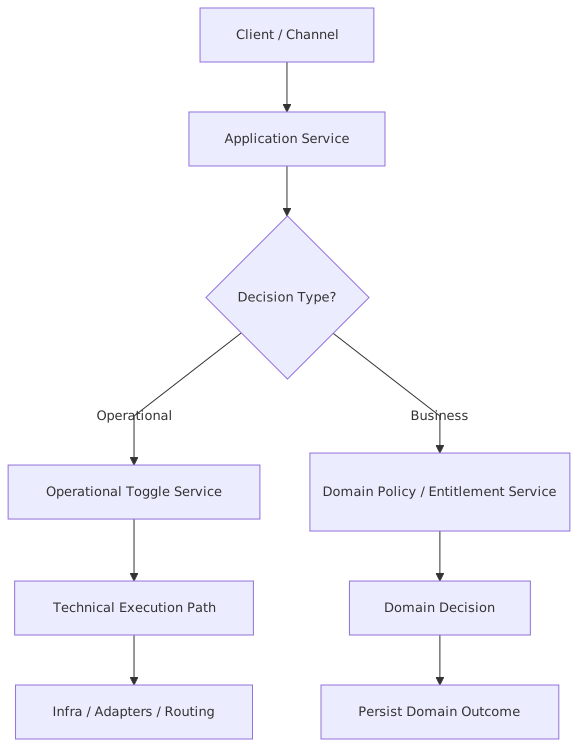
This diagram looks simple because the core idea is simple: different kinds of decisions deserve different homes.
Operational toggle architecture
Operational toggles are best evaluated close to execution flow, ideally in application or infrastructure layers. They should influence technical behavior without contaminating domain models.
Examples:
- A payment service chooses between two gateway adapters.
- A Kafka consumer decides whether to process in parallel.
- A web application turns on server-side rendering for a route.
- A batch process disables an expensive downstream call during an incident.
These toggles can often be cached aggressively, changed frequently, and propagated quickly.
Business toggle architecture
Business toggles should usually be represented through domain services or policy models. They should have names in the ubiquitous language and be evaluated in the context of a domain decision.
Examples:
CustomerEntitlementPolicyTransferEligibilityPolicyClaimsReviewPolicyRegionalCompliancePolicy
This has two benefits. First, the code reads like the business. Second, the toggle no longer hides alone; it lives inside a decision that can be explained, tested, versioned, and audited.
For instance, instead of:
you want something closer to:
Inside that policy, a flag may still exist. But now it is subordinate to business meaning, not masquerading as meaning.
Event-driven systems and Kafka
Kafka complicates the picture in exactly the way mature architectures tend to get complicated: history matters.
If an event is produced under one business policy and consumed later under another, you have a reconciliation problem. Operational toggles rarely care about this. Business toggles absolutely do.
Consider a loan application event stream:
- At 10:00, policy says loans above a threshold require manual review.
- At 10:15, the business toggle changes.
- At 11:00, a consumer replays earlier events.
If the consumer re-evaluates the current business toggle instead of using the policy effective at event creation time, the replay may produce different decisions. That breaks auditability and trust.
The answer is not to avoid flags. The answer is to preserve policy context.
Patterns that help:
- include decision version or policy snapshot identifier in events,
- persist the resulting business decision rather than re-evaluating on replay,
- separate event processing from current runtime operational controls,
- use reconciliation jobs to compare historical outcomes when policy changes require back-processing.
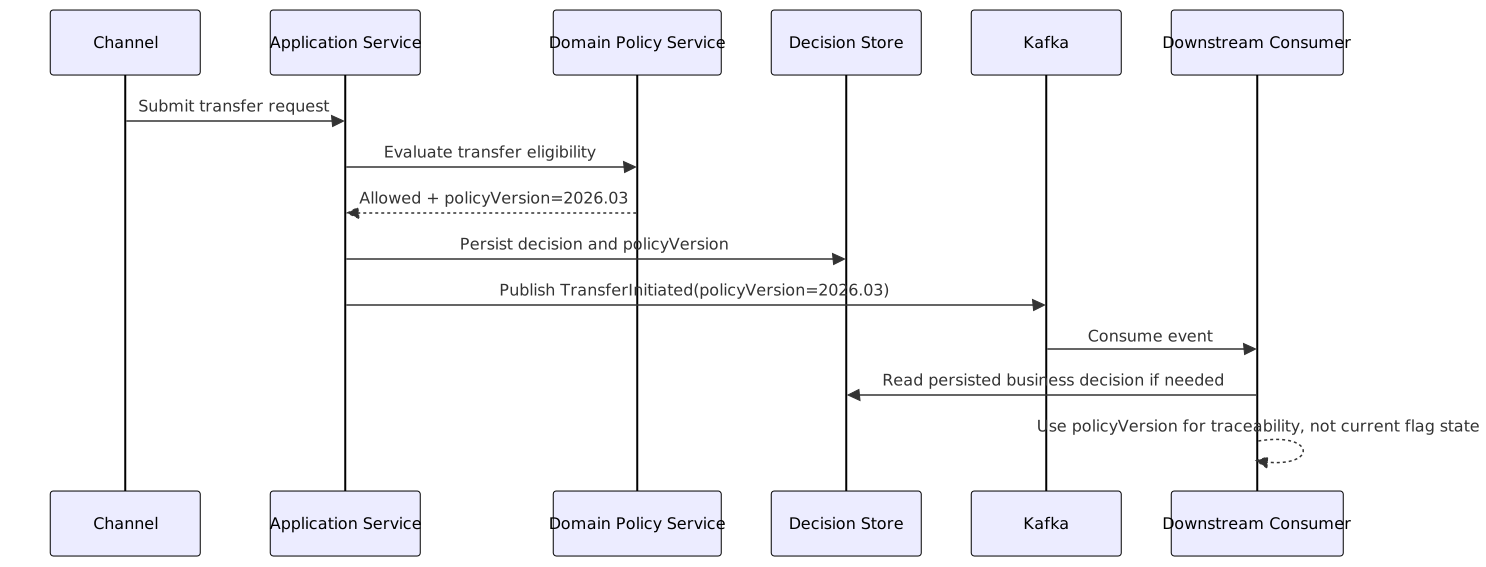
That single choice—capturing business decision context—avoids a host of reconciliation disasters.
Reconciliation
In enterprises, policy changes are rarely clean. A product rule changes on Monday, a settlement service still has stale cache on Tuesday, and a batch compensator reprocesses on Wednesday. You need a reconciliation approach for business toggles whenever outcomes can diverge over time.
Reconciliation may involve:
- identifying records processed under old policy versions,
- replaying commands or events into a policy simulator,
- issuing compensating actions,
- notifying downstream systems of corrected state,
- creating legal or financial audit evidence.
This is not overengineering. It is what happens when toggles stop being technical switches and start shaping money, rights, or obligations.
Migration Strategy
Most enterprises do not start with clean toggle classification. They start with a heap. So migration matters.
The right migration is usually progressive and strangler-like. You do not freeze delivery and redesign every flag. You gradually extract semantics from generic flags and relocate them into proper architectural homes.

Step 1: Create a toggle inventory
List every toggle with:
- name,
- description,
- owner,
- consuming systems,
- scope,
- expected lifespan,
- failure impact,
- whether it changes business meaning.
This exercise alone is usually revealing. Teams often discover “temporary” flags older than some junior engineers.
Step 2: Classify by semantic impact
Ask bluntly:
- Does this affect customer eligibility, price, compliance, contractual behavior, or domain outcome?
- Or does it affect rollout, routing, resilience, dependency use, or system performance?
If the answer is both, that is usually a smell. Split the decision.
For example:
new_checkout_enabledmight really be two toggles:
- route_checkout_to_v2 — operational
- installment_payments_available_for_market_x — business
Step 3: Introduce façade APIs
Do not let every service query generic flags directly. Create APIs with meaningful names.
Instead of:
featureFlagService.isEnabled("x")
use:
checkoutRoutingPolicy.useV2()transferEligibilityPolicy.allows(...)
This is the beginning of strangler migration. Existing implementation may still call the same flag platform underneath. That is fine. The point is to isolate semantics.
Step 4: Move business toggles into domain services
For business toggles, move evaluation into the bounded context that owns the decision. Over time this may evolve into:
- a policy engine,
- a product configuration service,
- an entitlement service,
- a pricing rules service,
- a compliance decision service.
Not every business toggle deserves a heavyweight rules engine. But if dozens of “flags” are really product or policy rules, then pretending they are simple booleans is denial, not simplicity.
Step 5: Persist business decisions
Where outcomes matter over time, persist:
- the decision,
- policy version,
- rationale,
- effective timestamp,
- maybe even the inputs.
This supports replay, reconciliation, customer support, and audit.
Step 6: Retire direct flag calls
Finally, remove raw generic flag checks from domain code. Leave operational flags where they belong, but stop letting business semantics leak into infrastructure-style APIs.
This is classic strangler migration: wrap, classify, redirect, and retire.
Enterprise Example
Consider a multinational retail bank modernizing its payments platform. It has mobile apps, a customer profile domain, an entitlement service, a payment orchestration layer, Kafka-based event streams, and downstream settlement microservices. The bank wants to launch cross-border SME payments in selected markets while replacing a legacy sanctions screening adapter and preserving rollback safety.
At first glance, one team proposes a single feature flag: cross_border_payments_enabled.
That name is a trap.
In reality, the bank has at least four distinct concerns:
- UI exposure
Should the mobile app show the cross-border payment option?
- Business entitlement
Are SME customers in Germany and Singapore allowed to use cross-border payments under current product policy?
- Compliance policy
Do transfers above a threshold require enhanced screening or additional disclosures by market?
- Operational routing
Should payment screening use the new sanctions adapter or the old one?
The architecture improved when the bank split them:
show_cross_border_payment_option— operational/product presentation, short-lived rolloutCrossBorderEntitlementPolicy— business decision in the payments domainRegionalCompliancePolicy— business decision owned with complianceuse_new_screening_adapter— operational toggle for technical routing
In the first release, the mobile app exposed the option only for internal staff and pilot customers. The entitlement service decided actual customer eligibility. The payment orchestration service persisted the entitlement and compliance decision with policy version metadata. Kafka events carried the policy version and decision outcome downstream. Settlement services did not re-evaluate current business flags. They executed the persisted business decision.
During rollout, the new screening adapter began timing out in one region. Operations flipped use_new_screening_adapter off. Traffic reverted to the old adapter. No customer entitlements changed. No compliance semantics changed. The switch did exactly what an operational toggle should do: protect technical execution without rewriting business meaning.
Later, the bank expanded cross-border payments to more SME tiers. That was not done by flipping a generic feature flag in the operational console. It was implemented as a change in the entitlement policy model, versioned, tested, approved, and auditable.
That separation sounds modest. In production, it is the difference between a controlled enterprise platform and a runtime superstition engine.
Operational Considerations
Even with good classification, toggles need discipline.
Ownership
Every toggle must have a clear owner:
- platform/SRE for operational toggles,
- product/domain/compliance owner for business toggles.
Shared ownership usually means no ownership.
Lifespan
Operational toggles should usually have expiry dates. Long-lived operational flags create branching logic that nobody trusts. Business toggles can be long-lived, but if they are permanent, they may belong in product or policy configuration rather than a flag system.
Naming
Names must reveal intent. Avoid names like:
new_logic_enabledv2smart_routing
Prefer names that expose semantics:
degrade_to_cached_exchange_ratesmanual_review_required_for_high_risk_claimsroute_payments_to_screening_adapter_b
Good names prevent category confusion.
Auditability
Business toggles require stronger audit than operational toggles:
- who changed it,
- why,
- approval path,
- affected customer segments,
- legal basis where applicable,
- effective date and policy version.
Propagation and caching
Operational toggles often need rapid propagation and can tolerate eventual consistency. Business toggles need consistency aligned to domain risk. A stale operational kill switch is annoying. A stale eligibility decision can be expensive, illegal, or both.
Testing
Test strategies differ:
- operational toggles: chaos, failover, rollback, resilience drills,
- business toggles: policy examples, boundary cases, decision tables, market-specific scenarios, replay tests.
Kafka and eventual consistency
If business toggles affect event outcomes, design explicit strategies for:
- event versioning,
- policy snapshots,
- idempotency,
- replay correctness,
- compensation and reconciliation.
These are not edge cases in an enterprise. They are Tuesday.
Tradeoffs
There is no free architecture here. Separation brings clarity, but it also introduces design decisions.
Benefit: better semantic integrity
Cost: more architectural surface area
You may end up with a flag service, a policy service, and an entitlement model instead of one generic mechanism. That is additional complexity. It is justified when business semantics matter.
Benefit: safer operations
Cost: stricter governance
Operational teams can move quickly when technical flags are clearly theirs. But they lose the illusion that one console controls everything. Good. That illusion was dangerous.
Benefit: historical correctness in event-driven systems
Cost: more persistence and versioning
Capturing policy versions and durable decisions takes effort. So does reconciliation. But if you process money, insurance claims, medical actions, or regulated workflows, you need that effort.
Benefit: bounded context ownership
Cost: reduced central simplicity
A central flag platform team may prefer a unified model. Yet bounded contexts need autonomy over business semantics. Tooling can be centralized. Meaning should not be.
Benefit: reduced toggle debt
Cost: migration work now
Untangling generic flags into operational and business categories requires refactoring. It is worth it, because hidden semantics age badly.
Failure Modes
Architectures are best judged not by their diagrams but by how they fail.
1. Generic toggle overload
A single flag controls UI exposure, backend routing, and customer eligibility. During rollback, engineers disable it and accidentally remove active customer rights. This is one of the most common enterprise mistakes.
2. Re-evaluating business toggles on replay
A Kafka consumer reprocesses historical events using today’s business flags. Audit fails. Settlement totals differ. Support can no longer explain outcomes. Reconciliation becomes a war room.
3. Toggle drift across services
Different microservices implement the same business flag with different defaults, caching, or target rules. The architecture claims central control while reality is fragmented.
4. Operational toggles become permanent architecture
A “temporary” routing toggle remains for years, creating two production paths, uneven test coverage, and chronic uncertainty. Nobody remembers which path is authoritative.
5. Business toggles bypass domain language
Developers scatter isEnabled("gold_customer_v2") throughout services instead of modeling entitlements or offers properly. The domain gets replaced by folklore.
6. Stale cache causes semantic inconsistency
One service has new business policy data, another still has old values. Customers get contradictory answers in adjacent steps of the same journey. This is especially painful in omnichannel enterprises.
7. Weak governance for high-risk domain flags
A compliance-critical business toggle is changed with no approval trail because it lives in the same workflow as harmless canary flags. That is governance theater, not governance.
When Not To Use
Not every decision should be a toggle.
Do not use a business toggle when the requirement is really stable domain configuration
If a product line, entitlement matrix, or jurisdictional rule is permanent and structured, model it as product or policy data. A feature flag system is not a substitute for a product catalog.
Do not use toggles for deep invariants
If a business invariant must always hold—say, “settled transactions cannot be reversed without compensation workflow”—that belongs in the domain model. Hiding it behind a flag invites accidental corruption.
Do not use operational toggles as a replacement for proper resilience engineering
A kill switch is useful. It is not a substitute for timeouts, circuit breakers, bulkheads, backpressure, and capacity planning.
Do not use a shared toggle for multiple semantic concerns
If one flag means three things, it means nothing clearly.
Do not use business toggles without explainability
If customer support, audit, or legal teams cannot reconstruct why a decision was made, the mechanism is inadequate for the problem.
Related Patterns
This topic touches several neighboring patterns.
Release toggles
Classic deployment/release controls. Almost always operational.
Canary release and dark launch
Operational rollout techniques. Useful, but they should not silently carry business semantics.
Kill switches
Pure operational safety valves. Keep them simple and well-governed.
Policy engine
A better fit than feature flags for rich business rules, especially when rules are numerous, structured, or decision-table driven.
Entitlement service
A natural home for business toggles related to customer rights, plans, and package access.
Product configuration
Useful where offerings differ by market, segment, or contract. Often preferable to long-lived business flags.
Strangler fig pattern
Ideal for migrating from generic toggle sprawl toward semantically explicit policy services and operational controls.
Saga and compensation
Relevant when business-toggle-driven outcomes must be corrected after asynchronous processing or policy shifts.
Event sourcing and snapshotting
Helpful when you need historical reconstruction of policy-driven decisions, though not mandatory for all systems.
Summary
Feature flags are not one thing. Treating them as one thing is how enterprises end up with fast switches and slow understanding.
Operational toggles and business toggles may share tooling, but they should not share semantics, ownership, or architectural placement. Operational toggles belong to release safety, resilience, routing, and technical execution. Business toggles belong to domain policy, entitlement, compliance, and product meaning. One protects the system. The other defines what the business is actually doing.
That distinction becomes critical in microservices, and even more so with Kafka and asynchronous workflows. Operational decisions can often be evaluated at runtime with little historical baggage. Business decisions must often be versioned, persisted, and reconciled. If you replay events under new business flags and expect truth to survive, you are building on wishful thinking.
The migration path is not dramatic. Inventory your toggles. Classify them by semantic impact. Wrap them in meaningful APIs. Move business logic into domain services. Persist policy context where history matters. Retire raw generic flag checks from domain code. This is classic progressive strangler migration: not a revolution, just a series of correct moves.
The memorable line is this: a toggle is easy to add, but expensive to misunderstand.
Classify them well, and feature flags remain a useful operational instrument. Classify them badly, and they become a secret constitution for your enterprise—written in scattered conditionals, enforced by accident, and understood by nobody when it matters most.
Frequently Asked Questions
What is enterprise architecture?
Enterprise architecture aligns strategy, business processes, applications, and technology in a coherent model. It enables impact analysis, portfolio rationalisation, governance, and transformation planning across the organisation.
How does ArchiMate support architecture practice?
ArchiMate provides a standard language connecting strategy, business operations, applications, and technology. It enables traceability from strategic goals through capabilities and services to infrastructure — making architecture decisions explicit and reviewable.
What tools support enterprise architecture modeling?
The main tools are Sparx Enterprise Architect (ArchiMate, UML, BPMN, SysML), Archi (free, ArchiMate-only), and BiZZdesign. Sparx EA is the most feature-rich, supporting concurrent repositories, automation, scripting, and Jira integration.