⏱ 22 min read
Most architecture diagrams lie.
Not because architects are dishonest, but because boxes and arrows freeze a world that is never still. They show the happy path, the sanctioned path, the path everyone agreed on in a workshop with too many sticky notes and not enough production traffic. Then the system goes live. Retries appear. Timeouts breed in dark corners. Teams fork semantics without realizing it. “Order confirmed” means one thing in checkout, another in fulfillment, and something else entirely in finance. By the time the quarterly architecture review arrives, the real system is no longer the one in PowerPoint. It is the one expressed in traces, logs, metrics, dead-letter queues, and ugly compensations.
That is why observability has to move out of operations and into design.
Most firms still treat observability as plumbing: dashboards for SRE, alerts for on-call, tracing for postmortems. Necessary, yes. Sufficient, no. In distributed systems, observability is not just how you watch the machine. It is how you discover what machine you actually built. Traces, service dependencies, event flows, latency distributions, and reconciliation patterns expose the true domain boundaries, the hidden couplings, and the places where architecture has drifted away from business intent.
An observability-driven architecture takes that seriously. It treats telemetry not as a byproduct but as a design input. Traces feed the design loop. They reveal where a bounded context is leaking, where an orchestration has become an accidental monolith, where Kafka topics have turned into shared databases with better marketing, and where “eventual consistency” is being used as a polite synonym for “nobody knows when this completes.” event-driven architecture patterns
This is not a call to instrument everything in sight and pray that the data warehouse will save you. That path ends in cardinality explosions, expensive SaaS bills, and developers who no longer trust any signal. The point is sharper than that: design the system so that its runtime evidence expresses domain semantics. If a business capability matters, it should be traceable. If a state transition matters, it should be observable. If a cross-context handoff matters, it should leave enough evidence that a human can understand whether the business process is healthy.
That changes architecture.
It changes how you define services. It changes how you name events. It changes how you migrate from monoliths to microservices. And it absolutely changes how you reason about failure. microservices architecture diagrams
Context
Distributed systems fail in ways that centralized systems merely sulk. A monolith can be slow, buggy, or ugly, but at least it usually fails in one place. A distributed system can be perfectly healthy in nine services while the tenth quietly poisons customer experience. Worse, every local team can claim their service is “green” while the end-to-end business journey is broken.
This is the gap between technical health and business health.
Traditional observability stacks focus on infrastructure symptoms: CPU, memory, request rate, tail latency, error budgets. Valuable, but incomplete. The enterprise does not sell 99.95% uptime. It sells fulfilled orders, settled claims, approved loans, paid invoices, booked shipments. Those are domain outcomes, and they cut across services, data stores, queues, and teams.
Domain-driven design gives us a language for this. Business capabilities live in bounded contexts. Each bounded context owns a model. Context mapping tells us how models relate and where translations happen. In theory, that is clear. In practice, once systems are split across microservices, Kafka streams, APIs, and vendor platforms, the seams become noisy. The runtime path of a customer journey often says more about your real context boundaries than your architecture repository ever will.
That is the architectural opportunity. Observability can become the empirical feedback mechanism for DDD. Instead of assuming context boundaries are right, we test them against runtime behavior. If traces consistently show long synchronous chains across three “independent” services just to approve a claim, then those services are not independent in any meaningful business sense. If a single Kafka topic is consumed by a dozen teams with incompatible interpretations of status fields, then the event contract is not a domain event. It is a shared confusion.
Observability-driven architecture starts from the idea that runtime evidence should shape design decisions continuously, not only after outages.
Problem
Most distributed estates suffer from one or more of these diseases:
- Local optimization, global blindness
Teams optimize their service metrics while nobody owns the business transaction end to end.
- Telemetry disconnected from domain semantics
You can see p95 latency for POST /v1/process, but not the rate of “policy issued but premium not collected within 15 minutes.”
- Tracing as forensic tooling only
Traces are consulted after incidents, not used to shape service decomposition, event design, or migration.
- Event-driven systems with weak business observability
Kafka topics move data beautifully, but the enterprise cannot answer, “Where is this order right now?” without joining six systems and a spreadsheet.
- Migrations that create new complexity without new understanding
Teams carve services out of a monolith, add sidecars and brokers, and end up with a more fragile system whose behavior is harder to explain.
The painful irony is that many organizations have plenty of telemetry. They have metrics, logs, traces, SIEM tools, APM agents, synthetic monitoring, and half a dozen vendor products. Yet they still do not understand the business flow. This is because they instrument technical components rather than domain interactions.
An order does not care that Envoy retried twice. A payment does not care that pod autoscaling worked. Those things matter operationally, but architecture begins with the business language. If telemetry is not aligned with domain events, business invariants, and cross-context handoffs, you get noise instead of knowledge.
Forces
There are several competing forces here, and architecture is mostly the art of deciding which pain you want to live with.
1. Autonomy versus end-to-end coherence
Microservices promise team autonomy. Fine. But customer journeys cut across teams. You cannot let every service emit arbitrary spans, event names, and status codes, then expect coherent trace narratives afterward. Some shared semantic discipline is non-negotiable.
2. Rich telemetry versus cost and cognitive load
The first draft of observability is always too verbose. High-cardinality labels, excessive span events, over-instrumented internal calls, and duplicate metrics quickly turn your platform into an expensive junk drawer. More data is not more truth.
3. Eventual consistency versus business accountability
Kafka and asynchronous messaging let services decouple in time. Good. They also make completion ambiguous. Bad. If no one can tell whether a process is delayed, failed, or merely pending, then the architecture has hidden accountability behind a broker.
4. Stable interfaces versus evolving domain understanding
Bounded contexts are not discovered once; they are refined. Observability often exposes that a service boundary is wrong. But changing boundaries means changing contracts, ownership, and sometimes funding. Architecture is social as much as technical.
5. Platform standardization versus domain specificity
A central platform team wants standard telemetry conventions. Domain teams need flexibility to express business meaning. Push too hard on standardization and everything becomes generic mush. Push too far toward local freedom and nobody can correlate anything end to end.
Solution
The core idea is simple: make traces and business telemetry first-class design artifacts, and use them to continuously reshape service boundaries, interaction styles, and domain contracts.
That means a few concrete architectural principles.
Model observable business journeys, not just technical requests
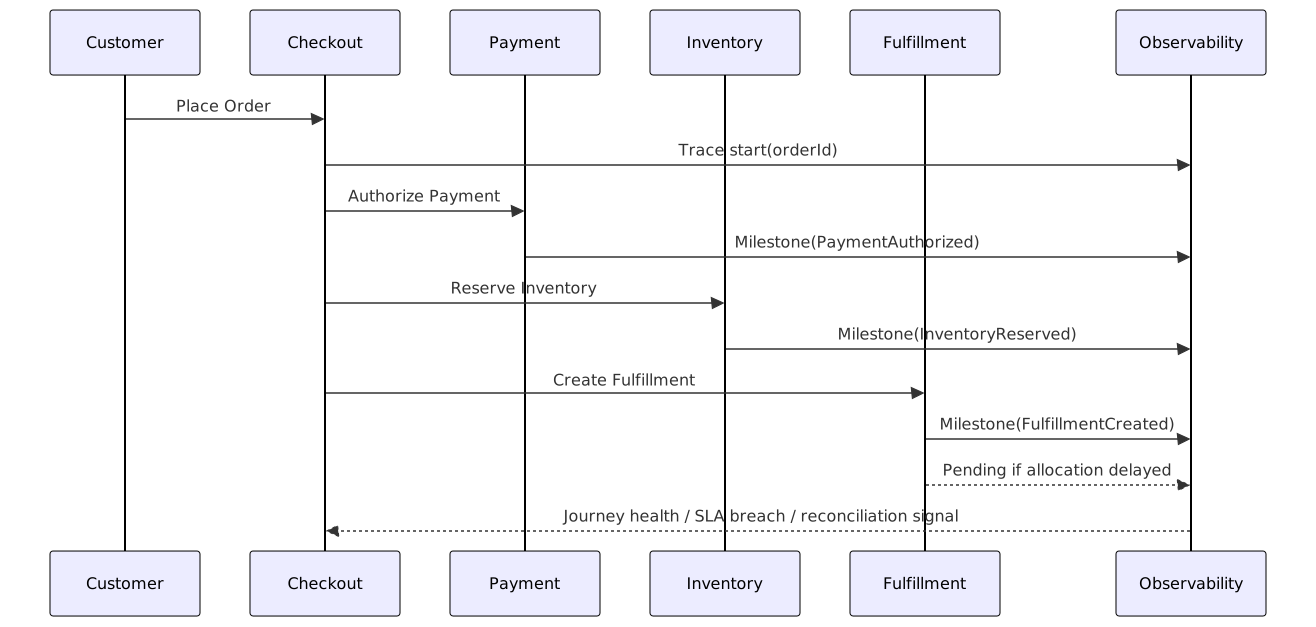
A request trace is not enough. You need a journey model: order placement, claim adjudication, payment settlement, shipment release, customer onboarding. Each journey should have a domain identity, lifecycle milestones, expected latency envelope, and terminal outcomes.
In practice, that means propagating correlation aligned to a business concept, not only HTTP request IDs. One order, one claim, one payment instruction, one policy issuance. Traces become understandable when they map to a thing the business recognizes.
Instrument domain transitions explicitly
Do not rely solely on auto-instrumentation. It gives you infrastructure visibility, not business meaning. Emit spans, events, and metrics around domain transitions:
OrderAuthorizedInventoryReservedPaymentCapturedShipmentAllocatedClaimReferredToManualReview
These are not mere log messages. They are architecture signals. They tell you where boundaries sit, where handoffs happen, and where latency accumulates.
Use telemetry to validate bounded contexts
DDD says each bounded context should own its model and language. Observability lets you test that claim.
If a trace shows a checkout request making synchronous calls into pricing, promotions, customer profile, tax, fraud, inventory, and shipping, all on the critical path, then checkout is likely not a clean bounded context. It may be an orchestration façade over unresolved domain decomposition. Sometimes that is acceptable. Often it is not.
Telemetry shows where one context cannot function without peering into another’s internals. That is usually a sign of either missing upstream data products, poor event design, or a boundary set by org chart rather than domain.
Design for reconciliation, not wishful completion
In a distributed estate, some outcomes will always need reconciliation. Messages arrive late. Consumers fail. duplicate events happen. Third-party systems drift. Human tasks stall. The architecture should make reconciliation visible and deliberate.
Observability-driven design therefore includes:
- explicit pending states
- timeout thresholds tied to business expectations
- compensating actions
- reconciliation jobs with measurable backlog
- dead-letter handling with business classification
- dashboards for “incomplete business transactions,” not only “consumer lag”
This is one of the big differences between toy event-driven systems and enterprise-grade ones. Enterprises do not just process events. They account for them.
Feed design reviews with runtime evidence
Architecture governance tends to be abstract. It should be empirical. Bring trace topologies, fan-out maps, longest critical paths, retry storms, topic dependency graphs, and reconciliation backlog trends into design review. Use them to ask uncomfortable questions:
- Why does this domain flow require seven synchronous hops?
- Why does one topic act as a de facto canonical data model for five contexts?
- Why is manual reconciliation growing every month?
- Why is the p99 of claim approval dominated by a supposedly peripheral AML service?
That is architecture with dirt under its nails.
Architecture
A practical observability-driven architecture usually has five layers:
- Domain telemetry model
- Instrumentation and context propagation
- Runtime telemetry platform
- Journey analytics and conformance analysis
- Design feedback loop

The loop matters. Without the final step back into design, you just have a fancy monitoring stack.
1. Domain telemetry model
Start by defining the key business journeys and milestones. This is not a giant canonical enterprise schema. Keep it practical. For each journey define:
- business identifier
- bounded contexts involved
- state milestones
- invariants
- expected completion window
- reconciliation owner
- terminal outcomes
For an order journey, that might be:
orderId- checkout, payment, inventory, fulfillment
- placed, authorized, reserved, packed, shipped
- must not ship without payment capture
- 95% complete within 10 minutes
- reconciliation owned by fulfillment operations
- success, cancelled, failed, manual intervention
This is where DDD earns its keep. You are not merely adding telemetry. You are making the domain executable in runtime signals.
2. Instrumentation and context propagation
Use standards where possible. OpenTelemetry is the obvious baseline. But the standard only gives wire format and generic conventions. You still need domain semantics:
- trace attributes for business identifiers
- span names that reflect domain actions
- message headers for cross-service correlation
- event metadata including causation and idempotency keys
For Kafka, propagate:
- correlation ID
- causation ID
- domain aggregate identifier
- event type and version
- source bounded context
Too many Kafka estates degrade because messages become anonymous payloads. If you cannot tell what business flow a message belongs to, your broker is doing transport, not architecture.
3. Runtime telemetry platform
You need traces, metrics, and logs, but not as three disconnected kingdoms. The platform should allow:
- jump from business journey to end-to-end trace
- correlate service latency with event lag
- identify incomplete or stalled journeys
- compare designed flow versus actual flow
- segment by tenant, region, product, or channel where appropriate
This usually means combining APM tooling, stream monitoring, and some business-state analytics. For larger enterprises, process mining can add real value here, especially when event logs are reliable enough to reconstruct lifecycle paths.
4. Journey analytics and conformance analysis
This is where observability starts changing architecture.
A few useful analyses:
- critical path discovery: which dependencies dominate completion time?
- fan-out detection: where one action explodes into dozens of calls or events?
- state conformance: which journeys deviate from the intended lifecycle?
- handoff delay analysis: where do cross-context transitions stall?
- reconciliation hotspot analysis: which services generate the most manual cleanup?
The strongest architecture teams treat these analyses the way product teams treat user analytics. They are not occasional reports. They are steering instruments.
5. Design feedback loop
At regular intervals, use telemetry to revisit:
- service boundaries
- sync versus async interactions
- event contract shape
- ownership of business states
- need for materialized views or read models
- where to introduce sagas, process managers, or explicit workflow engines
Sometimes observability shows the right move is more decoupling. Sometimes it shows the opposite: two services separated too early should be recombined or hidden behind a clearer module boundary. Good architects are not ideologues. They are mechanics.
Migration Strategy
If you try to impose observability-driven architecture with a grand rewrite, you will produce a governance deck and very little else. This has to be migrated progressively, usually alongside a strangler strategy. EA governance checklist
Step 1: Start with one business journey, not the whole estate
Pick a journey that matters commercially and hurts operationally. Order fulfillment is a classic. Claims processing is another. So is customer onboarding in banking.
Map the current path through monolith modules, APIs, Kafka topics, batch jobs, and vendor calls. Then instrument the milestones and correlations necessary to see that journey end to end.
The first goal is not perfect elegance. It is visibility.
Step 2: Wrap the monolith with journey-level telemetry
In many enterprises, the monolith still executes most of the domain logic. Fine. Add instrumentation at the seams:
- incoming channels
- key domain state transitions
- outbound integrations
- asynchronous batch handoffs
- manual intervention points
Do not wait for microservices before doing this. In fact, this telemetry often tells you where microservices are justified and where they are not.
Step 3: Strangle by capability, but verify with traces
As you carve out services, use traces to check whether the extracted capability really reduced coupling. If the new service still requires three synchronous monolith calls and two shared database lookups, then you have not extracted a bounded context. You have extracted deployment friction.
A progressive strangler migration should look like this:
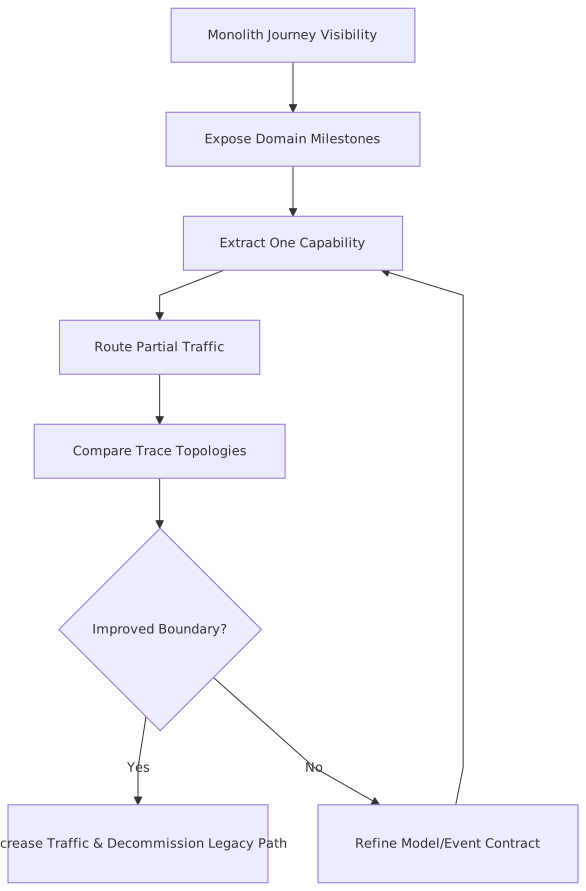
This is the key migration discipline: do not celebrate extraction until runtime evidence shows improved architecture.
Step 4: Introduce Kafka where asynchronous decoupling is warranted
Kafka is useful when:
- you need durable event distribution
- multiple downstream contexts react independently
- throughput and replay matter
- temporal decoupling improves resilience
Kafka is not useful merely because “microservices need events.” If every business action still requires immediate downstream confirmation, an event backbone may just conceal synchronous business dependency under asynchronous infrastructure.
When Kafka is used, define topic ownership tightly. Topics should represent domain event streams owned by a context, not generic integration buckets. Observability should include:
- consumer lag by business criticality
- event age to completion
- poison message classification
- duplicate handling rates
- replay impact analysis
Step 5: Build reconciliation before scale makes it mandatory
A common migration mistake is postponing reconciliation until after event-driven complexity grows. That is backwards. As soon as you split business flow across services and brokers, define:
- what “stuck” means
- who owns recovery
- which state is authoritative
- how mismatches are detected
- how compensations are audited
Otherwise your “modern architecture” will quietly depend on heroic humans with SQL access.
Enterprise Example
Consider a large insurer modernizing claims processing.
The original system was a thick claims platform with embedded rules, nightly batch integrations to finance, and several manual work queues. Leadership wanted microservices and Kafka. Fair enough. The first wave extracted document ingestion, fraud scoring, payment calculation, and notifications into separate services.
On paper, progress looked impressive.
In production, claim cycle time worsened.
Why? Because the architecture had split technical functions, not domain responsibilities. A single claim submission triggered synchronous calls for policy validation, coverage rules, fraud pre-checks, injury classification, and reserve estimation. Then Kafka events fanned out to finance, customer communications, analytics, and regulatory reporting. Every team had dashboards showing their component was “healthy,” but nobody could answer a simple question: why are claims sitting for six hours before adjuster assignment?
The firm introduced an observability-driven redesign.
First, they defined the claim journey in domain terms:
- claim received
- coverage validated
- triage completed
- fraud score assigned
- adjuster assigned
- settlement calculated
- payment issued
They propagated claimId and causation metadata through APIs and Kafka. They instrumented every milestone and every pending state, including manual queues. Then they reconstructed actual journey traces.
The traces told an uncomfortable story:
- “Triage” depended on too many synchronous lookups across policy, customer, and external medical classification.
- Fraud scoring was treated as a side service, but in reality it was on the critical path for 82% of claims.
- Kafka consumer lag in a supposedly non-critical regulatory reporting service was harmless, but lag in document ingestion caused claims to remain invisible to adjusters.
- The adjuster assignment service spent most of its time reconciling incomplete upstream state, not assigning anything.
That evidence changed the design.
The insurer re-centered around clearer bounded contexts: Claims Intake, Coverage Decisioning, Fraud Assessment, Case Assignment, and Settlement. They moved some data closer to intake through event-carried state transfer and materialized read models, reducing synchronous lookups. They separated truly asynchronous downstream reactions from critical-path decisions. Most importantly, they introduced explicit “ClaimPendingEvidence” and “ClaimPendingDecision” states with SLA-based alerts and reconciliation ownership.
Cycle time dropped. Not because of better dashboards, but because telemetry exposed the wrong architecture.
That is the pattern in mature enterprises: observability does not merely reveal incidents. It reveals misplaced boundaries.
Operational Considerations
Observability-driven architecture sounds attractive until someone has to run it. A few practical concerns matter.
Telemetry governance
You need semantic conventions. Without them, each team invents its own span names, attributes, and event labels. The minimum governance should cover: ArchiMate for governance
- business correlation identifiers
- naming for domain milestones
- required metadata on Kafka messages
- privacy and PII handling
- retention and sampling rules
This is one place where a lightweight architecture guild can earn its lunch.
Sampling strategy
Head-based sampling often drops the rare journeys you care about. Tail-based sampling is better for preserving slow or failed business transactions, but costs more. For critical journeys, consider always-on sampling at milestone level with richer traces retained only for anomalous paths.
Data privacy and compliance
Business telemetry often contains sensitive identifiers. You must design redaction, tokenization, and access control from day one. The easiest observability implementation is often legally unusable.
Cardinality discipline
Attaching arbitrary customer IDs, product variants, and free-text statuses to metrics is a fast route to cost pain. Keep high-cardinality detail in traces or logs where appropriate; reserve metrics for controlled dimensions.
Human workflow visibility
Enterprise processes often include case management, approvals, and manual review. If those steps are invisible to observability, your trace is fiction. Integrate workflow engines, work queues, and operational desktops into the journey model.
SLOs for business flow
Define service level objectives at journey level where possible:
- 95% of retail orders allocated within 10 minutes
- 99% of approved claims sent to payment within 30 minutes
- 98% of onboarding applications triaged within 5 minutes
These are more meaningful than isolated API latency goals.
Tradeoffs
This style of architecture is not free.
The biggest tradeoff is between design purity and runtime truth. Architects like coherent models. Runtime evidence is messy. It will show exceptions, temporary workarounds, and ugly dependencies. If you cannot tolerate that, you will ignore the best feedback available.
There is also a tradeoff between observability as product and observability as tax. Done well, teams see it as enabling change safely. Done poorly, it becomes mandatory annotation work with no visible payoff. You need to show teams that traces are improving design decisions, not merely feeding central dashboards.
Another tradeoff sits between local service autonomy and semantic consistency. Teams may resist shared domain telemetry standards. They are wrong to resist entirely, but architecture should avoid over-centralizing everything into one enterprise ontology. Shared core semantics, local flexibility.
And then there is cost. Rich tracing, Kafka monitoring, process mining, retention, and analysis are not cheap. But neither is flying blind. The point is not maximum visibility. It is sufficient visibility at the points where business risk and architectural uncertainty intersect.
Failure Modes
Observability-driven architecture has its own traps.
Instrumenting noise instead of meaning
The common failure is huge amounts of low-value telemetry with no domain semantics. You can see every RPC, but not whether a loan application is stuck.
Confusing correlation with causation
Just because two spans occur together does not mean one should own the other. Be careful not to redesign around incidental runtime coupling.
Treating traces as objective truth
Traces are partial representations. Missing propagation, dropped spans, batch boundaries, and external black boxes all distort them. Use traces as evidence, not scripture.
Over-standardizing event contracts
In the name of observability, some firms force every domain event into a generic enterprise wrapper so abstract it says almost nothing. That is not architecture. That is bureaucracy serialized as JSON.
Ignoring reconciliation debt
If observability shows rising backlog in mismatch handling and manual corrections, that is architecture debt. Many firms classify it as “ops noise” and keep scaling. Eventually it becomes the business process.
Making Kafka the answer to everything
Kafka is excellent infrastructure. It is also a fine way to spread ambiguity at high throughput. If ownership and state semantics are unclear, the broker just accelerates confusion.
When Not To Use
Do not reach for this approach everywhere.
If you are building a small, straightforward system with a single team and simple flows, conventional monitoring plus basic tracing may be entirely enough. You do not need a grand observability-driven design loop for a modest internal app.
Likewise, if the domain has low business criticality and failures are cheap, the overhead may not justify itself. Not every report generation workflow needs end-to-end business journey analytics.
And be careful in domains where runtime traces cannot safely carry meaningful business identifiers due to regulation or privacy constraints. You can still apply the pattern, but the implementation must be far more constrained.
Finally, if the organization is not willing to act on what telemetry reveals, do not pretend this is architecture. If service boundaries are politically fixed and no team owns end-to-end journeys, observability will only make the dysfunction more visible. Useful, perhaps. Pleasant, no.
Related Patterns
Observability-driven architecture works especially well alongside a few other patterns.
Domain-Driven Design
This is the foundation. Observability needs bounded contexts, ubiquitous language, and context maps to have meaning.
Saga / Process Manager
Useful when long-running distributed processes need explicit coordination. Observability then follows saga state, compensations, and timeout paths.
Event Sourcing
Helpful in some domains because event history naturally supports lifecycle reconstruction. Not required. Often overused.
CQRS and Materialized Views
A good fit when traces reveal too much synchronous read coupling across contexts. Replicate what is needed rather than forcing runtime dependency.
Strangler Fig Pattern
Essential for migration. Instrument the journey first, then replace capability by capability while comparing real runtime impact.
Process Mining
In larger enterprises, a strong complement to tracing. Especially useful for discovering actual business process variants from event logs across systems.
Summary
Observability is too important to leave in the operations basement.
In distributed systems, traces, business milestones, event flows, and reconciliation signals are not merely diagnostic artifacts. They are the runtime expression of your domain model. They reveal whether bounded contexts are real, whether Kafka topics represent meaningful events or just moving confusion around, whether eventual consistency is controlled or hand-waved, and whether your migration is actually reducing complexity.
The architectural move is simple to state and hard to fake: let runtime evidence feed the design loop.
Model business journeys explicitly. Instrument domain transitions, not just technical calls. Propagate meaningful correlation across APIs and Kafka. Design reconciliation as a first-class capability. Use traces and journey analytics to challenge service boundaries, sync chains, and event contracts. Migrate progressively with a strangler approach, and do not declare success until production telemetry proves the architecture got better.
Because the map is not the territory.
In distributed systems, the trace is often the closest thing you have to the truth.
Frequently Asked Questions
What is a service mesh?
A service mesh is an infrastructure layer managing service-to-service communication. It provides mutual TLS, load balancing, circuit breaking, retries, and observability without each service implementing these capabilities. Istio and Linkerd are common implementations.
How do you document microservices architecture for governance?
Use ArchiMate Application Cooperation diagrams for the service landscape, UML Component diagrams for internal structure, UML Sequence diagrams for key flows, and UML Deployment diagrams for Kubernetes topology. All views can coexist in Sparx EA with full traceability.
What is the difference between choreography and orchestration in microservices?
Choreography has services react to events independently — no central coordinator. Orchestration uses a central workflow engine that calls services in sequence. Choreography scales better but is harder to debug; orchestration is easier to reason about but creates a central coupling point.