⏱ 5 min read
Building a Digital Transformation Architecture Framework for Government Institutions: A TOGAF-Based Executive Guide
Digital transformation in government is often framed as modernization --- cloud adoption, AI pilots, citizen portals, automation initiatives. But for executive leaders, the real question is not which technology to adopt.

The real question is:
How do we structurally transform an institution designed decades ago into a resilient, interoperable, citizen-centric digital organization?
This is not an IT project. It is an architectural transformation.
And without a formal architecture framework --- particularly one grounded in TOGAF (The Open Group Architecture Framework) --- digital transformation in public institutions becomes fragmented, politically reactive, and financially inefficient. ArchiMate in TOGAF ADM
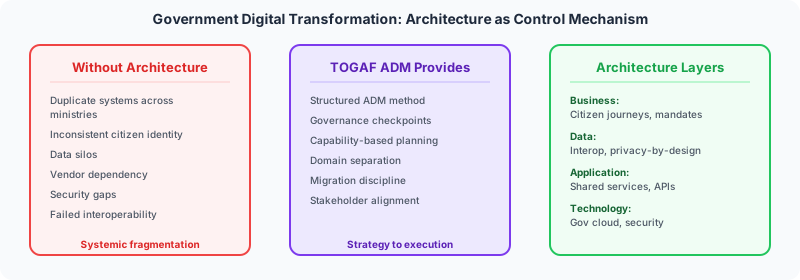
1. Why Government Digital Transformation Requires Architecture
Unlike private enterprises, government institutions operate under:
- Regulatory constraints
- Multi-layered accountability
- Long budget cycles
- Public scrutiny
- Inter-agency complexity
- Cross-border interoperability requirements
Digital initiatives launched without architectural alignment often result in:
- Duplicate systems across ministries
- Inconsistent citizen identity management
- Data silos
- Vendor dependency
- Security gaps
- Failed interoperability
The absence of architecture governance creates systemic fragmentation.
Architecture is the control mechanism between political ambition and technical execution.
2. What Makes TOGAF Suitable for Government?
TOGAF provides:
- A structured Architecture Development Method (ADM)
- Governance and compliance checkpoints
- Capability-based planning approach
- Clear separation of architecture domains
- Migration planning discipline
- Stakeholder alignment mechanisms
For government institutions, this ensures traceability from strategy to execution.
3. Executive Architecture Layers
Business Architecture
Focus on public value, citizen journeys, regulatory mandates, and measurable service outcomes.
Data Architecture
Enable interoperability, master data governance, privacy-by-design, and audit traceability.
Application Architecture
Rationalize portfolios, enable API-first integration, modularization, and reusable components. integration architecture diagram
Technology Architecture
Define hybrid cloud strategy, cybersecurity baseline, resilience, and controlled modernization. enterprise cloud architecture patterns
4. Applying the TOGAF ADM
Phase A -- Architecture Vision
Define strategic alignment, executive sponsorship, and transformation objectives.
Phase B -- Business Architecture
Assess baseline capabilities and define target institutional structure.
Phase C -- Information Systems Architecture
Design data and application landscapes aligned with business capabilities.
Phase D -- Technology Architecture
Modernize infrastructure with resilience and security controls.
Phase E & F -- Opportunities & Migration Planning
Develop phased transition architectures aligned with budget cycles.
Phase G -- Implementation Governance
Enforce compliance checkpoints and architecture reviews.
Phase H -- Change Management
Adapt architecture to policy, legislative, and technological changes.
5. Governance Model
- Architecture Board oversight
- Defined architecture principles
- Procurement alignment
- KPI-based reporting
Governance converts architecture from documentation into institutional discipline.
6. Capability-Based Planning
Shift from project-centric thinking to capability strengthening:
Instead of modernizing systems in isolation, strengthen institutional capabilities across people, process, data, application, and technology dimensions.
7. Measuring Success
Key KPI domains:
- Service efficiency
- Financial optimization
- Data quality & interoperability
- Security posture
Architecture enables measurable transformation.
Final Executive Reflection
Digital transformation in government is not about adopting emerging technologies faster.
It is about building architectural maturity that allows institutions to evolve predictably, securely, and sustainably.
TOGAF provides the discipline. Governance provides the control. Leadership provides the direction.
Together, they form a Digital Transformation Architecture Framework capable of modernizing government institutions without destabilizing them.
For expert guidance on enterprise architecture, explore our enterprise architecture consulting, architecture capability development, and Sparx EA consulting. Get in touch.
Tailoring TOGAF for practical results
TOGAF's strength is its comprehensiveness. Its weakness is also its comprehensiveness — organizations that try to implement every phase, every deliverable, and every governance mechanism simultaneously create a process that is too heavy to sustain. The most successful TOGAF implementations start small and expand based on demonstrated value.
Begin with Phase A (Architecture Vision) and Phase G (Architecture Governance). Vision ensures that architecture work is aligned with business strategy. Governance ensures that architecture decisions are reviewed, recorded, and enforced. These two phases provide immediate value: stakeholders see architecture alignment with their goals, and delivery teams see clear standards to follow.
Add Phases B through D incrementally as the architecture practice matures. Phase B (Business Architecture) adds capability maps and value stream models. Phase C (Information Systems Architecture) adds application portfolio views and data architecture. Phase D (Technology Architecture) adds infrastructure topology and platform design. Each phase produces ArchiMate views in the repository — not documents in a folder. ArchiMate relationship types
Skip Phases E and F (Opportunities and Migration Planning) initially. Replace them with ArchiMate Migration views that show plateaus (stable architecture states) and work packages (projects that move from one plateau to the next). This achieves the same outcome with less process overhead. ArchiMate layers explained
Frequently Asked Questions
How does ArchiMate support digital transformation planning?
ArchiMate supports transformation by modeling baseline architecture, target architecture, and transition plateaus. Implementation and Migration diagrams show work packages, migration events, and the sequencing of changes needed to move from current to future state.
What is a transition architecture in ArchiMate?
A transition architecture in ArchiMate represents an intermediate state between baseline and target. It describes the architecture at a specific milestone in the transformation journey, helping teams plan incremental delivery and manage dependencies across parallel workstreams.
How do you create an implementation roadmap in ArchiMate?
An implementation roadmap in ArchiMate is created using the Implementation and Migration layer, modeled with Work Packages (groups of work), Implementation Events (milestones or triggers), and Plateaus (stable architecture states). Gap Analysis diagrams show what must change between each plateau.