⏱ 19 min read
Most enterprise microservices diagrams are useless.
That sounds harsh, but it’s true. They look impressive in PowerPoint, full of hexagons, APIs, event buses, cloud icons, and arrows crossing like a bowl of spaghetti. Everyone nods in the architecture review. Nobody can actually use the thing to make decisions. Six months later the teams are arguing about service boundaries, Kafka topics are multiplying like rabbits, IAM is bolted on too late, and the “microservices platform” starts behaving like a distributed monolith with better branding.
This is exactly where ArchiMate helps. Not because it’s magical. Not because notation somehow fixes bad architecture. It helps because it forces architects to be explicit about what they usually leave vague: what the business needs, what the applications do, how services interact, where technology constraints apply, and who owns what. In other words, it turns hand-wavy architecture into something you can reason about.
And yes, I know the pushback. “ArchiMate is too formal.” “Teams won’t read it.” “We move too fast for modeling.” I’ve heard all of that. Usually from organizations drowning in accidental complexity they created by skipping architecture discipline. Not always, but often.
So let’s make this practical.
What this means, simply
If you want the short version early: ArchiMate is a modeling language that helps you design microservices architecture by connecting business capabilities, applications, data flows, integration patterns, and infrastructure in one coherent view.
That’s the SEO sentence. But the real point is this: ArchiMate helps you answer the questions that matter in real enterprise work: ArchiMate modeling guide
- Why does this service exist?
- What business capability does it support?
- What data does it own?
- How does it interact with other services?
- When should it use synchronous APIs vs Kafka events?
- Where does IAM sit in the design?
- What cloud platform components are required?
- What is stable, and what is likely to change?
Without those answers, “microservices architecture” is mostly just distributed guessing.
The problem with how enterprises design microservices
A lot of architecture teams start in the wrong place. They start with technical decomposition: customer-service, account-service, payment-service, notification-service, audit-service. Fine. Common enough. But often those names are just nouns pulled from a domain workshop, not carefully designed service boundaries.
Then three things happen.
First, they confuse business capabilities with microservices. A capability like “Lending” or “Customer Onboarding” is not automatically a single service. Sometimes it spans many services. Sometimes one service supports several sub-capabilities. If you model this badly, every service becomes a mini-ERP module.
Second, they model interfaces but not behavioral responsibility. They can tell you there is a REST API and a Kafka topic. They cannot tell you which service is the system of record, which one publishes the canonical event, or which process actually owns the decision.
Third, they ignore enterprise constraints until late in delivery. IAM, data residency, cloud network boundaries, resilience standards, audit logging, regulatory controls. These are not afterthoughts in banking. They are architecture.
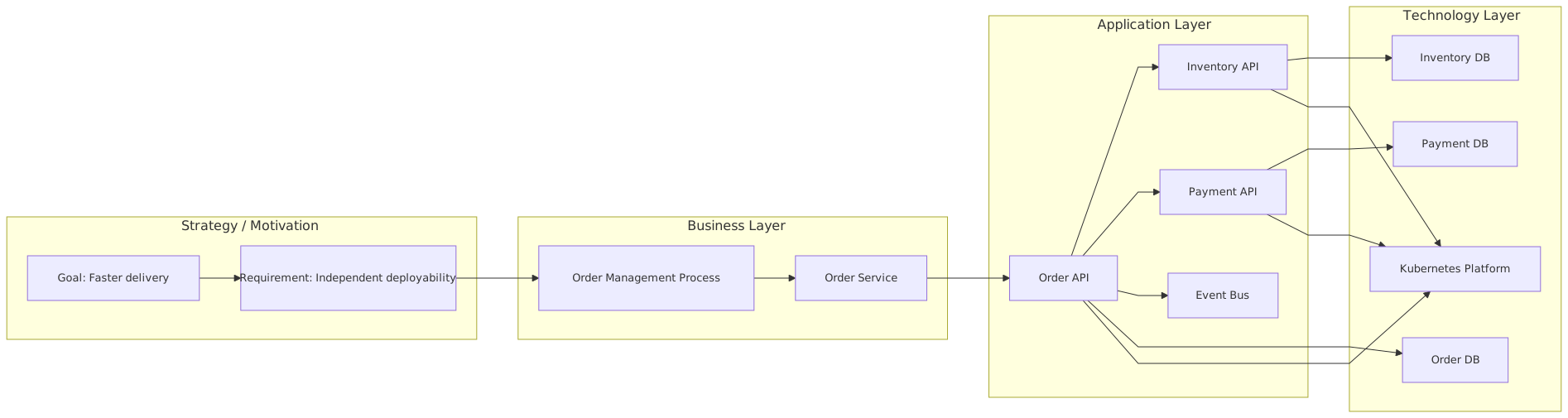
This is where ArchiMate is useful because it gives you layers and relationships that map nicely to enterprise concerns:
- Business layer: capabilities, processes, actors, products
- Application layer: application components, application services, data objects, interactions
- Technology layer: nodes, system software, devices, networks, cloud services
- Motivation/strategy elements: goals, requirements, principles, constraints, outcomes
The value is not drawing boxes. The value is tracing decisions across layers.
Why ArchiMate works well for microservices
Microservices are not just small applications. They are a design approach with consequences:
- decentralized ownership
- bounded responsibilities
- independent deployment
- explicit contracts
- operational complexity
- data distribution
- integration trade-offs
Those consequences are exactly what enterprise architecture needs to model.
ArchiMate is particularly strong for microservices because it lets you distinguish things that many teams blur together:
- Application component vs application service
- Data object vs business object
- Serving relationship vs flow relationship
- Technology service vs application service
- Business process vs application behavior
That matters. A lot.
For example, in a banking environment, a “Payments API” is not the same thing as the “Payments Service” component. The API is an exposed application service. The service itself may realize multiple behaviors, consume IAM capabilities, publish Kafka events, persist ledger-related data, and run on Kubernetes in a regulated cloud landing zone. If you flatten all of that into one icon, you lose architecture.
And this is my first strong opinion: if your microservices model does not show ownership, event flow, and security dependencies, it is not architecture. It is illustration.
Start with business capability, not service names
Real architecture work starts with business pressure.
Maybe the bank wants to reduce onboarding time from five days to fifteen minutes. Maybe fraud controls need to become real-time. Maybe open banking APIs are driving product redesign. Maybe the payments domain needs to scale independently from core customer servicing.
These are not technical stories. They are business drivers.
In ArchiMate, start by modeling:
- business actors: Retail Customer, Operations Agent, Fraud Analyst, Compliance Officer
- business capabilities: Customer Onboarding, Identity Verification, Payments Processing, Access Management
- business processes: Open Account, Approve Payment, Detect Suspicious Transaction
- products/services: Current Account, Mobile Banking, SME Lending
Only then move into application decomposition.
This sequence matters because microservice boundaries should support operational and business change, not just code modularity. A service that aligns to a business capability can evolve with less coordination cost. A service that exists because a team liked a domain noun usually ends up too chatty, too coupled, or too vague.
A contrarian thought here: domain-driven design is useful, but teams often use it as a slogan instead of a discipline. They say “bounded context” and then create services that share the same database schema. That’s not a bounded context. That’s denial.
A practical modeling approach in ArchiMate
Here’s the approach I’ve seen work in actual enterprise programs.
1. Model the capability map and change drivers
Capture the business capabilities and strategic outcomes. This gives you the “why”.
For a bank:
- Goal: reduce payment processing latency
- Goal: improve digital onboarding completion rate
- Requirement: support real-time fraud screening
- Constraint: comply with IAM and MFA policy
- Constraint: customer PII must remain within approved cloud region
This makes architecture traceable. When someone proposes a new microservice, you can ask: which capability or requirement does it support?
2. Model the core business processes
Show the important end-to-end flows:
- customer onboarding
- account opening
- payment initiation
- transaction monitoring
- user access provisioning
Do not model every BPMN-level detail. ArchiMate is not there to replace process design. It should show responsibility and support relationships clearly enough that application design has context. ArchiMate tutorial
3. Identify application components and services
Now define application components like:
- Customer Profile Service
- Identity Verification Service
- Payment Orchestration Service
- Fraud Decision Service
- Notification Service
- IAM Platform Integration
- Event Publishing Gateway
Then model the application services they expose:
- Customer Lookup API
- Identity Check Service
- Payment Initiation API
- Fraud Scoring Service
- Access Token Validation Service
This distinction is where architects often get lazy. Don’t.
4. Model data ownership and event flows
This is non-negotiable in microservices.
Show:
- which component owns Customer Profile
- which component owns Payment Instruction
- which component produces Payment Initiated event
- which component consumes Fraud Alert event
- which events are integration facts vs process triggers
And yes, use Kafka explicitly in the technology/application relationship where relevant.
5. Model technology and platform dependencies
Microservices do not run in the air. Show:
- Kubernetes cluster / cloud container platform
- Kafka platform
- API gateway
- IAM platform
- secrets management
- observability stack
- managed database services
- service mesh if you really need one
I’ll say it plainly: a microservices architecture without platform architecture is fantasy.
Example: retail banking payments platform
Let’s make this concrete.
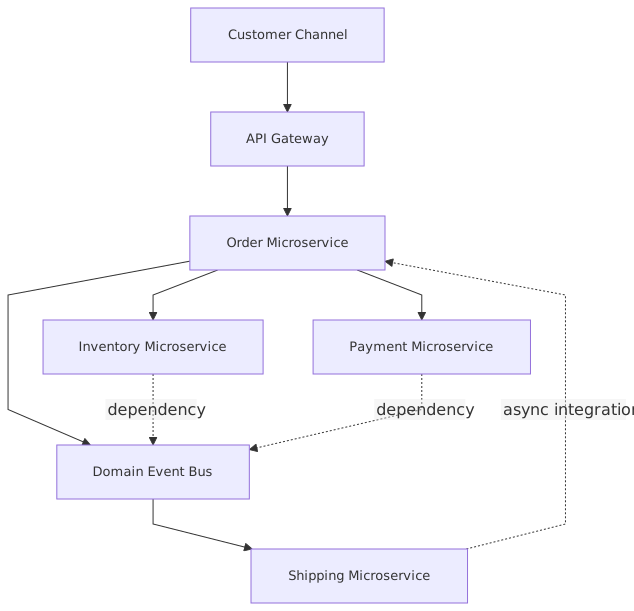
Imagine a mid-sized bank modernizing its retail payments stack. The old world is a core banking platform plus an enterprise service bus plus batch fraud checks. The target state is event-driven microservices in cloud, with Kafka for streaming, centralized IAM, and APIs for mobile and partner channels.
The business goals are:
- instant payment confirmation
- better fraud response
- faster feature delivery for mobile banking
- lower dependence on the legacy ESB
Business layer
Capabilities:
- Payments Processing
- Fraud Management
- Customer Authentication
- Customer Notification
- Account Management
Business processes:
- Initiate Payment
- Authenticate User
- Validate Payee
- Screen Transaction
- Post Transaction Notification
Actors:
- Retail Customer
- Mobile Banking App
- Fraud Analyst
- Contact Center Agent
Application layer
Application components:
- Mobile Channel Backend
- Payment Orchestration Service
- Account Service
- Fraud Decision Service
- Notification Service
- IAM Integration Service
- Audit Logging Service
Application services:
- Payment Initiation API
- Account Balance Query
- Fraud Assessment Service
- Notification Dispatch Service
- Token Validation Service
Data objects:
- Payment Instruction
- Customer Account
- Fraud Score
- Access Token
- Audit Record
Technology layer
Technology components/services:
- API Gateway
- Kafka Cluster
- Kubernetes Platform
- Cloud IAM / enterprise IdP federation
- Managed PostgreSQL
- Secrets Vault
- Monitoring and Tracing Platform
Now the real architecture decisions emerge.
- The Payment Orchestration Service exposes the Payment Initiation API.
- It consumes Token Validation Service from IAM Integration.
- It queries Account Service synchronously for balance and account status.
- It publishes a Payment Initiated event to Kafka.
- The Fraud Decision Service subscribes to Payment Initiated and emits Fraud Assessed.
- Notification Service subscribes to Payment Completed and sends customer alerts.
- Audit Logging Service consumes all critical domain events for immutable audit trails.
That is a useful architecture model because it reveals interaction style, ownership, and platform dependence.
Where ArchiMate is especially valuable: synchronous vs event-driven design
This is one of the biggest practical benefits.
In microservices, enterprise teams often become ideological. One camp wants everything event-driven. Another wants everything behind APIs. Both camps are usually wrong.
ArchiMate helps because it lets you model both interaction types clearly.
Use synchronous interactions when:
- the caller needs immediate response
- the business process is user-facing and latency-sensitive
- consistency requirements are tight
- the dependency is operationally acceptable
Use Kafka/event-driven patterns when:
- downstream processing can be asynchronous
- multiple consumers need the same event
- decoupling is valuable
- replay and auditability matter
- throughput and temporal decoupling matter
In the banking example:
- token validation should be synchronous
- payment initiation acknowledgement may be synchronous
- fraud enrichment, notifications, ledger replication, analytics, and audit often benefit from events
The mistake architects make is trying to solve organizational uncertainty with messaging patterns. They say, “let’s use Kafka so services are decoupled.” Fine. But if nobody owns event contracts, schemas, retention policy, replay semantics, or failure handling, you haven’t created decoupling. You’ve created distributed ambiguity.
Common mistakes architects make
Here’s the section people usually skip. They shouldn’t.
1. Modeling every microservice at the same level of detail
Not every service deserves the same modeling depth. Focus on architecturally significant services: those with critical business ownership, heavy integration, compliance impact, or platform complexity.
If you create a 120-service ArchiMate view with every endpoint, nobody will use it.
2. Confusing application service with business service
A “Customer Authentication Service” in business terms is not the same as an OAuth token introspection endpoint. One is a business-facing capability. The other is an application/technology mechanism.
This confusion leads to very bad conversations with stakeholders.
3. Ignoring data ownership
This is the classic enterprise failure. Teams say they have microservices, but five services update the same customer record through shared tables or backdoor integrations.
In ArchiMate, make data ownership visible. If a data object is central, show which application component owns it and which others only consume or replicate it.
4. Treating Kafka as magic glue
Kafka is powerful. It is not a substitute for architecture.
If every team can create topics without governance, naming standards, schema compatibility rules, and event lifecycle management, your platform will rot fast. I’ve seen banks end up with hundreds of topics no one fully understands, all marked “critical”. ArchiMate for governance
5. Bolting on IAM later
This one still surprises me. Teams design beautiful service interactions and only later ask, “how do users and services authenticate?”
In enterprise reality, IAM shapes architecture from day one:
- user authentication flows
- machine-to-machine trust
- token propagation
- authorization boundaries
- privileged access
- auditability
- federation with corporate identity providers
If IAM is not on your architecture diagram early, the architecture is incomplete.
6. Overusing orchestration
Not every process needs a central orchestration engine or “orchestrator service”. Sometimes choreography through events is cleaner. Sometimes a simple API composition is enough.
Architects love central control because it feels neat. Operations teams hate it later when everything depends on one giant process coordinator.
7. Forgetting operational architecture
You cannot separate runtime concerns from microservices design. Scaling, resilience, tracing, secrets, deployment boundaries, failover, observability, and cloud networking all matter.
A service boundary that looks elegant in a workshop may be operationally stupid in production.
A useful comparison table
Here’s a practical table I use in architecture discussions.
That table is not theory. It reflects the difference between architecture that survives implementation and architecture that dies in committee.
How this applies in real architecture work
This is where many articles become too abstract, so let’s bring it back to the day job.
In real enterprise architecture work, ArchiMate is useful in at least five concrete situations.
Architecture reviews
When teams propose a new microservice, ArchiMate helps you ask the right questions:
- What business capability does it support?
- Is it a new component or just a function that belongs in an existing service?
- What data will it own?
- What events will it publish?
- What IAM dependencies exist?
- What cloud runtime services does it require?
This prevents service sprawl.
Target-state architecture
For transformation programs, you need a target-state model that links strategic goals to implementation building blocks. ArchiMate is strong here because it can show transition from legacy core systems and ESB patterns to APIs, Kafka streams, and cloud-native services without losing enterprise context.
Solution architecture alignment
Enterprise architects and solution architects often talk past each other. One speaks capability maps. The other speaks APIs and clusters. ArchiMate can bridge that gap if used well.
Not perfectly, but better than most alternatives.
Governance and standards
If your organization has standards for IAM, eventing, cloud landing zones, or observability, ArchiMate can model those as reusable technology/application services and constraints. That makes standards visible as architecture building blocks, not buried PDFs nobody reads.
Impact analysis
A payment regulation changes. A new fraud control is required. A cloud region restriction appears. Which services are affected? Which processes? Which integrations? Which platform components?
If your model is coherent, impact analysis becomes much easier. Not easy. Easier.
Real enterprise example: onboarding in a bank
Let me give a second example because onboarding shows the value clearly.
A retail bank wanted to digitize current account opening. Their initial “microservices” design had:
- onboarding-service
- customer-service
- KYC-service
- document-service
- notification-service
- workflow-service
On paper, fine. In reality, it was a mess.
The workflow service knew too much. Customer service owned half the onboarding state. KYC outcomes were copied into multiple databases. IAM was handled inconsistently between mobile channel and back-office channel. Kafka existed, but mostly as an afterthought.
Using ArchiMate, we reworked the model.
Business view
Capabilities:
- Customer Onboarding
- Identity Verification
- Access Provisioning
- Compliance Screening
Processes:
- Start Application
- Capture Identity
- Verify Customer
- Create Account
- Provision Digital Access
Application view
Components:
- Onboarding Case Service
- Identity Verification Service
- Customer Master Service
- Access Provisioning Service
- Notification Service
- Decision Rules Service
Key clarifications:
- Onboarding Case Service owned process state, not customer master data
- Customer Master Service became the system of record for customer profile
- Identity Verification Service exposed verification outcomes, but did not own customer lifecycle
- Access Provisioning Service integrated with enterprise IAM to create digital banking entitlements
- events like Application Submitted, Identity Verified, Account Opened, Access Provisioned were modeled explicitly
Technology view
- API gateway for mobile and web channels
- Kafka for state change events
- cloud-managed Kubernetes
- enterprise IAM federation with MFA
- document storage in approved cloud region
- centralized observability and audit pipeline
That redesign solved three practical problems:
- clearer service ownership
- better IAM integration
- much cleaner event model
And here’s the uncomfortable truth: none of that required some revolutionary technology. It required better architecture thinking.
Contrarian view: not every microservice needs ArchiMate
Let me be fair.
If you’re a small product team with six services and direct ownership, you probably don’t need extensive ArchiMate modeling. A few C4 diagrams, ADRs, and good engineering discipline may be enough.
ArchiMate becomes especially valuable when:
- there are multiple teams
- business and technology alignment matters
- compliance is significant
- platform dependencies are non-trivial
- target-state and transition-state need to be managed
- you need governance without total bureaucracy
So no, I’m not claiming every startup should learn ArchiMate before writing code. That would be silly.
But in enterprise banking, insurance, telecom, government, or large retail? Yes, I think many organizations would benefit from using it more seriously, not less.
How to keep ArchiMate useful instead of bureaucratic
This is the trap. Enterprises discover modeling and immediately overdo it.
A few practical rules:
Keep views audience-specific
Do not put business goals, service APIs, Kafka topics, clusters, and IAM flows all on one giant diagram. Create focused views:
- executive capability view
- process-to-application view
- service interaction view
- platform dependency view
- security/IAM view
Model decisions, not decoration
If an element does not help someone understand a responsibility, dependency, constraint, or impact, leave it out.
Use ArchiMate with other artifacts
ArchiMate is not enough on its own. Pair it with:
- ADRs for decisions
- sequence diagrams for key interactions
- API specs
- event schemas
- deployment/runbook documentation
Update it where change matters
Do not try to maintain a perfect enterprise-wide model of every service at all times. That way lies madness. Maintain high-value areas: critical domains, shared platforms, regulated processes, major transformation streams.
Make ownership visible
A model without ownership is decorative architecture. Show which domain/team/platform owns which component and contract. It changes the quality of governance discussions immediately. EA governance checklist
Final thought
Microservices architecture is easy to oversell and even easier to get wrong. The industry still romanticizes it. Small services, independent teams, event-driven magic, cloud-native everything. Nice story. But in actual enterprises, especially banks, the hard part is not creating more services. The hard part is creating clear responsibility, controlled interaction, secure identity flows, manageable data ownership, and traceable alignment to business change.
That is why ArchiMate matters.
Not because it gives you prettier diagrams. Because it forces precision where enterprise architecture usually gets vague. It helps you connect capability to process, process to service, service to event, event to platform, platform to control. That chain is what makes architecture useful.
And I’ll end with one more strong opinion: if your microservices design cannot be explained through business capability, data ownership, IAM dependency, and runtime platform in one coherent model, it probably isn’t mature enough for enterprise scale.
That may sound strict. Good. Architecture should be.
FAQ
1. Is ArchiMate too heavyweight for microservices?
Not necessarily. It becomes heavyweight when architects model everything. Used selectively, it’s very effective for showing capability alignment, service boundaries, event flows, IAM dependencies, and cloud platform relationships.
2. How do you represent Kafka in ArchiMate?
Typically as a technology service or platform component in the technology layer, with application components publishing and consuming flows or events through it. The exact notation matters less than making event ownership and interaction semantics clear.
3. Should IAM be modeled as application or technology architecture?
Usually both. Enterprise IAM often provides technology-level platform services, but the integration points used by microservices—token validation, authorization checks, federation, provisioning—have application architecture implications too.
4. Can ArchiMate replace sequence diagrams and API documentation?
No. It should not try to. ArchiMate is strong for structural relationships, responsibilities, and cross-layer traceability. You still need sequence diagrams, API specs, event schemas, and operational docs.
5. What is the biggest mistake when using ArchiMate for microservices?
Modeling notation without modeling decisions. If the diagram looks formal but doesn’t clarify ownership, data boundaries, integration style, or platform constraints, it has failed.
Frequently Asked Questions
How are microservices modeled in ArchiMate?
Each microservice is an Application Component in the ArchiMate Application layer, exposing Application Services via Application Interfaces. Serving relationships show inter-service dependencies. Assignment to Technology Nodes models the deployment topology. Data Objects model the contracts and event schemas exchanged between services.
What is the difference between microservices and monolithic architecture?
A monolith packages all functionality into one deployable unit — simpler to develop initially but harder to scale and change independently. Microservices decompose the application into independently deployable services aligned to business domains. This enables team autonomy and independent scaling but introduces distributed system complexity.
How do you document microservices architecture for enterprise governance?
Use ArchiMate Application Cooperation diagrams for the service landscape, UML Component diagrams for internal service structure, UML Sequence diagrams for key interaction flows, and UML Deployment diagrams for container and infrastructure topology. In Sparx EA, all these views can exist in one repository with full traceability.