⏱ 19 min read
Let’s start with the uncomfortable truth: a lot of people think enterprise architects are expensive diagram-makers. The people who show up late to a program, ask for a capability map, say “we need standards,” and then disappear into PowerPoint. That reputation did not appear by accident.
Bad enterprise architecture creates theater. Good enterprise architecture changes decisions.
That’s the real job.
If I had to explain it simply, early and plainly: an enterprise architect helps a company make better technology decisions across teams, platforms, and business units so systems work together, risks are managed, and money is not wasted building the same thing five times. That is the SEO-friendly version. It’s also true.
But it’s incomplete.
Because in real life, enterprise architecture is not just “aligning business and IT.” That phrase is so overused it has become decorative. The actual work is messier. An enterprise architect sits in the tension between strategy and delivery, between executives and engineers, between what should exist and what already exists. You are trying to shape the future of an enterprise without pretending the past can be deleted.
And yes, sometimes that means saying no. Often.
The Short Answer: What an Enterprise Architect Actually Does
An enterprise architect defines and guides the structure of enterprise technology so the organization can scale, change, integrate, govern, and operate effectively.
In practical terms, that usually means they:
- set architecture principles and guardrails
- define target states for platforms, integration, data, security, and cloud
- evaluate major technology decisions
- reduce duplication across business units
- connect strategy to implementation
- govern change without stopping delivery
- help teams make local decisions that don’t create enterprise-level damage later
That sounds neat. Real work is not neat.
A real enterprise architect spends time in all of these areas:
- business strategy discussions
- portfolio and investment decisions
- application and platform rationalization
- integration patterns
- identity and access management
- cloud operating models
- data ownership and flow
- resilience and risk
- architecture reviews
- vendor selection
- migration planning
- politics, which nobody admits is part of the job but absolutely is
If that sounds broad, it is. That’s why weak enterprise architects retreat into frameworks. They want the comfort of boxes. But enterprises are not boxes. They are incentives, histories, mergers, old systems, regulatory obligations, and teams with conflicting priorities.
The Job Is Not “Design Every System”
This is one of the biggest misconceptions.
Enterprise architects are not there to design every API, every schema, every Kafka topic, every IAM role, or every cloud landing zone detail. If they try, they become a bottleneck and usually a shallow one. The role is not to be the smartest technologist in every room. It is to create coherence.
That coherence comes from answering questions like:
- What capabilities should be shared enterprise-wide?
- Where should we standardize, and where should we allow variation?
- Which systems are strategic, which are transitional, and which should be retired?
- How should identity be federated across business units and cloud platforms?
- When does event-driven architecture with Kafka make sense, and when is it just architectural fashion?
- What cloud patterns are acceptable for regulated workloads?
- What principles should product teams follow so they can move fast without blowing up security, cost, or integration?
An enterprise architect should shape the decision space, not micromanage every solution.
That distinction matters.
Why the Role Exists at All
In small companies, architecture can stay local. Teams can coordinate informally. In large enterprises, that stops working. Scale creates fragmentation.
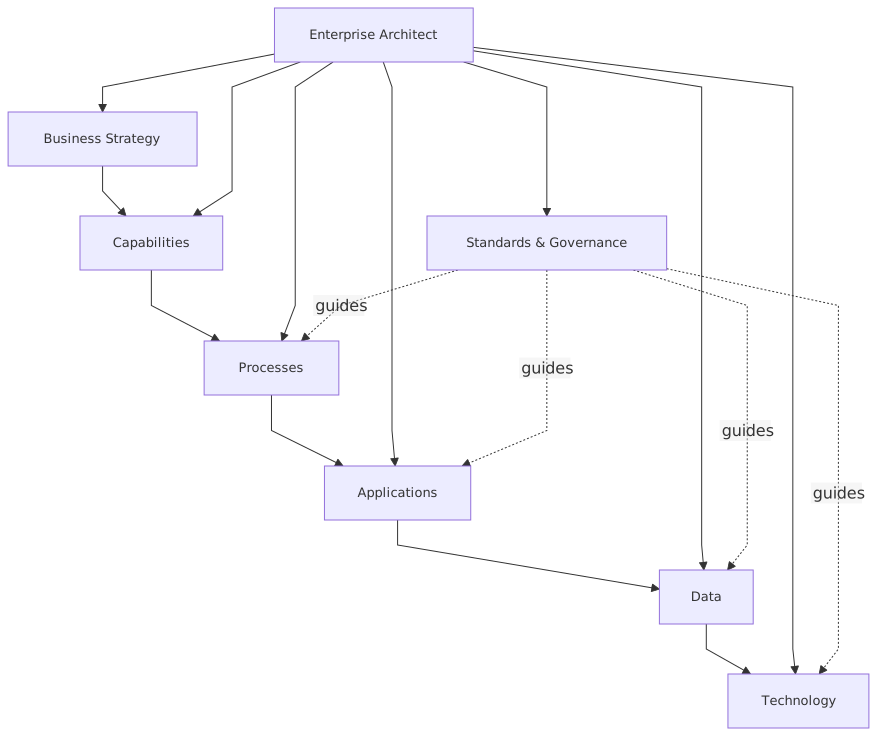
A bank, for example, might have:
- retail banking systems
- payments platforms
- fraud engines
- CRM tools
- loan origination platforms
- mobile apps
- branch applications
- IAM platforms
- cloud analytics environments
- partner APIs
- legacy mainframes
- Kafka clusters spread across multiple domains
- three or four different “strategic” customer databases because nobody killed the previous strategy
Without an enterprise-level view, each area optimizes for itself. That feels efficient locally. It is disastrous globally.
You get:
- duplicated capabilities
- inconsistent security models
- brittle integrations
- cloud sprawl
- conflicting data definitions
- platform proliferation
- rising operational cost
- compliance exposure
- delivery friction
- ugly modernization programs that are expensive because nobody managed architecture debt early
That is why enterprise architecture exists. Not to make pretty roadmaps. To prevent entropy from becoming your operating model.
What Enterprise Architects Work On in Real Life
Let’s get more specific.
1. They define principles and standards that matter
Not every standard matters. Good architects know the difference.
There is a huge temptation in enterprise architecture to standardize everything. That usually means standardizing the wrong things. Teams don’t need a 90-page opinion on naming conventions for internal services. They do need clarity on things like:
- approved identity providers and federation models
- cloud account and landing zone patterns
- integration approaches for synchronous vs asynchronous communication
- encryption and key management requirements
- observability expectations
- data classification and controls
- resiliency patterns for critical services
- API exposure standards
- event ownership and topic governance in Kafka
A useful standard reduces decision fatigue and risk. A useless standard creates architecture resentment.
2. They create target architectures and transition roadmaps
A target architecture is not a fantasy drawing of a perfect future. If it ignores budget, skills, contract cycles, regulatory deadlines, and delivery reality, it is not architecture. It is fiction.
A real target state says:
- where the enterprise is going
- why it is going there
- what capabilities must change first
- what legacy systems remain for now
- what dependencies exist
- how the transition can be staged
For example, in a bank moving toward more event-driven integration, the target architecture may define Kafka as the strategic event backbone for domain events, while still allowing APIs for request-response use cases and existing file-based interfaces during transition. That is architecture. “Everything will be event-driven by Q4” is not architecture. It’s a slogan.
3. They govern major technology decisions
I’ll say something mildly unpopular: architecture governance is necessary. The problem is not governance itself. The problem is ceremonial governance. ARB governance with Sparx EA
If architecture review boards only check templates and force teams into generic compliance slides, they deserve to be bypassed. But if governance helps teams make better trade-offs early, it saves time and money. EA governance checklist
Good governance asks:
- Does this solution duplicate an existing enterprise capability?
- Does it fit the target operating model?
- Are the security and IAM choices scalable?
- Will this integration pattern create long-term coupling?
- Is the cloud design supportable by operations and security teams?
- Are we creating a new platform when we should consume an existing one?
- Is this a strategic exception or just a convenience decision?
Governance should be fast, opinionated, and tied to outcomes. Not a monthly ritual where nobody wants to be there.
4. They connect business change to technology structure
This is the part many technologists underestimate.
If the business wants to launch embedded finance products through partners, that’s not just a product idea. It has architecture consequences:
- API exposure and partner onboarding
- IAM federation and consent
- data sharing controls
- fraud integration
- event distribution to downstream platforms
- cloud connectivity and network boundaries
- resilience requirements
- auditability and compliance
Enterprise architects should see those implications early. Not after three teams independently build partial answers.
5. They reduce accidental complexity
This is one of the most valuable things an enterprise architect can do, and it’s rarely celebrated because the outcome is absence. Less duplication. Fewer platforms. Simpler integrations. Clearer ownership. Lower cognitive load.
Enterprises are full of accidental complexity disguised as sophistication.
Examples:
- two IAM platforms because one business unit didn’t want to migrate
- six Kafka clusters with no ownership model and inconsistent topic design
- cloud subscriptions created outside platform controls
- customer data replicated into every product “for performance”
- APIs built over batch processes and then marketed internally as real-time architecture
A good enterprise architect sees complexity as a cost center.
What This Looks Like in Real Architecture Work
Let’s make this concrete.
Imagine a large bank modernizing customer servicing across channels. Today, branch, mobile, contact center, and back-office systems all use different integration methods. Some are direct database calls. Some are point-to-point APIs. Some use nightly files. IAM is fragmented between workforce identity, customer identity, and ad hoc service credentials. A cloud program is underway, but teams are deploying inconsistently across AWS and Azure. Fraud and audit teams are nervous. Delivery teams are impatient. Executives want faster product launches.
This is where enterprise architecture earns its keep.
The enterprise architect does not personally redesign every application. Instead, they shape the enterprise response:
Step 1: Clarify the operating model
Are channels supposed to act as independent products, or are they consuming shared customer servicing capabilities? If the latter, then the architecture should support shared domain services rather than channel-specific logic duplicated four times.
Step 2: Define strategic platforms
Maybe the bank chooses:
- Kafka for enterprise event streaming
- a central API platform for managed exposure
- a unified customer IAM platform for digital identity and consent
- cloud landing zones with common security controls
- domain-aligned service ownership for customer, account, payment, and case events
That does not solve everything. But it creates a backbone.
Step 3: Set architecture guardrails
For example:
- Domain events must be published through managed Kafka clusters with defined ownership.
- Customer-facing authentication must use the enterprise IAM platform, not app-local identity stores.
- New integrations should prefer APIs or events over direct database dependencies.
- Cloud workloads handling regulated customer data must use approved network, key management, and observability patterns.
- Shared customer data must be sourced from defined systems of record, not copied casually into product databases.
Now teams can build with some coherence.
Step 4: Sequence the transition
You do not rip out all point-to-point integration in one move. You prioritize:
- customer profile events first
- unified identity next
- API mediation for high-value channels
- legacy retirement where duplication is highest
- transitional adapters where old systems can’t yet publish events natively
This is where enterprise architects must be adults. Not revolutionaries every quarter.
A Real Enterprise Example
Let’s use a realistic banking example.

A regional bank had grown through acquisition. It ended up with three customer identity stores, two online banking platforms, a separate fraud event pipeline, and multiple cloud initiatives with no shared control model. Teams wanted “real-time banking,” so several programs started adopting Kafka. Sounds modern. It was not.
What happened?
- One team used Kafka for core domain events.
- Another used it as a queue replacement.
- A third used it for bulk data distribution with no retention discipline.
- Topic naming was inconsistent.
- Event schemas were unmanaged.
- IAM for producers and consumers was implemented differently in each cluster.
- Customer identifiers varied by source system.
- Audit teams could not trace data lineage confidently.
- Cloud teams deployed self-managed and managed Kafka in different environments.
- Security reviews became painful because there was no enterprise pattern.
This is exactly where enterprise architecture matters.
The enterprise architecture team stepped in and did not say, “Stop using Kafka.” That would have been lazy and politically stupid. They also did not say, “Kafka everywhere.” Equally lazy.
Instead, they established a pragmatic position:
That single shift changed delivery quality more than another hundred architecture review meetings would have.
The result was not instant perfection. It never is. But over 18 months, the bank reduced point-to-point integrations, improved fraud event consumption, simplified auditability, and stopped every program from inventing its own version of “real-time.”
That is enterprise architecture in action: not abstract purity, but managed convergence.
The Hard Part: Standardization vs Autonomy
Here’s a contrarian thought: enterprise architecture should not aim for total consistency. That sounds wrong to people who like control, but it’s true.
Different parts of an enterprise need different levels of freedom.
A trading platform and an HR portal do not need identical patterns everywhere. A machine learning analytics workload and a regulated payment service should not necessarily have the same deployment assumptions. Standardization has a cost. It can flatten useful variation.
The real architectural skill is knowing where consistency is essential and where diversity is acceptable.
Standardize hard on:
- IAM and identity federation
- security controls
- cloud foundations
- observability baselines
- integration guardrails
- critical data definitions
- resilience requirements for important workloads
Allow more variation in:
- internal implementation details
- team tooling within guardrails
- product-specific data models
- language and framework choices, within reason
- delivery methods that do not create enterprise friction
If an enterprise architect cannot make that distinction, they end up either irrelevant or oppressive.
Common Mistakes Enterprise Architects Make
Let’s be honest about the failure modes. There are many.
1. Living too far from delivery
This is the classic one. Architects spend their time in strategy decks, capability models, and governance forums, but they don’t understand what teams are actually building. Then they issue standards that don’t survive contact with engineering reality. architecture decision record template
If you are not talking regularly to platform teams, security engineers, solution architects, and product delivery leaders, you are probably producing architecture fiction.
2. Confusing frameworks with value
TOGAF has its place. So do reference models. But no executive has ever said, “Thank goodness we had that metamodel.” Businesses value outcomes, speed, risk reduction, and cost clarity.
Frameworks are tools. They are not the job.
3. Over-standardizing
As mentioned earlier, this is common and damaging. Architects often standardize because ambiguity makes them uncomfortable. But enterprises need some managed ambiguity. Otherwise you slow everything down and push teams into shadow IT.
4. Underestimating IAM
This one deserves emphasis. In modern enterprises, identity is architecture. Not just security architecture. Enterprise architecture.
When customer identity, workforce identity, service identity, authorization, consent, and federation are fragmented, every digital initiative becomes harder:
- partner onboarding
- API security
- cloud access
- zero trust initiatives
- audit
- customer journeys
- event security
- data access controls
Architects who treat IAM as a specialist side topic usually regret it later.
5. Treating cloud as a hosting decision
Cloud is not just “where servers go.” It changes operating models, cost management, resilience design, IAM, networking, deployment, platform engineering, and governance.
A lot of enterprise architects were comfortable in on-prem architecture because infrastructure was relatively static. Cloud punishes vague architecture. If you do not define landing zones, account strategy, identity boundaries, platform responsibilities, and service consumption models, you get cloud chaos fast.
6. Making target states with no migration path
This is architecture vanity. The future state looks elegant, but no one can get there from here. If your target architecture requires every legacy platform to be replaced before any value is delivered, it’s not useful.
7. Running governance as a control ritual
If governance exists mainly to approve or reject documents, teams will route around it. If it helps them make decisions sooner and with fewer surprises, they will use it.
Skills That Actually Matter
People often ask what skills enterprise architects need. The usual lists are fine but vague. Here’s the more honest version.
You need breadth, but not superficial breadth
You don’t need to be the deepest expert in Kafka, IAM, cloud networking, core banking, data governance, and APIs all at once. But you do need enough understanding to see how decisions in one area affect another.
You need judgment
This is more important than technical knowledge alone. Most enterprise decisions are not about right versus wrong. They are about better versus worse under constraints.
You need communication that works across levels
You should be able to talk to:
- executives about investment and risk
- engineers about patterns and trade-offs
- security teams about control implementation
- delivery leaders about sequencing and dependencies
If you only communicate well upward, you become decorative. If you only communicate well downward, you may never influence enterprise decisions.
You need political awareness without becoming political mush
Yes, architecture is political. Different groups have budgets, territory, and preferences. The enterprise architect cannot be naïve about that. But they also cannot become so diplomatic that they stop taking positions.
A real architect has opinions. Informed ones.
How Enterprise Architecture Should Work with Other Architecture Roles
Another common confusion: how is enterprise architecture different from solution architecture or domain architecture?
Here’s the simplest way to think about it.
The failure mode is when enterprise architecture either abdicates too much or reaches too far.
- If it abdicates, every domain fragments.
- If it reaches too far, it suffocates delivery.
The sweet spot is influence with selective intervention.
What Good Enterprise Architects Deliver
Not just artifacts. Decisions.
Still, artifacts matter when they support decisions. Useful outputs include:
- architecture principles
- target state models
- transition roadmaps
- reference architectures
- technology standards
- platform and integration patterns
- capability maps tied to investment decisions
- application rationalization views
- risk and exception registers
- architecture review outcomes with clear rationale
But again, the value is not the document itself. It’s whether the enterprise makes better choices because of it.
A Few Strong Opinions, Since We’re Here
Let me be direct.
If enterprise architecture cannot influence funding, it will mostly produce commentary.
Technology structure follows money. If architects are excluded from investment governance, they are often reduced to post-hoc review.
If architecture teams don’t understand operating cost, they will design fantasies.
Cloud especially exposes this. “Strategic platform” decisions mean little if nobody understands support burden, licensing, observability cost, data egress, or staffing implications.
If your architecture standards are ignored, the problem may be the standards.
Architects love to blame delivery teams. Sometimes that blame is deserved. Often, the standards are vague, slow, or detached from reality.
Kafka is not a strategy. Cloud is not a strategy. Zero trust is not a strategy.
These are tools or models. Strategy is about business outcomes and enterprise operating choices.
The best enterprise architects spend less time defending architecture and more time making it useful.
Nobody in delivery wakes up hoping for more architecture oversight. You have to earn relevance.
So, What Does an Enterprise Architect Do?
They create enough structure for a large organization to move without tearing itself apart.
They turn scattered technology decisions into a coherent direction.
They define where the enterprise must standardize, where it can vary, and how it transitions from the current mess to a better future without pretending the mess does not exist.
They work across business, security, data, cloud, integration, and delivery.
They prevent local optimization from becoming enterprise dysfunction.
And on good days, they help the company spend money once instead of six times.
That’s the role.
Not diagram police. Not framework custodians. Not detached strategists.
A real enterprise architect is a decision shaper, a systems thinker, a translator, and occasionally the person in the room willing to say, “No, this is clever, but it will hurt us later.”
That last part matters more than people admit. TOGAF roadmap template
FAQ
1. What is the difference between an enterprise architect and a solution architect?
A solution architect focuses on a specific project or solution. An enterprise architect focuses on the whole organization’s technology direction, standards, and long-term coherence. Solution architecture asks, “How should we build this?” Enterprise architecture asks, “How should the enterprise evolve so building things becomes easier, safer, and less duplicative?”
2. Does an enterprise architect need to be technical?
Yes. Absolutely. Maybe not hands-on in every tool, but definitely technical enough to understand trade-offs in areas like cloud, IAM, integration, data, resilience, and platform design. A non-technical enterprise architect becomes a process manager with diagrams.
3. Is enterprise architecture still relevant in agile and product-based organizations?
Yes, but only if it adapts. Agile does not remove enterprise-level concerns like identity, integration, cloud governance, shared platforms, data definitions, or regulatory controls. What changes is the style: less centralized command, more guardrails, faster governance, and tighter connection to product teams.
4. What are the most common enterprise architecture mistakes in cloud programs?
Treating cloud as simple infrastructure migration, failing to define IAM and landing zone patterns early, allowing uncontrolled account and platform sprawl, and assuming every team should choose its own architecture independently. Cloud without architectural guardrails becomes expensive chaos very quickly.
5. When should a company invest in enterprise architecture?
Usually when technology decisions are being made in multiple business units, duplication is growing, integration is becoming painful, cloud adoption is accelerating, regulatory pressure is increasing, or modernization efforts are conflicting. In short: when scale starts creating fragmentation. That’s when enterprise architecture stops being optional.
Frequently Asked Questions
What does an enterprise architect do?
An enterprise architect designs and governs an organisation's technology landscape to align with business strategy. Responsibilities include capability mapping, application portfolio management, architecture governance, technology roadmapping, and ensuring that delivery programs build toward a coherent target architecture rather than accumulating technical debt.
What is the average enterprise architect salary?
Enterprise architect salaries vary significantly by region, sector, and seniority. In Western Europe (UK, Belgium, Netherlands, Germany), senior enterprise architects typically earn €90,000–€150,000. In the US, salaries range from $130,000–$200,000+. Financial services, healthcare, and government are typically the highest-paying sectors.
What certifications are most valuable for enterprise architects?
The most recognised certifications are TOGAF (The Open Group Architecture Framework), ArchiMate (Foundation and Practitioner), and AWS/Azure/GCP cloud architecture certifications. For Sparx EA specialists, formal Sparx EA training and MDG development skills add significant market value.