⏱ 20 min read
Most enterprise architecture in EU institutions fails for a boring reason: it tries too hard to look official and not hard enough to be useful.
That’s the uncomfortable truth.
Too many architecture decks in the public sector are polished, aligned, and strategically worded — and still completely detached from delivery reality. They describe target states nobody funds, governance models nobody follows, and standards that are either too vague to matter or too rigid to survive contact with procurement, legal review, security constraints, and 27 different interpretations of “interoperability.” ARB governance with Sparx EA
If you work in or around EU institutions, you already know the pattern. Big ambition. Serious policy intent. Cross-border complexity. Heavy governance. A lot of committees. A lot of PowerPoint. Then somehow the actual systems still end up fragmented, identity remains messy, data is duplicated, integration becomes a patchwork, and cloud discussions turn ideological long before they become technical. EA governance checklist
So let’s say it plainly: enterprise architecture for EU institutions is not primarily about drawing cleaner diagrams. It is about creating enough structure to make institutional complexity survivable without freezing delivery.
That is the real job.
What enterprise architecture means in EU institutions, simply put
At a simple level, enterprise architecture for EU institutions is the discipline of making sure business goals, policy objectives, data, applications, technology, security, and governance move in the same direction. architecture decision record template
That’s the SEO-friendly version. It’s also true.
In practice, though, it means something more specific:
- deciding what should be shared across institutions and what should remain local
- defining where standardization is essential and where autonomy is healthy
- making identity, integration, and data exchange work across legal and organizational boundaries
- reducing the number of accidental systems created by procurement cycles
- making architecture useful in real projects, not just in strategy papers
The public sector version of enterprise architecture is not the same as the private-sector version. A bank can optimize aggressively around customer growth, margin, and risk. An EU institution has a different operating logic: legal mandate, democratic accountability, multilingualism, transparency, long-term continuity, cross-border interoperability, and often a much lower tolerance for opaque decision-making.
That changes the architecture game.
You are not designing only for efficiency. You are designing for legitimacy, traceability, resilience, procurement reality, and institutional memory. Those things matter. Sometimes they matter more than elegance.
And this is where many architects get it wrong. They import private-sector frameworks almost unchanged, then wonder why nothing sticks.
The first thing architects must accept: governance is not a side topic
A common mistake is treating governance as a wrapper around architecture. In EU institutions, governance is part of the architecture.
Not an afterthought. Not a PMO problem. Not something to “socialize later.”
If your target state requires five directorates, three security bodies, two procurement pathways, and one legal interpretation to align — then the governance path is part of the system design. If you ignore it, your architecture is fiction.
This is one of the big differences between architecture in theory and architecture in institutions. In theory, the architect defines principles, standards, and target capabilities. In reality, the architect must also understand decision rights, budget boundaries, delegated authority, compliance gates, and who can veto what.
That may sound political. It is political. Architecture in institutions is partly political design. Pretending otherwise is amateurish.
Strong opinion: if an enterprise architect cannot explain how a decision will get approved, funded, and adopted, they are not doing enterprise architecture. They are doing illustration.
The central tension: harmonization versus institutional autonomy
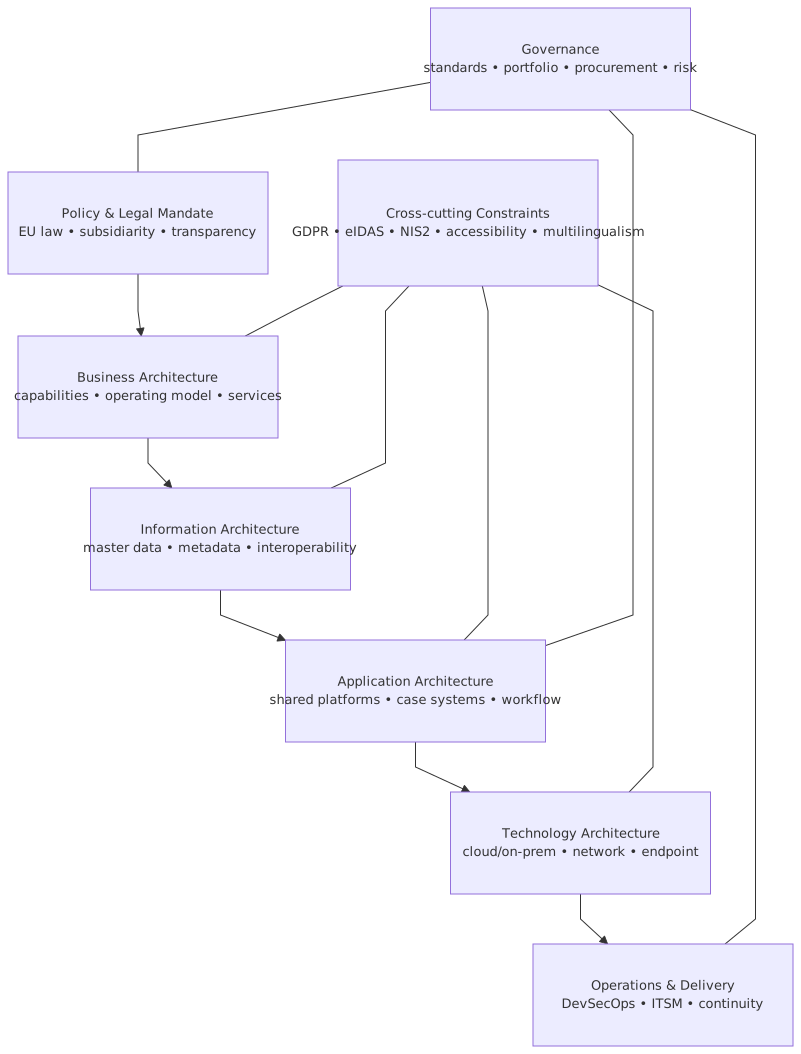
EU institutions live with a permanent tension: everyone wants interoperability, but nobody wants to lose control.
Again, fair enough.
Directorates, agencies, and institutional bodies have legitimate reasons for local choices. Different mandates. Different risk profiles. Different legacy estates. Different suppliers. Different timelines. A central architecture function that pushes total standardization usually creates resistance for good reason.
But the opposite failure is worse: allowing every organization to define its own identity model, integration style, cloud approach, data taxonomy, and application stack in the name of “flexibility.” That is not flexibility. That is fragmentation with nice language.
The right architectural position is neither total centralization nor laissez-faire federation. It is selective standardization.
That means being ruthless about what must be common:
- identity and access management foundations
- integration standards and event contracts
- security baseline controls
- shared reference data where relevant
- API principles
- observability and audit expectations
- cloud guardrails
- records and retention rules
And being pragmatic about what can vary:
- local implementation patterns
- product choices within approved boundaries
- domain-specific workflows
- UI layers
- analytical tooling in some cases
- operating models for specific missions
A mature architecture function knows the difference. An immature one standardizes what is visible and ignores what is foundational.
Start with identity, not applications
If I had to pick one place to begin architecture modernization in an EU institution, it would usually be IAM.
Not because IAM is glamorous. It isn’t. It is often painful, political, and deeply entangled with legacy systems. But identity is the spine of institutional architecture. If identity is weak, everything else becomes expensive: security, user experience, auditability, data access, cross-institution collaboration, and digital service delivery.
In many institutions, identity has grown in layers:
- staff identities in one directory
- external users in another
- contractors handled manually
- privileged access managed separately
- service accounts barely governed
- application-specific roles hardcoded everywhere
- federation added later, inconsistently
This creates exactly the kind of operational mess architects should be preventing.
A better IAM architecture for EU institutions usually needs a few hard choices:
In real architecture work, this means you do not start by saying “we need a modern IAM platform.” That’s vendor thinking. You start by mapping identity domains, lifecycle events, trust boundaries, regulatory obligations, and application dependencies.
Then you make a call on architecture principles such as:
- one person, one institutional identity where possible
- federation over duplication
- lifecycle automation over manual provisioning
- attribute-based access where roles become too coarse
- privileged identity separated from standard identity
- machine identity governance treated as seriously as human identity
A lot of architects talk about zero trust while ignoring service accounts with passwords that have not rotated in four years. That’s not zero trust. That’s slideware.
Integration architecture: stop building spaghetti with APIs on top
Another persistent issue in EU institutions is integration. Every modernization program says the same words: APIs, interoperability, data sharing, event-driven architecture. Fine. But many estates still operate like this:
- point-to-point batch feeds
- application-owned data copies
- undocumented transformation logic
- ESB patterns that became central bottlenecks
- APIs added as façades over unstable back-end processes
- no event governance at all
That architecture does not scale across institutions or policy domains.
This is where Kafka becomes interesting — not because every problem needs Kafka, but because many institutional environments genuinely need event streaming for decoupling, auditability, and near-real-time information exchange. Particularly where multiple systems need the same business event, and where relying on synchronous APIs creates brittle chains.
Let’s be clear, though. Kafka is not a modernization strategy. It is an integration tool. A powerful one, yes. Also easy to misuse.
The wrong pattern is treating Kafka as a magical replacement for architecture discipline. Teams dump events into topics with weak schemas, no ownership, and no retention logic, then call it an event-driven platform. A year later nobody knows which event is authoritative, consumers break silently, and data teams create side pipelines to compensate.
The better pattern is this:
- define event domains around business capabilities
- assign clear ownership for event contracts
- use schema governance seriously
- separate operational events from analytical feeds
- define replay, retention, and audit requirements upfront
- treat topic design as architecture, not as middleware configuration
A concrete example: imagine an EU grant management ecosystem involving applicant onboarding, eligibility verification, case handling, payment processing, and audit oversight. If each application synchronously calls the others for every status change, the result will be latency, cascading failure, and endless coupling. With a Kafka-based event backbone, core business events — applicant-registered, eligibility-confirmed, case-opened, payment-authorized, payment-executed, audit-flag-raised — can be published once and consumed by multiple bounded services.
That can work very well. But only if the architecture team defines standards for event naming, payload versioning, ownership, sensitive data handling, and operational support. Otherwise Kafka just becomes a faster way to create chaos.
I’ve seen this in banking too. Banks learned the hard way that event-driven architecture without governance can become a distributed compliance problem. EU institutions should not repeat that mistake.
The banking lesson EU institutions should borrow — and the one they should not
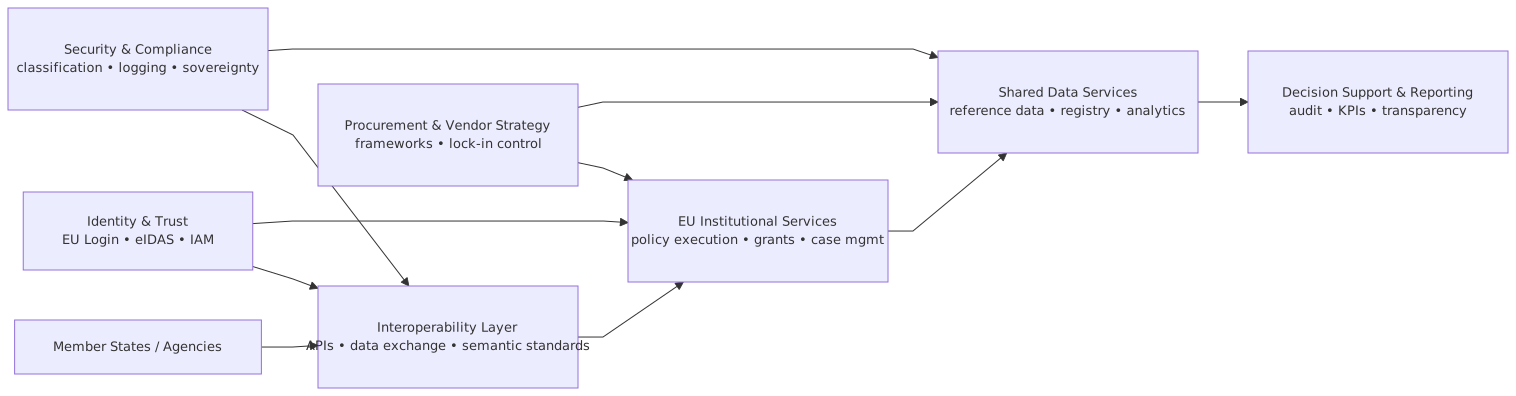
Banking is useful as a reference because it operates with high regulation, high security expectations, legacy estates, and increasing digital pressure. Sound familiar.
There are lessons worth borrowing.
Banks have become much better at:
- treating architecture as a portfolio discipline, not just a project activity
- investing in IAM and access governance because audit pain forces maturity
- using event streaming for operational decoupling
- separating system-of-record concerns from channel delivery
- defining non-functional requirements rigorously
- building architecture guardrails into delivery pipelines
EU institutions can absolutely learn from this.
But there is also a banking habit that should not be copied too eagerly: over-engineering control through layers of architecture boards and mandatory templates that slow delivery while creating an illusion of safety.
Some banks are excellent at governance and dreadful at simplification. They can produce 150 pages of architecture compliance while still running duplicate customer masters and undocumented batch jobs. Public institutions are already vulnerable to this pattern. They do not need help making it worse.
The better takeaway is this: use governance to force clarity, not paperwork.
Cloud in EU institutions: stop having theological debates
Cloud discussions in EU institutions often become strangely moral. Public cloud versus private cloud. Sovereignty versus agility. strategic autonomy versus delivery speed. The tone can become almost religious.
That is not architecture. That is ideology in technical clothing.
Here’s the practical position: cloud is not a destination. It is a set of operating models and service patterns. The question is not “are we pro-cloud?” The question is “which workloads belong where, under which control model, with which risk treatment, and at what cost?”
That’s the mature conversation.
EU institutions do have legitimate concerns around data protection, jurisdiction, resilience, supplier concentration, and strategic dependency. These are not excuses. They are real constraints. But architects often respond in one of two bad ways:
- They push public cloud by default without doing proper workload classification, exit planning, or control design.
- They reject cloud broadly, then quietly recreate inferior cloud-like platforms on-premises with less automation, worse resilience, and higher operational cost.
Both are bad architecture.
A more grounded cloud architecture approach for EU institutions should include:
- workload segmentation by sensitivity, criticality, latency, and legal constraints
- explicit control objectives for each deployment model
- platform engineering guardrails rather than one-off exceptions
- identity federation as a prerequisite
- centralized logging, key management, and policy enforcement
- FinOps discipline, because public sector waste is still waste
- portability where justified, not as a fantasy requirement for everything
Contrarian thought: “cloud sovereignty” is often discussed at the wrong abstraction level. The real sovereignty issue is not just where the compute runs. It is whether the institution retains control over identity, encryption, audit, architecture decisions, data lifecycle, and service continuity. You can lose sovereignty on-prem too, especially if your stack is dependent on a handful of integrators and nobody inside understands it.
That point usually makes some people uncomfortable. Good. It should.
What this looks like in real architecture work
This is where many articles go abstract. Let’s not do that.
In real architecture work inside EU institutions, your week is not spent inventing elegant target states from scratch. It is spent doing things like:
- reviewing a procurement document that accidentally hardcodes a vendor architecture
- pushing a project team to use the institutional IAM pattern instead of building local authentication again
- arguing for Kafka only where event-driven integration actually makes sense
- identifying that five programs are solving the same records-retention problem in five different ways
- translating security requirements into architecture decisions delivery teams can implement
- telling leadership that a “single platform for all use cases” is a bad idea
- negotiating phased modernization because the legacy case management system cannot be replaced in one budget cycle
- forcing application owners to identify authoritative data sources
- cleaning up reference architecture so it becomes usable instead of ceremonial
That is enterprise architecture. Messy, iterative, often repetitive.
A good architect in this environment has to move between levels constantly:
- strategic enough to align with institutional priorities
- technical enough to challenge weak designs
- operational enough to understand support implications
- political enough to navigate governance without becoming captured by it
And yes, sometimes you have to say no. More often than people like.
Common mistakes architects make in EU institutions
Let’s be blunt. Some architecture problems are structural. Some are self-inflicted.
1. Confusing framework compliance with architectural effectiveness
Just because the repository is complete and the capability map is beautifully color-coded does not mean architecture is helping. Frameworks are useful, but they are not outcomes. ArchiMate capability map
If architecture artifacts do not influence funding, design, technology choices, and delivery sequencing, they are museum pieces.
2. Starting with target architecture before understanding operational pain
Architects love target states. Institutions suffer from current states. If you cannot articulate the actual pain — onboarding delays, audit findings, duplicate data entry, fragile integrations, weak access controls, poor traceability — your architecture will sound smart and land badly.
3. Underestimating data ownership problems
Data architecture in institutions often stalls because everyone wants access and nobody wants accountability. Shared data is not just a technical problem. It needs stewardship, quality rules, change processes, and clear authority.
Without that, every “shared platform” becomes another place to copy bad data.
4. Treating IAM as an IT subsystem
It is not. IAM is institutional control architecture. It affects HR processes, external collaboration, legal accountability, procurement onboarding, and operational risk. If IAM is delegated entirely to a tooling team, expect trouble.
5. Doing integration by project instead of by ecosystem
Project-level integrations optimize for local delivery. Institutional integration architecture must optimize for reuse, decoupling, and lifecycle sustainability. These are different incentives. integration architecture guide
6. Assuming cloud adoption automatically modernizes architecture
It doesn’t. You can move a bad application to cloud and still have a bad application — just with more invoices and better dashboards.
7. Writing standards nobody can implement
This happens constantly. Standards say things like “all services should be interoperable, secure, scalable, and reusable.” Fine. Meaningless. Real standards need patterns, examples, constraints, and decision criteria.
A real enterprise example: modernizing a cross-institution grants and payments landscape
Let’s walk through a realistic example.
Imagine an EU institutional environment with a grants management ecosystem spread across multiple organizational entities. Over time, each area has built or procured its own components:
- separate applicant portals
- local case management platforms
- duplicated organization and beneficiary records
- payment interfaces with different validation logic
- fragmented reporting pipelines
- weakly aligned identity models
- manual exception handling for external users
On paper, each solution made sense at the time. Together, they create friction:
- applicants maintain multiple profiles
- staff re-enter data across systems
- audit trails are incomplete across process boundaries
- entitlement reviews are painful
- reporting is delayed because data reconciliation is manual
- changes in one application break downstream interfaces
An enterprise architecture intervention here should not begin with “let’s replace everything with one platform.” That instinct is common and usually wrong.
A better approach would be something like this:
Phase 1: establish cross-cutting foundations
- define a common external identity and federation model
- align beneficiary and organization master data principles
- introduce integration standards for APIs and events
- create a baseline reference architecture for case, payment, and audit domains
- define logging and traceability requirements end-to-end
Phase 2: decouple the most painful dependencies
- place a Kafka event backbone for key lifecycle events
- standardize payment status events and audit flags
- expose stable APIs for applicant profile and reference data
- remove direct point-to-point integrations where possible
- centralize access policies for staff and privileged functions
Phase 3: modernize domain services incrementally
- replace the weakest local portals first
- consolidate selected case workflows where processes are actually similar
- maintain local specialization only where mission differences justify it
- build reporting from governed operational events and curated data products
Phase 4: strengthen operating model
- formalize service ownership
- implement architecture review tied to funding decisions
- enforce schema and API governance
- measure reuse and reduction in duplicate controls
This kind of architecture work delivers real value because it does not rely on a fantasy “big bang” transformation. It improves institutional coherence while respecting delivery constraints.
And yes, some teams will complain that this is slower than buying a suite and mandating it everywhere. Maybe. But suite-driven standardization often creates hidden lock-in, brittle customization, and expensive compromise processes. Architects should be more skeptical of “single platform” promises, especially in heterogeneous public-sector environments.
The architecture artifacts that actually matter
Not every artifact deserves equal attention. In EU institutions, these tend to matter most:
- capability maps tied to funding and ownership
- reference architectures with enforceable patterns
- integration principles with concrete standards
- IAM architecture including lifecycle, federation, and privilege models
- data ownership and information exchange models
- transition roadmaps linked to budget cycles
- technology guardrails for cloud, observability, and security
- exception processes with expiry, not permanent exemptions
What matters less than many people think:
- giant inventories nobody trusts
- conceptual diagrams detached from implementation paths
- maturity models used only for presentations
- generic principle catalogs copied from frameworks
A harsh but fair rule: if an artifact does not help a real decision happen, simplify it or kill it.
How to make architecture stick
This is the hard part. Good architecture is rarely rejected because it is technically wrong. It fails because it is not embedded in institutional mechanisms.
To make architecture stick in EU institutions:
Tie architecture to money
If funding approval ignores architecture, architecture becomes advisory theater. Major investments should demonstrate alignment with shared IAM, integration, security, and data patterns.
Tie architecture to procurement
A lot of bad architecture enters through procurement wording. Architects must review requirements early, especially where vendors can smuggle in proprietary assumptions.
Tie architecture to delivery
Reference architectures must show implementation patterns, not just boxes. Teams need examples, reusable components, and decision support.
Tie architecture to risk and audit
When architecture controls map to audit findings, access reviews, resilience concerns, and compliance obligations, leaders pay attention.
Tie architecture to measurable outcomes
Examples:
- reduction in duplicate identities
- reduction in point-to-point integrations
- faster external user onboarding
- fewer critical access exceptions
- improved traceability across process steps
- lower time to integrate a new service
Without metrics, architecture becomes a language game.
Final thought: architecture should reduce institutional drag
That is the standard I would use.
Not whether the repository is complete. Not whether every framework box is filled. Not whether the target architecture looks elegantly federal on slide 14.
The real question is simpler: does the architecture reduce institutional drag?
Does it make it easier to onboard users securely? Easier to exchange data correctly? Easier to modernize one domain without breaking five others? Easier to satisfy audit without inventing manual controls? Easier to choose cloud rationally? Easier to integrate with partners? Easier to retire legacy without losing continuity?
If yes, good. Keep going.
If not, be honest. The architecture may be sophisticated, but it is not yet useful.
And EU institutions do not need more sophisticated irrelevance. They need architecture with backbone: selective standardization, serious IAM, disciplined integration, pragmatic cloud decisions, and governance that enables rather than suffocates.
That is not glamorous work. It is real work. And in this environment, real work beats elegant theory every time.
FAQ
1. What is the biggest enterprise architecture challenge for EU institutions?
Usually balancing cross-institution interoperability with local autonomy. Too much centralization creates resistance. Too little creates fragmentation. The hard part is deciding what must be common — IAM, integration standards, security controls — and what can remain local.
2. Why is IAM so critical in EU institutional architecture?
Because identity sits underneath security, collaboration, audit, and service delivery. If workforce, external, privileged, and machine identities are fragmented, everything becomes harder: onboarding, access reviews, federation, cloud adoption, and compliance.
3. Is Kafka a good fit for EU institutions?
Often yes, especially for event-driven integration across multiple systems and domains. But only if there is strong schema governance, ownership, retention policy, and security design. Kafka without governance is just high-speed disorder.
4. Should EU institutions move everything to cloud?
No. That is the wrong question. Institutions should classify workloads and choose deployment models based on sensitivity, legal constraints, resilience, cost, and operational capability. Some workloads fit public cloud well. Some do not. Architecture should be pragmatic, not ideological.
5. What mistake do enterprise architects most often make in public institutions?
Producing architecture that is governance-friendly but delivery-useless. In other words: good slides, weak implementation impact. Real architecture must shape procurement, funding, standards, and project design — otherwise it is just commentary.
Enterprise Architecture for EU Institutions: Key Considerations
Frequently Asked Questions
What is enterprise architecture?
Enterprise architecture is a discipline that aligns an organisation's strategy, business processes, information systems, and technology. Using frameworks like TOGAF and modeling languages like ArchiMate, it provides a structured view of how the enterprise operates and how it needs to change.
How does ArchiMate support enterprise architecture practice?
ArchiMate provides a standard modeling language that connects strategy, business operations, applications, data, and technology in one coherent model. It enables traceability from strategic goals through business capabilities and application services to the technology platforms that support them.
What tools are used for enterprise architecture modeling?
The main tools are Sparx Enterprise Architect (ArchiMate, UML, BPMN, SysML), Archi (free, ArchiMate-only), and BiZZdesign Enterprise Studio. Sparx EA is the most feature-rich option, supporting concurrent repositories, automation, scripting, and integration with delivery tools like Jira and Azure DevOps.