⏱ 19 min read
Most microservice disasters do not begin with scaling problems. They begin with a lie.
The lie is small, almost innocent: “these services just need to call each other.” A team sketches a few boxes, draws arrows between them, and feels a rush of architectural confidence. Customer Service talks to Order Service. Order Service talks to Inventory Service. Inventory Service publishes to Kafka. Billing subscribes. Shipping calls back. Notifications listens to everything because, well, it needs to know. event-driven architecture patterns
Six months later, the architecture diagram looks like a plate of dropped spaghetti and the teams call it “event-driven” as if that absolves them.
It does not.
What’s missing in most microservice landscapes is not another transport protocol or another service mesh feature. It is semantic discipline. You need a way to reason about who communicates with whom, why they communicate, what kind of dependency they create, and what business boundary that communication is crossing. That is where a service communication matrix becomes useful. Not as a pretty picture for a governance deck, but as a practical instrument for architectural control. EA governance checklist
A service communication matrix is one of those unfashionable tools that works because it forces clarity. It makes dependencies visible. It highlights coupling that teams would rather ignore. It reveals where synchronous calls are masking ownership confusion and where asynchronous messaging is being used as a theological preference rather than a design choice. In a microservices estate—especially one using Kafka, APIs, events, and legacy systems in a long migration—the matrix becomes less of a diagram and more of a map of organizational truth. microservices architecture diagrams
And truth matters. Because service communication is never just technical plumbing. It encodes business policy, domain language, team boundaries, failure propagation, and the shape of change.
Context
Microservices are often sold as an answer to scale, agility, and autonomous delivery. Sometimes they are. More often they are an amplifier. If your domain boundaries are weak, microservices make them weaker in public. If your teams are unclear about ownership, microservices let that confusion travel at network speed.
In an enterprise setting, communication between services usually takes several forms at once:
- synchronous request-response over HTTP or gRPC
- asynchronous event publication through Kafka
- command-style messaging through queues
- batch integration with downstream platforms
- database-fed reconciliation processes
- manual workflows and operational backstops
That combination is not a flaw. It is reality.
The problem is that many organizations treat these mechanisms as technology choices rather than domain decisions. Teams debate REST versus Kafka without first asking whether the interaction is a query, a command, a business event, or a compensating correction. They talk about latency without discussing ownership. They optimize message throughput while quietly creating circular dependencies between bounded contexts.
A communication matrix brings this back to first principles. It asks simple, awkward questions:
- Which service depends on which other service?
- Is the interaction synchronous, asynchronous, or both?
- Is it a query, command, event, or data replication?
- What domain boundary does it cross?
- What failure semantics are acceptable?
- Does the dependency belong at all?
Those questions sound obvious. In architecture, obvious questions are usually the ones people avoid.
Problem
Once a microservice estate grows beyond a dozen services, communication patterns become a source of systemic risk. The symptoms are painfully familiar.
A customer checkout flow times out because one service transitively depends on four others. A billing correction event arrives late, causing a customer account to appear unpaid. Shipping receives an order-created event before payment confirmation and allocates stock incorrectly. Teams start caching aggressively to survive dependency latency, then spend months debugging stale data. Kafka topics multiply. API gateways hide complexity for consumers but do nothing to reduce it inside the estate.
At this point, diagrams become deceptive. Traditional node-and-arrow diagrams are useful for storytelling, but they are bad at exposing density, directionality, and communication classes across many services. They show shape. They do not show discipline.
A service communication matrix does.
A matrix lists services on both axes and records the nature of communication at each intersection. It can capture:
- direction of dependency
- protocol or channel
- semantic type of interaction
- criticality
- ownership boundary
- consistency expectation
- failure handling strategy
That matters because not all communication is equal. A synchronous query from API Composition to Customer Profile is a very different thing from a domain event flowing from Orders to Billing. They create different operational behaviors and different coupling.
Without this visibility, enterprises drift into one of two bad states.
The first is the distributed monolith: many deployables, one change stream. Every service call is synchronous, every transaction crosses boundaries, and every outage becomes contagious.
The second is the event swamp: everything is “loosely coupled,” but nobody can explain which events are facts, which are notifications, which are commands disguised as events, and which are accidental replicas of another team’s internal model.
The matrix is not a silver bullet. But it is an antidote to architectural self-deception.
Forces
Several forces shape service communication, and they pull in different directions. Good architecture is not about eliminating these tensions. It is about choosing which ones you are willing to live with.
Domain autonomy versus end-to-end flow
Domain-driven design gives us bounded contexts for a reason. Orders, Billing, Inventory, Shipping, Customer Accounts—these are not merely technical partitions. They are semantic boundaries. The trouble begins when business workflows cross them, as they always do.
A customer order is not owned by one context alone. Ordering initiates it. Inventory reserves stock. Billing authorizes payment. Shipping fulfills it. Notifications informs the customer. Each step belongs somewhere. The workflow belongs nowhere in full.
So services must communicate. But every communication risks leaking one domain’s model into another.
Consistency versus availability
Synchronous calls can give immediate answers. They can also create chains of failure. Asynchronous messaging improves resilience and decouples runtime dependency, but it introduces lag, reordering, duplicates, and the need for reconciliation.
Most enterprises want both immediate user responses and decoupled back-end processing. They are asking for tension, not a solution.
Team autonomy versus estate governance
Teams should own their services. But communication is where one team’s “local design” becomes everyone else’s operational burden. A service that publishes ten poorly named Kafka topics is not autonomous. It is irresponsible.
A matrix gives central architecture and platform teams a way to govern without pretending they own every codebase. You do not need to dictate implementation details. You do need to make communication visible and intentional.
Delivery speed versus semantic stability
It is easy to add another API. It is harder to remove one. It is easy to publish another event. It is much harder to change its meaning once three downstream consumers depend on it.
The communication matrix helps distinguish tactical shortcuts from strategic interfaces. Some dependencies are transient. Others become part of the enterprise contract surface whether you admit it or not.
Solution
The solution is to treat service communication as a managed architectural asset and represent it explicitly through a matrix.
At its simplest, the matrix is a table where rows are source services and columns are target services. Each cell records if communication exists and what type it is. But the useful version is richer. It classifies communication by semantics and risk.
Here is a basic service communication matrix for an e-commerce platform:
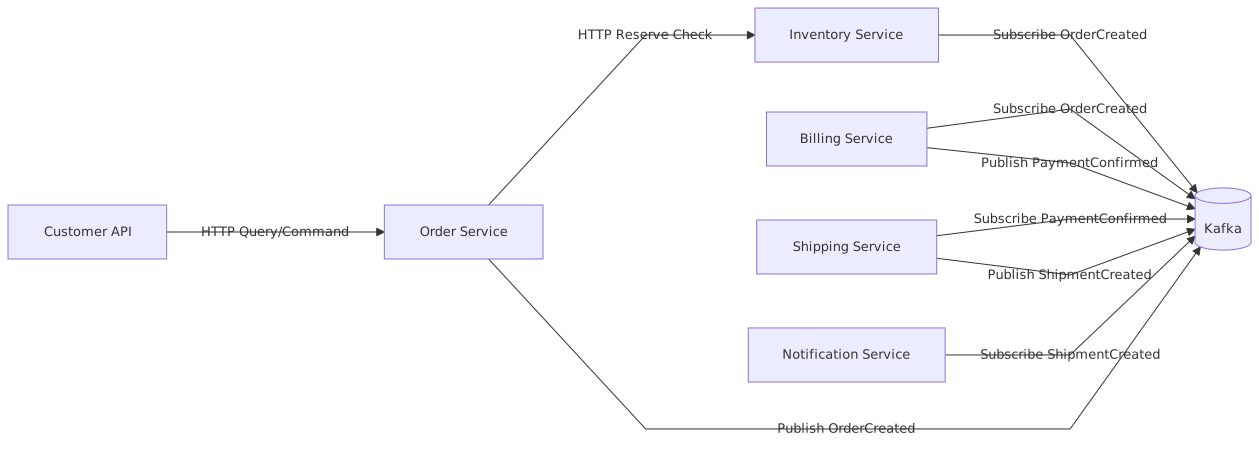
This diagram tells a story, but not enough of one. A matrix forces precision.
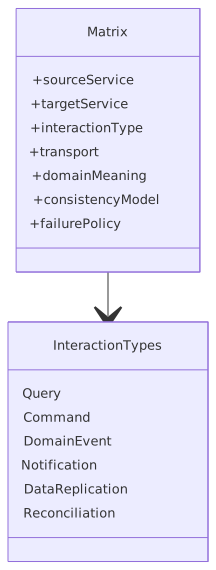
In practice, an enterprise communication matrix should capture at least these fields:
- Source service
- Target service or topic
- Interaction type: query, command, event, notification, replication, reconciliation
- Transport: HTTP, gRPC, Kafka, MQ, batch, CDC
- Business purpose
- Bounded context crossing
- Expected latency
- Consistency expectation: immediate, eventual, compensating
- Failure handling: retry, dead-letter, timeout, fallback, manual intervention
- Ownership
- Consumer count and criticality
This matters because words matter.
A query asks for information and should not change state.
A command asks another domain to make a decision or perform an action.
A domain event states that something meaningful has happened in the source bounded context.
A notification merely informs without carrying full domain significance.
A replication feed distributes data for local read optimization, not for domain ownership transfer.
A reconciliation flow repairs inevitable divergence between systems.
If you blur those distinctions, your architecture will blur them too.
Architecture
The architecture behind a good service communication matrix is less about the matrix artifact and more about communication design principles.
1. Align interactions with bounded contexts
Domain-driven design is the anchor here. If Order Service needs to know whether payment was captured, it should not read Billing’s database replica and infer state from ledger rows. It should consume a business event or query a published capability. The communication should reflect the language between bounded contexts, not implementation leakage.
That usually means:
- synchronous communication for immediate decisions and user-facing queries
- asynchronous domain events for state changes that other contexts care about
- replication only for local read models where latency and autonomy justify it
- reconciliation for cases where eventual consistency will fail in real life, because it always does eventually
2. Classify dependencies by runtime risk
Not all dependencies deserve equal fear. A synchronous call in a customer-facing request path is expensive in operational terms. It adds latency and propagates outages. An asynchronous subscription adds temporal complexity instead.
One useful pattern is to mark dependencies in the matrix by propagation type:
- hard runtime dependency: request cannot complete without it
- soft runtime dependency: fallback is possible
- deferred dependency: eventual processing acceptable
- offline dependency: batch or reconciliation only
This often leads to awkward but healthy redesign. Architects discover that many supposedly essential synchronous calls are really comfort blankets for teams unwilling to model eventual consistency.
3. Separate orchestration from ownership
There is a recurring mistake in enterprise microservices: central workflow services become de facto owners of business state. They coordinate too much, know too much, and eventually become mini-monoliths.
Use the matrix to identify where orchestration belongs. If a process spans domains, the coordinating component should manage workflow state, not absorb domain logic that belongs inside each bounded context. Commands go in. domain events come out. Ownership remains local.
4. Design for reconciliation, not fantasy
A mature matrix includes reconciliation paths because distributed systems are not neat. Kafka consumers fall behind. Events are replayed. messages arrive out of order. downstream systems reject updates. legacy platforms batch overnight and contradict near-real-time state.
If your architecture assumes perfect event delivery and perfectly idempotent consumers everywhere, you are not designing a system. You are writing fiction.
A practical architecture includes:
- idempotent consumers
- correlation IDs and business keys
- replay strategy
- compensating actions
- periodic state reconciliation jobs
- operational dashboards that surface divergence
Here is a more operational view:
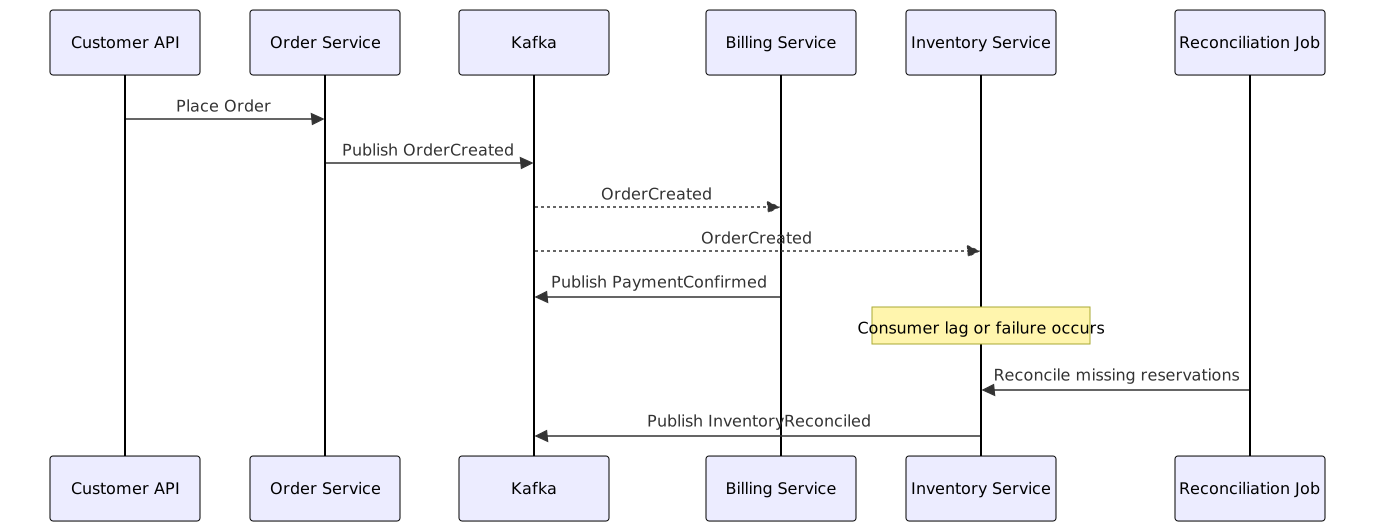
That last line is important. Reconciliation is not a shameful patch. It is part of the architecture.
Migration Strategy
Most enterprises do not get to start clean. They begin with a core system—ERP, order management, policy administration, claims platform, reservation engine, whatever runs the business—and then they begin the long, uneven work of extraction.
This is where the service communication matrix is particularly useful: during migration, not after it.
A progressive strangler migration benefits from a communication matrix because it helps you decide what to peel away first, what to shield, and what not to touch yet.
Start with communication inventory, not service decomposition
Before carving services, map current interactions:
- which business capabilities exist
- where requests originate
- which integrations are synchronous versus batch
- where data is copied
- where decisions are actually made
- which downstream consumers rely on side effects
This often reveals that the “legacy monolith” is not one system at all, but a set of muddled bounded contexts sharing a database and a release calendar.
Strangle at seams with stable semantics
The best candidates for first extraction are capabilities with:
- clear domain language
- manageable integration surface
- low transaction coupling
- high change demand
- obvious event boundaries
Expose new services behind existing channels if necessary. Let the old system remain the façade while new domain capability is implemented elsewhere. The matrix helps by showing which dependencies need to be preserved and which can be re-routed.
Introduce events carefully
Kafka is powerful in migration because it lets old and new worlds coexist. But migration by event publication is dangerous when semantics are ambiguous.
Do not publish “database changed” events and call that modernization. Publish domain events with business meaning. “OrderCreated” is useful. “ORDER_TBL_UPDATED” is not architecture; it is telemetry wearing a fake moustache.
A common migration pattern is:
- carve out a new bounded context service
- route write traffic into the new service
- publish domain events from the new service
- allow downstream consumers to migrate from legacy extracts to Kafka topics
- maintain reconciliation against legacy source of record during transition
- eventually invert ownership and retire old dependency
Keep dual-running honest
For a while, you will have duplicate sources, translation layers, and compensating controls. That is normal. What matters is that the matrix marks transitional dependencies explicitly. Temporary interfaces have a habit of becoming constitutional law unless someone names them as temporary and gives them an expiry plan.
Migration architecture should include:
- coexistence states
- anti-corruption layers
- canonical business identifiers
- replay and reconciliation strategy
- retirement criteria for old interfaces
A strangler pattern without retirement discipline is just distributed procrastination.
Enterprise Example
Consider a large retail bank modernizing its loan origination platform.
The legacy system handled application intake, credit checks, pricing, approval workflow, document generation, and account setup in one sprawling platform. It was not beautiful, but it worked—mostly. The bank wanted faster product change, better digital channels, and reduced coupling to overnight batch.
The first instinct from engineering was to create microservices for customer, application, pricing, credit, documents, funding, and notifications. Sensible on paper. Dangerous in practice.
The architecture team instead began with a communication matrix.
What they discovered was revealing:
- “Application” was not one domain; it mixed case management with lending decisions.
- Pricing depended synchronously on customer segmentation data that was refreshed only every four hours.
- Document generation consumed dozens of fields from internal tables rather than published business facts.
- Downstream account setup did not need full approval workflow context; it only needed a formal “loan approved” business event.
- Several APIs were really attempts to let teams read around ownership rather than ask for an explicit capability.
The target design created bounded contexts around:
- Loan Application
- Credit Decisioning
- Pricing
- Document Package
- Funding
- Customer Profile
Communication was then designed intentionally.
- Digital channel called Loan Application synchronously.
- Loan Application issued commands to Credit Decisioning and Pricing.
- Credit and Pricing published assessment-completed events.
- Loan Application owned workflow state and emitted LoanApproved.
- Funding and Document Package subscribed asynchronously.
- Customer Profile exposed queries but did not leak internal segmentation calculations.
- A reconciliation service compared approved-loan events with funded accounts daily to catch drift during migration.
Kafka became the backbone for domain events, but not everything went onto Kafka. Real-time customer eligibility remained synchronous because the user journey required immediate feedback. Funding remained asynchronous because it involved downstream core banking systems with unpredictable latency and operational windows.
The result was not “pure” microservices. It was better. The bank reduced release coupling, cut approval processing times, and could change pricing logic independently. More importantly, the matrix gave executives and engineers a shared language for discussing risk. They could see, concretely, which services formed customer-critical synchronous chains and which business capabilities were safely decoupled.
That is the hidden value of the matrix. It turns architecture from opinion into inspectable structure.
Operational Considerations
A communication matrix is only useful if it survives contact with production.
Observability
Every matrix entry should map to telemetry. If Order Service depends on Billing asynchronously through Kafka, you need:
- topic lag visibility
- consumer health
- dead-letter rates
- end-to-end business correlation
- time-from-event-to-outcome metrics
If a synchronous dependency is marked “soft with fallback,” then dashboards should prove the fallback path is actually used and works.
Versioning
Communication contracts outlive code releases. Event schemas and APIs need explicit versioning strategy. Backward-compatible evolution is not a nice-to-have when multiple teams and deployment cadences are involved.
Security and data classification
A matrix should identify not just communication type but sensitivity. Enterprises often discover after the fact that customer PII is being replicated to services that only needed a status code. Once data starts moving, it acquires a sort of architectural inertia. Better to stop it before it spreads.
Cost awareness
Kafka topics, API traffic, duplicated read stores, and cross-region calls all cost money. Communication patterns are part of economic architecture. Chatty services are not just ugly. They are expensive.
Governance
Do not turn the matrix into a bureaucratic artifact nobody trusts. Automate as much as possible:
- generate dependency candidates from traces and service catalogs
- enrich manually with semantic classification
- review high-risk changes in architecture forums
- treat new hard runtime dependencies as significant design events
Tradeoffs
The service communication matrix is a discipline tool. That means it comes with tradeoffs.
It introduces modeling overhead. Teams must think before they integrate. This is a feature disguised as inconvenience.
It can also tempt central architecture into overcontrol. If every communication change requires three review boards and a blood sample, teams will route around the process. The matrix should guide decisions, not freeze them.
Asynchronous messaging reduces direct runtime coupling but increases cognitive load. You trade immediate dependency for temporal complexity. Kafka gives scalability and decoupling, but also replay semantics, schema governance, duplicate handling, and debugging pain. You do not get simplicity. You get a different kind of difficulty. ArchiMate for governance
Synchronous APIs are often easier to reason about and test locally, but they create dependency chains and turn latency into an architectural tax.
Replication improves autonomy for reads, but creates stale data risk and reconciliation burden.
There is no perfect communication mode. Only context-appropriate compromise.
Failure Modes
The matrix becomes particularly valuable when things go wrong, because failure usually follows predictable patterns.
Circular dependency
Service A calls Service B for enrichment. Service B subscribes to events from Service A but also queries A for confirmation. Eventually both wait on each other in subtle ways. The matrix exposes cycles quickly.
Event ambiguity
A topic named customer-updated seems harmless until five services depend on it for different interpretations. One consumer treats it as a profile change. Another as consent revocation. Another as address change only. Eventually a schema change breaks all of them. The problem was never Kafka. It was semantic laziness.
Hidden synchronous path
Teams claim their system is event-driven, but the user-facing request still blocks on three validations performed over HTTP. The outage says otherwise.
Reconciliation blindness
An event was missed, a consumer was down, a batch failed—pick your favorite. Without explicit reconciliation flow, divergence becomes a customer complaint before it becomes an operational signal.
Ownership erosion
A reporting service begins as a read model and slowly starts serving operational decisions. Before long, replicated data becomes shadow authority. The matrix should flag these flows as replication, not source-of-truth ownership.
When Not To Use
Not every system needs a formal service communication matrix.
Do not use this as heavyweight ceremony for a small, simple product with three services and one team. A whiteboard and shared understanding may be enough.
Do not use it when your real problem is that you should not have microservices at all. If the domain is tightly coupled, the team is small, and change is coordinated, a modular monolith is often the better answer. Splitting into services and then constructing a beautiful matrix of all your unnecessary network calls is not architecture. It is self-harm with documentation.
Also do not confuse the matrix with dynamic workflow design. It is a structural tool, not a replacement for process orchestration, event storming, or capability mapping.
Related Patterns
Several patterns sit naturally beside the service communication matrix.
- Bounded Context Mapping from domain-driven design: to understand semantic boundaries before drawing technical dependencies.
- Strangler Fig Pattern: for progressive migration from legacy systems.
- Anti-Corruption Layer: to isolate new domain models from legacy semantics.
- Saga / Process Manager: for coordinating long-running cross-domain workflows.
- CQRS: where separate read models justify replication and asynchronous propagation.
- Outbox Pattern: to publish domain events reliably alongside state changes.
- Event Sourcing in selected domains where event history is the source of truth, though far less often than enthusiasts suggest.
- Service Mesh: useful for transport concerns, but not a substitute for semantic dependency design.
- Consumer-Driven Contracts: to keep API and event evolution disciplined.
The matrix does not replace these patterns. It gives them a shared map.
Summary
Microservice communication is where architecture stops being theory and starts becoming consequence. Every API call, Kafka topic, and replicated read store encodes a decision about ownership, timing, failure, and business meaning. Ignore that, and your system will still have a communication model. It will just be the accidental one.
A service communication matrix is valuable because it makes those decisions visible. It helps teams distinguish query from command, event from notification, dependency from convenience, ownership from leakage. It supports domain-driven design by grounding communication in bounded contexts. It supports migration by showing where legacy seams can be strangled safely. It supports operations by making runtime coupling and reconciliation explicit.
Most of all, it encourages honesty.
And honesty is rare in enterprise architecture. We like diagrams that reassure. We like standards that sound clean. We like to say “loosely coupled” while building systems that panic together. The matrix cuts through that. It shows the actual dependency fabric of the estate.
Use it when the landscape is large enough that informal understanding has already failed. Use it to challenge synchronous habits. Use it to tame Kafka enthusiasm with semantic rigor. Use it to design reconciliation before production teaches you humility.
But do not use it as a substitute for thinking. The matrix is a map, not the territory.
Still, a good map is better than a heroic guess. And in microservices, heroic guesses are usually what create the next modernization program.
Frequently Asked Questions
What is a service mesh?
A service mesh is an infrastructure layer managing service-to-service communication. It provides mutual TLS, load balancing, circuit breaking, retries, and observability without each service implementing these capabilities. Istio and Linkerd are common implementations.
How do you document microservices architecture for governance?
Use ArchiMate Application Cooperation diagrams for the service landscape, UML Component diagrams for internal structure, UML Sequence diagrams for key flows, and UML Deployment diagrams for Kubernetes topology. All views can coexist in Sparx EA with full traceability.
What is the difference between choreography and orchestration in microservices?
Choreography has services react to events independently — no central coordinator. Orchestration uses a central workflow engine that calls services in sequence. Choreography scales better but is harder to debug; orchestration is easier to reason about but creates a central coupling point.