⏱ 5 min read
Recommended Reading
Executive summary
Architecture debt becomes actionable only when it is visible in business terms: which capabilities are impacted, what risks are elevated, and what modernization work reduces the “interest.” ArchiMate supports modeling relationships across business, application, and technology domains, which enables debt to be represented as assessments/constraints linked to the architecture elements that create the debt and the capabilities that suffer from it. ArchiMate’s positioning as an unambiguous relationship language for enterprise architecture supports this cross-layer representation.
A governance-grade approach connects architecture debt to decision records (why the debt exists), baselined reference architectures (what “good” looks like), and migration work packages (how debt is reduced). When combined with audit/accountability expectations in security frameworks, debt modeling can also support compliance and operational resilience narratives by demonstrating a controlled plan for risk reduction. ArchiMate for architecture governance
- Modeling pattern: assessments/constraints linked to elements
- Heatmapping: capability criticality × debt level
- Roadmaps: plateaus/work packages/gaps
- Governance: decisions, exceptions, baselines

- ArchiMate 3.2 standard framing.
- ArchiMate reference cards.
- DORA regulation (resilience framing).
- ADR discipline (decision rationale).
Visible vs hidden architecture debt
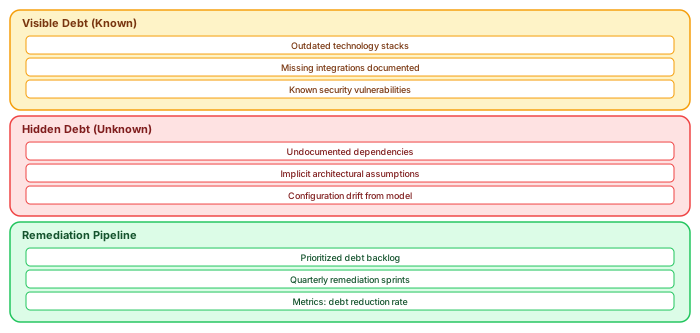
Architecture debt, like financial debt, has a principal (the deviation from the target architecture) and interest (the ongoing cost of maintaining the deviation). ArchiMate makes both visible by modeling the gap between current and target states. ArchiMate tutorial for enterprise architects
Visible debt is documented and acknowledged: outdated technology stacks tagged with end-of-support dates, missing integrations that force manual data re-entry, known security vulnerabilities recorded as Assessments linked to affected components. This debt exists in the model because someone identified it.
Hidden debt is the dangerous kind — it exists but nobody has documented it: undocumented dependencies between components that only surface during changes, implicit architectural assumptions that worked historically but break under new requirements, configuration drift where the deployed system no longer matches the model. Hidden debt is discovered through architecture reviews, incident postmortems, and automated model-to-reality reconciliation.
Quantifying debt impact. For each debt item, model three dimensions as tagged values: Maintenance Overhead (additional annual cost to maintain the deviation), Risk Exposure (probability × impact of the debt causing a failure), and Agility Constraint (how much the debt slows change delivery). These dimensions enable prioritization — debt with high risk and high agility constraint gets remediated first, regardless of maintenance cost.
Building the remediation pipeline
Model the remediation pipeline as a sequence of Work Packages, each addressing a cluster of related debt items. Prioritize by risk-weighted impact. Schedule quarterly remediation sprints alongside feature delivery — architecture debt that is "tracked but never addressed" provides zero value. Track the debt reduction rate as a KPI: total debt items at start of quarter vs end of quarter, weighted by severity.
// jArchi: Generate architecture debt report
$("application-component").forEach(function(app) {
    var eol = app.prop("End_of_Support");
    var stack = app.prop("Technology_Stack");
    if (eol && new Date(eol) < new Date("2026-12-31")) {
        console.log("DEBT: " + app.name + " — EOL: " + eol + " (" + stack + ")");
    }
});
Pricing the Interest
Debt language earns its keep the moment the interest gets a number, and the model is where the number can actually live. Three costs recur in every estate and are all attachable as properties on the indebted element: the operational drag (incident and workaround hours per quarter, from the ticketing system), the change tax (the delivery-lead multiplier teams apply when a change touches the legacy platform — ask them; they know it to a decimal), and the hard fees (extended-support contracts, legacy licence renewals, the premium for the one contractor who still knows the system). None of these requires precision to be useful; an order of magnitude, refreshed quarterly, beats the alternative, which is adjectives.
Once the properties exist, the roll-up is a query: interest per capability, summed up the realization chain. That single aggregation converts the architecture conversation into the funding conversation — "the payments capability carries roughly €400k a year of debt interest, concentrated in two platforms" is a sentence a CFO can act on, where "the payments stack has significant technical debt" is a sentence a CFO has learned to ignore. The architects did not become accountants; they became the only people in the building who could attach the costs everyone already knew to the structures that cause them.
The Debt Register Is a Generated Catalogue
With debt modelled as assessments and priced as properties, the register the governance forum needs is a catalogue query, not a document: every debt assessment, its element, the capabilities impacted through the chain, the annual interest, the accepted-or-planned status, and the link to whatever decision created or tolerates it. Generated at each publication, sorted by interest descending, with the gaps shown honestly — a debt item with no remediation package and no acceptance decision is the register's most important row, because it is debt nobody has decided anything about.
The register's quiet advantage over the spreadsheet it replaces is that it cannot drift from the architecture, because it is the architecture, filtered. When the platform is finally decommissioned, its debt rows disappear the same week; when a new assessment is attached during a design review, it surfaces in the next publication without anyone maintaining a parallel list. Estates that have run both models describe the difference simply: the spreadsheet register was a quarterly argument about whose numbers were current; the generated register moved the argument to what to do — which was the argument worth having all along.
Roadmapping Remediation with Plateaus
ArchiMate's implementation and migration layer is underused everywhere except exactly here. Remediation planning wants three of its elements: plateaus for the stable states (current, two intermediates, target), work packages for the funded chunks of change, and gaps for what separates one plateau from the next. Wire the debt assessments to the gaps they represent and the work packages to the gaps they close, and the roadmap stops being a slide and becomes a queryable claim: this programme, at this plateau, retires this much interest.
The payoff shows at steering level. Each plateau can render its own capability heatmap — the same view, projected forward — so the committee sees the red shrinking across the timeline in the same visual language they use for the current state. And because work packages carry costs while the debt carries interest, the model can answer the only prioritisation question that matters: which funded package buys the largest interest reduction per euro. In our experience the answer surprises the room roughly half the time, which is precisely the argument for deriving it from linked data rather than from the volume of whoever advocates loudest.
The Debt You Decide to Keep
A mature register has a category the immature one lacks: debt that has been examined and deliberately kept. The platform retiring with the business line in two years, the deviation whose remediation costs more than a decade of its interest, the vendor constraint nobody can renegotiate before the contract ends — for each, the honest state is accepted, recorded as a decision with an owner, a rationale and, critically, an expiry date on the acceptance, after which it returns to the register's undecided pile automatically.
This is the same waiver discipline that keeps quality gates honest, applied at portfolio scale, and it changes the register's politics entirely. Teams stop hiding debt, because disclosure no longer means an automatic remediation demand — it means a decision, and decisions can go their way. The register stops being a wall of shame and becomes what the financial metaphor always implied: a balance sheet, some of it strategic leverage, some of it expensive drift, all of it visible, priced and owned. An architecture practice that can show a regulator or a board its accepted-debt list, with dates and signatures, has demonstrated something rarer than a clean estate — a controlled one.
Where the Debt Data Actually Comes From
The register is only as good as its intake, and debt intake fails in a characteristic way: it depends on architects volunteering bad news about their own domains, on a form, unprompted. Some do. The estates with credible registers stopped relying on virtue and wired three harvesting channels instead.
The first channel is mechanical: end-of-support data. Vendor lifecycle dates live as tagged values on technology elements — importable from the CMDB or maintained during platform reviews — and a scheduled query turns "support ends within eighteen months" into an automatic debt assessment, created, linked and priced with the extended-support quote before any human opinion enters. In most estates this single query populates a third of the register, and it is the third nobody argues with. The second channel is the incident system: platforms whose ticket volume sits in the top decile carry operational debt by definition, and a quarterly import of incident-hours per application updates the interest figures with numbers the operations director already believes. The third channel is the design review itself: every accepted deviation from the target architecture — every "we know, but the deadline" — is a debt assessment created in the meeting, linked to the decision that accepted it, while the context is fresh and the shame is low.
Notice what the three channels share: none requires anyone to confess. The lifecycle data is the vendor's statement, the incident data is the ticketing system's, and the review deviations were already being discussed out loud. Harvest where the facts already are, and the register fills with defensible entries while the voluntary form — kept, for the genuine volunteers — becomes the smallest of the four sources. A debt register built this way survives its skeptics, because every row can answer the only question skeptics ask: says who?
Applying these patterns in practice
The value of ArchiMate modeling is realized not through comprehensive coverage of every element type, but through disciplined application of a few core patterns that answer recurring stakeholder questions. Three patterns account for the majority of architecture communication needs. ArchiMate layers explained
The Layered View pattern shows how business processes depend on applications, and how applications depend on infrastructure. Build this view by placing Business Processes at the top, Application Components in the middle, and Technology Nodes at the bottom. Connect them with Serving and Realization relationships. This single view demonstrates cross-layer traceability — when a server is decommissioned, trace upward to see which applications and business processes are affected.
The Cooperation View pattern shows how application components interact through interfaces and data flows. Place the core application in the center and its integration partners around it, connected by Flow relationships labeled with the data exchanged. This view reveals integration dependencies that are otherwise buried in technical documentation.
The Motivation View pattern connects strategic goals to architecture decisions. Stakeholder concerns drive Goals, Goals are realized by Outcomes, Outcomes are enabled by Capabilities, and Capabilities are realized by Application Components. This chain answers the question executives always ask: "Why are we building this?"
If you’d like hands-on training tailored to your team — Sparx Enterprise Architect, BPMN, SysML, Apache Kafka or the Archi tool — or modelling coaching in ArchiMate and TOGAF-aligned governance, you can reach us via our contact page.
Frequently Asked Questions
What is enterprise architecture?
Enterprise architecture is a discipline that aligns an organisation's strategy, business operations, information systems, and technology infrastructure. It provides a structured framework for understanding how an enterprise works today, where it needs to go, and how to manage the transition.
How is ArchiMate used in enterprise architecture practice?
ArchiMate is used as the standard modeling language in enterprise architecture practice. It enables architects to create consistent, layered models covering business capabilities, application services, data flows, and technology infrastructure — all traceable from strategic goals to implementation.
What tools are used for enterprise architecture modeling?
Common enterprise architecture modeling tools include Sparx Enterprise Architect (Sparx EA), Archi, BiZZdesign Enterprise Studio, LeanIX, and Orbus iServer. Sparx EA is widely used for its ArchiMate, UML, BPMN and SysML support combined with powerful automation and scripting capabilities.
The First Month, Concretely
To start from nothing: import the end-of-support dates and let the lifecycle query create its automatic assessments — that is week one, and the register exists. Weeks two and three, price the top twenty by interest using the three cost channels, roughly; precision comes later or never, and it does not matter. Week four, take the one-page register to whatever forum owns investment and let the empty remediation column do the talking. The apparatus of plateaus, acceptance decisions and projected heatmaps grows from that meeting's questions — pulled, not pushed, which is the only way governance artefacts survive their first year. Debt modelling fails as a modelling initiative and succeeds as a funding conversation with a model underneath; start with the conversation.
And keep the metaphor honest as the register matures: debt language works because executives know that some debt is leverage and all debt has a servicing cost. The model's job is to keep both halves of that sentence visible — the deliberate borrowings with their expiry-dated acceptances, and the interest line that compounds while decisions wait. An estate that can show both, priced and current, has turned its oldest embarrassment into its most persuasive planning instrument.