⏱ 6 min read
Recommended Reading
Executive summary
TOGAF and SAFe integration succeeds when governance aligns to delivery cadence rather than imposing heavyweight document cycles. TOGAF provides governance mechanisms such as architecture compliance reviews and architecture boards; SAFe provides agile architecture guidance emphasizing collaboration and balancing intentional and emergent design, plus Lean Portfolio Management constructs for aligning strategy and execution.
The integration pattern is “guardrails + exceptions”: publish standards and reference architectures as reusable assets, and reserve formal review for high-impact exceptions—while capturing decisions using ADRs for traceability. integration architecture diagram
- Governance design: guardrails and exception-path reviews
- Cadence mapping: PI planning, iteration, release, compliance
- Portfolio integration: Lean Portfolio Management + EA insights

- TOGAF compliance review concept.
- Architecture board definition.
- SAFe agile architecture guidance.
- SAFe Lean Portfolio Management page.
- ADR practice.
Mapping TOGAF to SAFe

SAFe organizes delivery at scale. TOGAF organizes architecture at scale. The integration maps roles, cadences, and artifacts so architecture flows naturally within agile delivery. ArchiMate in TOGAF ADM
Enterprise Architect (TOGAF) → Enterprise Architect (SAFe). SAFe explicitly includes an EA role for cross-ART architectural vision — mapping directly to the TOGAF team. The EA participates in PI Planning, contributes to the runway, and ensures cross-team coherence.
Architecture Board → Architecture Sync. TOGAF's formal review board maps to SAFe's distributed governance: the System Team handles integration architecture, Architecture Sync handles coordination. Significant decisions (new tech, platform changes) still require a formal review.
ADM Phases → PI Cadence. Phase A (Vision) during PI Planning. Phases B-D during the PI as enabler work. Phase E-F during Inspect & Adapt. Phase G as continuous compliance checking.
Enabler epics: making architecture visible
Architecture work is captured as Enabler Epics — large-scale technical initiatives building the runway. "Migrate payment service to microservice" is an enabler epic implementing the target architecture from Phase C. By making architecture work visible as epics, it competes for prioritization alongside business features — architecture investment becomes explicit, not hidden.
Role mapping: TOGAF to SAFe
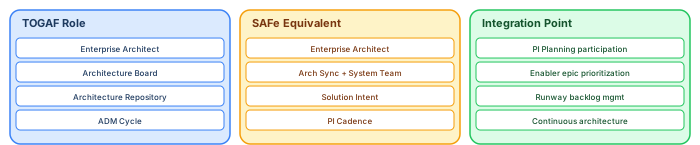
The practical integration of TOGAF and SAFe requires explicit mapping of roles, artifacts, and ceremonies. Without this mapping, TOGAF and SAFe operate as parallel processes that create confusion rather than clarity. modeling integration architecture with ArchiMate
Enterprise Architect maps directly — SAFe includes this role with responsibility for cross-ART (Agile Release Train) architectural vision. The enterprise architect participates in PI Planning at the portfolio level, contributes to the architecture runway, ensures cross-team technical coherence, and maintains the enterprise architecture repository. In practice, this person spends 50% of their time in SAFe ceremonies and 50% on TOGAF strategic work.
Architecture Board maps to a combination of Architecture Sync (weekly cross-team coordination) and the System Team (integration architecture). The formal board still exists for significant decisions — new technology adoption, platform changes, major API redesigns — but routine architecture coordination happens through SAFe ceremonies rather than separate governance meetings.
Architecture Repository maps to Solution Intent — SAFe's concept of a living document set that captures the architecture as it evolves. In practice, the Sparx EA repository IS the Solution Intent. ArchiMate views replace static architecture documents. The repository updates continuously as architecture decisions are made, not in periodic documentation sprints.
ADM Cycle maps to the PI cadence. Rather than running the ADM as a separate sequential process, ADM phases are distributed across the PI: Phase A (Vision) during PI Planning, Phases B-D during the PI as enabler work, Phases E-F during Inspect & Adapt, and Phase G as continuous compliance checking throughout.
The architecture runway in practice
The architecture runway is the most important concept that bridges TOGAF and SAFe. It represents the set of existing and planned architectural enablers that allow feature teams to deliver business value without being blocked by architectural work.
Each runway item is modeled in the EA repository as an Application Component or Technology Service with tagged values: Runway_Status (Ready / In Progress / Planned), Target_PI (when it will be ready), Consuming_Teams (which ARTs depend on it), and Business_Features_Enabled (which features this runway item unblocks). During PI Planning, the enterprise architect presents the runway status — green items are ready for teams to build on, amber items will be ready mid-PI, and red items need prioritization as enabler features.
Runway items that are not ready become Enabler Features in the program backlog. They compete for capacity alongside business features — which forces explicit trade-off conversations: "Do we build 3 customer features this PI, or 2 features plus the API gateway upgrade that unblocks 5 features next PI?" This transparency is precisely what TOGAF governance aims for but rarely achieves through traditional review boards.
Common pitfalls in TOGAF-SAFe integration
Organizations attempting to integrate TOGAF and SAFe frequently fall into three traps.
Trap 1: Parallel processes. The TOGAF team runs the ADM on a separate timeline from the SAFe PIs. Architecture deliverables arrive after teams have already made technical decisions. Fix: synchronize the ADM with the PI cadence. Architecture vision (Phase A) happens during PI Planning, not before it.
Trap 2: Architecture as a gate, not a service. The architecture review board operates as a gate that blocks delivery rather than a service that accelerates it. Teams learn to avoid architecture review by keeping changes small enough to fly under the radar. Fix: make architecture review valuable. Provide model-based impact analysis that saves teams from discovering dependencies in production. Target: teams request architecture input because it helps, not because governance requires it.
Trap 3: Ignoring technical debt. SAFe's velocity pressure drives teams to accumulate technical debt that TOGAF governance should catch. When architecture reviews are too slow or too heavy, teams skip them, and debt accumulates invisibly. Fix: automate debt detection through repository-based compliance checks. Flag debt in the backlog as visible technical debt items with estimated remediation cost, so product owners can make informed trade-off decisions.
If you’d like hands-on training tailored to your team — Sparx Enterprise Architect, BPMN, SysML, Apache Kafka or the Archi tool — or modelling coaching in ArchiMate and TOGAF-aligned governance, you can reach us via our contact page.
Frequently Asked Questions
What is TOGAF used for?
TOGAF (The Open Group Architecture Framework) is used to structure and manage enterprise architecture programmes. It provides the Architecture Development Method (ADM) for creating architecture, a content framework for deliverables, and an enterprise continuum for reuse.
How does ArchiMate relate to TOGAF?
ArchiMate and TOGAF are complementary. TOGAF provides the process framework (ADM phases, governance, deliverables) while ArchiMate provides the notation for creating the architecture content. Many organisations use TOGAF as their EA method and ArchiMate as the modeling language within each ADM phase.
What is the TOGAF Architecture Development Method (ADM)?
The ADM is a step-by-step process for developing enterprise architecture. It consists of a Preliminary phase and phases A through H: Architecture Vision, Business Architecture, Information Systems Architecture, Technology Architecture, Opportunities and Solutions, Migration Planning, Implementation Governance, and Architecture Change Management.