⏱ 5 min read
Recommended Reading
Executive summary
Regulated industries demand evidence, not opinions. TOGAF supports this by defining governance practices: formal architecture compliance review processes and architecture boards for strategic oversight, plus architecture contracts as agreements on deliverables, quality, and fitness for purpose.
In the EU financial sector, DORA raises expectations for ICT risk governance and operational resilience—pushing EA governance to model dependencies, controls, and evidence trails.
A practical implementation connects TOGAF governance to tooling evidence (baselines, audits, reviews) and to control frameworks like NIST SP 800-53 for audit/logging and accountability controls. ArchiMate in TOGAF ADM
- TOGAF governance primitives applied: boards, compliance, contracts
- Control mapping: NIST, privacy obligations, operational resilience
- Evidence workflows: baselines, audits, publication
- Case scenario: audit inquiry walk-through

- TOGAF compliance review process.
- TOGAF architecture board.
- TOGAF architecture contracts definition.
- DORA regulation text.
- EA auditing.
- EA baselines.
Layered compliance architecture
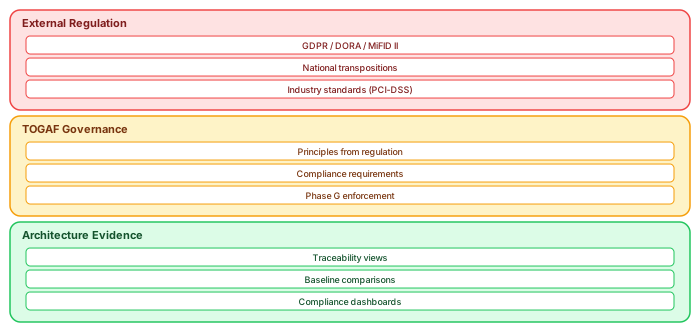
Regulated industries (banking, pharma, government, healthcare) face a unique challenge: architecture decisions must produce auditable evidence of regulatory compliance. TOGAF provides the governance framework; the challenge is connecting it to specific regulatory requirements.
External regulation layer: GDPR, DORA, MiFID II, NIS2, PCI-DSS, ISO 27001 define what organizations must do. Model these as Constraints in ArchiMate with tagged values for regulation ID, article number, and effective date.
TOGAF governance layer: Architecture principles derived directly from regulations. "All personal data must be encrypted at rest" is a principle derived from GDPR Article 32. ADM Phase G becomes the enforcement mechanism — every implementation is checked against regulatory requirements before go-live.
Architecture evidence layer: Traceability views show the chain from regulation → requirement → decision → component → test case. Baseline comparisons demonstrate change control. Compliance dashboards aggregate coverage per regulation.
Practical lessons
Model regulations as first-class elements. Do not bury requirements in documents. Model them with formal traceability to implementing components. When the regulator updates a requirement, impact analysis runs from the model.
Automate evidence generation. Build compliance queries as saved reports in Sparx EA and generate them on demand. The model produces evidence; humans produce judgment.
Baseline before every major change. Auditors need proof of what the architecture looked like before a change, what changed, and who approved it. Create baselines at every governance gate.
Making TOGAF work in practice
TOGAF succeeds when it is tailored to the organization's delivery cadence and decision-making culture. The ADM is designed to be adapted — running all phases sequentially with full artifact production works for waterfall delivery, but agile organizations need a compressed cycle that produces model-based deliverables rather than documents.
Practical TOGAF implementation keeps Phases A through D and G (governance), simplifies E-F with Migration views, and replaces the full artifact catalog with a focused set of ArchiMate views that answer specific stakeholder questions. Architecture contracts become single-page tables of standards and evidence checkpoints rather than multi-page documents. The test for every TOGAF artifact: "Will this improve a decision within 90 days?" If not, it is documentation overhead rather than architecture value. ArchiMate modeling best practices
Tailoring TOGAF for practical results
TOGAF's strength is its comprehensiveness. Its weakness is also its comprehensiveness — organizations that try to implement every phase, every deliverable, and every governance mechanism simultaneously create a process that is too heavy to sustain. The most successful TOGAF implementations start small and expand based on demonstrated value.
Begin with Phase A (Architecture Vision) and Phase G (Architecture Governance). Vision ensures that architecture work is aligned with business strategy. Governance ensures that architecture decisions are reviewed, recorded, and enforced. These two phases provide immediate value: stakeholders see architecture alignment with their goals, and delivery teams see clear standards to follow.
Add Phases B through D incrementally as the architecture practice matures. Phase B (Business Architecture) adds capability maps and value stream models. Phase C (Information Systems Architecture) adds application portfolio views and data architecture. Phase D (Technology Architecture) adds infrastructure topology and platform design. Each phase produces ArchiMate views in the repository — not documents in a folder. ArchiMate tutorial for enterprise architects
Skip Phases E and F (Opportunities and Migration Planning) initially. Replace them with ArchiMate Migration views that show plateaus (stable architecture states) and work packages (projects that move from one plateau to the next). This achieves the same outcome with less process overhead. ArchiMate layers explained
If you’d like hands-on training tailored to your team — Sparx Enterprise Architect, BPMN, SysML, Apache Kafka or the Archi tool — or modelling coaching in ArchiMate and TOGAF-aligned governance, you can reach us via our contact page.
Frequently Asked Questions
What is TOGAF used for?
TOGAF (The Open Group Architecture Framework) is used to structure and manage enterprise architecture programmes. It provides the Architecture Development Method (ADM) for creating architecture, a content framework for deliverables, and an enterprise continuum for reuse.
How does ArchiMate relate to TOGAF?
ArchiMate and TOGAF are complementary. TOGAF provides the process framework (ADM phases, governance, deliverables) while ArchiMate provides the notation for creating the architecture content. Many organisations use TOGAF as their EA method and ArchiMate as the modeling language within each ADM phase.
What is the TOGAF Architecture Development Method (ADM)?
The ADM is a step-by-step process for developing enterprise architecture. It consists of a Preliminary phase and phases A through H: Architecture Vision, Business Architecture, Information Systems Architecture, Technology Architecture, Opportunities and Solutions, Migration Planning, Implementation Governance, and Architecture Change Management.