⏱ 6 min read
Implementing BCBS 239 Using TOGAF: A Structured Architecture Approach
A Long-Form Technical Architecture Guide for Financial Institutions
Introduction
In the aftermath of the 2008 financial crisis, supervisors identified a systemic weakness across global banks: the inability to aggregate risk exposures quickly and accurately during stress conditions. Fragmented IT landscapes, inconsistent data definitions, and manual reporting processes prevented boards and regulators from obtaining a reliable risk view when it mattered most.
BCBS 239 -- Principles for Effective Risk Data Aggregation and Risk Reporting -- was introduced to address these weaknesses. More than a decade later, many institutions still struggle with sustainable compliance.
This paper explains how TOGAF (The Open Group Architecture Framework) can be used as a structured enterprise architecture methodology to implement BCBS 239 in a controlled, scalable, and sustainable way. ArchiMate in TOGAF ADM
1. BCBS 239 as an Architecture Problem
BCBS 239 defines 14 principles across four domains:
Governance and Infrastructure
- Strong governance
- Robust data architecture and IT infrastructure
Risk Data Aggregation Capabilities
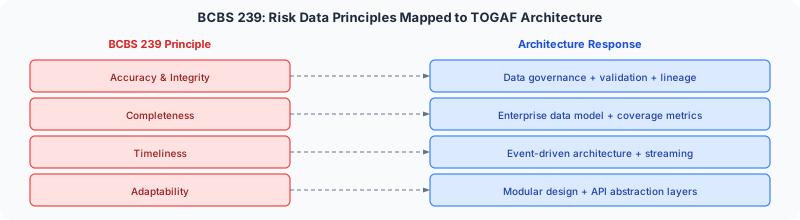
- Accuracy and integrity
- Completeness
- Timeliness
- Adaptability
Risk Reporting Practices
- Accuracy
- Comprehensiveness
- Clarity
- Frequency
- Distribution
Supervisory Review
These requirements are not isolated data challenges. They require coherence across:
- Business Architecture
- Data Architecture
- Application Architecture
- Technology Architecture
- Governance Architecture
This is precisely the scope of TOGAF.
2. Mapping BCBS 239 to TOGAF ADM
Phase A -- Architecture Vision
- Define regulatory scope
- Identify risk domains (Credit, Market, Liquidity, Operational)
- Establish executive sponsorship (CRO, CIO, CDO)
- Define architecture principles for risk data
Deliverables: - Architecture Charter - Stakeholder Map - High-Level Risk Capability Map
Phase B -- Business Architecture
Focus areas: - End-to-end risk reporting value streams - Data ownership model (Owner, Steward, Custodian) - RACI definitions - Risk taxonomy standardization
Key outcome: Clear accountability for all critical risk data elements.
Phase C -- Information Systems Architecture
Data Architecture
- Canonical enterprise risk data model
- Authoritative source strategy
- Golden source definition
- End-to-end lineage
- Data quality control framework
Application Architecture
- Risk engines consolidation
- Aggregation layer standardization
- API-based reporting services
- Reporting orchestration mechanisms
Phase D -- Technology Architecture
Infrastructure requirements:
- High availability
- Disaster recovery
- Horizontal scalability
- Distributed processing
- Stress scenario performance capacity
Technology design must align with regulatory materiality.
Phase E & F -- Opportunities and Migration
Typical gaps: - Manual Excel reconciliations - Fragmented data marts - Missing lineage tooling - Undefined ownership
Roadmap strategy: - Domain-based prioritization - Multi-year phased transformation - Governance gates before each deployment
Phase G -- Implementation Governance
- Architecture Review Board checkpoints
- Data quality KPI validation
- Lineage completeness verification
- Independent validation review
No deployment without architecture compliance validation.
Phase H -- Architecture Change Management
Ensure adaptability for:
- ESG risk expansion
- AI/ML risk integration
- New regulatory templates
- Cross-border consolidation requirements
Architecture must remain flexible yet controlled.
3. Reference Target Architecture
Layer 1 -- Source Systems Layer 2 -- Integration & Validation Layer 3 -- Enterprise Risk Data Platform Layer 4 -- Risk Calculation Engines Layer 5 -- Reporting & Analytics Layer 6 -- Governance & Metadata Layer integration architecture diagram
This layered model ensures separation of concerns while maintaining end-to-end traceability.
4. Governance and Operating Model
Integration with Three Lines of Defense:
1st Line -- Business ownership 2nd Line -- Risk oversight 3rd Line -- Audit validation
Architecture governance becomes a control mechanism rather than documentation exercise.
5. Measuring Success
KPIs may include:
- \% automated aggregation
- \% lineage coverage
- Data quality threshold adherence
- Manual adjustment reduction
- Audit finding reduction trend
- Stress reporting turnaround time
Conclusion
BCBS 239 implementation is not merely a compliance initiative. It is an enterprise architecture transformation opportunity. Sparx EA best practices
Using TOGAF as a structured governance and transformation framework enables banks to transform fragmented risk data landscapes into resilient, scalable, and trustworthy risk information ecosystems.
Regulatory compliance becomes a by-product of architecture excellence.
For expert guidance on enterprise architecture, explore our enterprise architecture consulting, architecture capability development, and Sparx EA consulting. Get in touch.
Tailoring TOGAF for practical results
TOGAF's strength is its comprehensiveness. Its weakness is also its comprehensiveness — organizations that try to implement every phase, every deliverable, and every governance mechanism simultaneously create a process that is too heavy to sustain. The most successful TOGAF implementations start small and expand based on demonstrated value.
Begin with Phase A (Architecture Vision) and Phase G (Architecture Governance). Vision ensures that architecture work is aligned with business strategy. Governance ensures that architecture decisions are reviewed, recorded, and enforced. These two phases provide immediate value: stakeholders see architecture alignment with their goals, and delivery teams see clear standards to follow.
Add Phases B through D incrementally as the architecture practice matures. Phase B (Business Architecture) adds capability maps and value stream models. Phase C (Information Systems Architecture) adds application portfolio views and data architecture. Phase D (Technology Architecture) adds infrastructure topology and platform design. Each phase produces ArchiMate views in the repository — not documents in a folder. ArchiMate best practices
Skip Phases E and F (Opportunities and Migration Planning) initially. Replace them with ArchiMate Migration views that show plateaus (stable architecture states) and work packages (projects that move from one plateau to the next). This achieves the same outcome with less process overhead. ArchiMate layers explained
Frequently Asked Questions
What is TOGAF used for?
TOGAF (The Open Group Architecture Framework) is used to structure and manage enterprise architecture programmes. It provides the Architecture Development Method (ADM) for creating architecture, a content framework for deliverables, and an enterprise continuum for reuse.
How does ArchiMate relate to TOGAF?
ArchiMate and TOGAF are complementary. TOGAF provides the process framework (ADM phases, governance, deliverables) while ArchiMate provides the notation for creating the architecture content. Many organisations use TOGAF as their EA method and ArchiMate as the modeling language within each ADM phase.
What is the TOGAF Architecture Development Method (ADM)?
The ADM is a step-by-step process for developing enterprise architecture. It consists of a Preliminary phase and phases A through H: Architecture Vision, Business Architecture, Information Systems Architecture, Technology Architecture, Opportunities and Solutions, Migration Planning, Implementation Governance, and Architecture Change Management.