⏱ 20 min read
Most UML diagrams die young.
They get born in workshops, polished in architecture decks, praised in steering committees, and then quietly abandoned the moment delivery gets difficult. Teams move on. Developers build what they can. Operations patches what it must. Security adds controls late. And six months later the “architecture” is a stale set of boxes nobody trusts.
That is the uncomfortable truth: in many enterprises, UML is not a bridge to implementation. It is a decoration around indecision. UML modeling best practices
I have a strong view on this. UML is not the problem. Bad architectural behavior is. Architects often create models as if the job ends when the arrows look clean. It does not. The real work starts when those diagrams have to survive Kafka topic design, IAM policy boundaries, cloud networking, release pipelines, audit findings, and production incidents at 2:13 a.m.
So let’s say it plainly, early, and in SEO-friendly language: bridging UML models to production systems means turning design diagrams into executable decisions, delivery constraints, operating models, and traceable implementation choices. If your UML cannot influence code structure, interface contracts, deployment patterns, security controls, and operational ownership, it is not architecture. It is illustration.
That may sound harsh. Good. Enterprise architecture needs a little more honesty.
This article is about how that bridge actually works in real architecture work. Not in textbooks. Not in certification exam language. In real companies, where banking platforms still carry 20 years of history, where Kafka becomes the nervous system of the estate, where IAM is either the safety net or the source of outages, and where “cloud-native” sometimes just means “we moved the old mess to Kubernetes.”
We’ll start simple, then go deeper.
The simple version: what “bridging design and implementation” really means
At the simplest level, bridging design and implementation means this:
- a UML component diagram should influence how services are split and how they interact
- a sequence diagram should influence API contracts, event choreography, timeout behavior, and failure handling
- a deployment diagram should influence cloud topology, resilience zones, networking, and runtime dependencies
- a state model should influence business rules, persistence transitions, and recovery logic
- a domain model should influence service ownership, data boundaries, and event schemas
That’s it. Not mystical. Not academic.
The mistake is thinking the diagram itself delivers value. It doesn’t. The value comes from what the diagram forces the organization to decide. A model should reduce ambiguity. If it doesn’t, it’s just architecture theater.
A good UML model answers questions like:
- What is the system boundary?
- What is synchronous vs asynchronous?
- Who owns the data?
- Where does identity get verified?
- What happens if Kafka is unavailable?
- What is deployed together and what scales independently?
- Which controls are mandatory because of regulation, not preference?
When those answers are carried into backlog items, implementation standards, cloud patterns, and operational runbooks, the bridge exists. When they are not, the bridge is broken.
Why architects fail at this more often than they admit
Here’s the contrarian thought: many architects are too attached to abstraction and not attached enough to consequence.
They love the purity of the model. They hate the messiness of implementation. But production systems are made of consequences. Latency has consequences. Identity federation has consequences. Event ordering has consequences. Data residency has consequences. Retry logic has consequences. You do not get to architect only the pleasant part.
Common failure modes look like this:
- The model is too generic
- “Service A talks to Service B” tells me almost nothing.
- Is it REST? gRPC? Kafka? Batch file drop? Managed integration platform?
- Is it request/response or event-driven?
- Is it internal trusted traffic or zero-trust with policy enforcement?
- Generic diagrams create generic thinking, and generic thinking creates expensive surprises.
- The diagram ignores runtime reality
- UML often captures happy-path interactions.
- Production lives in retries, poison messages, token expiry, partial outages, stale caches, and rate limits.
- If your sequence diagram has no failure branches, your architecture is unfinished.
- Security is bolted on later
- IAM is often shoved into one side box labeled “SSO” or “Identity Provider.”
- That’s not enough.
- Real systems need identity propagation, machine-to-machine auth, token exchange, privileged access boundaries, service account lifecycle, and audit trails.
- The model has no delivery path
- Teams get diagrams without coding standards, reference implementations, schema rules, deployment templates, or decision records.
- Then everybody “interprets” the architecture differently.
- Interpretation is just a polite word for fragmentation.
- No traceability from design to production
- Architects approve a model and disappear.
- No mapping to repositories, CI/CD pipelines, infrastructure-as-code modules, Kafka topics, IAM roles, or observability dashboards.
- Then they are surprised when the implementation diverges.
This is where real architect work begins: not drawing the ideal system, but designing a model that can survive organizational entropy.
UML is still useful. But only if you stop worshipping it
Some people overreact and say UML is dead. I don’t buy that. The issue is not UML itself. The issue is using UML as an end state. UML for microservices

UML is useful because it gives shared language:
- component diagrams for responsibilities and dependencies
- sequence diagrams for interaction order
- deployment diagrams for infrastructure placement
- state diagrams for lifecycle and business transitions
- class/domain models for conceptual consistency
In enterprise work, that shared language matters. Especially when you have business stakeholders, security teams, platform engineering, integration specialists, and multiple delivery squads all using different vocabularies.
But UML has to be used as decision scaffolding, not as architecture wallpaper.
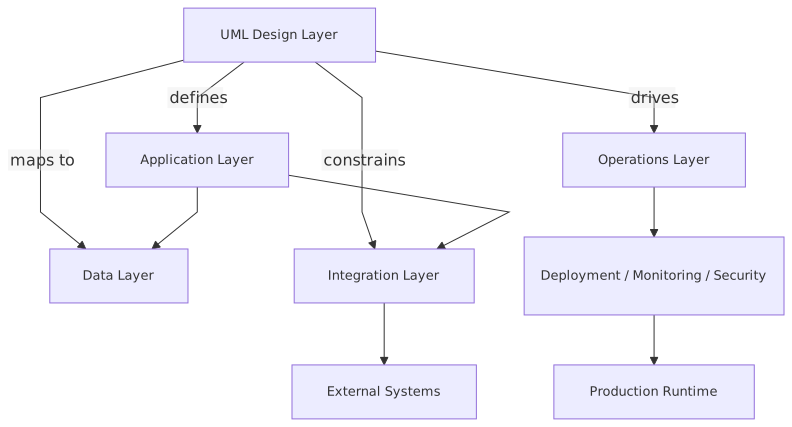
My rule is simple: every important element in a model should map to one of these:
If you cannot map the model to production artifacts, don’t pretend you have architecture. You have a conversation starter. Useful, maybe. But not enough.
What bridging looks like in real architecture work
This is the part people skip. They jump from design review to implementation kickoff and assume alignment will happen naturally. It won’t.
In real enterprise architecture work, the bridge from UML to production usually needs five layers.
1. Design intent
This is the diagram, yes. But with explicit decisions, not vague icons.
For example, if a banking payments system publishes payment status updates via Kafka, the diagram should not merely say “Payment Service sends event.” It should say, in the accompanying design notes:
- event type and ownership
- topic domain and naming convention
- keying strategy
- ordering assumptions
- schema management approach
- idempotency expectations
- consumer responsibility boundaries
That level of clarity changes implementation behavior.
2. Architecture decisions
Use Architecture Decision Records or equivalent. Short. Opinionated. Traceable.
Examples:
- We use Kafka for cross-domain asynchronous integration, not for internal CRUD synchronization.
- IAM tokens for user-initiated requests are exchanged for scoped service tokens before downstream calls.
- PII is excluded from broad domain events; sensitive attributes are retrieved through authorized APIs.
- Multi-region failover is active-passive for core ledger workloads because consistency matters more than theoretical availability.
This is where architects earn their salary. Not by saying “it depends” all day, but by deciding where the enterprise will standardize and where it will tolerate exceptions.
3. Delivery constraints and guardrails
Architecture must become constraints teams can build with:
- API linting rules
- schema registry enforcement
- standard Kafka topic templates
- Terraform modules for network and IAM patterns
- cloud landing zone rules
- logging and tracing standards
- secrets management patterns
- resilience policies
Without guardrails, every team becomes its own little architecture school. That sounds empowering until the integration bill arrives.
4. Implementation patterns
Reference implementations matter more than slide decks.
If you want teams to follow a sequence model for event-driven processing, give them:
- a sample producer
- a sample consumer
- retry and dead-letter handling
- observability hooks
- IAM policy examples
- schema compatibility checks in CI
A pattern that runs beats a model that inspires.
5. Operational alignment
This is the most neglected layer.
Production systems need:
- SLOs
- runbooks
- alert ownership
- topic retention policies
- key rotation procedures
- access recertification
- disaster recovery exercises
- audit evidence trails
An architect who ignores operations is not bridging design to implementation. They are outsourcing reality.
A real enterprise example: digital banking payments modernization
Let’s make this concrete.
Imagine a large bank modernizing its payments platform. It has:
- a legacy core banking system
- a digital channels platform for mobile and web
- an IAM platform using enterprise SSO and OAuth2/OIDC
- Kafka as the event backbone
- cloud-hosted microservices for orchestration, fraud checks, notifications, and customer preferences
- strict audit, resiliency, and data protection requirements
The initial UML looked great
The architecture team created:
- a component diagram showing Payment Orchestrator, Fraud Service, Limits Service, Customer Profile, Notification Service, Core Banking Adapter, and IAM
- a sequence diagram for payment initiation
- a deployment diagram with cloud services and on-prem connectivity
- a state model for payment lifecycle: Initiated → Validated → Authorized → Posted → Notified
On paper, very solid.
What was missing
A lot, actually.
The component diagram did not define:
- whether fraud and limits checks were synchronous or event-driven
- whether customer identity was propagated end-to-end or revalidated per service
- where payment idempotency was enforced
- who owned the canonical payment event schema
- whether the core adapter was allowed to publish events directly
- how failures between “Posted” and “Notified” were recovered
The sequence diagram showed a clean flow, but no:
- token expiry handling
- Kafka delivery failure path
- duplicate event protection
- timeout strategy for core banking dependency
- fallback behavior during fraud service degradation
The deployment diagram showed “cloud” and “data center,” but not:
- region boundaries
- private connectivity model
- IAM trust zones
- secrets storage
- service mesh or API gateway policy enforcement
- separation of production and non-production controls
This is exactly where many architecture efforts stop. The team says, “implementation will refine the details.” Sometimes yes. Usually no. Usually implementation improvises the details under pressure.
How the bridge was built properly
The bank corrected course by linking each model element to implementation and operations.
Component-to-service mapping
Each UML component became either:
- a deployable microservice
- a bounded context owned by a specific team
- or a non-deployable logical capability
That distinction matters. Not every box should become a service. Enterprises over-microservice themselves constantly. Another contrarian view: if your UML component diagram turns into 27 tiny services because “that’s modern,” you probably made the system worse.
In this case:
- Payment Orchestrator stayed a service
- Fraud and Limits remained separate services due to scaling and ownership needs
- Customer Profile was treated as a domain capability exposed via API, not copied into every flow
- Notification was asynchronous and downstream
- Core Banking Adapter became a tightly controlled integration boundary, not a general-purpose utility
Sequence-to-contract mapping
The payment initiation sequence was rewritten as:
- User authenticates through IAM
- Digital Channel receives user token
- Orchestrator exchanges token for scoped service token
- Orchestrator synchronously checks Limits
- Orchestrator synchronously submits Fraud assessment with timeout and degraded-mode policy
- Orchestrator writes payment command and idempotency key
- Core Banking Adapter posts transaction
- On successful post, Payment Posted event is published to Kafka
- Notification and analytics consume event independently
- If event publication fails after posting, recovery process republishes from outbox
Now we are in production territory. This sequence can be implemented, tested, and audited.
State model-to-persistence logic
The payment lifecycle state model was tied directly to persistence transitions and recovery rules:
- Initiated: request accepted, not yet validated
- Validated: limits and format checks passed
- Authorized: fraud and policy checks passed
- Posted: core banking committed
- Published: event emitted to Kafka
- Notified: customer communication completed
- Failed: terminal failure with reason code
- Pending Recovery: compensating or retry workflow required
That one addition — Published as a separate state — solved a common enterprise blind spot. Teams often assume that if business posting succeeds, downstream eventing is just “technical plumbing.” Wrong. In event-driven banking architectures, publication is part of business completion semantics.
Deployment-to-cloud topology mapping
The deployment diagram was expanded into actual cloud architecture decisions: cloud architecture guide
- Payment services deployed in two availability zones in primary region
- Kafka cluster provided as managed service with private endpoints
- Core adapter deployed in a secured integration subnet with dedicated connectivity to on-prem
- IAM trust configured so only approved workloads could exchange tokens
- Secrets stored in managed vault with automatic rotation for service credentials
- Production workloads isolated by account/subscription and policy
- Audit logs centralized in immutable storage
Now the deployment diagram was no longer decorative. It reflected the real operating environment.
Where Kafka changes the architecture, and where people misuse it
Kafka is one of those technologies that reveals whether an architecture is serious or fashionable.
Used well, Kafka decouples domains, supports replayable integration, improves scalability, and creates clean asynchronous boundaries. Used badly, it becomes a distributed rumor mill where nobody knows the source of truth.
Architects commonly make three mistakes with Kafka.
Mistake 1: turning every interaction into an event
Not everything should be asynchronous. Banking especially has points where synchronous certainty matters:
- payment acceptance
- balance validation
- fraud decisioning in some scenarios
- customer confirmation
If your UML sequence diagram hides those distinctions and just says “services communicate through events,” you’re avoiding design, not doing it.
Mistake 2: no event ownership model
A topic is not a dumping ground. Someone owns:
- the schema
- compatibility rules
- semantic meaning
- retention
- data classification
- producer standards
Without ownership, your beautiful component model becomes integration chaos.
Mistake 3: ignoring failure semantics
What happens when:
- a consumer is down?
- schema changes break compatibility?
- duplicate messages arrive?
- ordering is not preserved across partitions?
- publishing succeeds but consumer side effects fail?
These are not implementation details to “let teams handle.” These are architecture concerns.
A good architect will make sure UML sequence diagrams and component diagrams explicitly show:
- producer responsibilities
- consumer independence
- dead-letter strategy
- replay expectations
- idempotency boundaries
- exactly where business completion is declared
Kafka is not just middleware. It’s part of the system behavior. integration architecture guide
IAM: the box nobody models deeply enough
If there is one area consistently under-modeled in enterprise architecture, it is IAM.
Architects draw one external box called IAM or Identity Provider and move on. That is not enough for production systems, especially in cloud-heavy enterprises.
In real implementations, IAM affects:
- user authentication
- service-to-service trust
- token scope design
- role mapping
- privileged access
- API gateway enforcement
- workload identity in cloud
- secretless authentication patterns
- audit evidence
In our banking example, a proper UML-to-production bridge required modeling:
- the user as an actor with authenticated session
- the channel application as a confidential client
- the orchestrator as a workload identity
- token exchange between user context and service context
- authorization decisions at API boundaries
- machine identity for Kafka producer and consumer access
- fine-grained policies for which service can publish or subscribe to which topics
This matters enormously. I’ve seen enterprises modernize to cloud and still use broad shared service accounts because “it’s easier.” Easier until audit. Easier until breach. Easier until one compromised workload can read half the platform.
Architecture must force identity boundaries early. If your model cannot answer “who is this call acting as?” then it is not ready for implementation.
The cloud makes lazy architecture more expensive
Cloud does not fix weak architecture. It monetizes it.
In old data centers, bad boundaries could hide for years behind sunk cost and limited elasticity. In cloud, poor service decomposition, noisy eventing, broad network access, and over-chatty integrations turn directly into cost, risk, and operational pain.
This is why deployment diagrams matter more than people think. Not because diagrams are magical, but because cloud architecture needs explicit choices:
- region strategy
- availability zone use
- private vs public endpoints
- ingress and egress controls
- managed services vs self-managed runtimes
- data residency
- IAM federation
- observability topology
- backup and DR model
A UML deployment diagram that simply shows a few boxes labeled “AWS,” “Azure,” or “Cloud” is almost insulting. It tells nobody anything useful.
A good architect uses the deployment view to expose trade-offs:
- We put customer-facing APIs behind managed gateway for centralized auth and throttling.
- We keep Kafka private-only to reduce attack surface.
- We isolate regulated workloads into dedicated subscriptions/accounts.
- We avoid cross-region active-active for ledger-adjacent services because conflict resolution is not worth the fantasy.
- We use managed database services where possible, except where latency to legacy systems forces local integration patterns.
Those are architecture choices. They should appear in the bridge between UML and production.
Common mistakes architects make when trying to bridge design and implementation
Let’s be direct. These happen all the time.
1. Confusing logical architecture with deployable architecture
A logical component is not automatically a microservice. If every box becomes a deployable unit, you’ll create needless latency, IAM complexity, CI/CD overhead, and support burden.
2. Avoiding “ugly” constraints
Architects sometimes hide legacy dependencies because they spoil the clean picture. Bad habit. The ugly dependency to the core banking mainframe is often the most important architectural fact in the room.
3. Not modeling non-functional behavior
Performance, resilience, auditability, and recoverability are not side notes. They should alter the design, not be attached after.
4. Producing one model for everyone
Executives, engineers, security, and operations do not need the same view. One overloaded diagram helps nobody.
5. Leaving ownership ambiguous
Every service, topic, API, schema, and policy needs clear ownership. Shared ownership often means no ownership.
6. Overestimating team maturity
If the architecture depends on every squad making perfect local decisions, it’s a weak architecture. Good enterprise architecture assumes variation in skill and still creates safe outcomes.
7. No feedback loop from production
If incidents, cost spikes, security findings, and change failure rates never feed back into the models, the architecture becomes fiction.
A practical method architects can actually use
Here is a practical way to move from UML to production without pretending the world is cleaner than it is.
This is not glamorous. It is effective.
The deeper truth: architecture is translation work
At a deeper level, bridging UML to production is really about translation.
The architect translates:
- business intent into technical boundaries
- technical boundaries into delivery constraints
- delivery constraints into platform patterns
- platform patterns into operational behavior
- operational behavior back into architectural learning
That translation work is where many architects struggle. They are comfortable speaking to executives or speaking to engineers, but not both. Enterprise architecture requires both. You have to explain to a risk committee why IAM token exchange matters, and to a platform team why the business needs deterministic payment state transitions. Different language. Same architecture.
And yes, some of this means accepting imperfection.
Another contrarian thought: the best enterprise architecture is often not elegant. It is legible, resilient, governable, and incrementally improvable. Elegance is nice. Survivability is better.
In banking especially, the architecture that wins is rarely the one with the most modern buzzwords. It is the one that can pass audit, survive peaks, isolate failures, support investigation, and evolve without rewriting the estate every two years.
If your UML models help produce that outcome, they are valuable.
If they only help create polished slides, they are not.
What good looks like
You know the bridge is working when:
- developers can point from a service implementation back to a design decision
- platform teams can enforce architectural standards automatically
- IAM policies reflect modeled trust boundaries
- Kafka topics and schemas match domain ownership
- deployment topology matches resiliency assumptions
- operations runbooks align with state models and failure flows
- audit and risk teams can trace controls back to architecture intent
- diagrams are updated because production taught the organization something
That last point matters. Models should evolve. Architecture is not a museum.
Final thought
UML is not dead. But passive architecture should be.
The gap between design and implementation is not caused by notation. It is caused by architects who stop too early, teams who are left with ambiguity, and organizations that confuse approval with execution.
A real enterprise architect does more than model systems. They shape how systems get built, secured, deployed, operated, and changed. They carry the design across the river into production, even when the river is full of Kafka partitions, IAM headaches, cloud policy constraints, and legacy banking realities.
That’s the job.
And frankly, it’s a better job than drawing boxes.
FAQ
1. Is UML still relevant in modern cloud and microservices architecture?
Yes, but only as a means to drive implementation decisions. UML is useful for shared understanding, especially in large enterprises. It becomes irrelevant when it stays abstract and never maps to APIs, events, IAM, deployment, and operations.
2. How do you make sure UML diagrams actually influence development?
Tie every important model element to something real: backlog items, ADRs, API specs, Kafka topic definitions, IAM policies, IaC modules, and operational controls. If there is no traceability, the diagram will be ignored.
3. What is the biggest mistake architects make with event-driven systems like Kafka?
Treating Kafka as a generic decoupling tool without defining event ownership, schema governance, idempotency, replay strategy, and failure semantics. That creates distributed confusion, not good architecture. architecture decision records
4. How should IAM be represented in architecture models?
Not as a single box. Model users, workloads, token flows, trust boundaries, authorization points, and machine identities. In production, IAM shapes service design as much as networking does.
5. In a banking environment, what matters more: elegant design or operational control?
Operational control. Elegant design is nice, but banks need auditability, resilience, recoverability, data protection, and clear accountability. A slightly messy architecture that is governable is usually better than a beautiful one that collapses under real-world constraints.
Frequently Asked Questions
What is enterprise architecture?
Enterprise architecture is a discipline that aligns an organisation's strategy, business processes, information systems, and technology. Using frameworks like TOGAF and modeling languages like ArchiMate, it provides a structured view of how the enterprise operates and how it needs to change.
How does ArchiMate support enterprise architecture practice?
ArchiMate provides a standard modeling language that connects strategy, business operations, applications, data, and technology in one coherent model. It enables traceability from strategic goals through business capabilities and application services to the technology platforms that support them.
What tools are used for enterprise architecture modeling?
The main tools are Sparx Enterprise Architect (ArchiMate, UML, BPMN, SysML), Archi (free, ArchiMate-only), and BiZZdesign Enterprise Studio. Sparx EA is the most feature-rich option, supporting concurrent repositories, automation, scripting, and integration with delivery tools like Jira and Azure DevOps.