⏱ 21 min read
Most data architecture arguments are not really about data. They are arguments about time.
One team wants the dashboard updated “in real time.” Another says the finance ledger must close correctly, even if it takes an hour. Product wants instant recommendations. Compliance wants traceability. Operations wants the warehouse system to stop overselling inventory that physically is not there. Everyone says “data quality,” but what they usually mean is this: how old can the truth be before the business gets hurt?
That is the real design question.
Too many enterprise architectures collapse this distinction. They treat freshness as a technical tuning problem, a slider between batch and streaming, a matter of Kafka topics, CDC pipelines, and materialized views. That misses the point. Freshness is not a transport setting. Freshness is a business boundary. It belongs in the domain model just as much as orders, payments, policies, claims, shipments, and contracts.
Once you see it that way, a cleaner architecture appears. Not a magical one. Not a pristine greenfield fantasy. A practical one. You stop pretending every consumer needs the same latency. You stop shoving operational truth, analytical truth, and reconciled truth into a single layer and then wondering why nobody trusts the numbers. You begin to define freshness boundaries: explicit zones in which data has a business-acceptable age, consistency expectation, and operational purpose.
This is the sort of thing that sounds obvious after the fact. But in large enterprises, it is rarely explicit. And what is not explicit becomes political. One platform team says “event-driven everything.” Another says “warehouse is the source of truth.” A third quietly maintains a spreadsheet because neither system gives them the truth at the moment they need it.
A good architecture names the tension. A better one turns it into a design tool.
Context
Modern enterprises rarely have one data architecture. They have several layered on top of each other over time:
- transactional systems of record
- operational microservices with local databases
- event streams such as Kafka
- data lakes and lakehouses
- enterprise data warehouses
- API composition layers
- caches and search indexes
- operational data stores
- machine learning feature stores
- spreadsheets, because reality always leaks
Each of these technologies implies a different view of time. The OLTP database is close to the transaction. Kafka gives you ordered facts in motion, but not necessarily query-ready truth. The warehouse offers integrated history, but usually later. A cache is fast but derivative. A search index is useful but often stale. A domain service may own canonical behavior, while an analytical model owns canonical reporting definitions.
This is why data freshness becomes slippery. Architects ask, “What is the source of truth?” as if truth were singular. In practice, there are multiple truths shaped by business purpose:
- transaction truth: what the system accepted and committed
- operational truth: what a workflow can safely act on now
- analytical truth: what the enterprise uses to measure and decide
- regulatory truth: what can be explained, reproduced, and audited later
- customer-facing truth: what the user sees and expects to be coherent
These truths overlap, but they are not the same. Domain-driven design helps here because it forces us to ask: truth for whom, in which bounded context, and for what action?
That is a much better question than “should this be real-time?”
Problem
The classic enterprise failure is to build one integration fabric and assume it solves every freshness need. It never does.
Here is the pattern. Customer orders are captured in an order service. Payment status arrives from a payment provider. Inventory changes in a warehouse management system. Pricing lives somewhere else. Then an executive asks for a “single real-time customer view.” The architecture team responds with admirable optimism: stream everything into Kafka, build a canonical event model, hydrate a serving layer, and expose APIs plus dashboards. event-driven architecture patterns
Six months later:
- customer support sees one status
- finance sees another
- inventory planning trusts neither
- the warehouse dashboard is “near real-time” except during backlogs
- the CFO asks why booked revenue and shipped revenue drift daily
- nobody can explain which timestamp matters
The issue is not lack of technology. The issue is that freshness requirements were never separated by domain semantics. Order placement, shipment confirmation, invoice issuance, stock reservation, and revenue recognition each have different temporal meaning. If you flatten them into a generic “real-time pipeline,” you get speed without clarity.
And speed without clarity is just a faster way to be wrong.
Forces
Freshness boundaries exist because several forces pull the architecture in opposite directions.
1. Business urgency vs business correctness
Some decisions decay quickly. Fraud scoring, ad bidding, stock allocation, route optimization, and user notifications lose value within seconds. Others require reconciliation before action. Financial close, commission calculation, claims adjudication, and regulatory reporting punish premature certainty.
The first force is simple: some domains value immediacy more than finality; others value finality more than immediacy.
2. Local domain autonomy vs enterprise-wide coherence
Microservices encourage local ownership. That is good. A team should own its domain model and persistence. But enterprise processes cut across domains. A customer order spans sales, payment, fulfillment, taxation, and finance. Each bounded context emits valid facts from its own point of view, yet the enterprise still wants a coherent picture.
This creates a permanent tension: the closer you stay to domain autonomy, the harder global coherence becomes in the moment.
3. Event time vs processing time
Streaming architectures often hide a nasty detail. The event may describe something that happened at 10:03:12, arrive at 10:05:40, be processed at 10:06:10, and become queryable at 10:08:00. Which time governs freshness? It depends. For operational action, processing availability may matter. For legal sequence, event time may matter. For SLA management, ingestion lag may matter.
Architectures fail when they say “real-time” without naming the clock.
4. Cost and complexity
Real-time data products are expensive. They demand resilient streaming, idempotency, schema governance, backpressure handling, replay strategy, observability, and often specialized stores. Meanwhile, batch remains astonishingly effective for many enterprise workloads. EA governance checklist
A blunt truth: many organizations buy milliseconds they do not need and then cannot afford the trust they do need.
5. Human interpretation
The final force is social. Data only matters because people use it. If two reports disagree because one is T+5 seconds and the other is T+2 hours, users will call it “bad data,” not “differing freshness contracts.” If architecture does not make freshness visible and understandable, users will create their own semantics.
Usually in Excel.
Solution
The solution is to define data freshness boundaries as explicit architectural zones, each with a business purpose, allowable latency, consistency expectation, and reconciliation contract.
This is not merely a technical layering pattern. It is a domain-informed policy.
A freshness boundary says:
- what business decisions this zone supports
- how current the data must be
- what type of correctness is expected
- whether data is provisional, operational, or reconciled
- how exceptions are surfaced and repaired
- which upstream domain events or records establish its state
In practice, most enterprises benefit from three broad freshness zones.
Zone 1: Transactional / immediate zone
This is where domain transactions are born. It includes service-owned databases, command processing, and immediate read models required to safely execute business operations. Freshness is measured in milliseconds to seconds. Consistency is usually strongest within a bounded context, weaker across contexts.
Examples:
- order accepted
- stock reserved
- payment authorized
- customer profile updated
- shipment created
This zone is not meant to answer every enterprise query. It is meant to preserve domain integrity and operational responsiveness.
Zone 2: Operational / synchronized zone
This is where multiple domain facts are assembled for cross-process action. It may be powered by Kafka streams, CDC-fed operational stores, search indexes, or specialized read models. Freshness is typically seconds to minutes. Consistency is usually eventual, but good enough for operational decision-making.
Examples:
- customer support console
- order tracking view
- dispatch optimization
- fraud operations dashboard
- supply chain monitoring
This zone is where most “near real-time” ambitions belong. Not in the warehouse. Not in the ledger. Here.
Zone 3: Reconciled / analytical zone
This is the integrated and governed zone for analytics, reporting, historical analysis, planning, regulatory outputs, and executive KPIs. Freshness is minutes to hours, sometimes daily. Correctness is stronger because records are reconciled, conformed, enriched, and adjusted according to enterprise definitions.
Examples:
- financial reporting
- profitability analysis
- monthly inventory valuation
- enterprise customer 360 for segmentation
- board metrics
- regulated disclosures
This zone should not pretend to be instantaneous. Its value lies in explainability and consistency over time.
Here is the key principle:
> Do not force one zone to behave like another.
>
> An operational synchronized view is not a finance-grade reconciled dataset. A warehouse is not a low-latency command system. A service database is not an enterprise reporting platform.
That sentence alone can save a year of architectural waste.
Architecture
A practical freshness-boundary architecture usually combines domain services, event streaming, and multiple serving layers with explicit contracts.

This diagram matters because it separates three ideas architects often blend together:
- systems of transaction
- systems of operational synchronization
- systems of reconciliation and analysis
Now let’s make the semantics explicit.
Domain semantics first
A freshness boundary should be defined per domain capability, not merely per technology tier.
Consider “inventory.” In one bounded context, inventory means physical stock on hand. In another, it means available-to-promise stock. In another, it means financially valued inventory. These are not synonyms. They have different update rhythms, tolerances, and consumers.
Likewise, “order status” is usually a terrible field because it compresses a rich lifecycle into one coarse label. Order accepted, payment pending, allocated, picked, packed, shipped, invoiced, and recognized are distinct domain events. If you design freshness zones around an overloaded status field, every downstream consumer inherits ambiguity.
Domain-driven design gives us the discipline to define aggregates, events, and bounded contexts so freshness contracts attach to meaningful business facts.
Freshness contracts
Every exposed data product or API should carry a freshness contract. At minimum:
- expected latency range
- timestamp basis: event time, ingest time, processing time, publication time
- consistency type: transactional, eventual, reconciled
- completeness caveats
- reconciliation source and cadence
- behavior under backlog or partial outage
This should be documented like an API SLA, because that is what it is.
Reconciliation as a first-class capability
Eventually consistent architectures get romanticized. They should not be. Eventual consistency without reconciliation is just deferred confusion.
A solid freshness-boundary architecture includes:
- replayable event logs
- immutable raw capture where possible
- correction events
- late-arriving event handling
- periodic compare-and-repair jobs
- exception queues for semantic conflicts
- authoritative reference points for regulated domains
Reconciliation is the discipline that keeps fast zones from drifting permanently away from trusted zones.
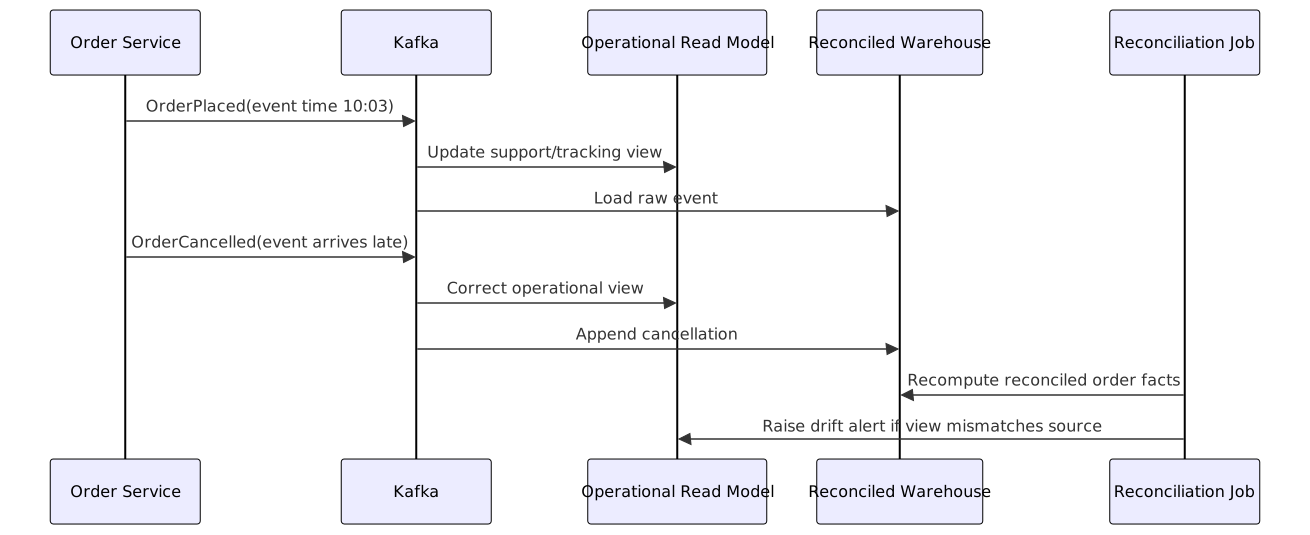
The point is not elegance. The point is survivability.
Kafka and microservices, used with restraint
Kafka is useful here because it decouples producers from consumers, preserves ordered facts within partitions, supports replay, and enables both operational synchronization and downstream analytical ingestion. In a microservices environment, it is often the right backbone for moving domain events across freshness zones. microservices architecture diagrams
But there is a trap. Teams start publishing technical events rather than business events. They emit row_updated_v7 or internal state blobs with weak semantics. That creates a high-speed fog. Freshness improves. Meaning deteriorates.
Use Kafka for domain events that matter:
OrderPlacedPaymentAuthorizedInventoryReservedShipmentDispatchedInvoiceIssued
Not for leaking every internal implementation detail onto the bus.
Migration Strategy
Most enterprises do not get to redesign truth from scratch. They inherit nightly ETL, a few heroic APIs, scattered CDC feeds, and operational pain hidden behind manual workarounds. So the migration must be progressive.
This is where a strangler migration works well. You do not replace the entire data estate with streaming. You identify specific decisions suffering from the wrong freshness zone, introduce new bounded data products around them, and gradually reroute consumers.
A sensible migration path looks like this.
Step 1: Map decision points, not pipelines
Do not start with technology inventory. Start with business decisions:
- What action is taken?
- What data is used?
- How old can that data be before the action becomes harmful?
- What happens when the data is wrong or late?
- Which domain owns the authoritative event?
This shifts the conversation from “we need real-time everywhere” to “customer support needs shipment events within 60 seconds, finance needs reconciled revenue by 8 a.m. next day.”
That is architecture, not enthusiasm.
Step 2: Classify existing assets into freshness zones
Tag systems and data products as transactional, operational synchronized, or reconciled. Some assets will straddle zones. That is fine initially, but call it out. Hidden dual-use systems become chronic bottlenecks.
Step 3: Introduce an event backbone and canonical domain events
If Kafka is appropriate, use it as the migration spine. If not, another event platform can work. The point is to establish replayable domain events from core systems. Where direct event emission is not feasible, CDC can bootstrap the journey, though CDC should be treated as transitional if semantics are weak.
Step 4: Build targeted operational read models
Pick one or two high-value workflows. For example:
- order tracking for customer support
- stock visibility for fulfillment
- payment exception console for operations
Create dedicated read models sourced from domain events. Do not attempt an enterprise-wide universal model first. Universal models are where migrations go to die.
Step 5: Establish reconciliation with the warehouse or ledger
As fast paths emerge, pair them with compare-and-repair logic against trusted stores. This gives confidence and exposes semantic mismatches early. Reconciliation should not be bolted on after the fact.
Step 6: Move consumers progressively
Redirect operational users and APIs to the new synchronized zone where appropriate. Keep analytical and regulated reporting on the reconciled zone until definitions and controls are proven.
Step 7: Retire brittle point-to-point integrations
Only after consumers have moved and reconciliations are stable should you cut old feeds. Enterprises often reverse this order and discover the old feed was quietly masking a semantic gap.
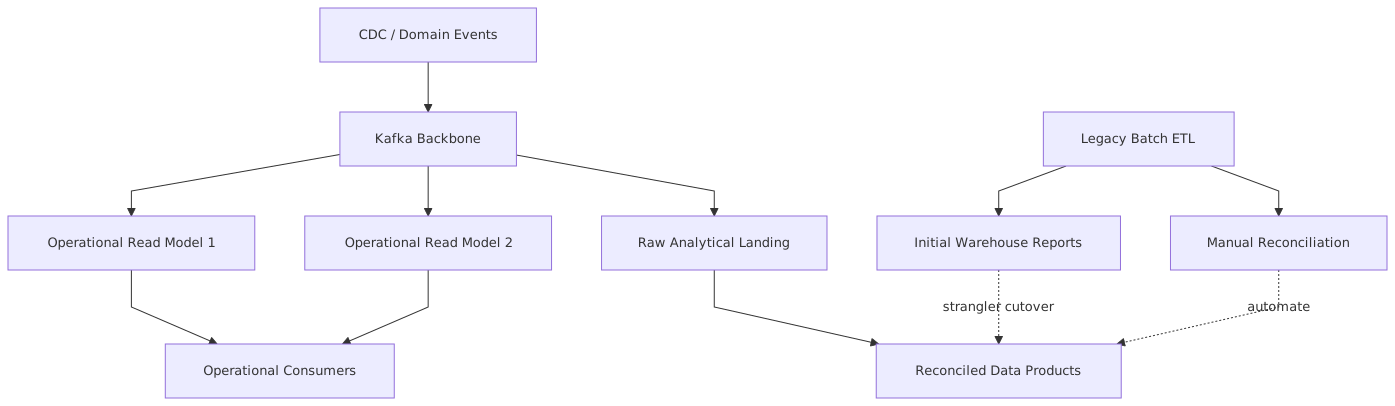
This migration strategy matters because freshness mistakes are easier to fix early in narrow workflows than later in enterprise reporting.
Enterprise Example
Consider a global retailer with e-commerce, stores, and distribution centers. This is a familiar kind of enterprise mess: SAP in finance, a warehouse management system from one vendor, an order management platform from another, microservices for the digital channel, and a cloud data platform built in parallel.
The business pain looked straightforward on paper: customers saw items “available” online that warehouses could not fulfill. Support agents had conflicting order statuses. Finance could not easily tie digital order events to shipment and revenue recognition. Everyone said the company needed “real-time inventory.”
That diagnosis was wrong. They did not need real-time inventory as a single thing. They needed freshness boundaries.
The domain view
The architecture team split the semantics:
- Stock on hand belonged to warehouse operations.
- Reserved inventory belonged to order allocation.
- Available to promise was a derived operational concept combining supply, reservations, safety stock, and channel rules.
- Inventory valuation belonged to finance and was reconciled later.
Likewise for orders:
- order accepted
- payment authorized
- order allocated
- order picked
- order shipped
- invoice posted
Each was a distinct domain fact with a clear owning context.
The target architecture
Microservices for order, payment, and customer continued to own their transactions. WMS and ERP published events through adapters and CDC where native events were poor. Kafka became the event backbone. A stream-processing layer built operational read models for customer support and available-to-promise inventory. The warehouse ingested raw events and produced reconciled enterprise facts overnight plus intraday refreshes.
What changed
Customer support stopped querying half a dozen systems. They used an operational synchronized view with a 90-second freshness SLA and clear timestamps per milestone. The e-commerce storefront consumed an available-to-promise service sourced from the synchronized zone, not from the warehouse. Finance remained on the reconciled zone, where shipment and invoice events were matched with accounting rules.
Reconciliation
This was the crucial part. Every day, reconciliation jobs compared:
- reservations in the order domain
- picks and shipments from WMS
- invoicing in ERP
- ATP calculations served to channels
Drift above threshold triggered investigation. Sometimes the cause was late events. Sometimes duplicate CDC records. Sometimes a bad domain assumption, such as returns increasing availability before physical inspection. Those are not pipeline bugs. Those are semantic bugs. Freshness boundaries helped expose them.
The result
The retailer did not become magically real-time. It became explicit.
- customer-facing stock accuracy improved materially
- support call handling time dropped
- finance stopped being forced into operational latency expectations
- platform engineering stopped trying to make the warehouse behave like a transactional system
That is success in enterprise architecture: not perfection, but fewer lies told faster.
Operational Considerations
Freshness boundaries only work if operated like products, not diagrams.
Measure lag everywhere
Track at least:
- source commit to event publication lag
- publication to consumer processing lag
- processing to serving availability lag
- event time vs processing time skew
- freshness SLA compliance by product
Do not publish “real-time” claims without telemetry. That is marketing, not engineering.
Design for replay
Any event-driven synchronized zone will eventually need replay due to code changes, bad schemas, missed consumers, or backfills. Replay is not an edge case. It is table stakes.
Handle late and out-of-order events
This is routine in enterprise systems, especially across SaaS, ERP, and partner integrations. If your design assumes monotonic arrival, it is already broken.
Surface provisional truth clearly
Users should know if a value is:
- pending
- estimated
- synchronized
- reconciled
- corrected after reconciliation
A small badge in a UI can prevent large governance arguments. ArchiMate for governance
Govern schema evolution
Domain events should be versioned with discipline. Breaking event contracts in a distributed estate is a splendid way to create silent freshness corruption.
Watch the human workflow
If operators start exporting synchronized views into spreadsheets and merging them with warehouse reports, that is feedback. The architecture has likely failed to provide one of the needed truth zones clearly enough.
Tradeoffs
No architecture gets a free lunch.
Benefit: better fit to business time
Freshness boundaries align systems to actual business needs. This reduces both overengineering and misuse.
Cost: more explicit complexity
You now have multiple truth zones, not one. Some executives and even some architects find that uncomfortable. Too bad. Reality was already plural; now it is merely named.
Benefit: safer microservices autonomy
Teams can own domain transactions without being forced into enterprise-wide synchronous coupling.
Cost: reconciliation overhead
You must invest in compare-and-repair capabilities, lineage, timestamps, and exception handling. This is not optional.
Benefit: analytical trust improves
The warehouse or lakehouse no longer has to masquerade as a low-latency operational platform, which usually makes reporting definitions more stable.
Cost: user education
Consumers must understand that “latest” and “reconciled” are different promises.
Benefit: migration is incremental
The pattern works well with strangler approaches and mixed legacy landscapes.
Cost: duplicate representations
The same business fact may appear in several forms across zones. That is acceptable if contracts are explicit. It is dangerous if hidden.
Failure Modes
This pattern has predictable ways to fail.
1. Treating freshness zones as technical layers only
If zones are defined without domain semantics, they become infrastructure categories with no business meaning. Then teams argue forever.
2. Publishing poor events
If event streams are low-semantic database change noise, operational read models become brittle and reconciliation becomes detective work.
3. No authoritative timestamps
Without clear event, ingest, and publication times, nobody can explain staleness or sequence.
4. Reconciliation deferred “to phase two”
There is no phase two. There is only the moment drift becomes visible to finance or customers.
5. Over-centralized canonical models
An enterprise-wide canonical model can be useful in moderation, but if it dominates bounded contexts, it slows teams and blurs meaning. Canonical is not the same as useful.
6. Chasing zero latency everywhere
This usually burns money, increases operational fragility, and solves the wrong problem. Many business processes are perfectly healthy at five minutes or next day.
7. Ignoring failure behavior
What should a product do when synchronized data is stale? Block action? Allow action with warning? Fall back to source system query? Queue for later? If this is undefined, outages become business improvisation.
When Not To Use
Freshness boundaries are powerful, but not universal.
Do not lean heavily on this pattern when:
A single transactional system already serves the domain well
If one well-governed platform handles the main workload and reporting needs modestly, adding multiple freshness zones may just create unnecessary complexity.
The business truly requires strong consistency across a narrow scope
Certain domains, such as some trading, core banking ledger operations, or tightly scoped inventory reservation systems, may need synchronous coordination and stronger immediate consistency than this pattern encourages across zones.
The organization lacks event and data governance maturity
If teams cannot manage schema contracts, lineage, timestamp discipline, and operational observability, a zoned freshness architecture will decay fast.
The domain is low change and batch-friendly
For many HR, planning, procurement, and back-office analytics use cases, nightly or intraday batch is enough. There is no virtue in streaming for its own sake.
A pattern is good when it solves a real tension. It is bad when used as a badge.
Related Patterns
Freshness boundaries sit well beside several established architectural patterns.
Bounded contexts
From domain-driven design. Essential for defining whose truth and whose latency matter.
CQRS
Very relevant where transactional writes and synchronized read models need separate designs.
Event sourcing
Useful in some domains for durable domain history and replay, though often overused. You do not need full event sourcing everywhere to benefit from freshness boundaries.
Data mesh
Helpful when data products are owned by domains, but freshness contracts must still be explicit. Domain ownership does not remove temporal ambiguity.
Lambda and Kappa-style streaming architectures
Technically related, but those patterns focus more on processing topology than business freshness semantics.
Operational data store
Often reappears here in modern form as a synchronized operational zone. The idea never really died; it just changed clothes.
Strangler fig migration
The right migration pattern for introducing freshness zones into a legacy estate without betting the company in one release.
Summary
Data freshness is not a performance feature. It is a business boundary wrapped in technical clothing.
That is the core idea.
When architects fail to make freshness explicit, enterprises end up with endless debates about source of truth, real-time dashboards nobody trusts, warehouses used as operational systems, operational systems abused for analytics, and reconciliation performed manually by exhausted people.
A better approach is to define freshness zones deliberately:
- transactional truth for immediate domain integrity
- operational synchronized truth for near-real-time cross-process action
- reconciled analytical truth for enterprise measurement and governance
Then back those zones with domain semantics, Kafka or equivalent event backbones where appropriate, explicit timestamps, replay and reconciliation capabilities, and a progressive strangler migration from legacy batch estates.
This is not about worshipping streaming. It is about respecting time.
The best enterprise data architectures do not promise one truth delivered instantly to everyone. They do something more honest and more useful. They tell the business which truth is available, how fresh it is, what it is good for, and how it will be reconciled if reality arrives late.
That honesty is not a compromise.
It is the architecture.
Frequently Asked Questions
What is enterprise architecture?
Enterprise architecture aligns strategy, business processes, applications, and technology in a coherent model. It enables impact analysis, portfolio rationalisation, governance, and transformation planning across the organisation.
How does ArchiMate support architecture practice?
ArchiMate provides a standard language connecting strategy, business operations, applications, and technology. It enables traceability from strategic goals through capabilities and services to infrastructure — making architecture decisions explicit and reviewable.
What tools support enterprise architecture modeling?
The main tools are Sparx Enterprise Architect (ArchiMate, UML, BPMN, SysML), Archi (free, ArchiMate-only), and BiZZdesign. Sparx EA is the most feature-rich, supporting concurrent repositories, automation, scripting, and Jira integration.