⏱ 21 min read
Microservices rarely fail because teams can’t write HTTP endpoints or publish Kafka events. They fail because the meaning of those interactions drifts while everyone is still shipping at speed. event-driven architecture patterns
That is the uncomfortable truth behind most integration pain. We like to tell ourselves the problem is technical: versioning, schema registries, CI pipelines, backward compatibility rules. Those matter, certainly. But the real fault line runs through semantics. One team says “customer,” another means “account holder,” a third means “billing party,” and all three exchange a field called customerId as if language were free. It isn’t. In distributed systems, language is architecture.
Consumer-driven contracts are one of the few practices that squarely confront this reality. Done well, they turn service interaction from tribal knowledge into executable agreement. Done badly, they produce a bureaucratic graveyard of brittle tests, fake confidence, and teams arguing over JSON fields while production burns.
At scale, the challenge gets sharper. A pairwise contract between one consumer and one provider is manageable. A hundred services, dozens of Kafka topics, multiple bounded contexts, and a steady flow of migrations across old and new platforms? That’s no longer a set of contracts. It’s a graph. And if you can’t see that graph, you can’t govern change.
This is where architecture earns its keep.
The useful question is not “should we use consumer-driven contracts?” The better question is: what kind of system are we in, what kind of organizational coupling do we have, and how do we use contracts to make change safer without freezing evolution? That distinction matters, especially in enterprises where the target architecture is modern but the starting point is an estate of APIs, ESBs, batch jobs, Kafka topics, and optimistic slide decks.
In this article, I’ll walk through consumer-driven contracts at scale with a particular focus on the contract graph: a way to reason about service relationships, semantic dependencies, migration paths, and blast radius. I’ll cover the forces pushing teams toward this approach, the architecture behind it, how to migrate progressively using a strangler strategy, how reconciliation fits into event-driven landscapes, and when this pattern is simply the wrong tool.
Context
Microservices introduced a useful discipline: split systems around business capabilities, let teams own services independently, and reduce the cost of change. The promise was never “small services.” It was faster, safer evolution.
Yet once a company has more than a few teams, the seams become visible. One service exposes REST APIs. Another consumes events from Kafka. A reporting platform extracts snapshots overnight. A mobile backend depends on several upstream services, some synchronously, some asynchronously. Meanwhile, the data platform, fraud engine, CRM integration, and billing services all need representations of the same business concepts, but not the same ones.
This is classic domain-driven design territory. Different bounded contexts use different models because they serve different purposes. The order domain thinks in terms of fulfillment state, the billing domain thinks in chargeable events, and customer support thinks in case history. Trying to force a single universal schema across them is usually a mistake. It creates the illusion of consistency while institutionalizing ambiguity.
But bounded contexts still need to collaborate. They exchange commands, queries, documents, and domain events. That exchange is where many architectures go soft. Teams rely on OpenAPI documents that describe syntax but not realistic usage. Event schemas are registered but never validated against actual consumer assumptions. Providers ship “non-breaking” changes that are only non-breaking in theory. Consumers overfit to fields they were never promised. The result is a familiar pattern: integration confidence in lower environments, breakage in production, emergency rollbacks, and governance meetings that somehow make things worse. EA governance checklist
Consumer-driven contracts emerged as a practical answer. Instead of the provider dictating every expectation, consumers publish the interactions they depend on. The provider verifies that it still satisfies them. That flips the burden in a useful way: compatibility is tested against real consumer needs, not imagined generic interfaces.
At small scale, that story is straightforward. At enterprise scale, it becomes architectural. Contracts span channels, teams, lifecycle stages, and migration waves. You need to understand not just whether Service A still satisfies Consumer B, but how a proposed change propagates across the ecosystem. That is what the contract graph makes explicit.
Problem
The core problem is unmanaged semantic coupling.
Not just interface coupling. Semantic coupling.
A provider can keep the same endpoint path and return valid JSON while still breaking consumers. Remove a status value. Change the timing of event emission. Start omitting a field when a business rule changes. Reorder a workflow. Reinterpret null semantics. Publish duplicate Kafka messages under load. All technically plausible. All operationally dangerous.
In large estates, these issues cluster into a few recurring pathologies:
- Hidden dependencies: consumers rely on undocumented behavior.
- Provider-centric API evolution: providers optimize their models without seeing downstream usage.
- Asynchronous ambiguity: event schemas are validated, but delivery semantics, ordering assumptions, and reconciliation expectations are not.
- Migration blindness: teams modernize one service at a time without understanding dependent contract paths.
- Governance theater: review boards approve standards but cannot predict real breakage.
The failure isn’t usually that no one wrote a contract. The failure is that no one managed the network of contracts as a living architectural asset.
Think of it this way: in a monolith, hidden coupling is expensive but visible in code. In microservices, hidden coupling becomes organizationally distributed. It leaks into backlog dependencies, release windows, incident bridges, and cross-team Slack archaeology. The code is separate; the pain is shared. microservices architecture diagrams
That is why a contract graph matters. It captures who depends on what, through which interfaces, with what semantic assumptions, and how changes ripple across bounded contexts.
Forces
Architectural decisions get interesting when the forces pull in different directions. Consumer-driven contracts at scale sit in the middle of several serious tensions.
Team autonomy vs ecosystem stability
Teams want to evolve their services independently. Enterprises want predictable change and fewer outages. Those goals sound aligned until a service with twenty downstream consumers wants to rename fields, split events, or alter workflow timing. Autonomy without visibility becomes recklessness. Stability without local freedom becomes central planning.
Domain purity vs integration pragmatism
DDD encourages each bounded context to model its own language. Good. But integration still requires translation. If contracts mirror internal models too closely, consumers inherit provider implementation details. If contracts become overly generic canonical models, the domain intent gets washed out. Somewhere between raw internals and enterprise Esperanto is the useful contract.
Synchronous clarity vs asynchronous reality
HTTP request-response interactions are easier to contract because the interaction is bounded. Events are harder. The provider emits facts, but consumers infer process. Kafka helps with decoupling, but it also allows teams to hide assumptions in stream processors, local state stores, retry behavior, and reconciliation jobs. A schema alone is not a contract for behavior.
Speed of delivery vs cost of verification
Pairwise contract verification is cheap when there are few services. At scale, verification cost grows with the graph. Every provider build may trigger many downstream compatibility checks. This cost is worth paying only if the verification tells us something meaningful. Badly designed contracts create lots of noise and little protection.
Migration ambition vs legacy gravity
Enterprises rarely introduce consumer-driven contracts into a greenfield. They add them during migration: from ESB to APIs, from batch integration to events, from monolith to services, from point-to-point integration to platform-based delivery. That means old and new coexist, and contracts must bridge them. Migration architectures need tolerance for partial adoption.
Solution
The pattern is simple to state and hard to institutionalize:
- Consumers define the interactions they rely on.
- Providers verify those expectations continuously.
- The enterprise tracks these agreements as a contract graph, not isolated test artifacts.
- Change is governed through graph impact, bounded context semantics, and migration intent.
The crucial move is the third one. Without the graph, consumer-driven contracts remain a local testing technique. With the graph, they become an architectural control surface.
A contract graph models services, topics, APIs, and consumers as nodes and dependencies as edges. Each edge carries metadata: channel type, operation, semantic versioning rules, bounded context ownership, criticality, deprecation state, and compatibility history. Now the architecture can answer practical questions:
- What consumers depend on this endpoint or Kafka topic?
- Which contracts are business-critical vs analytical?
- Which downstream systems still require a deprecated field?
- Can we split one event into two without introducing a bridge?
- Which legacy consumers block strangler migration?
- Where do we need reconciliation because asynchronous contracts can’t guarantee read-your-writes?
This is where domain-driven design sharpens the solution. Contracts should not be random payload snapshots. They should represent published language at the boundary of a bounded context. That means the provider is not exposing its persistence model, and the consumer is not asserting against accidental details. Contract design should start with domain meaning:
- What business fact is being communicated?
- Which terms are stable in this context?
- Which fields are invariants, and which are incidental?
- What are the lifecycle expectations?
- What timing assumptions are safe?
- What reconciliation path exists when events arrive late, out of order, or duplicated?
Those questions produce fewer but better contracts.
High-level shape
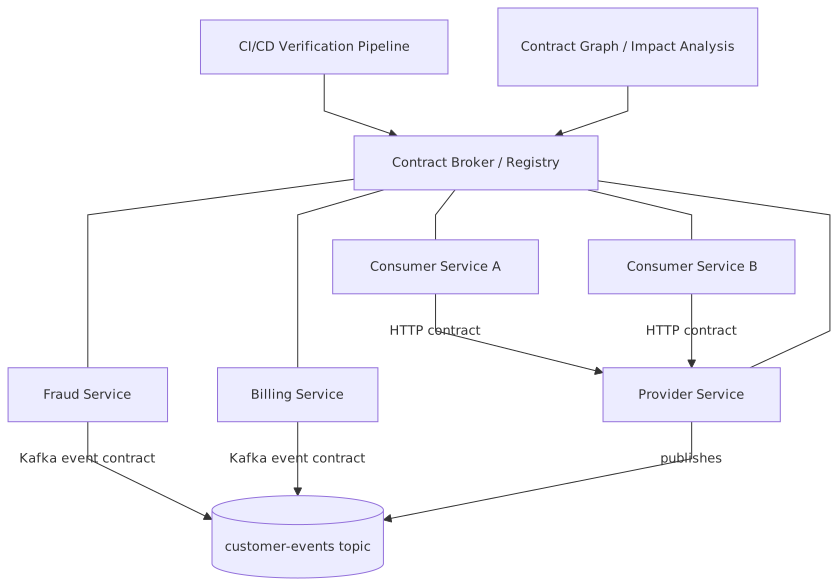
This is not just a test harness. It is a delivery mechanism for safe change.
Architecture
At scale, the architecture typically has six moving parts.
1. Contract authoring at the consumer edge
Consumers publish executable contracts that describe the subset of provider behavior they actually rely on. For HTTP, this usually means request-response interactions. For Kafka, it means event expectations, headers, keys, schema shape, and often delivery assumptions that need explicit expression elsewhere.
The important discipline is restraint. Consumers should assert only what they need. If a mobile backend needs customerId, tier, and a suspended flag, it should not pin the entire payload. Over-specification is the enemy. It turns harmless provider changes into noisy failures.
2. Provider verification in CI
Provider builds pull relevant consumer contracts and verify compatibility before promotion. This shifts integration failure left, where it belongs. In mature setups, verification is part of deployment policy: no green verification, no release.
For events, provider verification often combines:
- schema validation,
- example payload generation,
- compatibility checks against consumer contracts,
- and behavioral checks around event emission conditions.
Not everything can be verified statically. That’s fine. The architecture should distinguish verifiable contract guarantees from operational guarantees such as ordering, exactly-once illusions, replay behavior, and lag tolerance.
3. Contract broker or registry
You need a system of record for contracts, versions, provider tags, environment promotion state, and verification results. This can be a dedicated broker, a schema registry plus metadata store, or an internal platform service.
The point is discoverability. Teams need to know which contracts exist, who owns them, and whether a candidate release is safe.
4. Contract graph and impact analysis
This is the missing layer in many implementations. The graph aggregates contract metadata into an enterprise view.
A useful contract graph will model:
- provider and consumer identity,
- bounded context,
- transport type: REST, gRPC, Kafka, batch extract,
- operation or topic,
- criticality and SLA,
- current and target versions,
- deprecation deadlines,
- migration status,
- reconciliation paths,
- test and production verification history.
With this in place, architecture reviews stop being abstract. You can see the blast radius of a change before you make it.
5. Reconciliation mechanisms
In event-driven systems, contracts are necessary but insufficient. Events arrive late. Consumers go down. Messages are duplicated. Replays happen. A field once published may be corrected later. This is why scaled microservice estates need reconciliation thinking.
Reconciliation is the adult supervision of asynchronous architecture. It means:
- periodic comparison between source-of-record and downstream projections,
- repair events or compensating updates,
- dead-letter analysis and replay tooling,
- idempotent consumer design,
- and business-level exception handling when state diverges.
A contract can tell you the shape of CustomerSuspended. It cannot guarantee every downstream projection processed it exactly once, in order, and before the customer called support. That gap must be closed with operational patterns.
6. Architecture governance through policy, not committee
The best governance is executable. Define rules like:
- every externally consumed API must have verified consumer contracts;
- every critical Kafka topic must have ownership, schema policy, and reconciliation plan;
- deprecated contracts need sunset dates and graph-visible migration states;
- provider releases that break verified production consumers are blocked.
A standards document won’t save you. A policy enforced in pipelines might.
Domain semantics discussion
This subject is where many teams quietly lose the plot.
A contract is not merely a payload shape. It is a statement about meaning at a boundary. If your contracts ignore domain semantics, they will protect syntax while allowing business breakage.
Suppose a CustomerCreated event includes status: ACTIVE. Billing interprets that as “invoiceable.” Fraud interprets it as “identity verified.” Support interprets it as “visible in agent desktop.” The schema is consistent. The semantics are not. This is not an integration issue in the narrow sense; it is a bounded context issue. The provider published a term broader than its stable meaning.
Better design would separate concepts:
CustomerRegisteredCustomerVerifiedBillingAccountOpened
More events, perhaps. But cleaner language. Less accidental coupling.
DDD helps here because it forces us to ask whether an interface belongs to a bounded context and whether the published language is stable enough to be depended on. The best contracts sit on published domain events or explicit service capabilities, not on internal entities leaked over the wire.
A memorable rule: if your contract mirrors your database table, you don’t have a contract; you have a hostage situation.
Migration Strategy
Most enterprises won’t roll out consumer-driven contracts in one grand move. They will adopt them the same way they modernize everything else: unevenly, under pressure, while production still needs to run. So the migration strategy matters as much as the target design.
The right approach is a progressive strangler migration.
Start where change is frequent and breakage is expensive. That usually means:
- customer-facing APIs,
- high-change domain services,
- critical Kafka topics with multiple consumers,
- and legacy integration seams that repeatedly fail during releases.
You do not need to contract everything on day one. In fact, trying to do so is a common failure mode.
Migration phases
Phase 1: Observe the current integration landscape
Inventory providers, consumers, topics, and API dependencies. Build an initial contract graph, even if some edges are inferred from logs, API gateways, Kafka metadata, and source code analysis. Most estates discover consumers they didn’t know they had. That discovery alone justifies the effort.
Phase 2: Add contracts at key seams
Introduce consumer-driven contracts for a small set of high-value interactions. Pick seams with clear ownership and active change. For Kafka, pair schema management with consumer expectations and replay strategy. For HTTP, focus on business-critical APIs first.
Phase 3: Use a compatibility façade for legacy
Where legacy consumers cannot immediately adopt contract tooling, build a façade or adapter layer. This is classic strangler work. The new provider verifies modern contracts directly, while the adapter preserves behavior for older clients. The graph should show these bridges explicitly so they don’t become permanent architecture moss.
Phase 4: Deprecate through graph visibility
Once a new contract path is live, deprecate old endpoints or events with visible deadlines, verification warnings, and consumer outreach. If the graph can’t tell you who still depends on the old path, you are not ready to retire it.
Phase 5: Institutionalize policy
Make contracts part of delivery governance. Every new externally consumed capability needs ownership, contract registration, and verification in CI. This is where local practice becomes platform standard. ArchiMate for governance
Progressive migration view
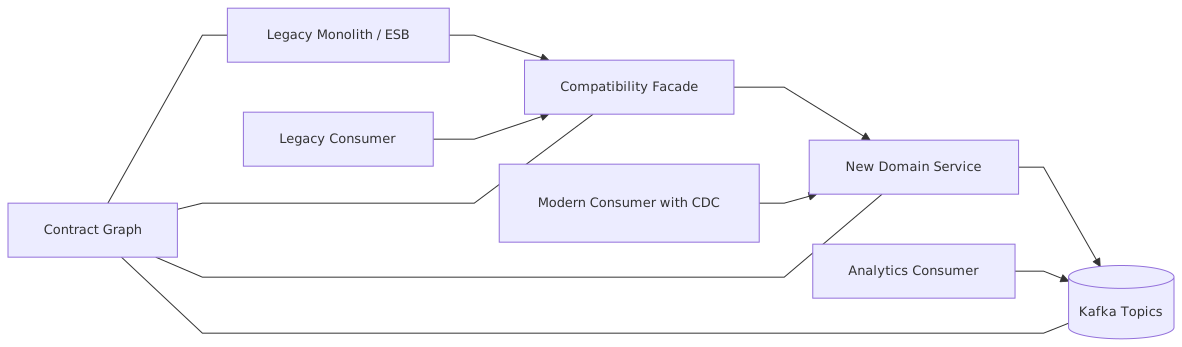
The important point is not elegance. It is controlled evolution. Strangler migration works because it allows old and new to coexist while traffic and dependency ownership gradually shift. Contracts give that migration a safety net.
Enterprise Example
Consider a large retail bank modernizing its customer servicing platform.
The starting point is familiar: a core customer system in a monolith, an ESB distributing customer updates, separate CRM and billing platforms, a Kafka backbone added in the last few years, and a growing set of microservices for digital channels. The mobile app backend depends on a customer profile API. The fraud service consumes customer risk events. Billing consumes customer status changes. Support tools read from a denormalized customer projection.
The bank’s recurring incident pattern looked like this:
- the profile service changed field semantics to support a new onboarding flow;
- mobile clients handled it, but billing did not;
- a Kafka event remained schema-compatible but changed emission timing;
- fraud projections lagged after replay;
- support agents saw stale status data;
- incident calls lasted half a day because nobody had a complete dependency picture.
The bank introduced consumer-driven contracts first on the profile API and the customer-status-events topic. But the real breakthrough came when they modeled a contract graph.
They discovered:
- seven active consumers of the profile API, not four;
- three teams depending on a “deprecated”
riskFlag; - one support integration consuming an ESB feed transformed from the same source;
- and two Kafka consumers assuming events were emitted only after KYC verification, an assumption never formally stated.
That last one mattered. The customer domain had overloaded “active” to mean “registered and usable,” while fraud meant “cleared.” So the bank refactored its published language. The new event set separated registration, verification, and account enablement. Legacy consumers continued through a compatibility translator during migration.
They also implemented reconciliation. Every night, a comparison job checked customer state across the source service, fraud projection, billing profile, and support read model. Divergence beyond tolerance created repair events and operational alerts. This did not make contracts less important. It made them realistic.
The result was not magic. The bank still had integration incidents. But release confidence improved dramatically because provider teams could see exactly which consumer contracts they were about to challenge. More importantly, semantic arguments started earlier, during design, rather than after deployment.
That is architecture doing useful work.
Operational Considerations
At scale, contract practices live or die on operational discipline.
CI/CD performance
Provider verification can become expensive when one provider has many consumers. You need selective verification, caching, and sensible tagging. Verify against relevant production consumer versions, not every historical artifact ever published. Otherwise your pipeline becomes a museum.
Environment promotion
A contract verified in CI is good. A contract verified against deployable provider artifacts in staging and then production release candidates is better. Promotion metadata matters. Enterprises often need to know not just whether a provider can satisfy a contract in theory, but whether the exact release candidate has done so.
Topic evolution in Kafka
Schema compatibility is necessary but not enough. Track key evolution, partitioning changes, ordering assumptions, retention effects, replay behavior, and tombstone semantics where compacted topics are involved. Consumers often depend on these operational properties more than they admit.
Observability
Instrument contract verification outcomes, consumer lag, dead-letter volume, replay rates, reconciliation failures, and deprecation progress. You want dashboards that answer:
- which critical contracts failed verification this week?
- where are deprecated interfaces still in use?
- which topics have the highest consumer fragility?
- where are reconciliation repairs increasing?
Ownership
Every contract edge needs clear owners on both sides. Shared responsibility usually means no responsibility. Ownership should include semantic clarification, deprecation communication, and incident response.
Tradeoffs
Consumer-driven contracts are not free. They buy safety by introducing a new form of structure.
Benefits
- Better alignment between provider evolution and real consumer needs.
- Earlier detection of breaking changes.
- Improved migration control during strangler modernization.
- Better visibility into dependency blast radius.
- Stronger domain conversations at service boundaries.
Costs
- More test artifacts to manage.
- Pipeline complexity and verification time.
- The temptation to over-specify behavior.
- Governance overhead if platform support is weak.
- False confidence if teams ignore operational realities like lag, replay, and reconciliation.
The central tradeoff is this: contracts reduce accidental breakage, but they also make coupling visible. Some teams mistake that visibility for increased coupling. It isn’t. The coupling was already there. The contracts simply stopped hiding it.
Failure Modes
This pattern fails in recognizable ways.
1. Snapshot fetish
Teams assert entire payloads and every header. Providers become unable to evolve. Contract tests then block harmless change, people lose trust, and eventually the tests are bypassed.
2. Provider-hosted fake consumers
Sometimes providers write the “consumer contracts” themselves. That defeats the point. The whole value comes from representing actual downstream assumptions.
3. Schema-only thinking for events
A registry with Avro or Protobuf schemas is useful, but it is not a full contract strategy. It won’t capture timing assumptions, replay expectations, idempotency needs, or reconciliation obligations.
4. No graph, no governance
Without a contract graph, enterprises can verify pairwise interactions while still failing at ecosystem change. You know a contract passed, but not whether a migration can proceed safely.
5. Ignoring bounded contexts
If contracts expose internal entities rather than published domain concepts, every provider refactor becomes an integration event. This is the slow bleed version of distributed monolith.
6. No reconciliation in async systems
Contract verification can be green while downstream state is wrong because of missed events, poison messages, offset resets, or lag. In Kafka-heavy estates, reconciliation is not optional for critical flows.
7. Permanent compatibility bridges
Strangler facades are useful. Permanent facades are debt. If the graph doesn’t show deprecation and retirement status, migration layers accumulate until nobody knows which interface is canonical.
Contract impact view
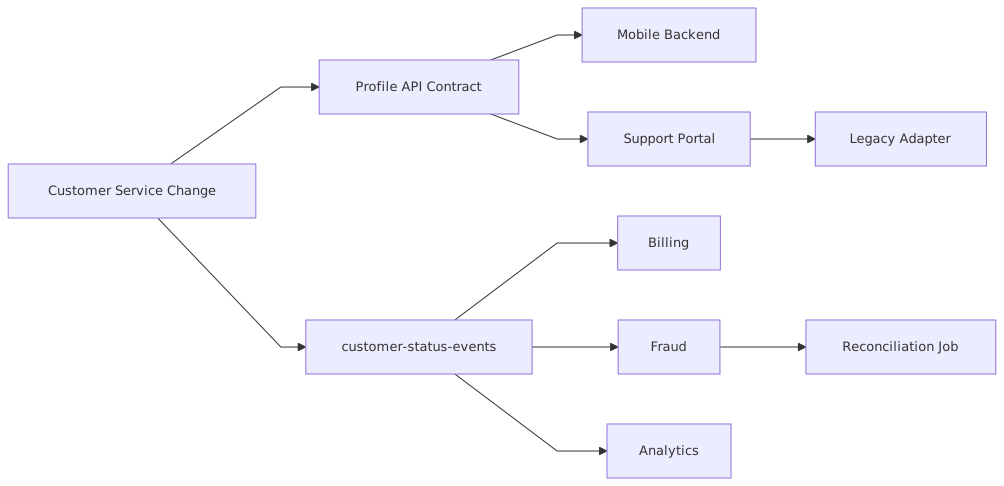
This is the picture architects need in front of them before approving “small” changes.
When Not To Use
Consumer-driven contracts are powerful, but not universal.
Do not reach for them when:
- a service has no meaningful external consumers;
- interfaces are internal implementation details within a tightly managed team boundary;
- the domain is still highly exploratory and semantics are changing daily;
- integration cost is low and end-to-end tests are sufficient;
- the organization lacks the platform maturity to manage contracts, brokers, and graph metadata;
- or the primary problem is not compatibility but poor service decomposition.
That last point matters. Contracts will not rescue bad boundaries. If one “customer service” is acting as the enterprise’s giant data vending machine, contract tooling won’t fix the design. You first need better bounded contexts, clearer ownership, and less promiscuous reuse.
Also, if your estate is small and cohesive, a lightweight schema compatibility and integration test approach may be enough. Not every company needs a formal contract graph. Scale justifies ceremony; fashion does not.
Related Patterns
Consumer-driven contracts work best alongside several related patterns.
Published Language
Straight from DDD. Shared terms at context boundaries reduce semantic drift. Contracts should encode this published language, not internal structures.
Anti-Corruption Layer
When integrating with legacy or external systems, use an ACL to translate semantics and shield the domain model. In migration, these layers often host transitional contracts.
Strangler Fig Pattern
Ideal for progressive contract adoption. Route consumers through compatibility layers while new services and contracts take over incrementally.
Schema Registry
Essential for event schemas, especially with Kafka. But remember: schema management is necessary, not sufficient.
Reconciliation
Critical in asynchronous landscapes. Contracts define expected interactions; reconciliation repairs the inevitable divergence between distributed representations.
Consumer-driven versioning and deprecation policy
Versioning should be business-informed, not reflexive. Prefer additive change and compatibility windows. Deprecation must be visible in the graph, with owners and deadlines.
Summary
Consumer-driven contracts are often pitched as a testing tactic. At enterprise scale, that undersells them. They are a way to govern semantic dependencies in a distributed system without resorting to central command-and-control.
The key shift is from isolated contracts to a contract graph. Once you can see service dependencies as a graph, you can reason about blast radius, migration paths, bounded context boundaries, deprecations, and reconciliation needs. You move from “does this provider still pass a test?” to “can this ecosystem evolve safely?”
That is the architecture question that matters.
Used well, consumer-driven contracts help microservice teams keep autonomy without pretending dependencies don’t exist. They support progressive strangler migration. They make Kafka integration less hand-wavy. They force hard conversations about domain semantics before production has them for you. And they expose where reconciliation is needed because asynchronous systems always leak uncertainty.
Used badly, they become brittle snapshots, pipeline drag, and a theater of fake certainty.
So be opinionated about them. Contract only what matters. Anchor contracts in published domain language. Model the graph. Treat migration as a first-class concern. Design for reconciliation. And retire compatibility bridges before they fossilize.
In distributed systems, syntax is the easy part. Meaning is the real interface.
Frequently Asked Questions
What is a service mesh?
A service mesh is an infrastructure layer managing service-to-service communication. It provides mutual TLS, load balancing, circuit breaking, retries, and observability without each service implementing these capabilities. Istio and Linkerd are common implementations.
How do you document microservices architecture for governance?
Use ArchiMate Application Cooperation diagrams for the service landscape, UML Component diagrams for internal structure, UML Sequence diagrams for key flows, and UML Deployment diagrams for Kubernetes topology. All views can coexist in Sparx EA with full traceability.
What is the difference between choreography and orchestration in microservices?
Choreography has services react to events independently — no central coordinator. Orchestration uses a central workflow engine that calls services in sequence. Choreography scales better but is harder to debug; orchestration is easier to reason about but creates a central coupling point.