⏱ 5 min read
Architecture Compliance in the European Commission
Technical Deep Dive (EIRA & ArchiMate) + Governance Comparison
PART I
Architecture Compliance in the European Commission -- Technical Deep Dive
(With ArchiMate Mapping Examples)
1. Governance Foundation
Architecture compliance within the European Commission ensures that digital systems align with corporate IT standards, interoperability principles, cloud strategy, security frameworks, and data governance policies. enterprise cloud architecture patterns

It is structured and enforced through centralized governance, primarily coordinated by DG DIGIT.
2. EIRA as Meta-Architecture Constraint
The European Interoperability Reference Architecture (EIRA) acts as a reference meta-model that structures solutions across:
- Legal layer
- Organizational layer
- Semantic layer
- Technical layer
In practice, this becomes a constraint model for solution architects designing systems within the Commission ecosystem.
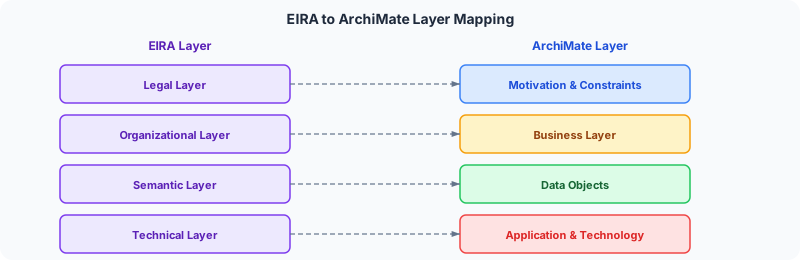
3. Mapping EIRA to ArchiMate
EIRA maps naturally to ArchiMate layers: ArchiMate tutorial for enterprise architects
| EIRA Layer | ArchiMate Layer |
|---|---|
| Legal | Motivation & Constraints |
| Organizational | Business Layer |
| Semantic | Data Objects |
| Technical | Application & Technology |
4. Example: Digital Permit Management System
Business Layer
- Business Actor: Directorate
- Business Role: Permit Authority
- Business Process: Permit Evaluation
- Business Service: Permit Issuance Service
Compliance checks include capability reuse and duplication avoidance.
Application Layer
- Application Component: Permit Core System
- Application Component: Identity Service
- Application Interface: Public API
- Application Service: Permit Validation Service
Compliance checks focus on interoperability and corporate service reuse.
Technology Layer
- Node: Commission Cloud Environment
- System Software: Container Platform
- Artifact: Deployed Microservice
Compliance checks include cloud alignment and approved technology usage. hybrid cloud architecture
Motivation Layer
- Driver: Interoperability Mandate
- Principle: Reuse Before Buy Before Build
- Requirement: GDPR Compliance
- Constraint: Approved Technology Stack
Traceability across these elements demonstrates architectural maturity.
5. Technical Evaluation Areas
Architecture reviews typically evaluate:
- Interoperability (API standards, semantics)
- Cloud-native alignment
- Security integration (IAM, encryption)
- Data governance compliance
- Vendor lock-in mitigation
PART II
European Commission Governance vs Corporate EA Governance
Governance Scope Comparison
| Dimension | Commission | Corporate |
|---|---|---|
| Scale | Multi-country public services | Single organization |
| Political Oversight | Yes | No |
| Regulatory Embeddedness | Very high | Variable |
Decision Drivers
Commission priorities:
- Interoperability
- Legal compliance
- Budget accountability
Corporate priorities:
- Cost optimization
- Speed to market
- Competitive advantage
Compliance Intensity
Commission:
- Mandatory formal reviews
- Centralized standards
- Limited technology freedom
Corporate:
- Advisory architecture boards
- Greater experimentation
- Higher business override potential
Architectural Mindset Shift
In corporate environments, architects optimize for speed and differentiation.
In the Commission, architects optimize for long-term interoperability and ecosystem coherence.
Conclusion
Architecture compliance in the European Commission is model-driven, governance-heavy, and interoperability-focused.
Corporate EA governance is strategy-driven, market-aligned, and comparatively flexible.
Both are mature --- but optimized for different realities.
For expert guidance on enterprise architecture, explore our enterprise architecture consulting, architecture capability development, and Sparx EA consulting. Get in touch.
Practical ArchiMate modeling guidance
Effective ArchiMate modeling requires discipline in three areas: element selection (choosing the right element type for each concept), relationship precision (using typed relationships instead of generic associations), and view composition (building viewpoint-specific diagrams with 15-20 elements maximum). These three disciplines determine whether an ArchiMate model communicates clearly or creates confusion. ArchiMate layers explained
Start each modeling effort by identifying the stakeholder question the view must answer. "Which applications support customer onboarding?" drives an Application Cooperation view. "What infrastructure is end-of-life?" drives a Technology Usage view with lifecycle tagged values. "How does this transformation affect the business?" drives a Layered view with migration plateaus. The question determines the viewpoint, the viewpoint determines the elements, and the elements determine the relationships.
Applying these patterns in practice
The value of ArchiMate modeling is realized not through comprehensive coverage of every element type, but through disciplined application of a few core patterns that answer recurring stakeholder questions. Three patterns account for the majority of architecture communication needs. ArchiMate relationship types
The Layered View pattern shows how business processes depend on applications, and how applications depend on infrastructure. Build this view by placing Business Processes at the top, Application Components in the middle, and Technology Nodes at the bottom. Connect them with Serving and Realization relationships. This single view demonstrates cross-layer traceability — when a server is decommissioned, trace upward to see which applications and business processes are affected.
The Cooperation View pattern shows how application components interact through interfaces and data flows. Place the core application in the center and its integration partners around it, connected by Flow relationships labeled with the data exchanged. This view reveals integration dependencies that are otherwise buried in technical documentation.
The Motivation View pattern connects strategic goals to architecture decisions. Stakeholder concerns drive Goals, Goals are realized by Outcomes, Outcomes are enabled by Capabilities, and Capabilities are realized by Application Components. This chain answers the question executives always ask: "Why are we building this?"
Frequently Asked Questions
What is architecture governance in enterprise architecture?
Architecture governance is the set of practices, processes, and standards that ensure architecture decisions are consistent, traceable, and aligned to organisational strategy. It typically includes an Architecture Review Board (ARB), architecture principles, modeling standards, and compliance checking.
How does ArchiMate support architecture governance?
ArchiMate supports governance by providing a standard language that makes architecture proposals comparable and reviewable. Governance decisions, architecture principles, and compliance requirements can be modeled as Motivation layer elements and traced to the architectural elements they constrain.
What are architecture principles and how are they modeled?
Architecture principles are fundamental rules that guide architecture decisions. In ArchiMate, they are modeled in the Motivation layer as Principle elements, often linked to Goals and Drivers that justify them, and connected via Influence relationships to the constraints they impose on design decisions.