⏱ 20 min read
Most enterprise architecture teams are not failing because they lack models. They’re failing because their models have no pulse.
That’s the uncomfortable truth.
I’ve seen ArchiMate repositories full of immaculate capability maps, application landscapes, and motivation views that nobody in delivery ever looks at. Meanwhile, DevOps teams are shipping to cloud platforms, wiring Kafka streams across domains, patching IAM policies at midnight, and making architecture decisions in pull requests instead of review boards. The architecture exists. The delivery exists. But they don’t speak to each other.
And then we act surprised when the enterprise becomes brittle.
Here’s the core opinion up front: if your ArchiMate practice does not connect directly to how software is built, deployed, operated, secured, and changed, then it is decorative architecture. Nice diagrams. Expensive shelfware. Maybe useful for annual planning decks. Not useful enough for modern enterprise change.
The simple explanation first
If you want the SEO version, here it is plainly:
Aligning ArchiMate with DevOps means using ArchiMate models to describe not just business and application structure, but also delivery pipelines, platform services, operational dependencies, automation boundaries, and ownership across change.
In practical terms:
- model what teams build and run
- show how applications depend on cloud services, Kafka platforms, IAM controls, and deployment pipelines
- connect architecture views to real delivery artifacts like APIs, environments, events, releases, and controls
- use ArchiMate to support decisions, not just documentation
That’s it. Not mystical. Not academic.
ArchiMate gives you a language for structure and relationships. DevOps gives you a way of working that collapses the wall between build and run. The alignment matters because enterprises don’t suffer from lack of concepts. They suffer from disconnects:
- business strategy not reflected in delivery
- platform teams building services nobody consumes well
- security controls applied too late
- event-driven architecture implemented with no enterprise visibility
- cloud adoption accelerating complexity instead of reducing it
ArchiMate can help. But only if it gets out of the ivory tower.
Why this alignment matters more than most architecture teams admit
A lot of enterprise architects still behave as if architecture is something that happens before delivery. That mindset is dead, even if some governance processes haven’t noticed yet. ArchiMate for governance
DevOps changed the tempo of enterprise change. Architecture did not always keep up.
In a DevOps operating model:
- systems are changed continuously
- environments are provisioned automatically
- infrastructure is code
- deployment risk is reduced through automation
- observability is part of design, not an afterthought
- team ownership matters as much as technical design
Traditional ArchiMate usage, however, often remains:
- static
- too high-level
- updated quarterly if you’re lucky
- disconnected from repositories and pipelines
- obsessed with application boxes but weak on runtime reality
That gap is where real enterprise problems grow.
Take banking. A bank may have a formal target architecture for customer onboarding, fraud detection, payments, and identity services. It may even have a clean ArchiMate model showing channels, business processes, applications, and technology platforms. Looks great.
But in delivery reality:
- onboarding emits Kafka events used by fraud and CRM
- IAM policies in cloud determine whether services can call each other
- a CI/CD pipeline pushes microservices into multiple Kubernetes clusters
- one legacy core banking integration still runs on a nightly batch dependency
- production support depends on observability tooling not shown anywhere in architecture
- resilience relies on a cloud-managed messaging service and secrets vault
If the architecture model doesn’t capture these realities, then it is telling a partial truth. Partial truth in enterprise architecture is dangerous because it gives executives confidence without giving engineers clarity.
That’s why aligning ArchiMate with DevOps is not a nice-to-have modernization exercise. It is basic professional hygiene. ArchiMate modeling guide
What ArchiMate is actually good at here
Let’s be fair. ArchiMate is not the problem. ArchiMate tutorial
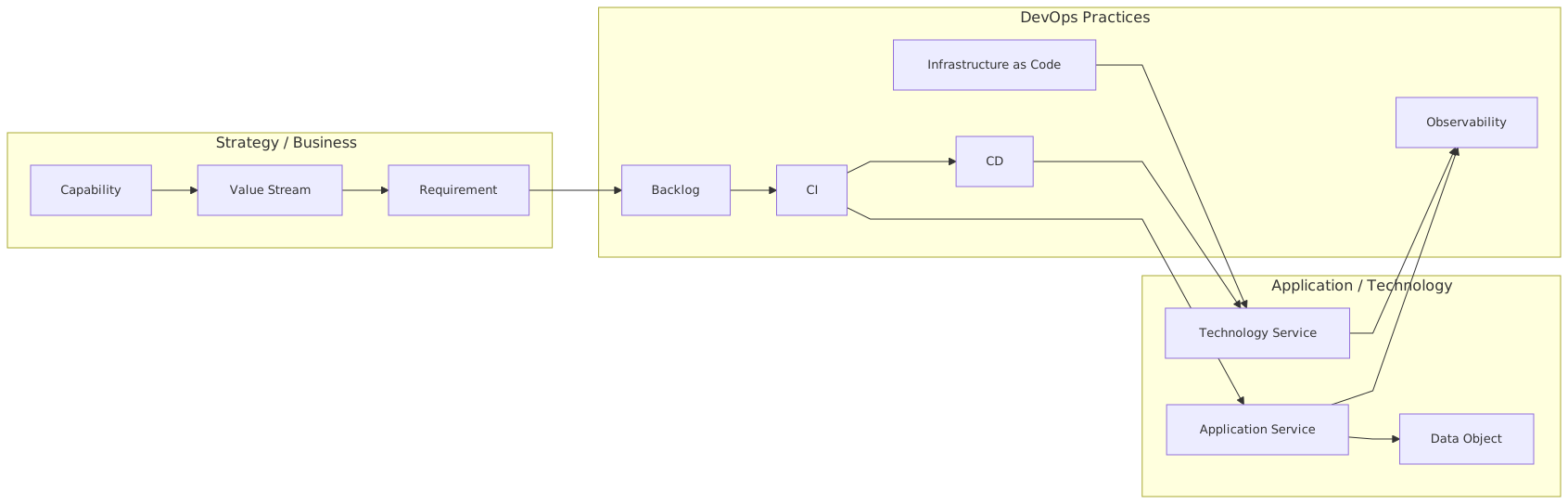
In fact, ArchiMate is one of the few enterprise architecture notations flexible enough to describe the layers that matter in DevOps-heavy enterprises:
- business actors and processes
- application services and interfaces
- technology services and nodes
- implementation and migration concepts
- strategy and motivation elements
- relationships between all of the above
The problem is usually how architects choose to use it.
Too many models stop at “application A serves business process B.” Useful, yes. Incomplete, absolutely.
A better use of ArchiMate in a DevOps context is to model:
- team-aligned ownership
- runtime dependencies
- platform services
- automation paths
- security and identity boundaries
- event flows
- release and change structures
- operational concerns like monitoring and recovery
Not because ArchiMate must become a deployment script. It shouldn’t. But because architecture should explain how the enterprise actually works under change.
That distinction matters. Architecture is not code. But architecture must be credible to people who write and run code.
The shift architects need to make
The biggest shift is mental, not notational.
Stop thinking of architecture as a map of systems.
Start thinking of architecture as a map of changeable operating relationships.
That means your ArchiMate views should answer questions like:
- Which team owns this service in production?
- What cloud platform capability does it rely on?
- Which IAM trust relationships make it work?
- What Kafka topics are enterprise-significant?
- Where is the control point for secrets, keys, and access?
- Which business capability is impacted if this deployment pipeline fails?
- What observability service gives operational evidence?
- What dependencies make this service hard to release independently?
That’s architecture work. Not just inventory management.
And yes, some people will say this becomes “too technical” for enterprise architecture. I disagree. Strongly. That argument is often a cover for architects who are uncomfortable with modern delivery mechanics.
If your enterprise runs on cloud, APIs, event streams, identity federation, and automated release, then those things are enterprise architecture concerns. Full stop.
A practical way to align ArchiMate with DevOps
Here’s the pattern I’ve found useful in real work.
1. Model products and value streams, not just applications
DevOps teams usually organize around products, platforms, or streams of value. If your ArchiMate repository is just a static application catalog, you’re already behind.
Start with:
- business capability
- value stream or major process
- product or service domain
- application services supporting that domain
- teams responsible for build and run
For example in a bank:
- Capability: Customer Onboarding
- Value stream: Open Account
- Product domain: Retail Customer Acquisition
- Application services: Identity Verification, Consent Capture, Risk Scoring, Customer Profile
- Teams: Onboarding Squad, IAM Platform Team, Event Platform Team, Core Banking Integration Team
This sounds obvious, but many architects still produce models where team ownership is either absent or buried in a spreadsheet. That’s a mistake. In DevOps, ownership is architecture.
2. Model platform dependencies explicitly
Cloud platforms, Kafka services, IAM platforms, CI/CD services, secrets management, observability tooling — these are not implementation trivia. They are foundational dependencies.
In ArchiMate, model:
- application components consuming platform services
- technology services provided by cloud or platform layers
- communication paths and runtime environments
- identity and access mechanisms where they materially shape design
You do not need to draw every container image and every pipeline stage. Don’t turn the model into a wiring diagram. But do show the dependencies that matter for resilience, security, compliance, and change velocity.
3. Bring event-driven architecture into the model
Kafka is where many enterprise architectures quietly become incoherent.
Architects love to model synchronous APIs because they’re easier to reason about. But modern enterprises, especially banks, increasingly rely on asynchronous event flows:
- customer created
- payment initiated
- KYC status updated
- account frozen
- fraud alert generated
If these events drive operational behavior across domains, they belong in architecture.
Use ArchiMate to show:
- producer application components
- event or data object semantics
- application services triggered by consumption
- platform service dependency on Kafka
- governance boundaries around topic ownership and schema responsibility
One contrarian point here: not every Kafka topic is an enterprise asset. Some are local plumbing. Architects get carried away and start modeling every topic. That’s noise. Focus on business-significant events, control-significant events, and integration-significant events.
4. Treat IAM as a first-class architectural concern
IAM is routinely under-modeled. Which is absurd, because identity is often the real control plane of the enterprise.
In cloud-native DevOps environments, IAM affects:
- service-to-service communication
- user entitlements
- admin access
- deployment permissions
- secrets access
- auditability
- segregation of duties
And in banking, IAM is never “just security stuff.” It directly shapes operational risk and regulatory posture.
Model:
- identity providers
- access management services
- trust relationships
- critical role boundaries
- which application services rely on which identity mechanisms
- where human and machine identities intersect
No, you don’t need to map every LDAP group. But if a cross-account cloud trust policy enables a payments service to consume customer data events, that is architecture.
5. Include implementation and migration views that reflect DevOps reality
This is one of the most neglected areas. Architects create target-state diagrams as if change happens by decree.
In reality, DevOps transformation is incremental:
- one domain moves to cloud while another remains on-prem
- Kafka bridges old and new worlds
- IAM federation spans legacy and modern estates
- deployment pipelines vary in maturity
- controls evolve unevenly
ArchiMate’s implementation and migration layer is useful here. Use it to show:
- plateaus of maturity
- transition architectures
- work packages
- dependency sequencing
- risk-bearing coexistence states
A model that cannot describe the awkward middle is not helping the enterprise.
What this looks like in real architecture work
Let’s make this concrete.
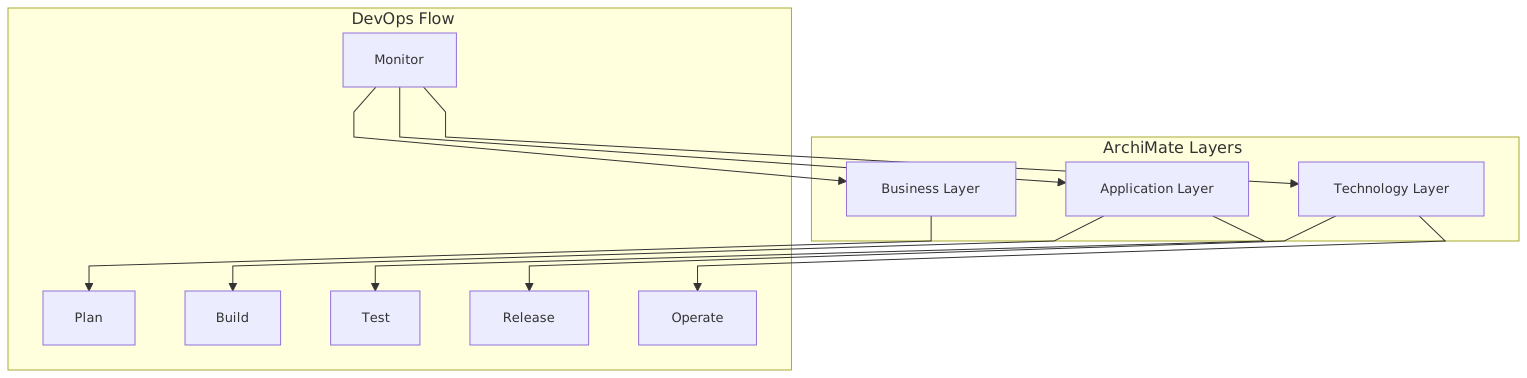
Suppose you’re the enterprise architect for a retail bank modernizing customer servicing. The bank wants faster product launches, better fraud detection, and lower operational risk. Delivery teams are moving workloads to cloud, adopting Kafka for event streaming, and standardizing IAM with federated identity and machine roles.
A traditional architecture approach might produce:
- capability map
- application landscape
- target cloud principles
- integration standards
- some reference diagrams
Fine. But not enough.
A DevOps-aligned ArchiMate approach would also produce views that answer operational and delivery questions:
View 1: Business-to-product alignment
Shows:
- customer servicing capability
- account maintenance process
- service domains
- product teams and platform teams
- key business outcomes
Purpose:
- clarify who owns what
- connect strategy to delivery structures
View 2: Runtime application and platform dependency view
Shows:
- servicing microservices
- API gateway
- Kafka platform
- IAM provider
- cloud container platform
- secrets manager
- observability service
- core banking integration service
Purpose:
- reveal critical runtime dependencies
- support resilience and operational risk discussions
View 3: Event and control view
Shows:
- “Customer Address Changed” event
- producing service
- consuming fraud, notifications, and compliance services
- schema authority
- retention and audit controls
- IAM permission boundaries for publishers and consumers
Purpose:
- make event governance visible
- identify control gaps and ownership ambiguity
View 4: Change and migration view
Shows:
- current on-prem servicing app
- target domain services in cloud
- coexistence period
- Kafka bridge
- phased IAM federation
- work packages for migration and decommissioning
Purpose:
- support roadmap realism
- expose temporary complexity before it bites operations
This is not theory. This is what architecture should be doing in transformation programs.
A useful mapping table
Here’s a simple way to think about the alignment.
Common mistakes architects make
This is where I’ll be blunt.
Mistake 1: Modeling structure but not operation
Architects often model what exists statically, but not how it behaves in delivery and runtime. That creates diagrams that are technically true and practically weak.
If your model can’t explain how a service gets deployed, authenticated, observed, or integrated through Kafka, then you are modeling a museum exhibit.
Mistake 2: Treating DevOps as a tooling topic
DevOps is not Jenkins plus Kubernetes plus some dashboards. It is an operating model around ownership, automation, and feedback.
Architects who reduce DevOps to tooling miss the real architecture implications:
- team boundaries
- control points
- release autonomy
- platform dependency
- runtime accountability
Mistake 3: Refusing to model cloud services because they change too fast
This one comes up all the time. “We can’t model cloud because it evolves rapidly.” Nonsense.
You don’t model every ephemeral detail. You model the stable architectural dependency:
- managed Kafka service
- container orchestration platform
- secret management service
- identity federation service
- object storage service
- logging and monitoring service
These are not too volatile to model. They are exactly the dependencies you need to understand.
Mistake 4: Overcomplicating ArchiMate views
The opposite mistake also happens. Once architects realize DevOps matters, they try to stuff every pipeline stage, namespace, queue, role, and topic into one mega-diagram.
That’s not architecture. That’s panic.
Use focused views. Each view should answer a decision question. If the audience cannot understand the point in under two minutes, the view is failing.
Mistake 5: Leaving IAM to someone else
In banking especially, architects who don’t understand IAM become passengers in critical decisions.
You don’t need to become the IAM engineer. But you do need to understand:
- identity domains
- trust models
- privileged access patterns
- service identity
- federation boundaries
- access control implications for architecture
Ignoring IAM is one of the fastest ways to produce unrealistic target states.
Mistake 6: Modeling the target state as if transition cost is irrelevant
This is the classic enterprise architecture sin.
A clean target architecture with no coexistence complexity is often fiction. In real life:
- legacy and cloud coexist
- Kafka bridges batch and event models
- IAM federation is partial
- teams adopt platform standards unevenly
- controls mature at different speeds
Architecture that ignores transition is not strategic. It is evasive.
A real enterprise example: banking modernization with Kafka, IAM, and cloud
Let’s walk through a realistic example.
A regional bank wanted to modernize its retail banking platform. The goal was to reduce time-to-market for customer features and improve fraud responsiveness. The legacy estate was predictable: core banking on older platforms, multiple channel applications, fragmented identity stores, and point-to-point integrations that nobody fully trusted.
The bank’s technology strategy was sensible:
- move customer-facing services to cloud
- use Kafka for event-driven integration
- centralize IAM with federation and service identities
- implement CI/CD pipelines for domain teams
- create reusable platform services for observability, secrets, and deployment
The first architecture attempt looked polished. It showed:
- business capabilities
- target application domains
- cloud-first principles
- an event-driven integration strategy
Executives liked it. Delivery teams tolerated it. Operations ignored it.
Why? Because it didn’t answer the hard questions.
For example:
- Which teams owned which services after go-live?
- Which Kafka topics were enterprise-controlled vs team-local?
- How would IAM work between legacy channels and cloud services?
- Which cloud services were mandatory platform standards?
- What transitional dependencies would keep the legacy customer master alive?
- How would fraud services consume onboarding events safely?
- What happened if the Kafka platform was degraded?
- Which controls were implemented in pipeline, and which remained manual?
The architecture team had described a direction. They had not described an operating reality.
So the modeling approach changed.
What the revised ArchiMate approach included
1. Product and team ownership views
Each major domain — onboarding, servicing, payments, fraud, customer profile — was linked to:
- business capability
- product owner
- delivery team
- platform dependencies
- run responsibility
This immediately exposed a problem: the “customer profile” service was treated as a shared enterprise asset, but nobody wanted production ownership. That is exactly the kind of issue good architecture should reveal early.
2. Event-centric views around Kafka
The team modeled business-significant events:
- Customer Registered
- KYC Completed
- Account Opened
- Address Changed
- Suspicious Activity Flagged
For each event, the model showed:
- producer domain
- Kafka platform dependency
- consuming services
- schema authority
- IAM access boundary
- retention/audit relevance
This surfaced a governance issue. Fraud wanted to consume nearly every customer event directly. Operations wanted to limit broad topic access. IAM constraints forced a more disciplined consumption pattern. The architecture model made that conflict visible before implementation got messy.
3. IAM as a cross-cutting architecture layer
Instead of treating IAM as a separate security workstream, the architecture connected:
- workforce identity provider
- customer identity services
- machine identities for cloud workloads
- role boundaries for deployment pipelines
- service-to-service access controls for Kafka and APIs
This exposed another issue: the initial design assumed legacy applications could participate cleanly in federated trust. They couldn’t, at least not consistently. The transition architecture had to include an identity mediation layer and stricter API boundaries.
Not glamorous. But real.
4. Cloud platform dependency views
The model showed which services depended on:
- managed Kubernetes
- managed Kafka
- secrets vault
- centralized logging
- API gateway
- policy enforcement services
This mattered because resilience assumptions were all over the place. One team assumed Kafka was multi-region by default. It wasn’t. Another assumed secret rotation was automated for all workloads. Also false. The architecture view forced actual platform conversations instead of mythology.
5. Migration plateaus
The final roadmap was not a single target-state poster. It had plateaus:
- Plateau 1: API wrapper over legacy customer master
- Plateau 2: Kafka event publication from onboarding and servicing
- Plateau 3: federated IAM for cloud-native domains
- Plateau 4: customer profile decomposition and legacy retirement
That sequencing prevented one of the most common transformation mistakes: trying to modernize integration, identity, platform, and domain design all at once.
The actual impact
The architecture became more useful because it became more honest.
Outcomes included:
- clearer product ownership and production accountability
- fewer hidden dependencies between cloud services and legacy apps
- better Kafka topic governance
- IAM decisions made earlier in design
- more realistic migration planning
- improved conversations between enterprise architects, platform teams, and delivery leads
Did ArchiMate itself create these outcomes? Of course not. People did. But ArchiMate provided a common language that could connect strategy, runtime design, and change planning without collapsing into either pure business abstraction or raw engineering detail.
That’s the sweet spot.
Contrarian thoughts architects should hear
A few opinions that won’t please everyone.
“Just enough architecture” is often used as an excuse for weak architecture
I like lightweight architecture. I do not like lazy architecture.
In DevOps settings, people sometimes weaponize agility against architectural thinking. The result is local optimization, duplicated controls, event chaos, and platform sprawl. If nobody can explain the enterprise-wide dependency picture, the enterprise pays later.
Not every team should be fully autonomous
This is another fashionable myth. In regulated enterprises, especially banks, some things need stronger standardization:
- IAM foundations
- secrets handling
- audit evidence
- Kafka platform controls
- observability patterns
- deployment guardrails
Architects should be careful not to romanticize autonomy where shared control is needed.
Reference architectures are overrated unless they show consumption paths
A generic “cloud reference architecture” means very little if teams can’t see how actual products consume platform capabilities. Architects love reference models because they feel reusable. Delivery teams care whether the thing maps to their reality.
Enterprise architects need more runtime literacy
I’ll say it plainly: if you don’t understand basic CI/CD patterns, cloud identity, event-driven integration, and operational dependencies, then your influence in modern architecture will keep shrinking. And honestly, it should.
How to make this work in practice
If you want to align ArchiMate with DevOps in a real organization, do these things.
Build views around questions, not layers
Don’t start with “let’s make a business layer view, then application, then technology.” Start with:
- What are we trying to decide?
- Who needs to understand it?
- Which relationships matter?
Then create the view.
Model ownership every time
Every critical service, platform dependency, and integration pattern should have visible ownership. If ownership is unclear, architecture risk is already present.
Use a small set of recurring viewpoints
For example:
- capability-to-product view
- product-to-platform dependency view
- event and integration view
- identity and trust view
- migration plateau view
Repeatable viewpoints create consistency without making everything rigid.
Integrate with delivery artifacts where possible
Architecture should reference:
- service catalogs
- API inventories
- Kafka topic registries
- IAM domain definitions
- deployment environments
- control libraries
No, the ArchiMate model should not become a CMDB clone. But it should not drift away from real delivery assets either.
Review models with engineers and platform teams
If your ArchiMate views are only reviewed by architects, they will become self-referential. Put them in front of:
- platform engineers
- SREs
- security architects
- product leads
- domain architects
If those people say, “yes, this reflects how the system actually works,” you’re on the right path.
Final thought
ArchiMate and DevOps are not opposing worlds. They only seem that way when architecture is treated as abstract governance and DevOps is treated as pure engineering execution.
In healthy enterprises, architecture gives shape to change, and DevOps gives change a delivery engine.
That is the alignment.
ArchiMate can absolutely support it, but only if architects stop using the notation as a polite way to stay distant from operational reality. Model the teams. Model the platform dependencies. Model Kafka where events matter. Model IAM where trust matters. Model the ugly transition states. And above all, make the model useful in the conversations where decisions actually get made.
Otherwise, don’t be surprised when the real architecture happens somewhere else — probably in a backlog, a Terraform module, a Kafka ACL, or a late-night incident call.
And if that’s where the truth lives, that’s where architects need to go.
FAQ
1. Isn’t ArchiMate too high-level for DevOps environments?
No. It’s often used too high-level, which is different. ArchiMate is flexible enough to show product ownership, platform services, event dependencies, IAM boundaries, and migration states. The issue is usually modeling discipline, not the language itself.
2. Should architects model CI/CD pipelines in detail?
Usually not in full engineering detail. But critical deployment automation dependencies, control points, and platform relationships should absolutely be visible. If pipeline capability affects release risk or compliance, it belongs in architecture.
3. How do you model Kafka without making the architecture unreadable?
Focus on business-significant events and major integration dependencies. Don’t model every topic. Show producers, consumers, platform dependency, ownership, and key control boundaries. That gives enterprise value without drowning the view.
4. Why is IAM so important in enterprise architecture?
Because identity determines who and what can interact across the enterprise. In cloud and DevOps contexts, IAM affects service trust, admin control, deployment permissions, auditability, and regulatory posture. It is not a side concern. TOGAF roadmap template
5. What’s the biggest mistake when aligning ArchiMate with DevOps?
Treating the exercise as documentation improvement rather than operating model alignment. The real goal is not prettier diagrams. It is making architecture reflect how teams build, deploy, secure, and run systems in the real enterprise.
Frequently Asked Questions
How is ArchiMate used for cloud transformation?
ArchiMate models cloud transformation by comparing baseline and target architectures across all layers. Cloud platforms appear as Technology Services, workloads as Application Components assigned to Technology Nodes. The Implementation and Migration layer models transition plateaus, work packages, and migration events — producing a traceable cloud roadmap.
How does ArchiMate align with DevOps practices?
ArchiMate supports DevOps by modeling the CI/CD pipeline as Application Behavior elements, infrastructure as code as Technology Artifacts, and deployment topology as Technology Nodes. Traceability from requirements through design to deployed infrastructure helps DevOps teams understand architectural constraints and governance requirements.
What cloud architecture patterns can be modeled in ArchiMate?
ArchiMate can model cloud-native patterns including: multi-region active-active deployments, event-driven integration via messaging platforms, API-led integration architectures, zero-trust network topology, container orchestration (Kubernetes), and hybrid cloud connectivity. Each pattern maps to specific Technology and Application layer elements.