⏱ 20 min read
Most enterprise architecture fails long before the first diagram is published.
Not because architects are stupid. Not because frameworks are useless. And not even because leadership “doesn’t get it,” though that certainly happens. It fails because too much enterprise architecture is built to look correct instead of being useful. It becomes a performance. A polished set of capability maps, target states, reference architectures, standards decks, and governance rituals that create the feeling of control while the actual enterprise gets messier by the month. ARB governance with Sparx EA
That’s the uncomfortable truth.
If I had to summarize the biggest mistake in enterprise architecture in one sentence, it would be this: architects confuse architectural output with architectural impact.
And once that happens, everything drifts. Standards become theatre. Governance becomes delay. Roadmaps become fiction. “Target architecture” becomes a polite term for “things we know will never happen.”
What enterprise architecture actually is
Let’s make this simple early.
Enterprise architecture is the discipline of making big technology decisions fit business reality over time.
That’s it.
It is not just drawing system landscapes. It is not just defining principles. It is not just enforcing standards. It is the work of aligning strategy, operating model, data, platforms, security, integration, and delivery constraints so the company can change without breaking itself.
A good enterprise architect helps answer questions like:
- What should we standardize, and what should we leave alone?
- Where do we need central control, and where do we allow local autonomy?
- Which platforms are strategic, and which are temporary?
- How do we reduce complexity without slowing delivery to a crawl?
- What technical decisions today will become expensive organizational problems in two years?
That’s the real job.
In real architecture work, especially in banks, insurers, retailers, governments, and large global companies, the challenge is almost never “what is the best design in theory?” The challenge is “what is the best decision given regulation, politics, legacy systems, budget cycles, cloud migration, identity sprawl, integration debt, and three conflicting executive priorities?”
That’s enterprise architecture.
Now let’s talk about the mistakes. The real ones.
Mistake #1: Treating enterprise architecture like a documentation factory
This is the classic failure mode.
The architecture team produces artifacts because artifacts are visible. Capability models. Current-state diagrams. Future-state diagrams. heatmaps. principles. standards. reference models. review templates. repositories. taxonomies.
None of these are bad on their own. The problem is when the team starts believing the artifacts are the work.
They aren’t.
The work is decision-making. Trade-offs. Escalation. Simplification. Political navigation. Technical pattern setting. Sequencing. Constraint management.
I’ve seen architecture teams in large banks maintain hundreds of diagrams in a repository that nobody trusts because none of them reflect what was actually deployed. Meanwhile, product teams are making major decisions in Jira comments, Slack threads, and vendor workshops. The architecture team still thinks it is “governing.”
It isn’t. It is archiving.
How this shows up in real work
A bank launches a digital onboarding initiative. The enterprise architecture team responds by asking for:
- current-state application inventory
- target-state capability alignment
- integration reference assessment
- security standards review
- cloud landing zone compliance review
- IAM pattern review
- data classification review
All valid topics. But six weeks later, the onboarding team still doesn’t know whether they should use the existing Kafka event backbone, call core banking services synchronously, or introduce a new orchestration layer. That was the actual architecture question. Everything else was support material.
The architecture team gave process. The delivery team needed direction.
Strong opinion
If your architecture function produces more diagrams than decisions, it is underperforming.
Not busy. Underperforming.
Mistake #2: Designing the “perfect target state” with no migration truth
Architects love target states. Clean boxes. rational domains. shared services. canonical APIs. event-driven integration. centralized identity. cloud-native platforms. zero trust. data products. all the modern language.
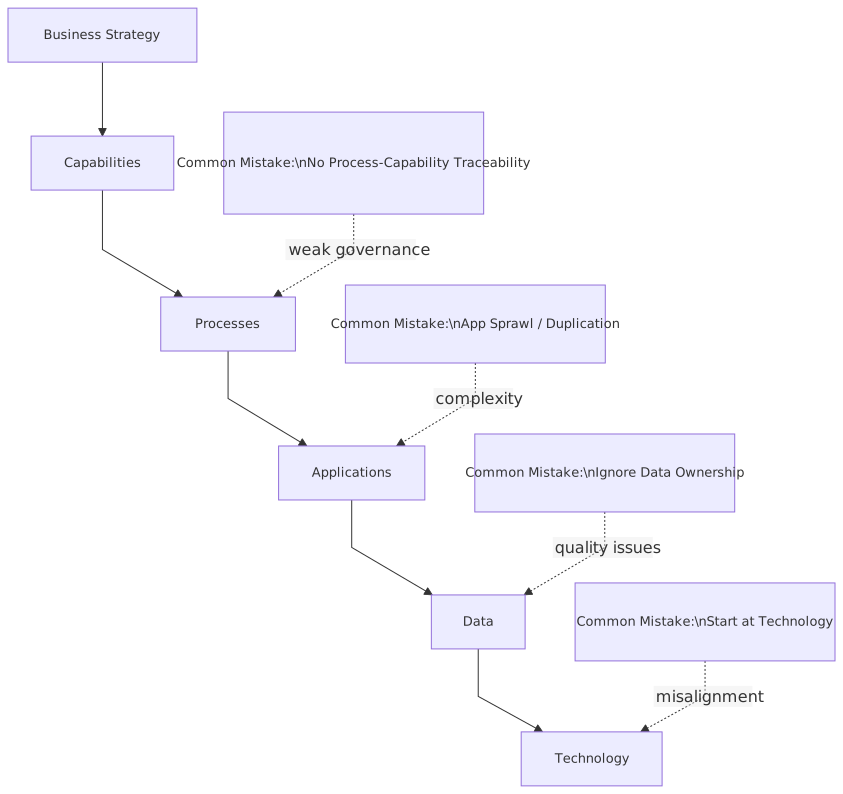
And yes, some of that is right. But too many target states are fantasy maps. They describe where the enterprise would be if history, contracts, regulations, budgets, and human behavior did not exist.
That is not architecture. That is wishful thinking with icons.
Real enterprise architecture lives in the path between current and target. If you cannot explain the migration in practical terms—funding, sequencing, ownership, risk, dependency, coexistence—then your target state is decorative.
A contrarian thought
Sometimes the right target state is not elegant.
Architects hate hearing that. But it’s true.
If a bank has three IAM stacks because of acquisitions, the “perfect” answer may be one strategic identity platform. Fine. But if one acquired business runs on a heavily customized legacy access model connected to regulated workflows and another has a cloud-native customer identity platform that actually works, forcing immediate convergence can create more risk than value.
Sometimes the right architecture is an explicitly temporary dual-model with strong federation rules, common governance, and a two-year transition plan. Ugly? Yes. Correct? Also yes. EA governance checklist
Real architecture lesson
A target state without a migration model is just a slide for executives.
Mistake #3: Confusing standards with strategy
This one is everywhere.
Architects publish standards for cloud, APIs, integration, IAM, data, observability, and development practices. Again, not bad. Standards matter. But many architecture teams use standards as a substitute for strategy.
A standard says: “Use Kafka for event streaming.”
A strategy says: “Use Kafka for enterprise event streaming in domains where decoupling, replayability, and near-real-time propagation justify the operating complexity. Do not use it as a replacement for every integration pattern. Build a platform team with ownership of topic governance, schema management, access control, and operational support.” architecture decision record template
See the difference?
One is a slogan. The other is architecture.
Kafka is a great example
In theory, enterprise architects love Kafka because it supports event-driven architecture, decoupling, scalability, and resilience. In practice, many organizations adopt Kafka and then create a distributed mess:
- no event ownership
- bad topic naming
- no schema governance
- no retention strategy
- no consumer accountability
- duplicate business events
- teams using Kafka as a batch transport
- sensitive data flowing into topics with weak IAM controls
Then six months later someone says, “Kafka is too complex for our organization.”
No. Your architecture was too shallow for the platform you adopted.
Kafka is not a strategy. Event-driven operating discipline is the strategy.
How this applies in real architecture work
If you are the enterprise architect in charge of integration modernization, your job is not to declare “event-first.” Your job is to define:
- when to use events vs APIs vs batch
- who owns enterprise event contracts
- how IAM works for producers and consumers
- how cloud networking and data residency affect cluster design
- who pays for platform operations
- how teams migrate from point-to-point integrations without freezing delivery
That is architecture. Standards support it. They do not replace it.
Mistake #4: Ignoring identity until it becomes a crisis
A surprising number of enterprise architecture teams still treat IAM as a security subtopic rather than a core enterprise architecture concern.
That is a major mistake.
Identity is not just authentication. It is the control plane for modern enterprise technology. It affects employee access, customer experience, partner integration, API security, cloud operations, audit, segregation of duties, and regulatory posture. If your architecture decisions don’t account for identity early, you are building fragility into everything else.
What architects often do wrong
They assume IAM is someone else’s domain.
So they design cloud platforms, integration patterns, application landscapes, and digital channels first. Then later someone asks:
- how will workforce identities federate across business units?
- how will service-to-service authentication work?
- which identity provider is authoritative for customers?
- how are privileged cloud roles managed?
- how do acquired entities integrate into access governance?
- how do we support B2B partner access?
- what happens when regulators ask for end-to-end access traceability?
At that point, every architecture decision gets more expensive.
Banking example
A retail bank modernizes customer onboarding in the cloud while keeping core banking on-prem. The architecture team focuses on APIs, workflow, and event streaming using Kafka. Good start. But IAM is deferred. Later they realize:
- customer identity is split across online banking, CRM, and onboarding systems
- internal users need access across old and new platforms
- fraud services require service identities with strict controls
- third-party KYC providers need secure delegated access
- audit requires end-to-end traceability of who approved what
Now the project is doing identity retrofitting across channels, APIs, middleware, and cloud roles. That is always ugly. Always expensive.
Strong opinion
If IAM is not on page one of your enterprise architecture thinking, your architecture is incomplete.
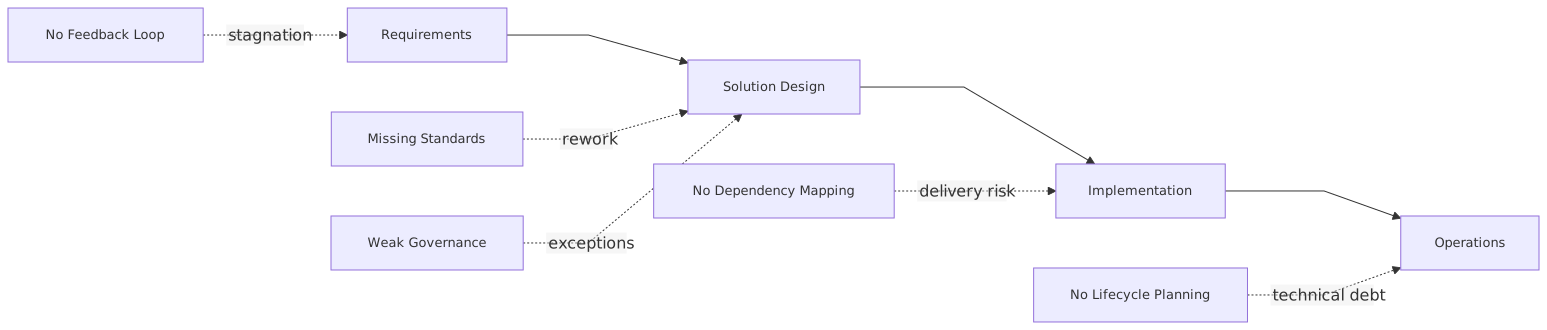
Mistake #5: Being too abstract to help delivery teams
Architects often say they want to “stay strategic.” Fair enough. But some use strategy as an excuse to avoid operational detail. They produce principles like:
- API-first
- cloud-smart
- zero trust
- domain-aligned
- reusable before new build
Fine. But what does any of that mean for a delivery team making decisions this quarter?
A real architect knows that abstraction without translation is useless.
If your principles do not help teams choose between two implementation paths, they are not architecture principles. They are posters.
What good translation looks like
Take “cloud-smart.” That should become decisions like:
- customer-facing workloads can run in public cloud if data classification and residency controls are satisfied
- regulated transaction ledgers remain on existing mainframe platforms until control equivalence and recovery objectives are proven
- Kafka clusters may run in managed cloud services for non-restricted domains, but payment events with specific residency requirements must stay in approved regional hosting
- IAM for cloud workloads must use federated enterprise identities and short-lived credentials, not static secrets
Now teams can act.
In real architecture work
Delivery teams rarely need more principles. They need architecture position statements, approved patterns, exception rules, and clear trade-off guidance.
The best enterprise architects I know can move between board-level operating model conversations and ugly implementation details like token propagation, network segmentation, event schema versioning, and batch coexistence.
You need both.
Mistake #6: Centralizing everything in the name of control
Large enterprises overcorrect. Especially regulated ones.
They see fragmentation and decide the cure is centralization. One cloud platform. One IAM stack. One integration standard. One data platform. One architecture review board. One truth. One way.
That sounds neat. It almost never survives contact with the enterprise.
The bigger and older the organization, the more likely it is that different parts of the business operate under genuinely different constraints. Retail banking, corporate banking, wealth, insurance, and payments do not always need identical patterns at the same pace. Acquired companies definitely do not.
Contrarian point
Not all variation is architecture debt.
Some variation is economically rational.
Architects sometimes chase uniformity because it looks cleaner on a roadmap. But forcing standardization where the payoff is weak can destroy momentum and credibility. The point is not to eliminate all local differences. The point is to manage the differences that create material cost, risk, or strategic drag. ArchiMate in TOGAF ADM
A better model
Use guardrailed autonomy:
- centralize a small number of high-value controls
- define mandatory standards where risk or scale demands it
- allow local implementation choices within approved patterns
- govern interfaces, identities, data contracts, and risk boundaries more tightly than internal code choices
For example:
- central IAM policy, but multiple implementation phases by business unit
- central Kafka platform standards, but domain-owned event schemas
- central cloud guardrails, but product team autonomy inside landing zones
- central security controls, but decentralized application delivery
That is usually how real enterprises work.
Mistake #7: Making governance slow, ceremonial, and easy to bypass
If architecture governance takes too long, teams route around it. Every time.
This is one of those truths architects know but still ignore. They create review boards that meet every two weeks, require giant templates, ask for exhaustive diagrams, and deliver vague feedback like “please align more closely with enterprise standards.”
By then, the team has already chosen a vendor, started implementation, and built around the architecture process.
Then the architects complain they are brought in too late.
Well, yes. You made yourself expensive to involve.
What better governance looks like
Governance should be:
That is more boring than a giant architecture board. And much more effective.
Real example
In one banking environment, cloud adoption stalled because every new workload needed architecture, security, infrastructure, and risk approvals through separate forums. Teams waited weeks for answers. So they started classifying workloads as “temporary pilots” to avoid full review.
The architecture team said governance was being ignored.
Actually, the governance model was broken. Once they moved to a lightweight architecture decision record, pre-approved cloud patterns, standard IAM integration, and risk-based review thresholds, throughput improved and compliance got better. Funny how that works.
Mistake #8: Underestimating legacy because it is unfashionable
There is a persistent bias in architecture toward the new thing. Cloud. eventing. platform engineering. AI. zero trust. composability. all important, all useful in the right context.
But many enterprise architects still talk about legacy systems as if they are simply obstacles waiting to be removed by superior design.
That is naïve.
Legacy systems are often ugly because they carry decades of business rules, regulatory adaptations, exception handling, operational workarounds, and institutional memory. Replacing them is not just a technical migration. It is a business decomposition exercise.
In banking especially
Core banking, payments, customer master, credit decisioning, anti-money laundering, and settlement systems often have more embedded behavior than people realize. Architects create target architectures assuming those capabilities can be cleanly extracted into APIs, event streams, or microservices. Then the migration hits reality:
- undocumented dependencies
- overnight batch coupling
- hidden data transformations
- manual operations in the middle of “automated” processes
- audit assumptions hardcoded in old workflows
The mistake is not wanting to modernize. The mistake is disrespecting what the old environment is actually doing.
Strong opinion
If you describe legacy as “just technical debt,” you probably do not understand the business well enough yet.
Mistake #9: Thinking cloud automatically simplifies architecture
Cloud can simplify architecture. It can also multiply complexity very quickly.
Too many enterprise architects still frame cloud migration as a move from complexity to simplicity. In reality, what usually happens is a shift in complexity:
- infrastructure complexity becomes policy complexity
- network complexity becomes connectivity and segmentation complexity
- server management becomes platform and cost management complexity
- static access models become federated IAM complexity
- deployment effort becomes operational observability complexity
If you move to cloud without changing operating model, skills, platform ownership, and governance, you usually just distribute confusion faster.
Real cloud architecture issue
A bank migrates customer-facing services to cloud and keeps core systems on-prem. Now it has:
- hybrid network design
- IAM federation across environments
- secrets management across multiple runtime platforms
- event propagation between on-prem Kafka and cloud-native services
- data residency constraints
- separate monitoring stacks
- recovery planning across providers and datacenters
This is not “simpler.” It may still be the right move. But architects need to tell the truth about what cloud introduces.
Contrarian point
“Cloud-first” is often a procurement slogan, not an architecture strategy.
The real question is not whether cloud is good. The real question is where cloud creates enough business and operating advantage to justify the complexity it adds.
Mistake #10: Failing to connect architecture to money, risk, and time
This is maybe the most career-limiting mistake.
Architects often present recommendations in technology language only. Platform rationalization. service reuse. event-driven integration. centralized IAM. data mesh. landing zones. resilience patterns.
Executives hear: cost, delay, risk, politics.
If you cannot connect your architecture choices to investment logic, control outcomes, speed of change, and measurable risk reduction, your influence will always be weaker than it should be.
What architects should say more often
Instead of:
- “We need a strategic Kafka platform.”
Say:
- “We currently have five overlapping integration patterns creating duplicated data movement, inconsistent controls, and slow onboarding for new consumers. A managed event platform with domain ownership and schema governance will reduce integration lead time and lower reconciliation effort in high-volume flows.”
Instead of:
- “We need identity consolidation.”
Say:
- “We cannot provide consistent access traceability, role lifecycle control, or cloud privilege management across acquired entities with the current IAM sprawl. This creates audit exposure and slows integration of new services.”
That is the language of enterprise architecture in the real world.
A real enterprise example: where architecture went wrong, and then got better
Let’s take a plausible but very real-feeling example from banking.
A regional bank had grown through acquisition. It had:
- three customer identity systems
- two workforce IAM stacks
- multiple integration platforms
- a central ESB everyone complained about
- a new Kafka platform launched by an enthusiastic platform team
- on-prem core banking
- cloud-native digital channels
- fragmented architecture governance
The bank wanted to launch a unified small-business lending journey. Sounds straightforward. It wasn’t.
What went wrong
The architecture team started with a target-state deck:
- single customer profile
- event-driven enterprise integration
- centralized IAM
- API-led connectivity
- cloud-first digital services
All sensible. But there were major mistakes:
- No migration sequencing
The deck assumed identity convergence, API modernization, and event adoption would happen in parallel. They didn’t.
- Kafka overuse
Teams were told to publish events for almost everything. Soon there were duplicate customer events, inconsistent schemas, and unclear ownership.
- IAM came too late
Customer login, employee approval flows, service identities, and partner broker access were handled separately by different projects.
- Governance lagged delivery
Architecture reviews happened after vendor and design choices were mostly fixed.
- Legacy assumptions were wrong
Credit workflows in the old lending platform had manual exception handling nobody had modeled.
What changed
A new lead architect reset the approach.
First, they stopped pretending the final target state mattered more than the next twelve months.
They introduced a phased architecture:
- Phase 1: establish a canonical lending journey at the experience layer, not the full enterprise customer master
- Phase 2: use APIs for synchronous decisioning and Kafka only for selected state-change events
- Phase 3: implement federated IAM patterns for workforce and partner access before broader identity consolidation
- Phase 4: isolate legacy lending rules behind stable services while documenting manual exceptions
- Phase 5: retire overlapping integration flows gradually, with measurable ownership transfer
They also changed governance:
- short architecture decisions instead of giant review packs
- named owners for event contracts
- IAM architecture review embedded early in solution shaping
- exceptions logged with expiry dates
- platform standards tied to delivery funding gates
The result
Was the architecture elegant? Not particularly.
Was it real? Yes.
The bank reduced integration confusion, improved audit posture around access, and delivered the lending journey without forcing immediate enterprise-wide identity unification. Over time, they still moved toward a cleaner target state. But they got there through sequencing and truth, not architecture theatre.
That is what mature enterprise architecture looks like.
What good enterprise architects do differently
The best architects I’ve worked with are not the ones with the prettiest diagrams. They are the ones who can hold tension without getting simplistic.
They know:
- standardization and autonomy must coexist
- target state matters, but migration matters more
- governance must control risk without killing speed
- IAM is architecture, not just security
- Kafka is powerful, but only with ownership discipline
- cloud is useful, but not magical
- legacy is inconvenient, but often business-critical
- architecture must speak in business consequences, not just technical ideals
They also have one trait that is underrated: they are willing to be unpopular for the right reasons.
A real architect sometimes says:
- no, not yet
- yes, but only in this domain
- your standard is too broad
- your roadmap is fiction
- this exception is acceptable
- this modernization case is weaker than people think
- we should leave that legacy system alone for now
- centralizing this would be a mistake
That’s not negativity. That’s judgment.
And judgment is the heart of enterprise architecture.
Final thought
Enterprise architecture is not failing because enterprises are too complex. Complexity is the job.
It fails when architects retreat into abstraction, overdesign target states, ignore identity, misuse standards, centralize too aggressively, and create governance that delivery teams naturally avoid.
The answer is not more framework. Usually it is less pretending.
Be clearer. Be earlier. Be more concrete. Tell the truth about trade-offs. Respect migration. Treat IAM and integration as first-class architecture concerns. Use cloud and Kafka with discipline, not fashion. And for the love of all things operational, stop measuring architecture by how many artifacts were produced.
Measure it by whether the enterprise can change with less friction, less risk, and less nonsense.
That’s the bar.
FAQ
1. What is the biggest mistake in enterprise architecture?
The biggest mistake is focusing on architecture artifacts instead of architecture decisions. Diagrams, principles, and standards matter, but if they do not shape real delivery choices, they are mostly decoration.
2. Why do enterprise architecture target states often fail?
Because they are designed without realistic migration planning. A target state needs funding logic, sequencing, ownership, dependency management, and coexistence rules. Otherwise it is just an idealized future slide.
3. How does IAM fit into enterprise architecture?
IAM is a core architecture concern because it affects workforce access, customer identity, API security, cloud operations, audit, and partner integration. Treating IAM as a late-stage security detail creates expensive rework.
4. Is Kafka always the right choice for enterprise integration?
No. Kafka is excellent for event streaming where replayability, decoupling, and scalable distribution matter. It is not a universal replacement for APIs, batch, or workflow orchestration. Without governance and ownership, Kafka can create as much chaos as it solves.
5. How can architects make governance more effective?
Use smaller and faster decision forums, short decision papers, explicit outcomes, documented exceptions, and embedded controls in platforms and delivery pipelines. Good governance should be hard to bypass because it is useful, not because it is bureaucratic.
Top Mistakes in Enterprise Architecture
Frequently Asked Questions
What is enterprise architecture?
Enterprise architecture is a discipline that aligns an organisation's strategy, business processes, information systems, and technology. Using frameworks like TOGAF and modeling languages like ArchiMate, it provides a structured view of how the enterprise operates and how it needs to change.
How does ArchiMate support enterprise architecture practice?
ArchiMate provides a standard modeling language that connects strategy, business operations, applications, data, and technology in one coherent model. It enables traceability from strategic goals through business capabilities and application services to the technology platforms that support them.
What tools are used for enterprise architecture modeling?
The main tools are Sparx Enterprise Architect (ArchiMate, UML, BPMN, SysML), Archi (free, ArchiMate-only), and BiZZdesign Enterprise Studio. Sparx EA is the most feature-rich option, supporting concurrent repositories, automation, scripting, and integration with delivery tools like Jira and Azure DevOps.