⏱ 21 min read
Microservices don’t fail because teams can’t write services. They fail because nobody can answer a simple question with confidence: what exists, who owns it, what does it depend on, and what business capability does it actually serve?
That sounds administrative. It isn’t. It is architecture.
In most enterprises, the real system is not the boxes in a PowerPoint diagram. The real system is a living sprawl of APIs, Kafka topics, scheduled jobs, databases, batch feeds, IAM rules, dashboards, deployment pipelines, ownership boundaries, and half-remembered tribal agreements. A microservice estate without a credible map becomes a city where roads were built by different contractors who never spoke to each other. Things still move. But nobody knows why traffic jams happen, or what bridge will collapse if you close one lane. microservices architecture diagrams
This is where a service catalog stops being an inventory spreadsheet and becomes something more useful: an architecture map. Not a static repository of metadata, but a graph of business capabilities, domain boundaries, service contracts, event flows, dependencies, ownership, runtime health, and lifecycle state. In other words, a catalog graph.
That shift matters. A list tells you what exists. A graph tells you what matters.
And in a microservices environment, especially one built around APIs and Kafka-driven interactions, the graph is the architecture. event-driven architecture patterns
Context
Enterprises adopted microservices for good reasons: independent deployment, team autonomy, bounded contexts, better scaling characteristics, and the ability to evolve systems incrementally rather than betting the company on another big-bang rewrite.
But microservices are a tax as much as they are a strategy. You trade the complexity of one large system for the complexity of coordination among many smaller ones. The code gets smaller; the sociotechnical system gets bigger.
That trade becomes harsh at enterprise scale.
A team launches a new Customer Profile service. Another team already has Party Master. A third publishes customer.created events to Kafka, but means “CRM lead converted,” while the fourth consumes that topic as if it meant “legally onboarded customer.” An order service depends on a pricing API, which depends on a product model, which is sourced from ERP overnight and corrected manually every Tuesday after finance spots a discrepancy. Security asks which services process PCI data. Nobody knows for sure. Platform engineering has service discovery, but not ownership clarity. EA has capability maps, but not runtime truth. Operations has dashboards, but not domain semantics.
The result is familiar: teams can discover endpoints, but cannot understand the system.
A proper service catalog closes that gap. But only if we design it as an architectural asset grounded in domain-driven design, not as a glorified CMDB and not as a developer portal vanity project.
The catalog has to represent the language of the business and the mechanics of the software at the same time. If it only knows technical metadata, it is operationally useful but strategically blind. If it only knows capabilities and domains, it is elegant but inert.
Architecture lives in the join.
Problem
Most service catalogs fail for one of three reasons.
First, they are built as documentation repositories. Someone creates templates. Teams are asked to fill in service descriptions, owners, API links, and dependencies. Six months later the data is stale, 30 percent of services are missing, and the portal becomes the place where wrong information goes to look official.
Second, they are built as platform features rather than architecture models. They integrate beautifully with Kubernetes, CI/CD, and OpenAPI specs, but they can’t answer domain questions. They know there is a service called cust-prof-v2. They do not know whether it belongs to the Customer domain, whether it is a system of record, whether it emits business events or integration events, or whether it is duplicating another bounded context.
Third, they are built as governance mechanisms. Every team must register every component and comply with mandatory fields before deployment. This creates resentment, weak data quality, and bureaucratic theatre. Teams game the catalog because they see it as tax, not leverage.
The deeper problem is conceptual: enterprises confuse service inventory with architecture knowledge.
A service inventory says:
- service name
- repo
- owner
- API URL
- runtime
Useful, but thin.
An architecture map says:
- which domain and bounded context the service belongs to
- what business capability it supports
- whether it is a system of record, process manager, read model, anti-corruption layer, or facade
- what contracts it exposes through APIs, events, and batch interfaces
- what upstream/downstream dependencies exist
- what data classifications and operational criticality it carries
- what lifecycle state it is in: emerging, active, constrained, deprecated, retired
- what legacy systems it is strangling or coexisting with
- where reconciliation is required because truth is distributed
That last point is especially important in event-driven estates. Once you introduce Kafka and asynchronous propagation, consistency becomes temporal, semantics become fragile, and ownership becomes the only thing that keeps systems from drifting into nonsense. If the catalog cannot represent those relationships, it cannot guide architecture.
Forces
Several forces push against each other here.
Team autonomy vs enterprise coherence
Microservices work when teams can move independently. Enterprises work when the whole system still makes sense. A catalog graph must enable local change without losing the big picture.
Runtime truth vs curated meaning
Automatically harvested metadata is fresh but shallow. Human-entered business meaning is richer but decays. You need both. One without the other gives either sterile facts or beautiful lies.
Domain boundaries vs technical topologies
Network diagrams show calls and topics. Domain models show bounded contexts and capabilities. Real architecture needs both views aligned, because technical dependencies that violate domain boundaries are where future pain is born.
Event-driven scalability vs semantic ambiguity
Kafka decouples producers and consumers technically. It often couples them semantically in more dangerous ways. Topic names age badly. Event schemas drift. Consumers infer meanings never promised. The catalog must expose event intent, ownership, compatibility rules, and business definitions.
Governance vs adoption
If the catalog becomes a compliance burden, teams will bypass it. If it has no governance, it becomes decorative. The winning design is not “strict” or “lightweight.” It is inevitable: useful enough that teams rely on it, automated enough that they don’t hate it, governed enough that the data means something.
Migration speed vs correctness
During a strangler migration, the map is moving while the road is being built. You will have duplicate capabilities, parallel data flows, and temporary reconciliations. The catalog must model transition states, not just ideal end states.
Solution
The practical solution is to treat the service catalog as a graph-backed architecture model with multiple lenses:
- Domain lens
Bounded contexts, aggregates, ubiquitous language, business capabilities, domain ownership.
- Service lens
APIs, Kafka topics, consumers, databases, operational metadata, deployment info, SLOs.
- Dependency lens
Synchronous calls, event subscriptions, data lineage, shared infrastructure reliance, critical path relationships.
- Lifecycle lens
Planned, active, deprecated, replacement target, migration stage, source-of-truth state.
- Risk lens
PII/PCI handling, resilience tier, recovery posture, compliance obligations, blast radius.
That is the core idea behind the catalog graph: every service is a node, but not the only node. Domains, teams, events, capabilities, systems of record, and data products are also nodes. Relationships carry meaning.
For example:
Customer Profile Servicebelongs toCustomer Managementbounded contextCustomer Profile ServicesupportsCustomer 360capabilityCustomer Profile Servicepublishescustomer-profile-updatedBilling Serviceconsumescustomer-profile-updatedCRMis being strangled byCustomer Profile ServiceCustomer Profile Servicereconciles withMDM HubPayments APIdepends onCustomer Risk Score ServiceCustomer Risk Score Servicecontains data classified asPII-sensitive
This is more than metadata. It is executable architecture knowledge.
What belongs in the catalog
At minimum, the graph should include:
- business capability
- domain and subdomain
- bounded context
- service/application
- team/owner
- API contract
- event/topic and schema
- data store or source of truth
- environment/runtime
- dependency relationship
- lifecycle status
- data classification
- SLO / criticality tier
- migration linkage to legacy assets
What should be automated
Automate anything that can be harvested reliably:
- repositories, build pipelines, deployment targets
- OpenAPI and AsyncAPI contracts
- Kafka topics, schemas, consumer groups
- runtime telemetry and service mesh dependencies
- cloud resources and infrastructure attachments
- alerting, dashboards, SLO indicators
What must be curated
Curate the parts automation cannot infer:
- business capability
- bounded context
- semantic definition of events
- system-of-record designation
- stewardship/ownership
- lifecycle intent
- reconciliation rules
- migration target and replacement plan
If you only automate, you get infrastructure observability. If you only curate, you get enterprise fiction. The architecture map needs both.
Architecture
A service catalog as architecture map usually works best as a federated platform with a graph model at the center.
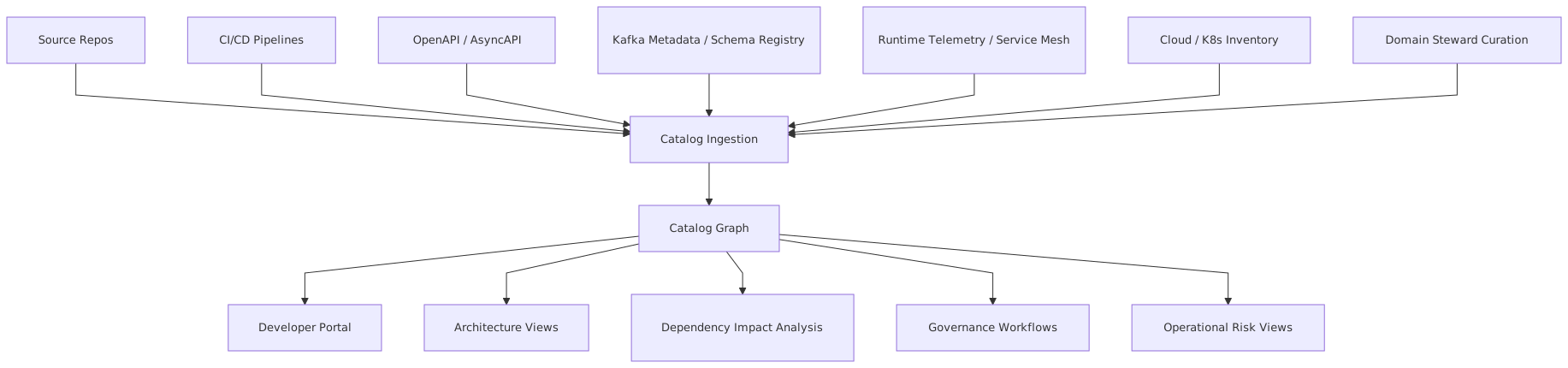
The central graph is not merely a storage choice. It is the right mental model. Microservice architecture is a network of relationships. A graph database or graph-oriented model makes dependency traversal, impact analysis, ownership tracing, and lineage exploration far more natural than forcing everything into flat records.
Domain-driven structure
This is where many catalogs become disappointing: they stop at the service. They need to begin one level up.
A healthy catalog graph organizes services under domains and bounded contexts, not under Kubernetes namespaces or cloud accounts. Technical placement matters operationally. Domain placement matters architecturally.
A good service entry should answer:
- What capability is this in service of?
- What domain language does it use?
- Which aggregate or core entities does it own?
- Is it authoritative for a business concept, or merely a projection?
- Which external terms are translated through an anti-corruption layer?
That is straight DDD thinking, and it matters because enterprises drown in semantic duplication before they drown in CPU utilization.
If “customer,” “account holder,” “subscriber,” and “party” are all represented by different services with overlapping truths, your architecture problem is not discovery. It is ontology.
Event-driven mapping
For Kafka-heavy environments, the catalog must model events as first-class artifacts, not notes attached to services. Topics and schemas need architectural meaning.
You want to know:
- who owns the event
- what business fact it represents
- whether it is a domain event, integration event, or change-data event
- schema version policy
- compatibility guarantees
- downstream consumers
- operational criticality
- replay and retention expectations
- whether consumers can reconstruct state or need reconciliation
That last question is often neglected. In practice, event-driven systems accumulate drift. Consumers miss events, process duplicates, lag behind schema evolution, or derive local views that diverge from upstream truth. A mature catalog should identify where reconciliation is part of the design.

That small relationship—periodic reconciliation between a new service and an MDM or legacy source—is not an implementation footnote. It is architecture truth. During migration and often long after, distributed truth requires explicit repair mechanisms. The catalog should capture those links.
Views for different audiences
One catalog, multiple views:
- Engineering view: APIs, topics, dependencies, repos, runbooks, SLOs
- Architecture view: domains, bounded contexts, patterns, target state, policy exceptions
- Operations view: critical paths, ownership, support tiers, blast radius
- Risk/compliance view: data classification, retention, control obligations
- Product/portfolio view: capabilities, lifecycle, business value, migration progress
A catalog without views is a database. An architecture map is useful because it can render the same graph differently depending on the question.
Migration Strategy
This is the part that separates real architecture from diagram theatre.
No large enterprise starts with a clean catalog graph. They start with a messy estate and partial knowledge. So the adoption strategy must be incremental, and it should mirror the same strangler approach many teams use for system modernization.
Step 1: Start with critical domains, not all services
Do not begin with a universal mandate to register 2,000 services. That is how catalogs become political and irrelevant.
Start with one or two critical domains where ambiguity is expensive: customer, order, payment, identity, product, pricing. Model the bounded contexts, key systems of record, major APIs, Kafka flows, and top dependencies. Make it useful fast.
Step 2: Harvest technical truth automatically
Integrate with repos, CI/CD, OpenAPI, AsyncAPI, schema registry, Kubernetes, and telemetry. Reduce manual entry aggressively. Every field someone must type will eventually rot.
Step 3: Curate semantic truth with domain stewards
Assign stewardship at the domain level, not just service ownership. Teams own service facts; domain stewards own language and boundary integrity. This is crucial where multiple services touch shared business concepts.
Step 4: Expose impact analysis
Once teams can answer questions like “what breaks if this topic changes?” or “which deprecated services still sit on the checkout critical path?” adoption rises sharply. Utility beats policy.
Step 5: Model migration state explicitly
During strangler migration, catalog entries should express:
- legacy source
- replacement target
- coexistence period
- sync/reconciliation pattern
- cutover criteria
- retirement blockers

Progressive strangler and the catalog graph
The strangler pattern is usually described in terms of routing traffic away from a monolith. That is necessary, but not sufficient. In enterprise migration, the harder problem is not traffic routing. It is truth routing.
As capabilities are peeled out, the catalog must clarify:
- which service is now authoritative for which business concept
- which legacy function still remains active
- which downstream consumers should use event streams versus direct API calls
- where duplicate writes or dual reads exist temporarily
- what reconciliation jobs are compensating for transitional inconsistency
This is why the catalog graph should not pretend transition states are defects. Transition is normal. Architecture needs to model the temporary scaffolding as honestly as the target design.
Reconciliation as a first-class migration concern
In migration projects, reconciliation often appears late, as an “operational” detail. That is a mistake.
Anytime you have:
- event-driven propagation,
- dual-run legacy and new services,
- partial data replication,
- asynchronous read models,
- or external system dependencies,
you need explicit reconciliation strategy.
That could mean:
- periodic compare-and-repair jobs
- event replay from Kafka
- snapshot rehydration
- compensating workflows
- manual exception queues
- golden-source dispute rules
The service catalog should expose which services require reconciliation and why. Otherwise architects draw clean boundaries while operators inherit messy reality.
Enterprise Example
Consider a global insurer modernizing its policy administration landscape.
It had:
- a 20-year-old policy monolith
- regional customer systems
- a central MDM hub
- document management
- claims services
- a growing Kafka platform
- around 300 APIs, though nobody agreed on the number
The company’s immediate issue was not deployment speed. It was semantic fragmentation. Three different systems claimed to own “customer.” Policy systems used “insured party.” Billing used “account holder.” Claims used “claimant.” Marketing built a customer 360 read model that quietly merged all four concepts and then exposed them through an API as if they were one thing. Integration looked successful until downstream processes started making regulatory mistakes.
The enterprise architecture team introduced a catalog graph, but wisely avoided making it a universal registry program on day one.
They started with two domains: Customer and Policy.
For Customer, they modeled:
- bounded contexts: Party Management, Customer Profile, Customer Communications, Identity Verification
- systems of record: regional party master for some jurisdictions, MDM for enterprise golden identity, CRM for prospect data
- services and events
- ownership
- data classifications
- reconciliation relationships
For Policy, they mapped:
- quote, bind, endorsement, renewal, cancellation
- APIs exposed from the monolith
- newly extracted policy services
- Kafka events for policy lifecycle
- downstream consumers in billing, claims, and reporting
This quickly surfaced several uncomfortable truths.
First, many “microservices” were actually integration wrappers around the monolith, with no clear domain ownership. Fine. Better to know than to pretend.
Second, the event taxonomy was weak. A topic named customer.updated was being emitted by two producers with incompatible semantics. One meant KYC identity changes; another meant CRM preference updates. The catalog made that visible and triggered a split into explicitly named domain events.
Third, the migration plan had underestimated reconciliation. The new Policy service published events to Kafka, and claims consumed them to maintain local views. But historical endorsements and out-of-band corrections in the monolith created gaps. The architecture team added scheduled compare-and-repair jobs and event replay procedures, and recorded them in the catalog as part of the service relationship model.
The result was not “perfect architecture.” That phrase is usually a sign someone has not run systems in production. The result was better:
- impact analysis became credible
- ownership became visible
- duplicate capabilities were identified
- migration discussions moved from ideology to evidence
- deprecation of legacy interfaces became manageable
Most importantly, the catalog became a place teams consulted before building. That is the real test. If people only visit the catalog when governance asks them to, it has failed. EA governance checklist
Operational Considerations
A catalog graph only helps if it remains trustworthy.
Data freshness
Technical metadata should be refreshed continuously or near-real-time. Stale dependency data is worse than missing data because it encourages false confidence.
Ownership discipline
Every service needs a real owner, ideally a team identity rather than an individual. Ownership is not just for support escalation. It is how semantic disputes get resolved.
Critical path mapping
The catalog should expose business-critical transaction paths:
- login
- checkout
- payment authorization
- policy issuance
- claim submission
This allows operations and architecture to understand blast radius when a dependency degrades.
Schema and contract governance
OpenAPI and AsyncAPI specs, plus Kafka schema registry, should feed the catalog. Contract changes should trigger impact analysis across consumers.
Lifecycle enforcement
Deprecation should be visible and measurable. Which teams still consume deprecated APIs or events? Which “temporary” bridges are now three years old? Architecture debt becomes manageable when it is named.
Security and compliance metadata
You need to know not only what exists, but what it touches:
- PII
- PCI
- health data
- regulated retention
- residency obligations
For many enterprises, this alone justifies the effort.
Catalog as product
A service catalog is not a project. It is a product with users:
- developers
- architects
- operators
- security teams
- product managers
If nobody is accountable for the product experience, adoption declines and data quality follows.
Tradeoffs
Let’s be clear: this approach is not free.
Benefit: better decisions
Cost: modeling effort
You must model domains, ownership, and semantics, which requires real architectural thinking. Some organizations would rather buy a portal and declare victory.
Benefit: enterprise visibility
Cost: political exposure
The catalog reveals duplication, weak ownership, unclear boundaries, and fake microservices. Not everyone enjoys that kind of transparency.
Benefit: safer migration
Cost: transitional complexity on display
A graph-based catalog makes the messy coexistence during strangler migration visible. That is good architecture, but it can make leaders uncomfortable because it shows how much temporary scaffolding really exists.
Benefit: stronger event governance
Cost: less casual publishing
Teams can no longer toss vaguely defined events onto Kafka and hope consumers figure it out. That reduces accidental integration, but also slows reckless speed. Good.
Benefit: impact analysis and resilience insight
Cost: platform integration overhead
To keep the catalog current, you need ingestion from many systems. That takes engineering effort and product discipline.
This is the recurring enterprise truth: the tools that reduce future chaos often increase present clarity, and people frequently mistake that clarity for added complexity.
Failure Modes
Several failure modes appear repeatedly.
The catalog becomes a wiki with better branding
If updates depend on manual discipline alone, entropy wins. Documentation-only catalogs always decay.
It models only infrastructure
If the catalog knows pods, services, and endpoints but not bounded contexts, capabilities, or system-of-record roles, it helps SREs but not architects.
It becomes governance theatre
If mandatory registration is the main interaction model, teams optimize for passing the form rather than conveying truth.
It lacks semantic stewardship
Without domain stewardship, event definitions drift, terms overlap, and the graph fills with technically correct but business-meaningless artifacts.
Dependency inference is too naive
Runtime telemetry can show calls. It cannot always distinguish critical dependency from incidental telemetry path, nor can it explain semantic dependency. Architects still need judgment.
Migration states are hidden
Many catalogs only show target-state architecture. Real enterprises live in transition. If the model cannot represent coexistence and reconciliation, it will mislead decision-makers.
It becomes too centralised
A central architecture team cannot manually curate the entire enterprise. The graph must be federated: automated inputs, local ownership, domain stewardship, central standards.
When Not To Use
This pattern is powerful, but not universal.
Do not invest heavily in a graph-based architecture catalog if:
- you have a small system with a handful of services and direct human awareness still works
- your architecture is modular monolith first, and service decomposition is limited
- your organization lacks stable ownership and basic operational discipline
- you are looking for a shortcut to avoid domain modeling
- your primary problem is delivery execution, not architectural discoverability
- you do not have enough platform maturity to automate metadata collection
In those conditions, start simpler. A well-run modular monolith with clear bounded contexts is better than a cataloged mess of premature microservices.
Also, if leadership wants a catalog mainly to produce pretty architecture views for governance committees, stop. That path leads to polished irrelevance. ArchiMate for governance
Related Patterns
A service catalog as architecture map sits alongside several important patterns.
Bounded Context Mapping
This is the domain foundation. The catalog should represent bounded contexts and relationships such as conformist, customer-supplier, and anti-corruption layers where useful.
Strangler Fig Pattern
Ideal for migration. The catalog should show what is being replaced, what remains, and how traffic and truth are shifting over time.
Anti-Corruption Layer
Crucial when extracting services from legacy or integrating acquired systems. The catalog should identify translation boundaries explicitly.
Event Carried State Transfer
Common with Kafka-based microservices. The catalog should distinguish this from true domain events and flag where reconciliation is needed.
Backend for Frontend
Useful, but often confused with domain services. The catalog can prevent presentation-oriented APIs from masquerading as business systems of record.
System of Record / Source of Truth
Not glamorous, absolutely essential. In distributed estates, the catalog should identify authoritative sources clearly.
Data Product and Data Lineage
Especially relevant when services feed analytical or operational data platforms. The graph should connect operational events to downstream data consumption.
Summary
A service catalog is only interesting when it stops being a list.
In a microservices enterprise, the hard part is rarely finding a URL. The hard part is understanding meaning, ownership, dependency, authority, and change. That is why the service catalog should be designed as a catalog graph: a living architecture map that connects domain semantics with operational reality.
Done well, it becomes the place where:
- DDD boundaries are made visible
- Kafka events gain explicit meaning
- migration states are tracked honestly
- reconciliation is treated as design, not cleanup
- dependency impact is knowable
- ownership stops being folklore
Done badly, it becomes another portal full of stale facts and false comfort.
My bias is simple: if you are running microservices at enterprise scale, you need a trustworthy architectural map. And if your map does not include domains, bounded contexts, systems of record, event flows, lifecycle state, and reconciliation paths, then it is not really a map. It is just a tourist brochure.
Architecture is the set of important decisions. A catalog graph makes those decisions visible, navigable, and governable over time.
That is not administration.
That is how you keep a microservice landscape from turning into weather.
Frequently Asked Questions
What is a service mesh?
A service mesh is an infrastructure layer managing service-to-service communication. It provides mutual TLS, load balancing, circuit breaking, retries, and observability without each service implementing these capabilities. Istio and Linkerd are common implementations.
How do you document microservices architecture for governance?
Use ArchiMate Application Cooperation diagrams for the service landscape, UML Component diagrams for internal structure, UML Sequence diagrams for key flows, and UML Deployment diagrams for Kubernetes topology. All views can coexist in Sparx EA with full traceability.
What is the difference between choreography and orchestration in microservices?
Choreography has services react to events independently — no central coordinator. Orchestration uses a central workflow engine that calls services in sequence. Choreography scales better but is harder to debug; orchestration is easier to reason about but creates a central coupling point.