⏱ 19 min read
Integration programs rarely fail because teams can’t move bytes. They fail because people pretend bytes are the business.
That is the original sin of enterprise integration. A customer becomes a CUST_REC. An order becomes a payload with twenty-seven fields, three optional arrays, and one undocumented status code that “means shipped except in Germany.” Then we act surprised when every downstream system interprets the same message differently. The pipes work. The meaning leaks.
This is where schema translation gateways earn their keep.
A schema translation gateway is not just another mapping layer. It is an architectural boundary that protects domain semantics while allowing systems with different models, message shapes, and evolutionary timelines to collaborate. Done well, it stops the spread of canonical-model fantasies, slows the entropy of shared contracts, and gives migration programs room to breathe. Done badly, it becomes a dumping ground for transformation logic, a place where business meaning goes to die in XSLT, JavaScript, or some vendor mapping DSL no one wants to touch.
The distinction matters.
In modern integration architecture—especially around microservices, event streams, SaaS platforms, ERP packages, and Kafka-based data flow—the question is no longer whether translation exists. It always exists. The real question is where translation lives, who owns it, and how much semantic damage it causes. event-driven architecture patterns
This article takes the opinionated view that schema translation gateways are useful when they are treated as anti-corruption boundaries in the Domain-Driven Design sense, not as universal mediators. They are a strategic pattern for dealing with mismatched models during coexistence and migration. They are not a substitute for domain design. And they are absolutely not a license to postpone hard modeling decisions forever.
Context
Enterprises don’t have one architecture. They have layers of history held together by interfaces.
A retailer has an order capture platform built in the cloud, a thirty-year-old ERP for fulfillment, a customer data platform fed by Kafka topics, an e-commerce front end with its own catalog model, and a loyalty engine bought from a vendor that insists every customer must have exactly one “membership household.” None of those systems were designed together. All of them are “strategic.” enterprise architecture with ArchiMate
Now add time. Teams modernize one bounded context at a time. A new pricing service appears before the old promotion engine is retired. A claims microservice publishes events in JSON while the policy administration platform still sends COBOL-copybook-derived XML over MQ. A CRM migration runs for two years, during which both old and new customer models are live. microservices architecture diagrams
This is normal enterprise architecture. It is not greenfield. It is contested territory.
The integration challenge in this world is not simply protocol mediation. REST to SOAP is the easy part. The hard part is semantic mediation:
- one system stores order lines as shipment intentions, another as financial commitments
- one customer model is person-centric, another account-centric
- one event says
OrderCancelled, another saysOrderReleased = false - one platform has strong lifecycle states, another uses free-form status codes
- one service treats price as tax-exclusive, another as tax-inclusive by market
Schemas are merely the visible surface of deeper domain assumptions.
A schema translation gateway sits at this seam. It receives one schema, understands the contract and meaning behind it, and emits another schema fit for the receiving context. It may validate, enrich, normalize, split, combine, or route messages. More importantly, it makes those translations explicit. That explicitness is valuable. Hidden translation is where integration debt compounds.
Problem
Teams often respond to schema mismatch in one of three predictable ways.
First, they push adaptation into every consuming service. “Just handle both versions.” This scales badly. Every consumer grows translation code, contract quirks spread everywhere, and changes require synchronized release theater. You haven’t solved coupling. You’ve aerosolized it.
Second, they invent a canonical enterprise schema. This sounds sensible in architecture review decks and ages terribly in production. The canonical model becomes a political artifact: too generic to be useful, too central to evolve, and too detached from real bounded contexts. Everyone maps to it; no one truly owns it. Eventually it turns into an accidental enterprise database schema with XML tags.
Third, they bury mappings inside the integration platform as tactical glue. That works for a while, especially under project pressure. But as business rules creep into transformations, the gateway becomes a silent application. It decides what a customer is, what counts as a valid order, and how lifecycle states correspond. It gains domain power without domain accountability.
The root problem is this: heterogeneous systems need to exchange information, but they do not share the same domain language, lifecycle, identity model, or schema evolution path.
A schema translation gateway addresses that mismatch by making translation a first-class architectural concern. But it only works if we are honest about what is being translated. Not fields. Meanings.
Forces
Several forces pull architecture in conflicting directions here.
Local autonomy versus enterprise interoperability
Microservices and product-oriented teams want autonomy. They should. A service that can’t evolve its own model is not autonomous; it’s a puppet. But enterprises also need interoperability across products, channels, and core systems. Translation gateways can preserve local models while enabling collaboration.
The tradeoff: every translation boundary introduces latency, observability needs, and another place to reason about change.
Domain purity versus delivery pressure
DDD tells us bounded contexts should own their language. That is right. Yet delivery programs are rarely funded to redesign every adjacent system. Translation becomes the practical compromise. It lets teams move without forcing immediate harmonization.
The danger: compromise hardens into permanent architecture.
Migration velocity versus consistency
In strangler migrations, coexistence is unavoidable. Old and new models run side by side. Translation gateways are often the only sane way to bridge them. But coexistence creates reconciliation issues, dual-write risks, and semantic drift over time.
Event streaming versus transactional truth
Kafka makes integration cheaper and faster. It does not make semantics free. If a topic becomes a shared contract across many microservices, schema changes ripple quickly. Translation gateways around Kafka producers, consumers, or stream processors can isolate those changes. But too much translation in the stream can obscure event intent and make debugging miserable.
Reuse versus ownership
Central integration teams love reusable mappings. Domain teams love owning their contracts. Both are rational. The right design usually puts translation ownership close to the bounded context being protected, not in an abstract center of excellence.
A useful rule: the team that feels the semantic pain should own the translation.
Solution
A schema translation gateway is a dedicated integration component that transforms messages, events, or API payloads between external and internal schemas at a bounded context boundary.
That is the short definition. The architectural definition is stronger:
> A schema translation gateway is an anti-corruption layer with operational discipline.
It does four jobs.
- Protects domain boundaries
The receiving system should not have to internalize foreign concepts that don’t belong in its model.
- Manages schema evolution
It allows upstream and downstream contracts to evolve at different speeds.
- Makes semantic translation explicit
Mapping logic is visible, governed, tested, and observable.
- Supports phased migration
Legacy and target systems can coexist while translation bridges between them.
This is not a universal canonical hub. In fact, the best translation gateways are usually specific, narrow, and context-aware. They are designed around a particular relationship between systems or bounded contexts.
For example:
- CRM customer profile to e-commerce shopper profile
- order orchestration event model to ERP fulfillment interface
- legacy policy XML to modern claims service API
- external partner EDI message to internal purchase order command
That specificity is a feature, not a flaw. Generic translation is where semantics get flattened.
Domain-driven design thinking
In DDD terms, the gateway belongs at the edge of a bounded context. It translates from one ubiquitous language into another without contaminating the receiving model. If the sales context thinks in “carts” and the ERP thinks in “sales orders,” the gateway must not pretend those are the same thing just because both contain line items.
This is where architects earn their lunch.
A translation gateway should force teams to answer uncomfortable questions:
- Is this actually the same business concept?
- Are we mapping state, intent, or historical fact?
- Is this field missing, or does the source not have the concept at all?
- Are we preserving identity, or creating a correlated alias?
- What happens when one side has finer granularity than the other?
These are domain questions disguised as integration questions.
Architecture
There are several viable placements for a schema translation gateway. The shape depends on traffic style: synchronous API calls, asynchronous messages, or event streams.
Pattern 1: Edge gateway for synchronous APIs
This pattern is common when a domain service must expose a stable contract while internal services evolve.

The consumer sees an external contract. The domain service sees its own internal model. The gateway validates payloads, transforms schemas, translates errors where necessary, and may handle version negotiation.
Use this when:
- external consumers cannot change quickly
- internal services are being modernized
- you need explicit backward compatibility
Do not let this become a business workflow engine. It should translate and protect, not orchestrate the company.
Pattern 2: Translation between event streams and bounded contexts
In Kafka-centric architectures, translation often occurs between topics. One bounded context publishes events in its own language. Another consumes a translated topic or stream projection.

This is not mere format conversion. The translated event may be more than a renaming exercise:
- combining fields
- deriving statuses
- splitting one event into multiple downstream intents
- suppressing fields irrelevant to the consumer context
The discipline here is crucial: published domain events should still reflect domain truth, not be contorted to fit every consumer. The translation layer absorbs consumer-specific needs. Otherwise, shared topics become the new shared database.
Pattern 3: Strangler bridge during legacy migration
This is the enterprise classic: a new platform takes over piece by piece while the legacy system remains operational.
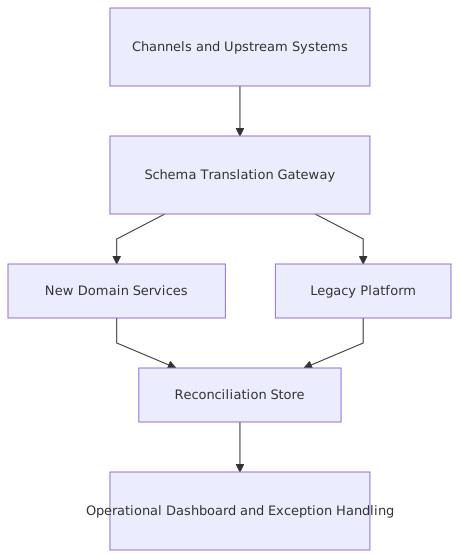
The gateway routes some interactions to the new stack, some to legacy, and may duplicate, compare, or translate data between both. This is where progressive strangler migration becomes real architecture rather than a slogan.
Core capabilities
Regardless of shape, serious translation gateways usually need:
- schema validation
- semantic mapping rules
- version handling
- contract test suites
- observability and trace correlation
- dead-letter and replay support
- reconciliation support for dual-run periods
- reference data lookup where unavoidable
- idempotency safeguards
The words “where unavoidable” matter. A gateway that depends on five master data systems and two side databases to map a message is no longer a boundary. It is a hostage.
Migration Strategy
Migration is where schema translation gateways shine, because migrations are stories of uneven change. One system moves, another doesn’t. One domain is redesigned, another is merely wrapped. The gateway buys time. Time is precious. Time is also dangerous.
The right migration strategy is progressive strangler, not big-bang replacement.
Step 1: Stabilize external contracts
Before you replace a core system, reduce the blast radius. Put a translation gateway in front of the unstable or legacy-facing interface. The immediate value is not elegance. It is containment.
Consumers stop speaking directly to the legacy schema. That means future migration work is concentrated behind the gateway, not scattered across fifty applications.
Step 2: Separate transport mapping from semantic mapping
Early in migration, teams often lump everything together: field renames, protocol conversion, business defaults, lookup logic, lifecycle changes. Resist this. Keep technical adaptation distinct from domain translation. It makes testing saner and exposes where actual business interpretation is happening.
Step 3: Introduce side-by-side processing
For critical flows, route production traffic to the legacy system while the new platform processes the same input in shadow mode. Compare outputs. Reconcile differences. Learn where assumptions diverge.
This is how grown-up migrations work. Not with confidence, but with comparison.
Step 4: Reconcile aggressively
Reconciliation deserves more respect than it gets. During coexistence, you will have mismatches:
- message accepted by one side, rejected by the other
- status calculated differently
- reference data stale in one system
- identifiers generated at different times
- partial updates arriving out of order
A translation gateway often becomes the best place to capture correlation IDs, mapping decisions, and normalized comparison records. Without that, migration teams end up reconciling from logs and screenshots. That way lies pain.
Step 5: Shift routing incrementally
As confidence grows, use the gateway to route subsets of traffic—by product, market, customer segment, transaction type—to the new platform. Keep rollback possible. The gateway can act as the policy point for cutover decisions.
Step 6: Retire translation deliberately
This is the step many programs forget. A gateway created for migration should have an end-state plan. Some translation remains permanently because bounded contexts differ. Temporary translation that exists only to preserve legacy quirks should be removed. Otherwise modernization leaves behind a fossil bed of compatibility logic.
Enterprise Example
Consider a multinational insurer replacing its policy administration platform while keeping claims, billing, partner portals, and downstream actuarial feeds running.
The old platform exposes policy updates as XML messages derived from an internal relational schema. It thinks in endorsements, policy terms, and risk units. The new policy services are designed around bounded contexts with cleaner APIs and Kafka events. The claims platform, however, still expects a flattened “insured object” structure with product-specific codes. Billing wants account-level payment schedules. Partner portals need near-real-time policy status.
If the insurer forces every downstream system to consume the new policy schema directly, the migration stalls. Claims teams object. Billing wants exceptions. Portals need compatibility. Every team becomes dependent on the pace of the new policy program.
So the architecture introduces schema translation gateways at two critical points:
- an API translation gateway for synchronous partner and channel access
- an event translation gateway from new policy domain events into downstream, context-specific integration topics
The policy service publishes clean events like PolicyActivated, CoverageAdjusted, and PolicyCancelled. The translation layer turns these into:
- claims-facing coverage snapshots
- billing schedule adjustment events
- portal status payloads
- regulatory feed records
This is not just shape conversion. It is semantic tailoring per bounded context.
During migration, the gateway also supports coexistence:
- some products remain on legacy policy admin
- some renewals are serviced in the new platform
- endorsement transactions for specific regions still route to legacy
- reconciliation compares policy state across both platforms nightly and for selected real-time flows
The result is not “simple.” Enterprise architecture is rarely simple. But it is governable. Teams can evolve the new policy model without forcing every consumer to swallow its vocabulary immediately. Claims remains protected from policy-internal refactoring. Billing receives a stable contract. The migration moves product by product.
That is the practical value.
Operational Considerations
Translation gateways are deceptively operationally heavy. Architects who treat them as mere middleware usually discover this the hard way.
Observability
Every translated interaction should carry:
- correlation ID
- source schema version
- target schema version
- mapping decision metadata where useful
- validation outcomes
- routing decision
- latency metrics
Without these, debugging cross-system issues becomes archaeology.
Contract testing
You need more than unit tests. Translation gateways deserve:
- consumer-driven contract tests
- schema compatibility checks
- golden message regression packs
- semantic assertions for critical mapping rules
Especially in Kafka ecosystems, schema registry compatibility is useful but insufficient. A field can remain technically compatible while meaning changes underneath it.
Replay and idempotency
When translation fails or downstream consumers are unavailable, replay matters. But replay can duplicate business effects if the gateway or target is not idempotent. Store enough state to recognize duplicates, or design commands and events to tolerate replay.
Reference data dependencies
Many mappings rely on codes, product definitions, or market-specific rules. If these are fetched dynamically during translation, latency and failure handling get ugly. Cache carefully. Version reference data. Make stale-data behavior explicit.
Performance
Translation adds CPU cost, serialization overhead, and sometimes network hops. In high-throughput Kafka pipelines, badly designed transformations can become bottlenecks. In synchronous APIs, they add latency directly felt by users.
This is one reason to keep gateways narrow. A gateway that tries to enrich every message from half the enterprise creates both semantic and performance debt.
Ownership model
Someone must own translation logic as a product. Not in theory. In backlog, support, and incident response. Shared ownership is often abandoned ownership.
My preference: the receiving bounded context owns the anti-corruption logic protecting itself, while a platform team may provide tooling and runtime standards.
Tradeoffs
Schema translation gateways are a useful compromise. Compromise is not the same as free.
Benefits
- decouples producer and consumer schema evolution
- protects bounded contexts from foreign models
- enables progressive strangler migrations
- localizes compatibility complexity
- supports coexistence across legacy and modern platforms
- makes mapping logic testable and observable
Costs
- introduces another runtime hop or processing stage
- can centralize too much complexity
- may duplicate logic across multiple translations
- can obscure end-to-end business flow
- risks becoming a permanent crutch
- requires strong governance and operational maturity
The biggest tradeoff is philosophical: translation preserves autonomy at the cost of more moving parts. That is often the right deal in a large enterprise. In a small system landscape, it may be needless machinery.
Failure Modes
This pattern has a few classic ways to go wrong.
The canonical model trap
A translation gateway starts narrow, then gets generalized into “the enterprise schema layer.” Soon every project must map through it. It becomes bloated, political, and slow to change. People say “standardized.” What they mean is “stuck.”
Semantic laundering
Teams rename fields and call it translation while ignoring deeper domain mismatch. A policyStatus mapped to activeFlag may technically compile while losing lifecycle nuance. Data arrives. Meaning does not.
Hidden business logic
Pricing exceptions, eligibility rules, and lifecycle decisions creep into the gateway because “it was convenient.” Now the integration layer contains business policy no domain team owns. Incidents become blame tennis.
Dual-write inconsistency during migration
The gateway sends translated updates to both legacy and new systems, one succeeds, the other fails, and reconciliation is weak. Now you have split truth. This is common, dangerous, and expensive.
Version sprawl
Supporting too many source and target contract versions inside one gateway creates combinatorial misery. If every consumer gets a special variant, the gateway stops being a boundary and starts being a museum.
Operational black box
Without strong tracing and dead-letter handling, failures vanish into middleware logs. The business sees missing orders or stale customer updates. IT sees green dashboards. This is how trust is lost.
When Not To Use
There is a tendency in enterprise architecture to turn every useful pattern into a universal answer. Resist that.
Do not use a schema translation gateway when:
The systems already share the same bounded context and model
If two services are really part of the same domain and evolve together, translation may be needless indirection. Use explicit versioning and disciplined contracts instead.
The mismatch is only superficial
If this is just JSON shape cleanup or protocol adaptation with no semantic difference, an API adapter or client SDK may be enough. Not every field rename deserves architectural ceremony.
Latency is critical and translation is avoidable
For ultra-low-latency flows, additional hops and transformation overhead may be unacceptable. Simplify contracts or colocate adaptation with the caller if semantics are trivial.
You are masking bad domain design
If teams cannot agree what a customer, order, or policy actually is, a gateway will not save you. It will merely preserve confusion in executable form.
The gateway becomes a central dependency for everything
If all traffic must pass through one team’s translation backlog, you have built an organizational bottleneck disguised as architecture.
Related Patterns
Schema translation gateways sit near several adjacent patterns. They are not the same.
Anti-Corruption Layer
This is the closest conceptual match from DDD. A schema translation gateway is often an operationalized anti-corruption layer focused on schemas, contracts, and message exchange.
API Gateway
An API gateway handles routing, auth, throttling, and edge concerns. It may perform lightweight transformation, but it should not automatically become a semantic translation boundary. That is a different responsibility.
Backend for Frontend
A BFF shapes responses for a specific UI. Sometimes it translates schemas, but its audience is a frontend experience, not usually a bounded context migration problem.
Canonical Data Model
Useful in limited, stable domains. Dangerous as an enterprise default. Translation gateways are usually safer when they map directly between context-specific models rather than through a grand universal schema.
Event Carried State Transfer
Common with Kafka and event-driven architecture. Translation gateways may produce context-specific state transfer events derived from domain events for downstream consumers.
Strangler Fig Pattern
A migration approach, not an integration mechanism. Translation gateways are often one of the key tools that make strangler migration possible.
Summary
Schema translation gateways matter because enterprises are not tidy. They are living systems with conflicting models, uneven modernization, and a great deal of historical baggage. Pretending otherwise is how integration architectures become fragile. integration architecture guide
Used well, a schema translation gateway is an explicit semantic boundary. It protects bounded contexts, localizes compatibility logic, supports Kafka and microservice ecosystems, and gives strangler migrations a practical path through coexistence. It also creates room for reconciliation, which is the unglamorous backbone of serious transformation programs.
Used badly, it becomes a universal canonical hub, a hiding place for business logic, or a museum of every contract version the company ever regretted.
The discipline is simple to say and hard to sustain:
- translate at bounded context boundaries
- preserve domain semantics, not just field names
- keep ownership close to the domain being protected
- support migration with reconciliation and observability
- remove temporary compatibility logic when its job is done
The best integration architecture is not the one with the fewest mappings. It is the one where meaning survives the journey.
Frequently Asked Questions
What is enterprise architecture?
Enterprise architecture aligns strategy, business processes, applications, and technology in a coherent model. It enables impact analysis, portfolio rationalisation, governance, and transformation planning across the organisation.
How does ArchiMate support architecture practice?
ArchiMate provides a standard language connecting strategy, business operations, applications, and technology. It enables traceability from strategic goals through capabilities and services to infrastructure — making architecture decisions explicit and reviewable.
What tools support enterprise architecture modeling?
The main tools are Sparx Enterprise Architect (ArchiMate, UML, BPMN, SysML), Archi (free, ArchiMate-only), and BiZZdesign. Sparx EA is the most feature-rich, supporting concurrent repositories, automation, scripting, and Jira integration.