⏱ 24 min read
Modeling Technology Architecture with ArchiMate: Best Practices and Examples
Learn how to model technology architecture with ArchiMate using practical techniques, core concepts, and best practices for infrastructure, platforms, networks, and dependencies. ArchiMate tutorial for enterprise architects
Modeling Technology Architecture with ArchiMate, ArchiMate technology architecture, ArchiMate modeling, enterprise architecture, technology layer ArchiMate, infrastructure modeling, application and technology architecture, ArchiMate best practices, architecture diagrams, TOGAF ArchiMate ArchiMate layers explained
Introduction
Technology architecture describes the infrastructure, platforms, and technical services that allow business and application capabilities to operate securely, reliably, and at scale. In ArchiMate, the technology layer provides a disciplined way to model that operational foundation: compute environments, networks, storage, middleware, system software, and the technology services exposed upward to applications and business services. If business architecture explains what the enterprise does, and application architecture explains how software supports it, technology architecture explains where systems run, how they connect, and which technical dependencies shape resilience, security, performance, and cost. ArchiMate relationship types
That matters because most enterprise environments are anything but simple. They span on-premises infrastructure, private and public cloud, managed platforms, containers, integration services, and user devices. The resulting documentation is usually fragmented: infrastructure diagrams, vendor schematics, operations runbooks, service catalogs, and security standards. Each artifact may be useful on its own, but together they rarely form a coherent architectural picture. ArchiMate helps close that gap by linking physical and virtual infrastructure to application behavior and, ultimately, to business outcomes through a consistent metamodel. ArchiMate modeling best practices
The purpose of modeling technology architecture is not to catalog servers or network components for their own sake. Its value lies in making technical choices visible and open to analysis. A model can show which applications depend on a shared database platform, which customer-facing services rely on a single cloud region, or where identity, monitoring, and backup services act as critical cross-cutting capabilities. Those views support impact analysis, risk assessment, standardization, and roadmap planning. A move from virtual machines to container platforms, for example, is not just a deployment change; it also shifts operational responsibility, security controls, and platform dependency.
One of the most useful distinctions in ArchiMate is between technology services and the nodes or devices that realize them. Most stakeholders care far less about individual hosts than about the availability of storage, messaging, authentication, runtime hosting, or network connectivity. By modeling services explicitly, architects can abstract away unnecessary detail while still tracing each service back to concrete implementation elements when needed. That makes the model useful for strategic planning, solution governance, and operational risk discussions alike.
A simple example illustrates the point. A retail enterprise may run its e-commerce platform on a Kubernetes cluster in one cloud provider, while payment settlement remains on a virtual machine estate in a private data center. An infrastructure diagram would show two separate technical worlds. An ArchiMate model, by contrast, can show both as part of the same technology landscape, with shared identity services, network connectivity, and monitoring dependencies across them.
Effective technology architecture models are selective. They focus on the level of detail needed to answer enterprise questions about scalability, resilience, compliance, interoperability, and change. The goal is not to reproduce an operations diagram. It is to create a decision-support view of the technical foundation and its relationship to the rest of the enterprise architecture.
1. Positioning Technology Architecture in the Enterprise Architecture Landscape
Technology architecture has a distinct role within enterprise architecture because it turns strategic and solution intent into an operationally viable technical foundation. It is more than a detailed engineering view, but it is not a purely conceptual abstraction either. It sits between application design and the infrastructure, platforms, and operational services required to run, secure, integrate, and manage applications.
Across the wider enterprise architecture landscape, business architecture defines capabilities, value streams, products, and organizational responsibilities. Application architecture structures the software behavior and information processing that support those concerns. Technology architecture provides the execution context for both. It answers questions such as:
- Which hosting patterns are available?
- Which runtime and data platform standards apply?
- How are environments segmented?
- How is integration performed?
- Which technical constraints influence security, resilience, and cost?
In that sense, technology architecture does not simply support applications after they are designed. In many cases, it shapes what is feasible, economical, and governable from the outset.
A useful way to understand this layer is to see it as the enterprise’s platform architecture. Most organizations no longer build every solution from the ground up. They assemble solutions from shared capabilities such as cloud landing zones, identity services, observability tooling, database platforms, container runtimes, API gateways, and endpoint management. Technology architecture formalizes these as enterprise assets rather than project-specific choices. In ArchiMate, that is particularly valuable because it allows multiple applications to be shown as consumers of common technology services, making platform reuse and standardization visible.
This position also makes technology architecture central to non-functional requirements. Performance, availability, recoverability, security, and operational support are rarely delivered by an application team alone. They emerge from deployment topologies, resilience patterns, network segmentation, identity controls, and shared operational services. Modeling those structures explicitly helps architects connect quality attributes to architectural choices. A decision to centralize identity, deploy across regions, or separate workloads into network zones is not just an implementation preference. It is an enterprise architecture decision with implications for cost, risk, and compliance.
Consider a bank exposing customer APIs to mobile applications. The application design may be sound, but if internet-facing traffic bypasses the shared API gateway and uses project-specific authentication, the resulting solution weakens policy enforcement and complicates auditability. Technology architecture is the layer that makes that issue visible before it becomes an operational problem.
This becomes even clearer in transformation programs. In a modernization initiative, application teams may focus on APIs, service boundaries, and user-facing functionality. Yet enterprise success often depends just as much on technology architecture choices: connectivity models, secrets management, runtime standards, data residency controls, and operational ownership. ArchiMate brings those concerns into the same conversation as business goals and application change, narrowing the gap between target-state design and actual deployability.
Technology architecture also sits between enterprise architecture and operational domains such as infrastructure engineering, cloud platform teams, cybersecurity, and IT operations. Those teams maintain detailed, tool-specific views, while enterprise architecture needs abstractions suited to planning and governance. ArchiMate provides a common notation that links those perspectives without forcing them into the same level of detail.
Positioned well, technology architecture is not a back-office appendix to business and application views. It is the structural layer that turns digital ambition into dependable execution.
2. Core ArchiMate Concepts for Modeling Technology Architecture
To model technology architecture effectively, architects need a clear grasp of the main ArchiMate concepts in the technology layer and the role each one plays in architectural reasoning. The aim is not to inventory assets mechanically, but to represent the technical structure that matters for enterprise decisions.
2.1 Structural Elements
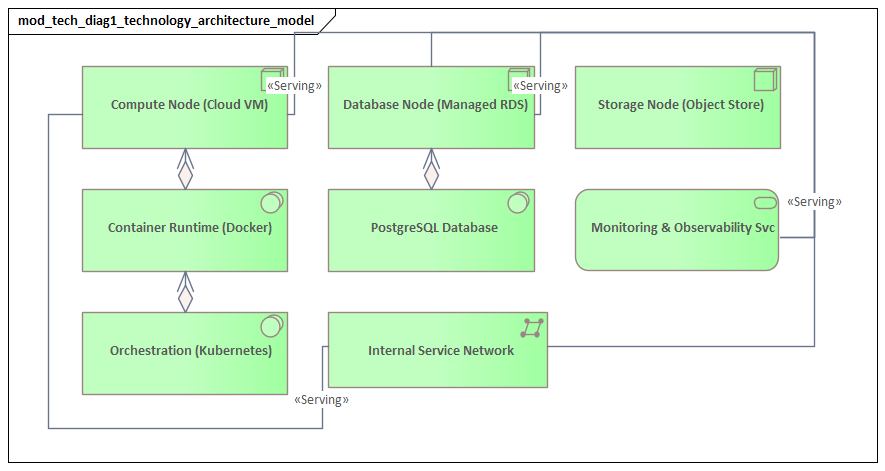
The most important structural concept is the node. A node represents a computational or physical resource on which artifacts are deployed or technology behavior is executed. Depending on the level of abstraction, a node might represent a virtual machine, a Kubernetes cluster, a cloud runtime environment, an application server, or an edge gateway. In enterprise models, nodes are most useful when they represent meaningful platform building blocks rather than every individual host.
The device represents physical equipment such as servers, storage hardware, laptops, or network appliances. In cloud-centric models, devices often recede into the background because virtualization hides the underlying hardware. They remain relevant, however, when physical characteristics matter architecturally, as in manufacturing, branch environments, edge computing, or regulated hosting scenarios. A practical rule is to model devices only when their physical nature affects resilience, ownership, location, or compliance.
The system software element captures software that provides the operational environment for applications or data services. Typical examples include operating systems, database management systems, container runtimes, middleware, web servers, or integration brokers. This concept becomes particularly valuable when technology stack standardization is part of the architectural decision. It allows the model to distinguish between an application merely deployed on infrastructure and an application dependent on a specific runtime or managed platform component.
2.2 Behavioral Elements
Behavior in the technology layer is expressed primarily through technology services, supported where necessary by technology functions and technology processes.
A technology service represents what the infrastructure provides to consumers. Examples include container hosting, managed messaging, object storage, authentication, secure connectivity, or monitoring. This is often the most important abstraction in technology architecture because stakeholders depend on services more than on infrastructure internals. Technology services make shared capability visible and provide a stable way to relate infrastructure to applications and business outcomes.
Technology functions and technology processes are useful when architects need to describe internal operational behavior, such as traffic routing, backup execution, or job scheduling. They are best used sparingly. Overusing them can turn an architecture model into an operations manual, which reduces clarity and weakens its governance value.
2.3 Connectivity and Deployment Concepts
For connectivity, ArchiMate offers communication networks and paths. These concepts represent how nodes interact through network structures such as WAN links, cloud virtual networks, segmented subnets, partner connections, or secure channels. They matter when topology affects latency, security boundaries, disaster recovery, or integration reliability.
Deployment is represented through artifacts, which are physical pieces of information such as executables, container images, configuration bundles, or database schemas. Artifacts are deployed onto nodes and realize application or technology behavior. This is one of the mechanisms that lets ArchiMate bridge design and implementation: the model can show not only that an application component exists, but also how it is packaged and where it runs.
2.4 Modeling Discipline
The key discipline is to model these concepts at the level where decisions are actually made. If the question is platform standardization, emphasize shared nodes, system software, and technology services. If the concern is resilience, emphasize deployment across nodes, regions, and communication networks. If the concern is compliance, include devices, locations, and physical constraints only where they change the architectural outcome.
For example, a hospital may not need to model every hypervisor host in its private cloud. It may, however, need to model the fact that imaging systems run on a regulated on-premises platform while patient scheduling runs on a public cloud platform connected through a secured network path. That distinction has architectural significance; the host inventory does not.
This principle of selective abstraction runs through the rest of the article. The following sections build on these concepts to show how infrastructure, platforms, deployment, and cross-layer relationships can be modeled coherently.
3. Mapping Infrastructure, Platforms, and Network Services
A useful technology architecture model organizes technical elements into three related concerns: infrastructure, platform capability, and network service. That helps prevent the model from becoming either too vague or too operationally detailed.
3.1 Modeling Infrastructure as Governed Building Blocks
Infrastructure is the foundational execution and storage environment in which workloads operate. In many enterprises, it should not be modeled as a list of individual servers. Instead, it is better represented as governed architectural constructs such as cloud subscriptions, virtual machine pools, Kubernetes clusters, managed database environments, storage platforms, or edge nodes.
In ArchiMate, these are typically represented as nodes and related structural elements. The architectural value comes from showing stable building blocks that can be reused, standardized, and governed across the portfolio. What matters is not that twenty-seven servers exist, but that the enterprise relies on a particular hosting pattern or platform capability.
3.2 Modeling Platforms as Technology Services
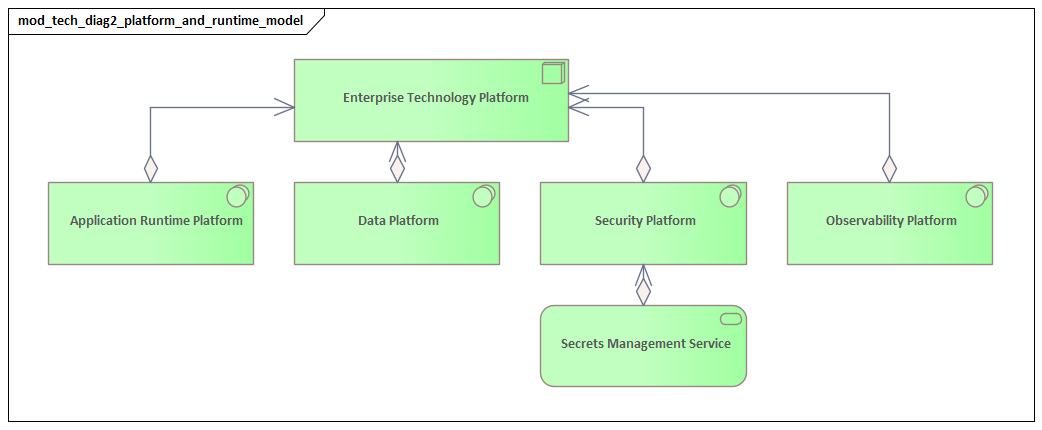
Above infrastructure sits the platform layer. A platform is rarely just a technical component; more often, it is a reusable capability realized by a combination of nodes, system software, and operational controls. A container platform, for example, is not only a cluster. It may also include orchestration, ingress, monitoring hooks, deployment policy, and scaling mechanisms. A data platform may combine storage engines, access services, security controls, and backup capabilities.
For that reason, platforms are often best modeled as technology services realized by underlying structural elements. Application teams typically consume outcomes such as “container hosting,” “managed database,” or “event streaming,” not raw infrastructure internals. Modeling platforms this way makes shared enterprise capability visible and easier to govern.
A realistic example is Kafka. Rather than modeling only broker clusters, the enterprise can model an event streaming service consumed by order, billing, and notification applications, with Kafka nodes and supporting system software realizing that service. That representation is far more useful for impact analysis than a broker topology diagram alone.
This abstraction becomes even more useful in hybrid and multi-cloud environments. Different implementations may realize similar technology services. An enterprise may run one integration platform on-premises and another in the cloud, yet expose both as forms of messaging or API mediation service. ArchiMate allows multiple nodes and system software elements to realize equivalent or related services, helping architects compare options, identify redundancy, and define target-state convergence.
3.3 Modeling Network Services Explicitly
Network services deserve explicit treatment because connectivity often determines security posture, resilience, and performance. Rather than drawing unlabeled lines between systems, ArchiMate allows communication networks and paths to be modeled as architectural structures in their own right. That makes it possible to represent network zones, inter-region links, secure partner channels, remote access patterns, or transit layers as governed assets.
Those structures can in turn realize or support technology services such as load balancing, DNS, firewalling, service mesh routing, or private connectivity. Once modeled this way, the architecture shows not only that systems communicate, but also under what protections, constraints, and dependencies they do so.
3.4 Clarifying Platform Boundaries
One of the most important modeling choices is deciding where to draw the boundary between platform responsibility and application responsibility. If observability, secrets management, identity federation, certificate handling, or ingress are centrally provided, they should be represented as technology services rather than hidden inside each application deployment. This makes cross-cutting dependencies visible and supports more realistic impact analysis.
For example, if many applications depend on a shared identity platform, the model should show a common authentication service consumed across the portfolio. That makes IAM modernization visible as a platform change rather than a series of isolated application upgrades.
3.5 Building Views Around Questions
Technology views are most useful when they are organized around recurring architectural questions rather than asset categories alone. Examples include:
- A resilience view emphasizing regions, clusters, failover services, and critical network paths
- A platform standardization view comparing approved runtimes and the applications deployed onto them
- A security zoning view highlighting communication networks, trust boundaries, and shared control services
This reinforces a central principle: technology architecture models should reveal the enterprise operating model embedded in the technical landscape, not simply sketch the environment.
4. Modeling Deployment, Environments, and Technology Relationships
Once infrastructure and platform services are defined, the next step is to model how software is deployed into those structures and how technical dependencies form around it. This is where application structure, platform capability, and infrastructure choice come together.
4.1 Deployment as an Architectural Concern
Deployment should be treated as an architectural concern, not merely an operational detail. A deployment model reveals how software is packaged, where it is placed, what it depends on, and which structural choices affect reliability, security, and changeability.
A typical deployment view starts with the relationship between application artifacts and the nodes or system software on which they are deployed. An API, for example, may be packaged as a container image, deployed onto a container platform, connected to a managed database service, and exposed through an API gateway. The objective is not to reproduce every CI/CD step, but to make visible the deployment choices that matter for governance and operations.
4.2 Modeling Environments
Enterprises rarely operate in a single runtime context. They maintain development, test, staging, production, disaster recovery, and sometimes region-specific or regulatory environments. In ArchiMate, these may be represented as distinct nodes, groupings, locations, or target states depending on the purpose of the view.
The important point is that environments are not just lifecycle labels. They often embody different controls, data policies, integration permissions, and support models. A production environment may require hardened segmentation, centralized monitoring, restricted deployment rights, and audited access. A development environment may prioritize speed and flexibility. Modeling these distinctions helps explain why a solution cannot simply be moved from one environment to another without broader architectural implications.
A practical example is a government agency that allows synthetic data in development but requires citizen data to remain in a segregated production environment hosted in-country. In that case, “development” and “production” are not only stages in a pipeline; they are materially different architectural contexts.
4.3 Making Technology Relationships Explicit
Application deployments usually depend on more than a runtime host. They often rely on identity services, secret stores, event brokers, observability tooling, backup services, and external network paths. If those relationships remain implicit, architecture assessments tend to underestimate coupling and operational risk.
ArchiMate provides several relationship types to express these dependencies clearly:
- Serving to show one element providing functionality to another
- Access to show use of data or information objects
- Flow to show transfer or interaction
- Deployment to show placement of artifacts on nodes
These relationships help architects show that a workload sits within a wider technical ecosystem of shared services and governed connections.
4.4 Distinguishing Functional Independence from Operational Dependence
One particularly valuable use of deployment modeling is to expose the difference between logical independence and operational dependence. An application may be well-bounded at the application layer, yet still rely on a shared ingress service, centralized identity provider, common logging pipeline, or enterprise integration broker. If those dependencies are not modeled, resilience and ownership decisions can become misleading.
A customer-notification service, for instance, may appear independent because it has its own codebase and release cycle. In production, however, it may still depend on the shared API gateway, enterprise SMTP relay, centralized secrets vault, and common monitoring stack. From an operational standpoint, that is not true independence, and the model should make that plain.
4.5 Using Deployment Views for Decision-Making
Deployment models are most effective when they answer specific questions:
- If the concern is release risk, show how artifacts move across controlled environments and where shared runtime dependencies exist.
- If the concern is resilience, show which deployments are duplicated across zones or regions and which services remain single points of failure.
- If the concern is compliance, emphasize where regulated data is processed, which environments are in scope, and how segregation or location constraints are enforced.
A deployment view should highlight architectural consequences, not become a post hoc operations diagram.
5. Integrating Technology Architecture with Application and Business Layers
The full value of technology modeling appears when the technology layer is connected to the application and business layers. Without those links, technology architecture remains informative but incomplete. With them, it becomes a basis for end-to-end reasoning about change, risk, and investment.
5.1 Connecting Application Services to Technology Services
Applications do not simply “run on infrastructure.” They consume technology services such as runtime hosting, storage, authentication, connectivity, messaging, and monitoring. In ArchiMate, showing application elements as consumers of technology services creates a more meaningful architectural picture than simply placing them on a cloud or server node.
For example, instead of saying an application runs in the cloud, the model can show that it depends on managed container hosting, encrypted storage, centralized authentication, and API mediation. That creates traceability useful for governance, impact analysis, and platform planning.
5.2 Connecting Application Behavior to Business Outcomes
The next step is to connect application services upward to business processes, capabilities, or products. This is where technology architecture becomes strategically visible. A customer onboarding capability may depend on an application service for identity verification, which in turn depends on secure API exposure, event processing, and resilient storage. Once those relationships are visible, technology change can be assessed in business terms.
Retiring a messaging platform, for example, is no longer just a technical upgrade. It may affect customer-facing operations, reporting obligations, or service continuity. Cross-layer modeling helps architects evaluate change in terms of consequence, not only implementation effort.
5.3 Tracing Non-Functional Requirements Across Layers
Business stakeholders usually express needs in terms of reliability, responsiveness, confidentiality, or continuity. Technical teams express them as redundancy, latency, encryption, failover, and segmentation. ArchiMate helps connect those perspectives. A business requirement for uninterrupted order processing can be traced through application services to the deployment patterns, network structures, and technology services that support high availability and disaster recovery.
This kind of traceability does more than improve documentation. It strengthens decision-making by showing which technical mechanisms are essential to business commitments and where investment is needed to sustain them.
5.4 Clarifying Shared Responsibility
Cross-layer modeling also clarifies shared responsibility. In many enterprises, business owners assume that once an application exists, the capability is fully supported. In reality, operational dependencies may be spread across platform teams, security teams, network teams, and service providers. By linking business services and application behavior to enabling technology services, ArchiMate makes those dependencies visible.
This is especially important in cloud and platform-based operating models, where accountability is distributed. A model can show, for example, that a business-critical customer service depends not only on an application team, but also on enterprise identity, observability, integration, and network control services managed elsewhere.
5.5 Supporting Stakeholder Decisions
Integrated views are often where the most valuable stakeholder conversations happen. Executives may not need every node or artifact, but they do need to understand:
- Which business capabilities depend on aging platforms
- Which high-value products rely on a single technology provider
- Which transformation initiatives require foundational platform investment before application delivery can scale
By linking the layers, technology architecture becomes part of enterprise decision-making rather than a technical side document.
6. Practical Guidance, Governance, and Common Pitfalls
Technology architecture modeling becomes useful only when it is governed as an architectural practice rather than treated as occasional diagramming. Good models do not stay useful by accident; they remain useful because scope, conventions, and ownership are managed deliberately.
6.1 Establish Modeling Conventions
One of the first governance tasks is to define technology modeling conventions. Architects should agree on:
- What qualifies as a node
- When system software should be modeled separately
- How technology services are named
- Which deployment relationships are architecturally significant
- How environments and network structures are represented
Without these conventions, different teams may model the same platform in incompatible ways. One team may represent a managed database as a node, another as system software, and a third as a vendor product. The result is inconsistency and reduced analytical value. A lightweight metamodel profile, naming standards, and reference examples for common patterns can prevent that.
6.2 Control Scope Deliberately
Technology models often fail by drifting to one of two extremes. They become so abstract that they say little more than “applications run on infrastructure,” or so detailed that they replicate a CMDB, topology map, or engineering blueprint.
A practical test is whether a modeled element helps answer a recurring architectural question such as:
- Is this platform strategic?
- Does this dependency create concentration risk?
- Does this structure affect resilience or compliance?
- Does this technology constrain modernization?
- Does this service represent a reusable enterprise capability?
If not, it may belong in an operational repository rather than in the architecture model.
6.3 Assign Ownership and Maintenance
Technology architecture changes frequently, especially in cloud-centric environments, and stale models quickly lose credibility. The answer is not to model everything continuously, but to assign accountability for the architectural representation of shared platforms and major deployment patterns.
Platform teams, infrastructure architects, security architects, and enterprise architects should each own parts of the model, with updates tied to governance events such as:
- Solution design reviews
- Technology standard changes
- Platform roadmap updates
- Transformation milestones
- Major risk or compliance assessments
This keeps the model alive through governance processes rather than ad hoc documentation exercises.
6.4 Avoid Common Pitfalls
Several pitfalls recur in ArchiMate technology modeling:
Vendor-driven modeling
Diagrams sometimes mirror cloud provider product catalogs instead of enterprise concerns. Vendor specificity may be necessary, but the primary focus should remain enterprise capabilities, dependencies, and constraints.
Confusing environments with lifecycle labels
Environments often imply different controls, integrations, and risk profiles. Treating them as simple labels hides important architectural distinctions.
Hiding shared dependencies in application views
Failing to model shared platform services creates a false impression of autonomy and weakens impact analysis.
Modeling too much operational detail
Architecture models lose value when they become substitutes for engineering schematics or configuration repositories.
6.5 Use Models in Decisions
The strongest technology models are used in real decisions, not simply stored in repositories. They should support questions such as:
- Which platforms are strategic?
- Where is technical debt concentrated?
- Which dependencies create operational or vendor risk?
- Which migrations require foundational platform changes before applications can move?
- Which business-critical services depend on fragile technology structures?
For example, a technology lifecycle view may show that several revenue-critical applications still depend on an out-of-support integration broker. That gives the architecture board a concrete basis to prioritize replacement funding and set a retirement deadline. Governance, in this context, is not administrative overhead. It is what keeps technology modeling selective, comparable, and actionable.
Conclusion
Modeling technology architecture with ArchiMate is most valuable when it helps the enterprise reason about choice, consequence, and change. The notation is not the goal. The goal is to create a shared architectural language for discussing platform direction, deployment patterns, operational dependencies, and infrastructure-related risk in a way that connects engineering detail to enterprise decision-making.
Effective modeling starts with a clear distinction between structural elements such as nodes, devices, and system software, and behavioral elements such as technology services. From there, architects can map infrastructure, platforms, and network services; model deployment and environment differences; and connect technology architecture to application services and business outcomes. The result is not merely a better infrastructure diagram, but a model of the enterprise’s technical foundation as a governed, reusable, and analyzable asset.
This becomes especially important in cloud, hybrid, and platform-based operating models. The most important architectural questions increasingly revolve around reuse, concentration risk, control points, and transformation readiness. Which shared services are foundational to many value streams? Which business capabilities depend on aging platforms? Which modernization efforts require platform investment before application change can succeed? ArchiMate provides a disciplined way to surface those questions and make them visible across layers.
A mature technology model supports both strategy and execution. It remains stable enough to guide planning, yet selective enough to avoid becoming an operational inventory. It gives engineers traceability, architects comparability, and decision-makers a clearer basis for investment and governance.
Ultimately, technology architecture modeling in ArchiMate is about making the enterprise’s technical foundation visible as part of enterprise design. Done well, it supports resilience, enables change, and turns platform architecture into an explicit instrument of business execution.
Frequently Asked Questions
What is enterprise architecture?
Enterprise architecture is a discipline that aligns an organisation's strategy, business operations, information systems, and technology infrastructure. It provides a structured framework for understanding how an enterprise works today, where it needs to go, and how to manage the transition.
How is ArchiMate used in enterprise architecture practice?
ArchiMate is used as the standard modeling language in enterprise architecture practice. It enables architects to create consistent, layered models covering business capabilities, application services, data flows, and technology infrastructure — all traceable from strategic goals to implementation.
What tools are used for enterprise architecture modeling?
Common enterprise architecture modeling tools include Sparx Enterprise Architect (Sparx EA), Archi, BiZZdesign Enterprise Studio, LeanIX, and Orbus iServer. Sparx EA is widely used for its ArchiMate, UML, BPMN and SysML support combined with powerful automation and scripting capabilities.