⏱ 19 min read
Let’s start with the uncomfortable truth: a lot of enterprise architects are underpaid, and a surprising number of others are overpaid for the wrong reasons.
That sounds harsh, but it’s true. In many companies, salary has less to do with architecture capability and more to do with title inflation, political visibility, or whether someone can survive three steering committees without falling asleep. Meanwhile, the architects actually untangling identity platforms, fixing cloud governance, or stopping Kafka from becoming a distributed mess are often not the highest-paid people in the room. ARB governance with Sparx EA
That’s the problem with most “enterprise architecture salary guides.” They treat the role like it’s a static job family with a nice neat pay band. It isn’t. Enterprise architecture is one of the most unevenly valued disciplines in IT. Two people can both be called “Enterprise Architect” and one is doing glorified PowerPoint governance while the other is shaping a bank’s cloud landing zones, IAM strategy, data event backbone, and regulatory architecture. Their salaries should not be close. Yet often they are. EA governance checklist
So this guide is opinionated on purpose. Because if you’re looking at enterprise architecture compensation, you need more than generic numbers. You need to understand what the market actually rewards, what companies say they value versus what they really pay for, and how salary maps to real architecture work.
What is an enterprise architect, really?
For SEO and sanity, let’s keep this simple first.
An enterprise architect is responsible for aligning business strategy, technology strategy, and execution across the organization. That usually means setting standards, designing target states, guiding major transformation programs, reducing technology sprawl, and making sure systems, platforms, data, and security fit together in a way that serves the business.
In plain English: the enterprise architect is supposed to stop the company from becoming an expensive, fragmented technology accident.
That sounds lofty. In practice, it often means things like:
- deciding whether a bank should modernize core integration using Kafka or keep piling APIs on top of batch jobs
- defining cloud governance so every product team doesn’t create its own version of AWS chaos
- setting IAM direction so identity isn’t spread across Active Directory, Azure AD, five customer identity tools, and a pile of custom auth logic
- evaluating whether a merger creates application overlap that should be rationalized or tolerated
- helping delivery teams make decisions that fit the enterprise, not just one project
That’s the role. Now the salary part.
Enterprise architect salary ranges: the practical view
Salary varies massively by geography, industry, and scope. But if we’re being practical, here’s a broad market view for salaried enterprise architecture roles in large enterprises in North America and Western Europe.
Typical enterprise architecture salary ranges
Typical enterprise architecture salary ranges
These are not universal. Finance, insurance, big tech-adjacent firms, and regulated industries tend to pay more. Public sector and traditional non-digital industries often pay less, sometimes significantly less, though there are exceptions.
And yes, contracting can exceed these numbers. A strong enterprise architect in banking, cloud transformation, or IAM can command very high day rates. But contracting income is not the same as salary, and people mix those up all the time.
The biggest salary truth nobody likes saying
Enterprise architecture does not pay well just because it is strategic.

It pays well when it is tied to risk, cost, regulation, or transformation at scale.
That’s the real market.
If your role is “strategic” but has no operational consequence, no budget influence, and no decision rights, the company will eventually treat you like overhead. Maybe well-dressed overhead, but overhead all the same.
On the other hand, if your architecture decisions affect:
- cloud spend in the tens of millions
- identity risk and regulatory exposure
- integration resilience in payment flows
- merger rationalization cost
- platform duplication across business units
- control effectiveness in regulated environments
then your role becomes economically visible. And visible economics drives compensation far more than abstract strategic language.
This is why enterprise architects in banking, telecom, healthcare, and large-scale cloud programs often do better than architects in slower-moving firms with weak architecture maturity. Not because they’re automatically smarter. Because the consequences are bigger.
What actually drives enterprise architect salary
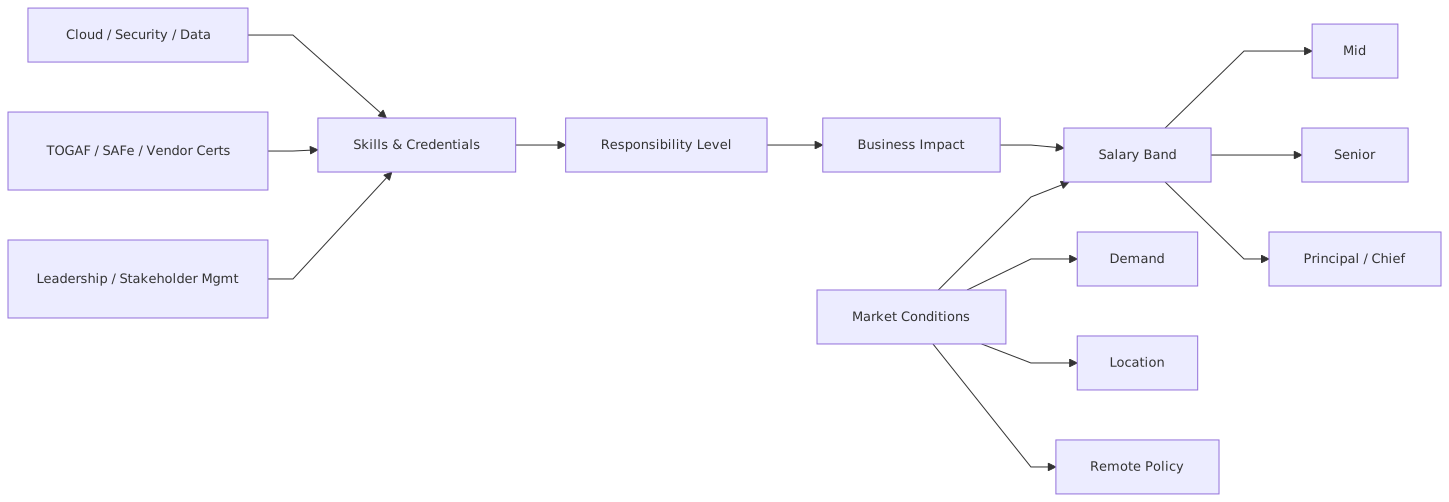
There are five things that really move salary. Not fifteen. Five.
1. Scope across domains
A true enterprise architect works across business capability, applications, data, integration, security, infrastructure, and operating model. If you only have deep knowledge in one area, you may still be highly valuable, but the salary ceiling is usually lower unless that area is especially critical, like IAM or cloud.
The market pays more when you can connect domains, not just represent one.
For example, in a bank, moving customer onboarding to cloud-native services is not just an application decision. It touches:
- IAM for customer identity and workforce access
- Kafka or event streaming for onboarding and fraud signals
- compliance controls
- cloud landing zone standards
- data lineage and audit
- resilience and regional failover
The architect who can hold that whole picture is worth more than the architect who only knows integration patterns.
2. Regulatory or risk-heavy context
This is where banking becomes a very good example.
In a retail bank, architecture mistakes are expensive in ways many industries never experience. A weak IAM model can create audit findings. A badly governed Kafka platform can become a security and data retention problem. A sloppy multi-cloud strategy can break control evidence and resilience expectations. Regulators do not care that your target architecture looked elegant in a slide deck.
Architects who can work inside regulated complexity without becoming bureaucratic are rare. Rare gets paid.
3. Transformation scale
There’s a huge difference between maintaining standards and leading transformation.
If you are guiding a three-year application rationalization program across 800 systems, or redesigning a cloud operating model across multiple countries, your salary should reflect that scale. If you are mostly reviewing solution designs and updating standards quarterly, maybe not.
This is where many architects overestimate their market value. They confuse influence with scale. Those are not the same thing.
4. Executive trust
Here’s the slightly annoying truth: compensation often rises when executives trust you to simplify hard trade-offs.
Not because you know more buzzwords. Because you can answer questions like:
- Should we centralize IAM now or phase it by business unit?
- Is Kafka the right backbone for event integration, or are teams forcing it where APIs and batch are better?
- Do we keep this workload on-prem because of latency and control, or move it to cloud for operating model reasons?
- What is the least painful migration path for legacy identity stores?
If you can reduce ambiguity for CIOs, CTOs, CISOs, and transformation leaders, you become expensive in a good way.
5. Ability to affect delivery, not just architecture artifacts
A lot of enterprise architects produce diagrams. Fewer produce outcomes.
Outcomes mean teams actually adopt the standards, roadmaps get funded, transition states are realistic, and major programs avoid predictable mistakes. If your architecture never leaves the repository, your salary growth will eventually flatten no matter how senior the title sounds. TOGAF roadmap template
The salary split by architecture flavor
Not all enterprise architecture roles are equal. The title is annoyingly broad. Here’s the blunt version of how the market tends to see subtypes.
That last row may irritate some people. Fine. But I’ve seen too many architecture teams become governance museums. They produce principles, taxonomies, and review boards that are internally impressive and commercially weak. Companies pay more for architects who make change happen. architecture decision record template
Real architecture work: how salary maps to actual problems
This is where salary guides usually become useless. They give numbers but ignore the work. So let’s connect compensation to reality.
Example 1: Banking and Kafka
A large bank decides to modernize customer event processing. Historically, customer updates moved through nightly batch jobs and point-to-point integrations. Product teams now want real-time events for onboarding, fraud detection, CRM updates, and mobile notifications.
Someone says, “Let’s use Kafka everywhere.”
Classic mistake.
A good enterprise architect does not just approve Kafka because it is modern. They ask:
- What events are enterprise-significant versus local domain events?
- Who owns schemas?
- What retention and replay requirements exist?
- How do IAM and access controls work for producers and consumers?
- What happens when teams create duplicate event streams?
- How are regulated data elements handled?
- Is the bank building an enterprise event platform or just another integration sprawl problem with a better logo?
That architect is doing work that affects platform cost, resilience, security, compliance, and delivery speed. This is salary-worthy work. Not because Kafka is fashionable, but because getting it wrong creates years of operational pain.
A weaker architect, frankly, will produce a target-state diagram with “event-driven architecture” in a blue box and call it strategy.
Those two people should not earn the same.
Example 2: IAM in a global enterprise
IAM is one of the clearest areas where enterprise architects can create visible value.
Imagine a multinational organization with:
- workforce identity in Active Directory and Entra ID
- customer identity split across regional platforms
- privileged access managed inconsistently
- cloud roles controlled differently in AWS and Azure
- application teams embedding authorization logic in custom code
- audit findings around joiner/mover/leaver processes
This is not just a security issue. It is an enterprise architecture issue because identity is a cross-cutting control plane.
A strong architect will frame IAM as an enterprise capability with business and technical consequences:
- reduced operational friction for onboarding
- cleaner access governance
- lower audit risk
- standardized federation patterns
- better cloud role design
- fewer duplicated identity services
- more realistic zero trust progression
This kind of architect often commands strong compensation because the work touches every platform and every control model. IAM is not sexy in conference-talk terms. In salary terms, it absolutely matters.
Example 3: Cloud architecture in the real world
Cloud is another area where title inflation gets exposed fast.
Lots of people say they are enterprise architects because they can talk about multi-cloud strategy. Fewer can actually define:
- landing zone guardrails
- account/subscription structure
- shared services boundaries
- network segmentation models
- IAM federation patterns
- FinOps governance
- workload placement principles
- resilience design for regulated workloads
- transition states from legacy hosting
The enterprise architect who can link cloud strategy to operating model, security controls, and portfolio decisions usually earns more than the architect who just promotes cloud adoption in general terms.
And that’s fair.
Common mistakes architects make about salary
Let’s get practical. Here are the mistakes I see again and again.
Mistake 1: Believing the title means the market value
It doesn’t.
“Enterprise Architect” can mean:
- strategic advisor to the CIO
- domain-spanning transformation lead
- standards owner
- architecture governance reviewer
- senior solution architect with a broader title
- ex-manager parked in architecture
The market eventually looks past the title and asks: what problems do you solve?
Mistake 2: Over-indexing on frameworks
TOGAF still appears in job descriptions. Fine. It can be useful as a common language. But no company pays a premium because you can recite ADM phases from memory. ArchiMate in TOGAF ADM
They pay when you can apply structure to messy enterprise decisions.
I’ll say it plainly: if your strongest salary argument is a framework certification, your position is weaker than you think.
Mistake 3: Avoiding technical depth
Some enterprise architects drift too far from technology and become strategy-only people. That can work at very senior levels, but for most architects it’s dangerous.
If you cannot meaningfully discuss Kafka event ownership, IAM federation, cloud control models, or integration transition patterns, your credibility drops with the people delivering change. And once delivery stops listening, your value erodes.
Enterprise architecture is not supposed to be detached from implementation reality. That’s one of the profession’s worst habits.
Mistake 4: Confusing governance with impact
Architecture review boards matter. Standards matter. Reference architectures matter.
But if those things don’t influence funding, delivery, or technology choices, they are paperwork with ambition.
Architects who spend years in low-impact governance sometimes wonder why their salary stalls. That’s usually why.
Mistake 5: Not quantifying value
This one is huge.
If you helped rationalize 120 applications after a merger, reduced duplicate IAM tooling, cut cloud platform variance, or prevented five business units from creating five separate Kafka clusters, say so in economic terms.
Executives and recruiters understand:
- cost avoided
- risk reduced
- control improved
- delivery accelerated
- duplication removed
They do not really understand “developed enterprise target architecture artifacts.”
Contrarian view: sometimes solution architects should be paid more
Yes, really.
There are situations where a top-tier solution architect leading a critical digital platform should earn more than a mid-tier enterprise architect. That’s not a failure of the profession. That’s rational.
Why? Because some enterprise architecture roles are broad but shallow in operational consequence. Meanwhile, a strong solution architect may be directly accountable for a payment platform, digital channel, or identity service that generates revenue or carries serious risk.
So if you are an enterprise architect, don’t assume the title should automatically outrank solution architecture compensation. It should depend on scope, leverage, and consequence.
This is also why the best enterprise architects usually have strong solution architecture history. They know what decisions cost in the real world.
A real enterprise example
Here’s a realistic composite example based on patterns I’ve seen in large financial services organizations.
A regional bank had grown through acquisition. It ended up with:
- three customer identity platforms
- two workforce directories
- multiple API gateways
- inconsistent Kafka adoption across business units
- hybrid hosting with on-prem, private cloud, AWS, and Azure
- duplicated customer notification services
- overlapping fraud data pipelines
- architecture governance that existed mostly as slideware
The bank hired a lead enterprise architect, not to “do architecture” in a vague sense, but to support a three-year simplification and modernization program.
What did the architect actually do?
- Created a capability-based view of the estate
Not just applications. Capabilities tied to business outcomes: customer onboarding, payments, fraud management, identity and access, communication, case management.
- Defined enterprise platform decisions
One strategic customer IAM direction. One event streaming operating model for Kafka. Clear API versus event versus batch guidance. Cloud hosting principles by workload type.
- Built transition states, not fantasy end states
This matters. The architect didn’t pretend the bank could replace everything in 18 months. Instead, they defined interim patterns so acquired platforms could coexist while consolidation happened safely.
- Attached architecture to funding decisions
Programs that aligned to target platforms got faster approval. Duplicative builds had to justify themselves. Suddenly architecture had teeth.
- Worked with security and operations, not around them
IAM, privileged access, cloud guardrails, resilience, and audit evidence were built into the roadmap, not bolted on later.
The result after two years was not perfection. It never is. But the bank reduced platform duplication, improved audit posture, cut some cloud waste, and stopped random Kafka deployments from turning into unmanaged event silos.
That architect was paid very well. As they should have been. Because they were not paid for having an architecture title. They were paid for reducing enterprise entropy in a high-risk environment.
What skills increase enterprise architect salary fastest?
If you want to move up in compensation, these are the skills that tend to matter most right now.
High-value salary accelerators
Notice what is not on that list: generic framework knowledge, abstract principles, and long architecture documents. Useful, yes. Premium salary drivers, not usually.
Industry differences matter more than people admit
If you compare salaries without industry context, you’ll get bad conclusions.
Banking and financial services
Usually strong compensation. Why? Regulation, scale, resilience requirements, identity complexity, integration sprawl, audit pressure, and large transformation programs. Architects who can navigate these constraints are valuable.
Insurance
Often good compensation, especially where legacy modernization and data complexity are significant. Slower than banking sometimes, but still architecture-heavy.
Retail and consumer
Can pay well when digital platforms are central to revenue. But some retail environments treat architecture as support rather than leverage.
Manufacturing
Mixed. Strong opportunities in ERP transformation, OT/IT convergence, and cloud/data modernization. But some firms still underinvest in architecture leadership.
Public sector
Important work, often complex work, but salary ceilings can be lower. Contracting may offset this.
Remote work and salary
Remote work widened the market, but not evenly.
Top firms still pay premiums for architects who can influence large-scale transformation, even remotely. But remote work also increased competition for architecture roles that are governance-heavy and less tied to local business context.
In my view, enterprise architecture remains partly relationship-driven. You can absolutely do it remotely, but the architects who build trust with executives, security leaders, operations teams, and delivery heads still tend to outperform. Salary follows influence.
How to judge whether your salary is fair
Ask yourself these questions:
- Do I influence funding or just standards?
- Am I responsible for transition decisions across multiple domains?
- Do executives ask me to simplify major trade-offs?
- Have I delivered measurable cost, risk, or simplification outcomes?
- Am I credible with engineering, security, and operations teams?
- Does my role affect enterprise platforms like IAM, cloud, integration, or data?
If the answer is yes to most of those, and your pay is sitting near the lower end of market ranges, you may be underpaid.
If the answer is no, but you still have a senior title, be careful. The market may be valuing you more generously than your role would command elsewhere.
Negotiation advice for enterprise architects
A few direct points.
First, negotiate on business consequence, not title prestige.
Say:
- “I’m shaping cloud governance across four business units.”
- “I’m leading IAM consolidation tied to audit remediation.”
- “I’m reducing integration duplication by standardizing API and Kafka patterns.”
- “I’m defining transition architecture for a merger rationalization program.”
Do not say:
- “I have ten years of architecture experience and TOGAF.”
Second, be specific about scope. Enterprise-wide is often overstated. If your actual scope is one function, say that. If it really is enterprise-wide, make the scale visible.
Third, understand total compensation. Bonus, pension, stock, retention incentives, and flexibility all matter, especially at senior levels.
Fourth, if you want premium compensation, choose premium problems. Banking modernization, identity transformation, cloud operating model redesign, and post-merger simplification are all areas where strong architects can earn more.
Final thought
Enterprise architecture salary is not really about architecture. It’s about whether you can reduce complexity that the business can feel.
That’s the line.
If you can help a bank modernize event flows without turning Kafka into governance theater, simplify IAM without breaking controls, move to cloud without creating financial and security chaos, and guide executives through real trade-offs, you are valuable. Very valuable.
If you mostly produce static target states and attend review boards, the market will eventually price you accordingly.
That may sound blunt. Good. The profession needs more bluntness.
Enterprise architecture is at its best when it is practical, commercially aware, technically credible, and brave enough to say no to fashionable nonsense. The salaries follow that version of the role. Not the ceremonial one.
FAQ
1. What is the average enterprise architect salary?
In the US, a typical enterprise architect salary often lands around $160,000 to $220,000 base, with total compensation higher depending on bonus and equity. In the UK, a common range is roughly £105,000 to £145,000 base. But “average” hides too much. Industry, scope, and actual influence matter more than the title.
2. Do enterprise architects earn more than solution architects?
Sometimes, but not always. A high-impact solution architect on a critical payments, IAM, or digital platform can absolutely out-earn a lower-impact enterprise architect. The deciding factor is business consequence, not title hierarchy.
3. Which industries pay enterprise architects the most?
Banking, financial services, insurance, and large regulated enterprises often pay the most. That’s because architecture decisions in those environments affect risk, compliance, resilience, and large transformation budgets.
4. What skills increase enterprise architect salary the fastest?
Cloud operating model design, IAM, security architecture, integration/event architecture, portfolio rationalization, and executive communication are among the strongest salary accelerators. The common thread is simple: these skills influence expensive decisions.
5. Is TOGAF enough to get a high-paying enterprise architect role?
No. It may help with credibility or hiring filters, but it is not enough. High-paying roles usually go to architects who can connect strategy to delivery, handle cross-domain complexity, and solve real enterprise problems in areas like cloud, IAM, and integration.
Frequently Asked Questions
What does an enterprise architect do?
An enterprise architect designs and governs an organisation's technology landscape to align with business strategy. Responsibilities include capability mapping, application portfolio management, architecture governance, technology roadmapping, and ensuring that delivery programs build toward a coherent target architecture rather than accumulating technical debt.
What is the average enterprise architect salary?
Enterprise architect salaries vary significantly by region, sector, and seniority. In Western Europe (UK, Belgium, Netherlands, Germany), senior enterprise architects typically earn €90,000–€150,000. In the US, salaries range from $130,000–$200,000+. Financial services, healthcare, and government are typically the highest-paying sectors.
What certifications are most valuable for enterprise architects?
The most recognised certifications are TOGAF (The Open Group Architecture Framework), ArchiMate (Foundation and Practitioner), and AWS/Azure/GCP cloud architecture certifications. For Sparx EA specialists, formal Sparx EA training and MDG development skills add significant market value.