⏱ 8 min read
Recommended Reading
Assumptions / unspecified constraints: No single regulator/industry is presumed; the strategy focuses on common regulatory expectations: accountability, traceability, evidence retention, and auditable change control.
Executive summary
Traceability in regulated environments is not “more links.” It is a disciplined system that produces defensible evidence: what was required, what was designed, what changed, who approved it, and how implementation evidence maps back to requirements and controls. Sparx EA provides governance primitives that directly support this: auditing records changes (who changed what and when) across packages, elements, connectors, and diagrams; baselines snapshot packages so you can compare current state to an approved snapshot and revert if necessary; and model reviews provide structured collaborative assessment of model content. Sparx EA training
Regulators and security frameworks consistently emphasize record-keeping and accountability. For privacy, GDPR Article 30 requires records of processing activities containing defined information categories; for security controls, NIST SP 800-53 provides a catalogue of controls including audit and accountability; and in the EU financial sector, DORA establishes rules on digital operational resilience that amplify the importance of governing ICT risk and evidence. enterprise architecture guide
A practical EA traceability strategy therefore uses a small set of mandatory relationships, consistent metadata (ownership, classification, lifecycle), approval/baseline milestones, and an evidence workflow that keeps architecture and implementation aligned—without turning the repository into a bureaucratic burden.
Background and context
Traceability “breaks” at scale in regulated environments for predictable reasons:

- Links exist but semantics are inconsistent (no controlled vocabulary).
- Artifacts are not versioned in a way auditors can understand.
- Approvals happen outside the model (email, slides), destroying evidentiary continuity.
- Teams optimize locally, creating partial traces that don’t compose enterprise-wide.
EA’s tooling supports the foundations of defensible traceability:
- Auditing: records model changes with timestamps and user attribution.
- Baselines: snapshot package states (including child packages) and enable compare and revert.
- Model reviews: formal collaboration for assessing model content.
- Security and permissions: define who can update what.
Design patterns and traceability architectures
The “minimum viable traceability spine”
A robust spine limits required links to those that yield audit value:
- Regulatory driver / policy →
- Requirement / control objective →
- Architecture decision / design constraint →
- Solution building block / service →
- Implementation work item / change →
- Test evidence / operational controls
EA does not enforce this automatically “by default,” so you encode it via modeling conventions, MDG profiles/tags, and review checklists. MDG technologies and profiles enable consistent metadata capture and consistent artifact creation.
Baselined approvals as “architecture releases”
Baselines are package-level snapshots and provide a practical versioning model for architecture approvals: “Approved baseline v1.3 (2026-02-15).” EA explicitly describes baselines as snapshots that can be compared to current state; comparison shows accumulated changes since the baseline.
This is often more auditor-friendly than relying solely on informal diagram exports.
Auditing for accountability vs baselines for state comparison
Auditing records individual change events and attribution, but it does not replace baselines or version control; Sparx documentation highlights that auditing is a passive tool and cannot return the model to a previous state, contrasting it with version control/baselines. Sparx EA best practices
Use:
- Auditing to answer “who changed this and when?”
- Baselines to answer “what changed since approval?”
- Version control/controlled packages to manage structured change boundaries.
Implementation playbook
Step one: define traceability semantics (not just link types)
Document:
- Which element types represent requirements, controls, decisions, evidence.
- Which connector types represent “satisfies,” “constrains,” “implements,” “verifies.”
- Which tags are mandatory (owner, classification, regulator scope, review date).
Use UML profiles/tagged values and ship them as an MDG technology for consistency.
Step two: build an “evidence workflow” around reviews and baselines
A regulator-ready workflow is explicit:
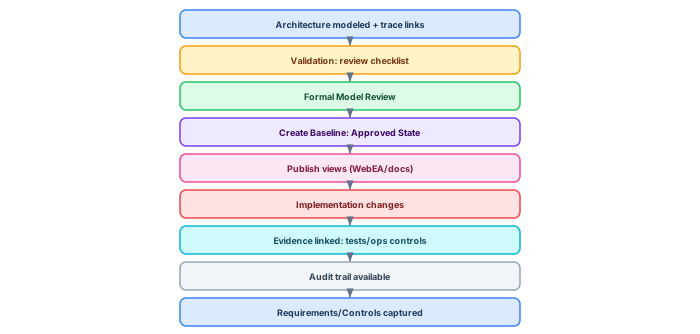
Model Reviews support formal collaborative review of elements and diagrams.
Baselines provide snapshot/compare/revert at package scope.
Auditing provides change attribution records.
Step three: enforce access and separation of duties
Your compliance posture improves when: architecture decision records
- Only governance roles can mark content “approved” or baseline reference packages.
- Model security permissions limit update capability while allowing broad read access.
Step four: connect traceability to external obligations
This step is about mapping. Examples:
- GDPR Article 30 requires a record of processing activities with defined fields (controller, purposes, categories, recipients, retention periods, security measures). While EA is not legally required as the RoPA tool, modeling these relationships can improve completeness and impact analysis.
- DORA establishes digital operational resilience requirements for financial entities, making system dependency and operational governance visibility more important.
Governance, checklists, and controls
Review checklist (regulatory traceability)
- Every “regulated scope” requirement has at least one realizing architecture element.
- Every critical architecture element has an owner and a lifecycle state tag.
- Approved packages have a baseline id and date.
- High-risk changes have a recorded review outcome.
- Audit logs are enabled during periods of high change (or continuously for high-assurance repos).
Evidence readiness table
| Audit question | Expected evidence | EA mechanism |
|---|---|---|
| What changed since approval? | Delta set | Baseline comparison |
| Who changed this requirement? | Attribution & timestamp | Auditing |
| Was this design reviewed? | Review record, comments, participants | Model reviews |
| Who can edit regulated packages? | Role/permission rules | Model security permissions |
Pitfalls and anti-patterns
Over-linking: if you require too many links, teams will create meaningless ones. Start with the traceability spine and expand only when a concrete audit question demands it.
Approval outside the model: if decisions live in email, architecture becomes non-auditable. Pair model reviews with baselines to keep governance artifacts inside the system-of-record.
Confusing audit logs with versioning: auditing records changes but cannot restore previous states, unlike baselines/version control.
Examples and case scenarios
Scenario: regulated data processing change
- A new processing purpose is introduced (GDPR scope).
- Architecture captures processing activities, systems, data flows; requirement/control mapped.
- Change reviewed via model review; approved package baselined; auditing provides attribution trail.
Scenario: operational resilience modernization
- For financial entities, resilience expectations (DORA) drive architecture changes.
- Baselines mark “approved resilience architecture,” enabling drift detection over time.
Key takeaways
Audit-grade traceability with EA is achieved by combining: (1) a small number of mandatory semantic links, (2) governed metadata via profiles/tags, (3) model reviews for approval evidence, (4) baselines for state comparison and reversion, and (5) auditing for change attribution.
- Auditing records model changes (who/what/when).
- Auditing note: does not replace baselines/version control.
- Baselines definition (snapshot, compare, revert).
- Baseline comparison (accumulated changes view).
- Model reviews (formal assessment collaboration).
- GDPR Article 30 (records of processing activities).
- Model security and permissions.
- MDG Technologies (packaging profiles/tags).
The five-link traceability chain

Regulatory traceability in Sparx EA requires an unbroken chain from external regulation through internal requirements to implementation evidence. Each link must be a formal relationship in the model — not a comment, not a document reference, but a traceable connector. free Sparx EA maturity assessment
Link 1: Regulation → Requirement. External regulations (GDPR Article 32, PCI-DSS Requirement 6, NIS2 Article 21) are modeled as Constraints or external Requirements. Internal EA Requirements realize these external obligations. Each internal requirement has a unique ID, owner, and compliance status.
Link 2: Requirement → Architecture Decision. Each requirement generates one or more architecture decisions. Model decisions as ArchiMate Assessments or custom ADR (Architecture Decision Record) elements. The decision documents what was chosen, why, and what alternatives were rejected.
Link 3: Decision → Application Component. Decisions are realized by architecture elements — the Application Component, Technology Service, or security control that implements the decision.
Link 4: Component → Test Case. Each implementing component is verified by test cases. Model test cases as linked elements with status tracking (Planned, Passed, Failed).
Link 5: Test Case → Evidence. Test execution produces evidence — audit logs, penetration test reports, compliance certificates. Link these as documents or artifacts in the model.
-- SQL: Traceability gap report — requirements without implementation
SELECT r.Name AS Requirement, r.Stereotype, r.Status
FROM t_object r
WHERE r.Object_Type = 'Requirement'
AND r.Object_ID NOT IN (
    SELECT c.Start_Object_ID FROM t_connector c
    WHERE c.Connector_Type = 'Realisation'
)
ORDER BY r.Name;
If you’d like hands-on training tailored to your team — Sparx Enterprise Architect, BPMN, SysML, Apache Kafka or the Archi tool — or modelling coaching in ArchiMate and TOGAF-aligned governance, you can reach us via our contact page.
Frequently Asked Questions
What is Sparx Enterprise Architect used for?
Sparx Enterprise Architect (Sparx EA) is a comprehensive UML, ArchiMate, BPMN, and SysML modeling tool used for enterprise architecture, software design, requirements management, and system modeling. It supports the full architecture lifecycle from strategy through implementation.
How does Sparx EA support ArchiMate modeling?
Sparx EA natively supports ArchiMate 3.x notation through built-in MDG Technology. Architects can model all three ArchiMate layers, create viewpoints, add tagged values, trace relationships across elements, and publish HTML reports — making it one of the most popular tools for enterprise ArchiMate modeling.
What are the benefits of a centralised Sparx EA repository?
A centralised SQL Server or PostgreSQL repository enables concurrent multi-user access, package-level security, version baselines, and governance controls. It transforms Sparx EA from an individual diagramming tool into an organisation-wide architecture knowledge base.