⏱ 22 min read
Most enterprise architecture maturity assessments are a waste of time.
That’s the uncomfortable truth. Too many of them are glorified scorecards built to impress executives for one steering committee meeting, then quietly abandoned in a SharePoint folder no one opens again. They look polished. They sound strategic. And they change almost nothing.
A real maturity assessment should do one thing: help the organization make better architecture decisions, faster, with less politics and less accidental complexity.
If it doesn’t help with that, it’s theater.
So let’s make this practical.
What is an enterprise architecture maturity assessment?
Simple version first.
An enterprise architecture maturity assessment is a structured way to evaluate how well an organization uses architecture to guide technology decisions, align with business goals, govern change, manage standards, and reduce delivery chaos.
In plain English: it tells you whether architecture is actually helping the enterprise, or just producing diagrams.
A good assessment looks at things like:
- architecture governance
- business and IT alignment
- standards and reference architectures
- solution design quality
- data and integration practices
- security and IAM consistency
- cloud operating model
- architecture tooling and repository discipline
- architecture team capability
- how architecture supports delivery teams in the real world
And yes, maturity matters. But not in the fake “we want to be level 5 because level 5 sounds impressive” sense. Maturity matters because low maturity shows up as real pain:
- duplicate platforms
- cloud cost sprawl
- Kafka used as a magic fix for everything
- IAM bolted on late
- business capabilities mapped differently by every team
- regulatory risk
- project delays because no one agreed on target state
- architecture reviews that happen after the build is already halfway done
That’s the stuff that hurts.
The biggest misconception: maturity is not the same as process heaviness
Here’s my first strong opinion.
A lot of organizations think a mature architecture practice means more templates, more review boards, more checkpoints, more mandatory artifacts, more “compliance.”
Usually it means the opposite.
A mature EA function should create clarity with less friction. It should make good decisions repeatable. It should reduce debate where standards already exist. It should help product teams move faster because the hard thinking has already been done in reusable ways.
If your architecture practice is slowing down every cloud migration, every IAM integration, every Kafka onboarding, every API decision, you are not mature. You are bureaucratic.
Those are not the same thing.
Why organizations do maturity assessments badly
Before getting into the step-by-step guide, it’s worth naming the common failure patterns. I’ve seen these in banks, insurers, retailers, government, and large SaaS shops.
1. They assess architecture in isolation
This is the classic EA mistake. The architects assess themselves. They interview each other. They score their own methods. Then they conclude architecture is doing fairly well.
Meanwhile delivery teams are building workarounds around governance because the official process is too slow. ArchiMate for governance
Architecture maturity is not about how architects feel about architecture. It’s about whether the enterprise can make coherent technology decisions at scale.
2. They chase an abstract maturity model
Some maturity models are useful. Many are generic to the point of being harmless. They ask broad questions, produce broad ratings, and tell you broad things you already know.
“Improve stakeholder engagement.”
“Strengthen standards adoption.”
“Enhance governance effectiveness.”
Thanks. Very actionable.
A maturity assessment has to be grounded in real architecture work: cloud landing zones, IAM patterns, event streaming standards, reference architectures, data contracts, regulatory traceability, project intake, technical debt decisions.
If it never gets concrete, it won’t matter.
3. They confuse architecture artifacts with architecture outcomes
Having principles, standards, capability maps, roadmaps, and target-state diagrams is fine. Necessary, even.
But here’s the contrarian bit: an architecture repository full of beautiful content does not prove maturity. Sometimes it proves the team had time to draw things because no one asks them to solve hard delivery problems.
The real question is whether those artifacts are used in decision-making.
Do solution teams actually use the cloud reference architecture?
Does IAM onboarding follow approved patterns?
Are Kafka topics governed with ownership, schema, retention, and security standards?
Do architecture decisions reduce rework?
That’s maturity.
4. They assess once and declare victory
Maturity isn’t a one-time audit. It’s an operating discipline. The organization changes, strategy changes, platforms change, and the architecture practice needs to evolve with them.
If the assessment is not tied to a 12–18 month improvement plan with measurable checkpoints, it’s mostly PowerPoint.
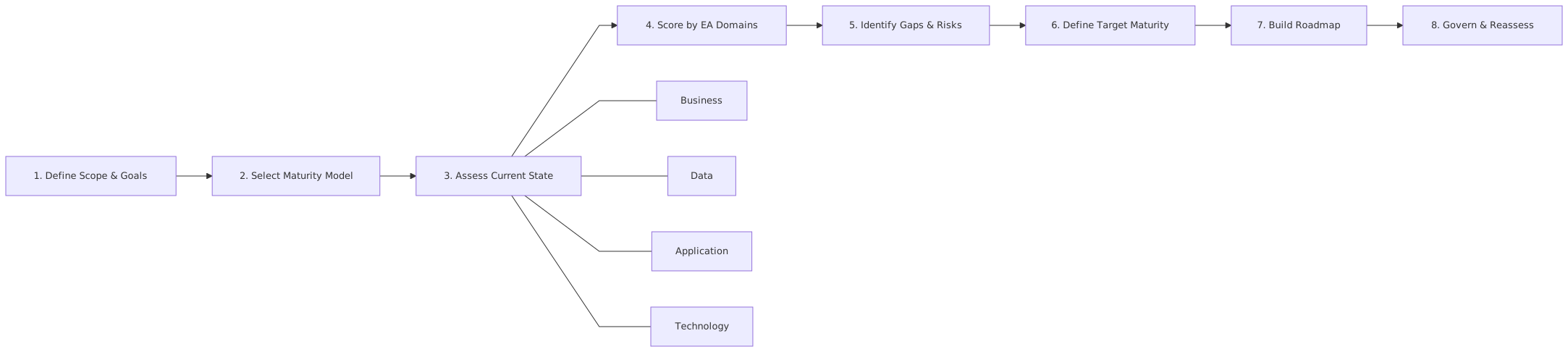
This is the way I’d run an enterprise architecture maturity assessment in a real organization. Not academically. Not as a consulting poster. In real life.
Step 1: Define what “maturity” means for your enterprise
Do not start with scoring.
Start with context.
A bank, a digital-native retailer, a manufacturer, and a government department should not assess architecture maturity the same way. They have different constraints, different risk profiles, different delivery models, and different architecture problems.
For example:
- A bank may care deeply about IAM control, data lineage, resilience, integration governance, and cloud risk management.
- A retailer may prioritize speed, API scalability, event-driven integration, customer data consistency, and vendor ecosystem integration.
- A regulated healthcare organization may emphasize privacy architecture, interoperability, auditability, and identity federation.
So define maturity in terms of what the business actually needs.
Questions to answer first
- What business outcomes should architecture support over the next 2–3 years?
- What delivery model does the organization use: project-based, product-based, federated, centralized?
- Where is the pain today: cloud sprawl, integration chaos, duplicated capabilities, weak governance, poor roadmaps?
- Which domains are strategically important: data, security, IAM, cloud, event streaming, application rationalization?
- What level of standardization is realistic?
This sounds obvious. It isn’t. Many teams skip this and go straight to generic assessment templates.
That’s lazy architecture.
Step 2: Choose the assessment dimensions that matter
You do not need 17 dimensions unless you enjoy meetings. Keep it focused enough to act on.
Here’s a practical set I use often.
You can expand or compress this list, but don’t overcomplicate it.
Step 3: Define maturity levels in plain language
Maturity levels should be understandable by non-architects. If you need a methodology handbook to interpret them, they’re too abstract.
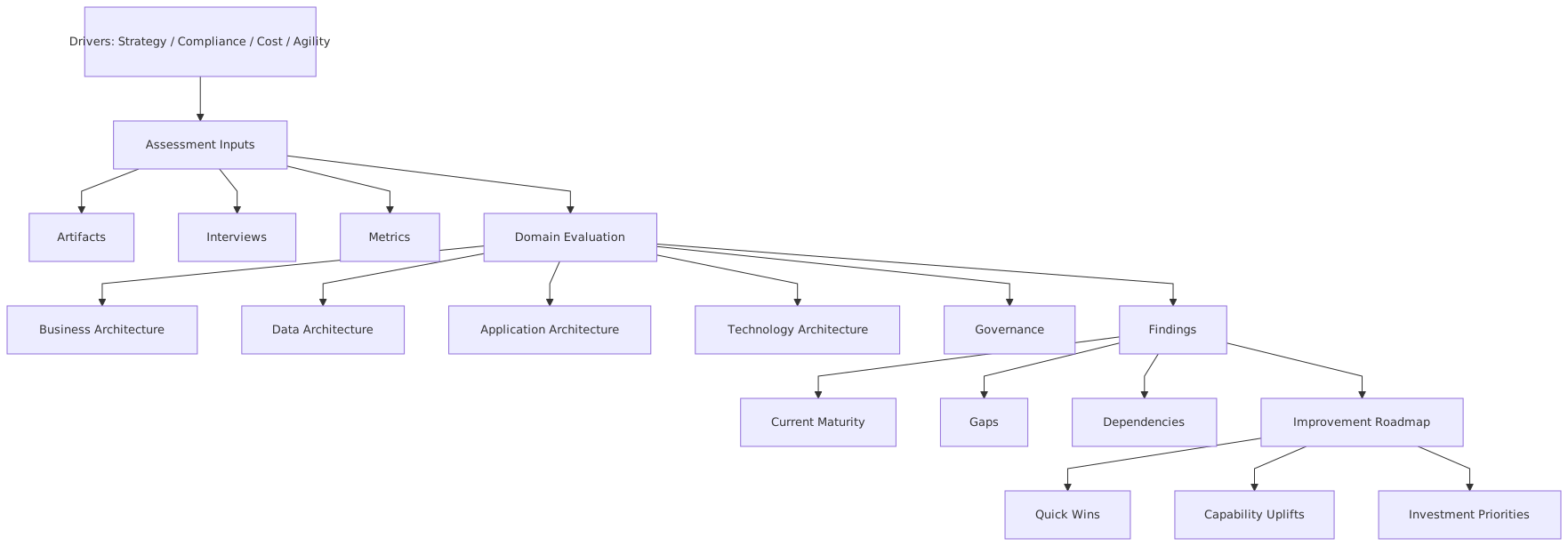
A simple 5-level model works well:
- Ad hoc – inconsistent, person-dependent, reactive
- Emerging – some repeatability, limited standards, patchy adoption
- Defined – documented practices exist and are used in major areas
- Managed – governance, standards, and metrics are operating consistently
- Optimized – architecture continuously improves delivery, risk, and portfolio outcomes
Don’t obsess over the labels. What matters is the behavior behind them.
For example, in IAM architecture:
- Level 1: each application team handles identity differently
- Level 2: some SSO patterns exist but are inconsistently applied
- Level 3: enterprise IAM patterns exist for workforce and customer identity
- Level 4: IAM is integrated into delivery pipelines and onboarding processes
- Level 5: identity architecture is adaptive, measurable, and supports strategic business change with low friction
That’s concrete. That’s useful.
Step 4: Gather evidence from the work, not just from interviews
This step separates serious assessments from fluffy ones.
Yes, do interviews. But interviews are not enough. People are unreliable narrators of architecture maturity, especially senior leaders who mostly see governance decks. EA governance checklist
You need evidence from actual work:
- architecture review outcomes
- project and product delivery artifacts
- cloud platform guardrails
- IAM onboarding patterns
- Kafka topic governance and event standards
- technology standards catalog
- application portfolio data
- exceptions and waivers
- ADRs or decision records
- roadmap traceability to strategy
- metrics on review cycle time, reuse, standard adoption, and technical debt
When I assess architecture maturity, I look for proof in operational decisions.
Example evidence areas
Cloud
- Are there approved landing zones?
- Are network, logging, secrets, tagging, and identity patterns standardized?
- How often do teams request architecture exceptions because the standard path is unusable?
Kafka
- Is Kafka treated as an enterprise event backbone with clear ownership and standards, or as a random messaging utility?
- Are topic naming, schema evolution, retention, encryption, and consumer ownership governed?
- Is there domain ownership, or just platform ownership?
IAM
- Are application teams still inventing role models and access flows?
- Is there a standard pattern for workforce federation, customer identity, service-to-service authentication, and privileged access?
- Are IAM reviews happening at design time or just before production release?
This is where real architecture work shows up.
Step 5: Interview the right people, not just the architecture team
If you only talk to architects, you’ll get a polished story.
Interview these groups:
- CIO or CTO leadership
- business or product leaders
- engineering leaders
- platform/cloud teams
- security and IAM teams
- data and integration leads
- delivery managers or PMO if relevant
- solution architects
- operations/SRE leaders
- a few delivery teams who recently went through architecture governance
And ask uncomfortable questions.
- Where does architecture help most?
- Where does it slow you down?
- Which standards are useful?
- Which standards are ignored?
- Where do teams bypass governance?
- What decisions get escalated repeatedly?
- What architecture artifacts do you actually use?
- What causes rework late in delivery?
A mature assessment needs some friction. If every interview sounds positive, either you interviewed the wrong people or no one felt safe telling the truth.
Step 6: Score honestly, and resist vanity inflation
Architects are not immune to score inflation. In fact, they’re often worse than engineers because they know how to justify nuance.
Be disciplined.
For each dimension, assign a maturity level based on evidence, not intent.
This is another place where strong opinion matters: “we have a standard” does not mean level 3 or 4. If the standard is ignored, outdated, or unknown to delivery teams, it barely counts.
Likewise, “we are implementing a new cloud platform” is not maturity. It’s a program. Maturity is what happens after the launch deck.
A useful way to score is by combining three views:
- Documented state – what policies, standards, and models exist
- Operational state – what teams actually do
- Outcome state – what results the organization gets
If those three don’t align, score lower. Harsh, maybe. But honest.
Step 7: Identify patterns, not just low scores
This is where many assessments become shallow. They produce a heatmap and stop.
A good architect looks for systemic patterns.
For example:
- weak governance may actually be caused by poor reference architectures
- cloud inconsistency may actually be caused by an unclear platform operating model
- Kafka chaos may actually be caused by lack of domain ownership and event governance
- IAM exceptions may actually be caused by late architecture engagement in projects
- duplicate applications may actually be caused by weak business capability ownership
The point is not to say “Data & Integration scored 2.8.” The point is to explain why the organization behaves the way it does.
That’s architecture.
Step 8: Prioritize improvements based on business value, not architecture purity
Not every maturity gap matters equally.
This is where architects often go wrong. They see inconsistency and want to fix all of it. But enterprises run on trade-offs. Sometimes a low-maturity area is tolerable. Sometimes it’s strategically dangerous.
Prioritize using these filters:
- business impact
- delivery friction
- operational risk
- regulatory exposure
- cost inefficiency
- dependency on strategic programs
- feasibility in the next 12 months
Example prioritization in a bank
Imagine a retail bank with these findings:
- Cloud Architecture: level 3
- IAM: level 2
- Data & Integration: level 2
- Governance: level 3
- Technology Portfolio: level 2
- Team Capability: level 4
A weak architect might say: “Let’s improve everything.”
A better architect says:
- Fix IAM patterns first because every digital initiative depends on identity and access controls.
- Stabilize Kafka and event governance because customer and payment events are inconsistent across domains.
- Rationalize cloud platform guardrails because teams are building around them.
- Tackle application portfolio reduction in waves, not as a giant theory exercise.
That’s prioritization tied to enterprise reality.
Step 9: Turn assessment findings into a real improvement roadmap
This is where assessments usually die.
You need a roadmap with named owners, funding assumptions, measurable outcomes, and integration into existing governance. architecture decision record template
Not “improve architecture repository.”
Instead:
- establish architecture standards lifecycle with quarterly review and deprecation process
- implement enterprise IAM reference patterns for workforce SSO, B2B federation, and service identity
- define Kafka event governance model including schema ownership, topic lifecycle, and security controls
- embed architecture checkpoints into product inception and platform design
- publish cloud reference patterns for network segmentation, observability, secrets, and resilience
- launch portfolio rationalization for customer communications platforms
A maturity roadmap should include three kinds of actions:
Quick wins
Visible, low-effort changes that improve credibility.
Examples:
- simplify architecture review templates
- publish top 10 approved cloud patterns
- create a one-page IAM integration decision tree
- standardize Kafka topic naming and ownership metadata
Structural improvements
Changes to the operating model.
Examples:
- redesign governance forums
- clarify decision rights between EA, security, and platform teams
- assign domain architects to strategic business areas
- connect architecture standards to engineering enablement
Strategic initiatives
Bigger changes that require investment.
Examples:
- enterprise IAM modernization
- cloud platform engineering capability
- application rationalization by capability
- enterprise event architecture and data contract framework
Step 10: Measure whether architecture maturity is improving in practice
If you can’t measure improvement, the assessment becomes a narrative exercise.
Don’t overdo metrics. A few useful ones beat a giant dashboard no one trusts.
Here are practical measures:
The point is not metric perfection. The point is to make architecture outcomes visible.
Let’s make this concrete, because enterprise architecture gets fuzzy very quickly if you let it.
A maturity assessment should directly affect how architects spend their time.
In solution design
If the assessment shows weak standards adoption, architects should stop producing more principles and instead create reusable solution patterns.
Example:
- standard Kafka integration patterns for event producers and consumers
- approved IAM flows for web apps, APIs, and machine identities
- cloud deployment blueprints with logging, tagging, and network controls built in
This changes architecture from review-heavy to enablement-heavy.
In governance
If review boards are overloaded and late, maturity work should redesign governance.
That may mean:
- fewer central review gates
- more pre-approved patterns
- risk-based review tiers
- architecture involvement at inception, not at build completion
- tighter integration with security and platform teams
A mature architecture function does not review every little thing manually. It builds systems where many good decisions are pre-made.
In domain architecture
If the assessment shows fragmentation in customer, payments, identity, or data domains, architects should shift attention from enterprise-wide theory to domain-specific roadmaps and ownership. TOGAF roadmap template
This is especially true in banking.
Banks love central models. They also have deeply fragmented reality. If there’s no clear domain ownership for customer profile, consent, payment events, fraud signals, or IAM attributes, enterprise architecture becomes abstract very fast.
In cloud transformation
Cloud maturity is one of the clearest tests of architecture maturity.
If every team has a different VPC pattern, IAM role design, logging setup, secret management method, and resilience model, then architecture is not doing its job.
A maturity assessment should force direct action:
- create or refine landing zones
- define non-negotiable guardrails
- separate platform responsibilities from application responsibilities
- publish patterns teams can actually use
- reduce exceptions
In security and IAM
This one gets neglected until it becomes painful.
Low IAM maturity usually looks like this:
- identity decisions made too late
- inconsistent RBAC models
- too many local accounts
- poor federation strategy
- service-to-service auth handled differently by every platform
- access reviews disconnected from architecture
A mature architecture function treats IAM as foundational architecture, not just security implementation detail.
That’s especially true in banking, where identity, consent, privileged access, and auditability are not optional.
Let’s be blunt. Architects create a lot of their own problems.
Mistake 1: making the model too complicated
If your maturity model needs a 40-page guide to explain scoring, you’ve already lost the audience. Simplicity is not lack of rigor. It’s discipline.
Mistake 2: scoring based on existence, not adoption
“We have a standard” is one of the most misleading sentences in enterprise IT.
A standard unused by delivery teams is architecture fiction.
Mistake 3: ignoring engineering reality
Some architects assess maturity as if delivery happens in a vacuum. They don’t understand developer workflows, platform constraints, CI/CD, observability, or operational support.
Then they wonder why teams bypass architecture.
If the architecture function is detached from engineering, the maturity score should reflect that.
Mistake 4: treating governance as the center of architecture
Governance matters. But architecture is not a review board. It’s a decision-enabling capability.
If your maturity assessment spends 70% of its weight on review processes, it’s biased toward bureaucracy.
Mistake 5: copying target maturity from another company
This happens all the time. A bank sees what a big tech firm or another bank is doing and decides that’s the target.
Bad idea.
Your target maturity should reflect your business strategy, risk profile, talent model, and current platform landscape. Not someone else’s conference presentation.
Mistake 6: underestimating organizational politics
Architecture maturity is not only about capability. It’s also about power, ownership, incentives, and funding.
If application teams are rewarded for local delivery speed and not enterprise coherence, maturity will stall no matter how good the standards are.
A serious architect factors this in. A naive one writes a recommendation and wonders why nothing changes.
Let’s walk through a realistic example.
A regional retail bank was running a multi-year modernization program:
- channel modernization in cloud
- API and event-driven integration rollout
- IAM modernization for workforce and customer identity
- gradual core decoupling
- data platform uplift
On paper, the architecture function looked mature:
- enterprise principles existed
- standards catalog existed
- architecture review board existed
- capability maps existed
- target-state diagrams existed
Leadership assumed maturity was around level 4.
It wasn’t.
What the assessment found
Business alignment: moderate
Architecture was linked to strategy at the annual planning level, but not tightly connected to investment sequencing.
Governance: moderate
Review forums existed, but decisions came late and exemptions were common.
Cloud architecture: emerging to defined
There was a cloud landing zone, but teams found it too restrictive and created side paths. Logging and IAM patterns were inconsistent.
IAM: emerging
Customer identity and workforce identity were being handled by separate programs with little architectural convergence. Service identity was immature. Role models varied widely.
Data & integration: emerging
Kafka adoption had grown rapidly, but event ownership was weak. Topic sprawl was real. Schema governance was inconsistent. Some teams were using Kafka as synchronous integration with extra steps, which is always a bad smell.
Technology portfolio: emerging
Duplicate customer communication and document services existed across business units.
Team capability: strong
The architects themselves were capable. That was not the issue.
The root causes
This is the important part.
The problem was not lack of smart architects. It was:
- architecture engaged too late in delivery
- standards were not translated into reusable engineering patterns
- IAM was treated as a security program, not enterprise architecture
- Kafka platform ownership existed, but event domain ownership did not
- cloud guardrails were designed centrally without enough delivery input
- governance focused on review, not enablement
So the maturity assessment changed the roadmap.
What the bank did next
- Created practical reference patterns
For IAM integration, Kafka producer/consumer design, cloud network segmentation, and API security.
- Introduced domain-based event ownership
Kafka topics required business/domain ownership, schema stewardship, retention policy, and security classification.
- Redesigned governance
More early-stage architecture engagement, fewer late-stage review surprises, and tiered review based on risk.
- Unified IAM architecture direction
Workforce federation, customer identity, and service identity were put under a coherent enterprise architecture model.
- Improved cloud operating model
The platform team and architects jointly simplified standard deployment patterns to reduce exceptions.
Results after 12 months
Not magic. But real progress.
- architecture decision lead time dropped
- exception volume decreased
- more solutions used standard IAM flows
- Kafka governance improved enough to reduce topic duplication and schema conflicts
- cloud deployments became more consistent
- architecture credibility with delivery teams improved
That’s what a maturity assessment is supposed to do. Not produce a prettier heatmap. Produce better enterprise behavior.
Let me end the main section with another opinion that some architects dislike.
You do not need level 5 maturity across all architecture domains.
In fact, chasing maximum maturity everywhere is often a sign the architecture team has lost touch with business economics.
Some domains deserve high maturity:
- IAM in a bank
- resilience architecture in critical services
- cloud guardrails in a regulated environment
- data lineage where reporting and compliance matter
Some domains may be fine at level 2 or 3 for a while:
- certain low-risk internal applications
- niche platforms with limited strategic value
- non-core capabilities slated for retirement
Architecture maturity should be intentional, not aspirational for its own sake.
That’s the difference between real architecture and architecture vanity.
An enterprise architecture maturity assessment is useful only if it tells the truth and changes decisions.
It should be evidence-based. Tied to business outcomes. Grounded in real architecture work like cloud patterns, IAM design, Kafka governance, portfolio rationalization, and delivery integration.
And it should be a little uncomfortable.
Because if everyone reads the assessment and nods politely, chances are it said nothing important.
Real enterprise architecture is not about producing the most complete model. It’s about reducing confusion in a messy enterprise. Helping teams make better choices. Creating enough standardization to scale, without killing delivery. And knowing where rigor matters and where it doesn’t.
That’s the maturity that counts.
1. How often should an enterprise architecture maturity assessment be done?
A formal assessment every 12 to 18 months is usually enough. More often than that and you risk turning it into administrative churn. But progress against the improvement roadmap should be reviewed quarterly, especially for areas like cloud, IAM, and integration governance.
2. Who should own the maturity assessment?
Usually the chief architect, head of enterprise architecture, or CTO-sponsored architecture lead. But ownership should not mean self-assessment in isolation. You need input from engineering, security, platform, data, and business stakeholders. If architecture marks its own homework alone, expect inflated scores.
3. What’s the difference between architecture maturity and technology maturity?
Architecture maturity is about how well the organization makes and governs technology decisions at enterprise scale. Technology maturity is about the state of specific platforms or tools. You can have a modern cloud stack and still have immature architecture if decisions are inconsistent, duplicated, and poorly governed.
4. How do Kafka and IAM fit into an enterprise architecture maturity assessment?
They are excellent indicators of real maturity because they expose cross-cutting architecture behavior. Kafka tests whether the organization can govern event-driven integration beyond platform installation. IAM tests whether identity, access, and trust are treated as enterprise design concerns rather than late-stage security fixes.
5. What is a good first step if our architecture maturity is low?
Don’t start with a giant framework redesign. Start by identifying the biggest delivery pain caused by poor architecture discipline. In many enterprises that’s cloud inconsistency, weak IAM patterns, or chaotic integration. Fix one or two high-value areas with practical standards and reusable patterns. Credibility grows faster from solving real problems than from publishing a new architecture model.
Enterprise Architecture Maturity Assessment: Step-by-Step Guide
Frequently Asked Questions
What is enterprise architecture?
Enterprise architecture is a discipline that aligns an organisation's strategy, business processes, information systems, and technology. Using frameworks like TOGAF and modeling languages like ArchiMate, it provides a structured view of how the enterprise operates and how it needs to change.
How does ArchiMate support enterprise architecture practice?
ArchiMate provides a standard modeling language that connects strategy, business operations, applications, data, and technology in one coherent model. It enables traceability from strategic goals through business capabilities and application services to the technology platforms that support them.
What tools are used for enterprise architecture modeling?
The main tools are Sparx Enterprise Architect (ArchiMate, UML, BPMN, SysML), Archi (free, ArchiMate-only), and BiZZdesign Enterprise Studio. Sparx EA is the most feature-rich option, supporting concurrent repositories, automation, scripting, and integration with delivery tools like Jira and Azure DevOps.