⏱ 18 min read
Most enterprise architecture consulting is sold like a cure and delivered like wallpaper.
That’s the blunt version. A lot of firms talk about “business-IT alignment,” “strategic transformation,” and “future-state capability models” as if executives wake up wanting more diagrams. They don’t. They want fewer outages, faster product launches, lower risk, cleaner audits, and less money wasted on technology that looked smart in a steering committee and useless six months later. ArchiMate capability map
That’s where enterprise architecture consulting either proves its value or exposes itself as theater.
So let’s make this simple early: enterprise architecture consulting services help organizations make better technology decisions across business, data, application, security, and infrastructure domains—so systems work together, change is faster, and risk is controlled.
That’s the SEO-friendly answer. It’s true, but incomplete.
The real answer is harsher: good enterprise architecture consulting is decision support for complicated organizations. It’s not just drawing target-state diagrams. It’s helping leaders decide what to standardize, what to retire, what to modernize, what to centralize, what to leave alone, and where to spend political capital. That last part matters more than most architecture books admit.
A real architect knows the job is not to produce architecture. The job is to produce better outcomes through architecture.
What enterprise architecture consulting services actually are
At a practical level, enterprise architecture consulting usually covers some combination of these:
- current-state assessment
- target-state architecture design
- application portfolio rationalization
- cloud strategy and operating model
- integration architecture
- data architecture and governance
- security and IAM architecture
- technology roadmaps
- architecture governance and review boards
- modernization planning
- M&A technology integration
- regulatory and resilience architecture
That list is familiar. Too familiar, maybe. The problem is that many firms treat these as deliverables. Mature clients treat them as instruments.
For example:
- A current-state assessment is not a document. It’s a way to expose waste and hidden coupling.
- A target-state architecture is not a poster. It’s a negotiation tool.
- A roadmap is not a timeline. It’s a sequence of trade-offs under budget and delivery pressure.
- Governance is not approval theater. It’s a mechanism to prevent local optimization from wrecking the enterprise.
That’s the shift people miss. Enterprise architecture consulting is valuable when it changes how decisions get made.
Why companies bring in enterprise architecture consultants
Usually because something is already going wrong.
Not always a disaster. Sometimes it’s just drift. But there is almost always pain under the surface:
- cloud costs rising with no ownership model
- duplicated capabilities across business units
- fragmented IAM and inconsistent access controls
- integration sprawl with point-to-point APIs and brittle batch jobs
- data platforms multiplying because nobody says no
- Kafka introduced everywhere but governed nowhere
- architecture standards that exist on SharePoint and nowhere else
- mergers creating overlapping systems that nobody wants to retire
- regulatory pressure exposing weak controls and undocumented dependencies
The polite consulting version says, “organizations engage enterprise architects to support transformation.” Fine. True enough.
The honest version says, “companies call architects when complexity finally becomes expensive enough to notice.”
And by the time they notice, they often want speed and certainty at the same time. That’s another place consultants fail. They promise both. In enterprise architecture, you can improve speed, and you can improve certainty, but only if you’re willing to make some things less flexible. Every architecture is a set of constraints. If your consultant never says that out loud, they’re selling fantasy.
The simple explanation: what an EA consultant does
If you need the short version for a leadership team:
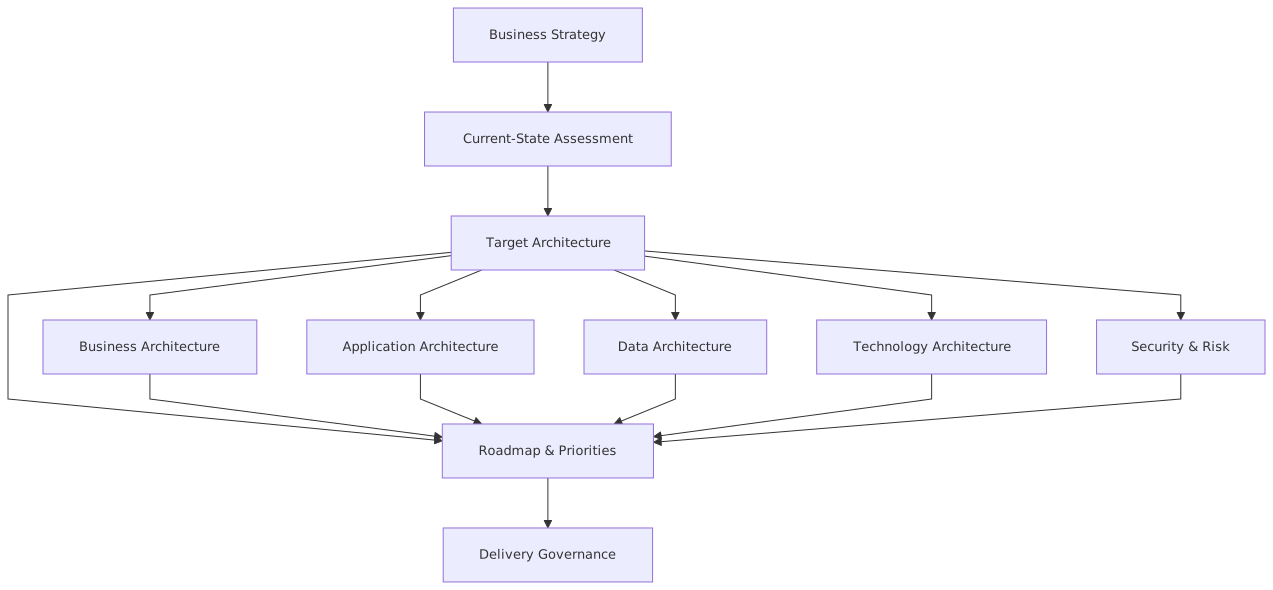
Enterprise architecture consulting helps an organization connect business goals to technology choices, define standards, reduce duplication, manage risk, and create a realistic path from today’s mess to tomorrow’s operating model.
That includes questions like:
- Which applications should we keep, replace, or retire?
- How should we structure cloud platforms across teams and regions?
- Where do we use event streaming like Kafka, and where should we not?
- How do we unify IAM across legacy and cloud applications?
- What should be enterprise standards versus team-level choice?
- How do we modernize without breaking critical operations?
- How do we govern architecture without slowing delivery to a crawl?
The keyword there is realistic.
A lot of architecture consulting fails because it designs for a company that does not exist. It assumes cleaner teams, better data, stronger governance, more budget, and more executive discipline than the client actually has. That’s not architecture. That’s fan fiction. ArchiMate for governance
The deeper explanation: architecture consulting is mostly about operating models
Here’s the contrarian point: enterprise architecture is often framed as a technology discipline, but in practice it is usually an operating model discipline with technical consequences.
The hard questions are not “What cloud should we use?” or “Should we adopt Kafka?” Those are downstream questions.
The upstream questions are:
- Who owns shared platforms?
- Which decisions are centralized?
- Which controls are mandatory?
- How much local variation is acceptable?
- What is the escalation path when standards conflict with delivery?
- Who funds enterprise capabilities that don’t belong to one product team?
- How much technical debt are we willing to tolerate in regulated systems?
That’s why architecture consulting can’t just be technical design. It has to cut across business structure, funding, delivery, risk, and governance. EA governance checklist
Take cloud as an example. A consultant can propose a polished multi-account cloud landing zone with identity federation, network segmentation, logging, secrets management, policy-as-code, and cost controls. Great. But if no one owns the platform, if every product team can bypass standards, and if finance still allocates spend in a way that rewards duplication, the architecture will decay immediately.
The architecture isn’t only the platform design. It’s the decision system around the platform.
What enterprise architecture consulting looks like in real work
Let’s stop speaking in abstractions.
In real architecture work, enterprise consultants tend to do five things repeatedly.
1. They make the current state visible
Not every detail. Enough to expose risk and duplication.
This usually means mapping:
- business capabilities
- application landscape
- data flows
- integration patterns
- IAM domains and trust relationships
- cloud estates and tenancy/account structures
- critical dependencies
- resilience and recovery posture
- vendor concentration
- control gaps
If this sounds basic, it is. But basic does not mean easy. Enterprises are full of undocumented systems, tribal knowledge, and “temporary” interfaces that are 11 years old.
A good consultant does not try to document everything. They identify the things that matter for decisions.
2. They define principles and guardrails
Not 47 principles. Usually 8–12 that people can actually remember and use.
For example:
- identities are enterprise assets, not application-local constructs
- events are for business facts, not remote procedure calls in disguise
- customer data has a system of record and authorized copies
- resilience requirements vary by business criticality, not by team preference
- cloud platforms are standardized; exceptions are explicit and time-bound
Weak consultants write principles that sound noble and do nothing. Strong ones write principles that force trade-offs.
3. They create target states with levels, not fantasies
A proper target state usually has layers:
- strategic end-state
- intermediate states
- transition architecture
- non-negotiable controls
- exception path
This matters because enterprises don’t transform in one move. They migrate in awkward half-steps while still serving customers, passing audits, and surviving budget cycles.
4. They build a roadmap tied to business priorities
Not “year 1, year 2, year 3” nonsense detached from reality.
A useful roadmap links architecture changes to actual drivers:
- launch digital onboarding in 2 markets
- reduce fraud losses
- decommission 3 data centers
- pass new regulatory control requirements
- integrate an acquired company
- cut IAM-related support tickets
- reduce settlement processing failures
If architecture work is not tied to outcomes, it gets deprioritized. And honestly, it should.
5. They set up governance that can survive contact with delivery teams
Architecture review boards are notorious for becoming bottlenecks. Some deserve the criticism.
Good EA consulting sets governance based on risk and change type: architecture decision record template
- lightweight review for standard patterns
- deeper review for cross-domain changes
- mandatory review for regulated, customer-facing, or high-risk systems
- pre-approved reference architectures where possible
- measurable exception handling
If everything needs a committee, governance is broken.
A real enterprise example: banking, Kafka, IAM, and cloud done the hard way
Let’s use a realistic banking example.

A regional bank had grown through acquisition. Over time it ended up with:
- three online banking platforms
- two customer identity stores
- separate IAM solutions for workforce and customer channels
- multiple integration stacks, including legacy ESB, APIs, and a growing Kafka deployment
- hybrid infrastructure: on-prem core systems, plus cloud-native digital services
- overlapping fraud, notification, and customer profile services
- different resilience standards between old and new platforms
From the outside, leadership called it “modernization.” Inside, it was fragmentation with branding.
The trigger
The bank wanted to launch a new digital lending product in six months. Sounds straightforward. It wasn’t.
The new product needed:
- customer authentication and consent
- credit decisioning integration
- event-driven updates to downstream systems
- auditability for regulatory review
- cloud deployment for speed
- integration with legacy account systems still on-prem
Every team thought its part was manageable. The enterprise view said otherwise.
What the architecture consulting engagement uncovered
The assessment found several issues:
- Kafka was being used inconsistently
- Some teams published proper business events.
- Others used Kafka as a command bus.
- Topic naming, retention, schema control, and ownership were inconsistent.
- Replay behavior was poorly understood.
- There was no enterprise event taxonomy.
- IAM was fragmented
- Customer identity for retail banking lived in one platform.
- Lending used a separate identity flow from a previous acquisition.
- Workforce access for operations teams relied on another IAM tool entirely.
- Authorization rules were embedded in applications instead of managed consistently.
- Audit evidence was painful to assemble.
- Cloud controls were immature
- Teams could deploy quickly, but not consistently.
- Logging, secrets handling, and network policies varied by squad.
- There was no clear shared services model.
- Cost and risk ownership were fuzzy.
- Core banking integration was brittle
- Legacy systems exposed batch interfaces and a handful of APIs.
- New cloud services assumed near-real-time behavior that didn’t always exist.
- Teams had built custom adapters with little reuse.
What the target architecture looked like
Not a giant revolution. A focused set of decisions.
For Kafka
- Kafka would be positioned as the enterprise event backbone for selected domains, not a universal integration replacement.
- Business events were standardized with schema governance.
- Command-style interactions would move to APIs where synchronous control was required.
- Topic ownership was assigned to business-aligned domain teams.
- Retention, replay, and PII handling standards were made explicit.
This is important because many architects get intoxicated by event-driven architecture and start treating Kafka like a religion. It’s not. It’s a tool. In banking, that distinction matters. Event streaming is excellent for decoupling, audit trails, and reactive processing. It is terrible when used as a vague substitute for clear transactional responsibility.
For IAM
- The bank introduced a federated IAM model with a clear distinction between workforce identity, customer identity, and machine identity.
- A centralized policy decision approach was defined for high-risk authorization scenarios.
- Customer identity journeys were standardized across channels.
- Privileged access controls were tightened for operational staff.
- Identity lifecycle and access review processes were aligned with audit requirements.
This was one of the highest-value areas. IAM is often treated as a security side project. In reality, it is foundational enterprise architecture. If identity is fragmented, every digital initiative becomes more expensive.
For cloud
- A standard cloud landing zone was established with mandatory logging, key management, network segmentation, and policy baselines.
- Shared platform services were owned by a central cloud platform team.
- Product teams had bounded autonomy within standard patterns.
- Exceptions required time-limited approval and remediation plans.
That “bounded autonomy” phrase is crucial. Total centralization kills speed. Total decentralization kills coherence. Mature architecture lives in the uncomfortable middle.
The result
The bank did not modernize everything. It did something better: it reduced ambiguity where ambiguity was expensive.
The lending product launched with:
- unified customer authentication
- controlled event contracts
- clearer audit trails
- reusable integration patterns
- fewer one-off security decisions
And just as importantly, the architecture team created a repeatable model for future products. That’s the real win. Enterprise architecture should compound.
Common mistakes architects make
This is where I’ll be opinionated, because the industry needs it.
1. They confuse completeness with usefulness
Architects love exhaustive models. The enterprise does not need exhaustive models. It needs enough clarity to make decisions.
If your repository is beautifully complete and nobody uses it to shape investment, you built a museum.
2. They design target states with no transition logic
A gorgeous future-state diagram that ignores migration constraints is a form of dishonesty.
Real enterprises have:
- contracts
- release windows
- legacy dependencies
- audit obligations
- skill shortages
- political boundaries
- sunk-cost bias
Architecture that ignores these is not strategic. It’s decorative.
3. They over-standardize
This one is unpopular. Standardization is good. Excessive standardization is laziness wearing governance clothes.
Not every team needs the same stack. Not every problem should use Kafka. Not every identity pattern should be identical. The enterprise should standardize where variation creates cost or risk, and allow variation where it creates business advantage.
Architects who cannot tell the difference become blockers.
4. They underplay IAM
Many architects still treat IAM as a security team issue and focus on apps, data, and cloud. That’s a mistake.
Identity cuts through:
- customer experience
- fraud controls
- workforce productivity
- compliance
- API security
- machine-to-machine trust
- privileged access
- auditability
If your enterprise architecture doesn’t have a strong IAM view, it is structurally weak.
5. They misuse event-driven architecture
Kafka is the poster child here.
Common failures:
- no event ownership
- no schema discipline
- events containing too much PII
- pretending asynchronous messaging solves transactional ambiguity
- using events to hide poor domain boundaries
- no replay strategy
- no dead-letter handling model
- no operational ownership across domains
Event streaming can be transformative. It can also create a distributed mess faster than almost anything else.
6. They make governance performative
If the architecture review board exists mainly to prove architecture has authority, it will eventually be bypassed.
Governance should:
- accelerate standard decisions
- focus review effort on genuine risk
- provide patterns teams can reuse
- track exceptions
- close the loop with delivery metrics
If governance creates more meetings than clarity, it’s failing.
7. They forget that budgets are architecture
This is another contrarian truth. Funding models shape architecture more than principles do.
If every business unit funds its own tools, you will get duplication.
If no one funds shared services, your platform strategy will fail.
If cost savings are local but complexity costs are enterprise-wide, fragmentation will continue.
An architect who ignores finance mechanics is operating at half power.
Where enterprise architecture consulting creates the most value
Not everywhere equally.
In my experience, EA consulting delivers the highest value in these situations:
Notice the pattern. The value appears where complexity crosses domain boundaries. That’s the core territory of enterprise architecture.
How to tell if an EA consulting engagement is good or bad
Here’s a practical test.
A bad engagement usually produces:
- lots of slides
- generic capability maps
- principles nobody remembers
- target states with no migration path
- governance councils with vague charters
- recommendations detached from funding and delivery reality
A good engagement usually produces:
- a clear view of where complexity and risk are concentrated
- a small number of hard decisions made explicit
- standards that teams can actually apply
- transition architectures tied to business priorities
- ownership clarified across domains
- governance integrated into delivery, not sitting above it
- measurable reduction in duplication, risk, or delivery friction
If you can’t point to changed decisions, the consulting didn’t work.
What clients should expect from enterprise architecture consultants
They should expect more challenge and less flattery.
A competent EA consultant should be willing to say:
- your organization has too many overlapping platforms
- your cloud model is decentralized beyond what your controls can support
- your IAM fragmentation is driving delivery cost and audit pain
- your Kafka adoption has outpaced your governance
- your architecture principles are too generic to matter
- your target state assumes organizational behaviors you haven’t earned yet
That may sound sharp, but it’s useful. Architecture consulting should not just validate executive intent. It should improve it.
Clients should also expect consultants to be practical. That means:
- meeting product and engineering teams where they are
- understanding operational constraints
- respecting existing investments where they still make sense
- distinguishing strategic debt from tolerable debt
- proposing staged modernization, not endless postponement
There’s a balance here. Some consultants are too abstract. Others become so tactical they stop doing enterprise architecture at all. The best ones can move between boardroom strategy and API gateway policy without changing tone too much.
That’s the real craft.
A final opinion: enterprise architecture consulting is valuable, but only when it is accountable
I like enterprise architecture. I’ve spent enough time in it to know both its power and its bad habits.
Done well, EA consulting helps enterprises:
- move faster with fewer surprises
- modernize without losing control
- simplify technology landscapes
- build reusable patterns
- improve security and resilience
- make cloud, IAM, data, and integration decisions coherently
Done badly, it generates expensive ambiguity.
The difference is accountability.
If the consulting team is accountable only for deliverables, you’ll get documents.
If they are accountable for decisions, adoption, and measurable outcomes, you might get real architecture.
And that’s the point. Enterprise architecture consulting services are not there to make the enterprise look organized. They are there to help it become more governable, adaptable, and economically sane.
That’s less glamorous than the marketing language. It’s also much more useful.
FAQ
1. What do enterprise architecture consulting services include?
Typically they include current-state assessment, target-state design, cloud strategy, application rationalization, integration architecture, data architecture, IAM strategy, governance setup, and modernization roadmaps. The good ones also help with decision-making, not just documentation. TOGAF roadmap template
2. How is enterprise architecture consulting different from solution architecture?
Solution architecture focuses on a specific system or initiative. Enterprise architecture looks across the organization—business capabilities, shared platforms, standards, dependencies, risk, and long-term operating model. Solution architecture asks, “How do we build this right?” Enterprise architecture asks, “How do we avoid building the wrong set of things repeatedly?”
3. When should a company hire enterprise architecture consultants?
Usually during cloud transformation, major modernization, M&A integration, IAM consolidation, regulatory remediation, or when technology sprawl starts slowing delivery and increasing risk. If teams are moving fast but the enterprise is getting messier, that’s usually the moment.
4. Is Kafka part of enterprise architecture?
Yes, when event streaming becomes a cross-domain integration capability. But it needs governance. Kafka should have clear ownership, schema standards, security controls, retention policies, and a defined role relative to APIs and batch integration. Without that, it becomes distributed confusion.
5. Why is IAM so important in enterprise architecture?
Because identity sits underneath customer journeys, workforce access, API security, compliance, and operational risk. Fragmented IAM increases cost, weakens control, and complicates every digital initiative. In many enterprises, fixing IAM creates more practical value than launching another shiny platform.
Frequently Asked Questions
What is enterprise architecture?
Enterprise architecture is a discipline that aligns an organisation's strategy, business processes, information systems, and technology. Using frameworks like TOGAF and modeling languages like ArchiMate, it provides a structured view of how the enterprise operates and how it needs to change.
How does ArchiMate support enterprise architecture practice?
ArchiMate provides a standard modeling language that connects strategy, business operations, applications, data, and technology in one coherent model. It enables traceability from strategic goals through business capabilities and application services to the technology platforms that support them.
What tools are used for enterprise architecture modeling?
The main tools are Sparx Enterprise Architect (ArchiMate, UML, BPMN, SysML), Archi (free, ArchiMate-only), and BiZZdesign Enterprise Studio. Sparx EA is the most feature-rich option, supporting concurrent repositories, automation, scripting, and integration with delivery tools like Jira and Azure DevOps.