⏱ 21 min read
Most enterprise architecture repositories are lying to someone.
Not always maliciously. Usually just quietly. A diagram says a business process “uses” an application component when it actually depends on a service contract exposed through an API gateway. A data object is modeled as if it were a capability. An IAM platform is drawn like a technology node. Kafka becomes a magical blob in the middle of every integration diagram, connected to everything with every relationship type anyone could find in the tool palette.
And then people wonder why architecture repositories become shelfware.
Here’s the blunt truth: if your ArchiMate metamodel integrity is weak, your architecture stops being architecture and becomes illustration. Pretty maybe. Useful, no. The metamodel is not bureaucracy. It is the minimum discipline needed so models mean the same thing across teams, time, and decisions.
So let’s make this simple early.
What metamodel integrity in ArchiMate actually means
Metamodel integrity in ArchiMate means your models follow the rules of the language consistently: the right element types, the right relationship types, the right layer boundaries, and the right constraints for your organization. In plain English, it means you model things as what they are, not as what is convenient in the moment. ArchiMate modeling guide
That matters because architecture work depends on comparability and traceability. If one team models IAM as an application service, another as a technology service, and a third as a capability, you cannot analyze dependencies, risk, ownership, or change impact reliably. You do not have one repository. You have many incompatible personal dialects.
ArchiMate gives you a standard metamodel. That’s the baseline. But in real enterprises, baseline is never enough. You also need local rules, constraints, and validation. Otherwise, every modeler improvises, and the repository collapses into ambiguity.
This article is about that practical problem: how to keep ArchiMate models structurally honest without turning architecture into a compliance circus. ArchiMate tutorial
The uncomfortable reality: most ArchiMate problems are not tool problems
Architects love blaming tools. “The repository is messy because the tool allows too much.” Maybe. But usually the problem is sloppier than that.
The real issue is that many architecture teams adopt ArchiMate as notation, not as a semantic discipline.
That distinction matters. Notation is drawing boxes and lines. Semantic discipline is saying:
- this thing is a business role, not an actor
- this is an application service, not an application component
- this relationship is serving, not flow
- this object exists in the model because it supports a decision, not because someone wanted a complete diagram
Without that discipline, the metamodel becomes decorative.
And I’ll say something slightly contrarian: more diagrams often make integrity worse, not better. Enterprises sometimes celebrate repository growth as maturity. Hundreds of views. Thousands of objects. Lovely. But if the underlying semantics are inconsistent, scale just multiplies confusion. A small wrong repository is recoverable. A large wrong repository becomes political.
Why metamodel integrity matters in real architecture work
This is not an academic issue. It shows up in the work architects are actually paid to do.
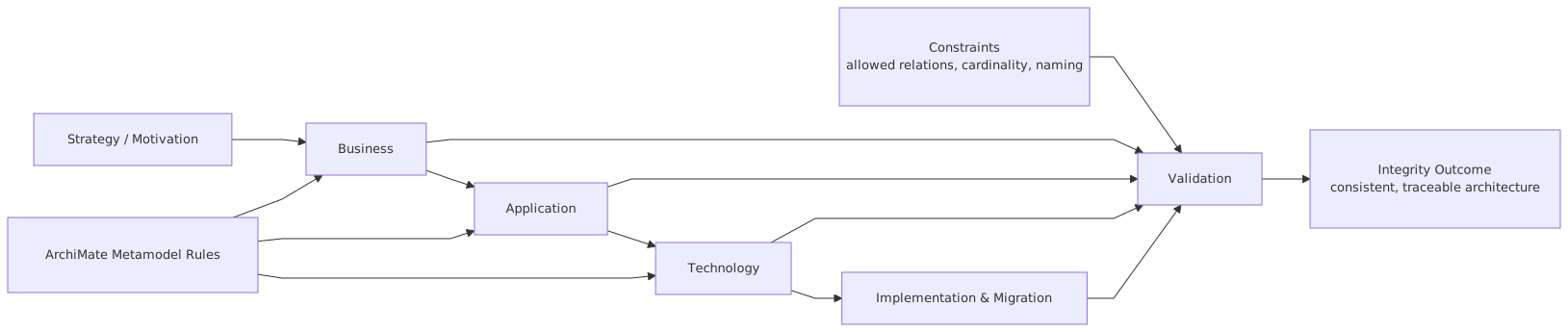
1. Impact analysis
If a cloud IAM service changes, what business processes, applications, integrations, and controls are affected? You can only answer this if the model distinguishes correctly between capabilities, services, components, interfaces, and data objects.
2. Transformation planning
When a bank moves from batch integration to event-driven architecture with Kafka, the roadmap depends on knowing what currently exposes services, what consumes events, what owns data, and where identity and access enforcement sits. Bad metamodel integrity destroys that visibility. EA governance checklist
3. Risk and compliance
Auditors and security teams care about facts: where authentication happens, where authorization decisions are made, where customer data is stored, where encryption applies. If your models blur application behavior with technology infrastructure, control mapping becomes unreliable.
4. Portfolio rationalization
You cannot rationalize duplicate platforms if one team models “Customer Identity” as a business capability and another models the actual IAM product under the same name as an application component. You’ll think you have one thing when you actually have three.
5. Decision credibility
This one is underrated. Architects lose trust when different diagrams tell different stories. Executives won’t say “your metamodel integrity is poor.” They’ll say “architecture is too abstract” or “we can’t rely on these models.” Same problem.
The foundation: ArchiMate already gives you rules, but they are not enough
ArchiMate is not a freeform canvas. It has a metamodel with defined concepts and allowed relationships. That’s good. It prevents complete chaos.
But let’s be honest: the standard is intentionally broad. It has to work across industries, scales, and use cases. So it gives you possibility, not enough precision for enterprise governance.
That means every serious architecture function needs three layers of control:
If you only have the first layer, your repository will still drift badly.
The most common modeling mistakes architects make
Some of these are so common they’ve become normal. They shouldn’t be.
Mistake 1: Confusing capabilities with operating reality
Capabilities are what the enterprise needs to be able to do. They are not systems, teams, processes, or products. But architects constantly use capabilities as labels for implementation things.
For example:
- “Identity and Access Management” as a capability: valid
- “Okta” as a capability: nonsense
- “Authentication Service” as a capability: probably wrong
- “Access Governance Team” as a capability: also wrong
Capabilities sit at a different level of abstraction. If you collapse them into implementation, you lose strategic traceability.
Mistake 2: Modeling products and platforms as services only
In cloud-heavy environments, people often model AWS, Kafka, or IAM platforms purely as services because “everything is a service now.” No. That’s lazy abstraction.
A Kafka cluster may be represented as a technology node or system software depending on your viewpoint. The event streaming capability it enables is not the same thing as the application services built on top of it. Likewise, an IAM platform may provide application services, expose interfaces, and run on technology infrastructure. Those are different model elements.
If you flatten all of that into one service box, you’ve hidden the architecture.
Mistake 3: Using relationships because they look right visually
This happens all the time:
- flow used where serving is correct
- association used because the modeler is unsure
- realization used as a generic “implements” line
- composition used when the relationship is actually just dependency
Association is the junk drawer of ArchiMate. If your repository is full of it, that’s a warning sign. Not every uncertainty should be solved with a vague line.
Mistake 4: Mixing layers without intent
Business, application, and technology layers are not prison walls, but they are meaningful distinctions. Good models can cross layers. Bad models collapse them casually.
A business process should not directly trigger a technology node unless you are deliberately modeling automation or deployment implications. More often, there is an application behavior or service in between. Skip that and you create false directness.
Mistake 5: Creating local synonyms
This is deadly in large repositories. One team models “Customer Profile,” another “Client Master,” another “Party Record,” and all mean roughly the same data concept. Or maybe not. Nobody knows.
Metamodel integrity is not just about relationship legality. It is also about concept identity. If your repository lacks controlled vocabulary and canonical elements, validation will catch syntax but miss semantic duplication.
Mistake 6: Modeling every integration as point-to-point flow
In event-driven architecture, especially with Kafka, teams often keep drawing producer-to-consumer arrows as if the broker were incidental. That misses the architecture pattern entirely.
The broker matters. Topics matter. Schemas matter. Event contracts matter. Retention and replay matter. Security context propagation matters. If your metamodel usage cannot express these distinctions, your integration architecture becomes misleading.
What rules and constraints should an enterprise actually define?
This is where architecture teams either get serious or stay decorative.
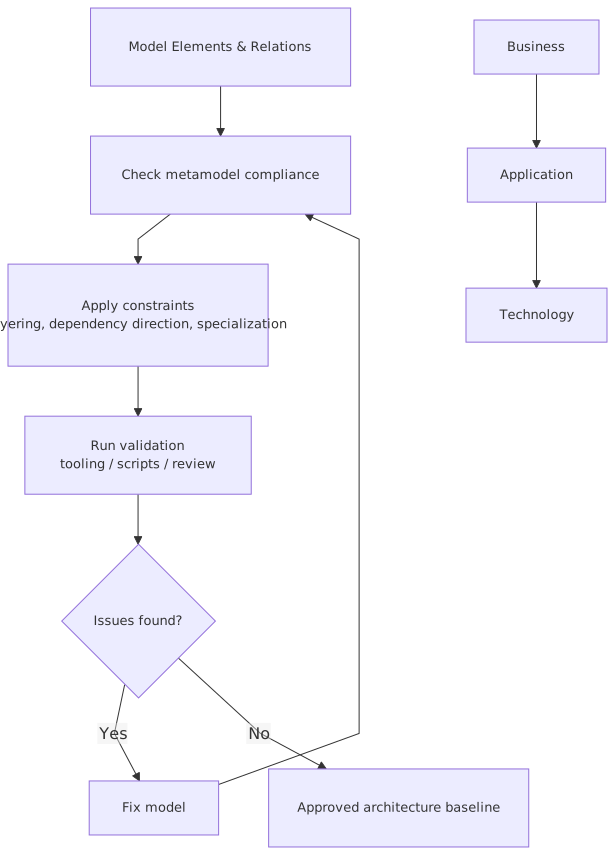
A useful enterprise metamodel governance approach should define rules in four categories.
1. Element typing rules
These answer: what kind of thing is this?
Examples:
- Business capabilities must not be used to represent applications, teams, or processes
- Application components must represent deployable or logically distinct software units
- Application services must represent externally visible behavior offered by application components
- Technology nodes must represent infrastructure execution environments, not products in the procurement sense
- Data objects must represent information structures relevant to architecture decisions, not every database table
This sounds obvious. It isn’t. In practice, teams need examples and anti-examples.
For IAM:
- “Identity and Access Management” = capability
- “Central IAM Platform” = application component
- “Authentication API” = application service
- “Login UI” = application interface
- “Azure tenant hosting IAM workloads” = technology node context, if relevant to the viewpoint
That separation is what makes the model usable.
2. Relationship rules
These answer: how may things connect?
Examples:
- Business processes may use application services, not application components directly, unless you intentionally model implementation dependency
- Application components realize application services
- Application components may access data objects, but ownership should be explicit
- Kafka topic relationships should distinguish between producer behavior, broker platform, and consumer behavior rather than generic association
- Flow relationships should be used for transfer or movement, not generic dependency
This is where repositories either become analyzable or become spaghetti.
3. Mandatory attributes and qualifiers
A model element without attributes is often just a drawing aid.
Useful mandatory fields might include:
- owner
- lifecycle status
- criticality
- environment
- source system of record
- data classification
- deployment type
- authentication method
- cloud region
- resilience tier
For example, if an application service exposes customer data and there is no data classification or owner attached, your model is incomplete for any serious governance use.
4. Naming and canonicalization rules
This is less glamorous and more important than many architects admit. ArchiMate in TOGAF ADM
Rules might include:
- singular noun form for data objects
- no vendor names in capability names
- product names allowed only for implementation elements
- one canonical enterprise concept per business object
- abbreviations only from controlled glossary
If you skip naming discipline, validation will pass technically correct nonsense.
A real enterprise example: a bank modernizing IAM and event architecture
Let’s ground this in a plausible banking example, because this is where metamodel integrity stops being theoretical.
A retail bank is modernizing three things at once:
- moving customer-facing applications to cloud-native platforms
- introducing Kafka for event-driven integration
- centralizing IAM for workforce and customer identity
Sounds familiar, because half the industry is doing some version of this.
The initial state
The architecture repository has these problems:
- “IAM” appears as a capability, application, service, and project in different diagrams
- Kafka is shown as a single application component connected to dozens of systems with association lines
- customer data objects are duplicated under different names across channels and core banking
- cloud services are modeled inconsistently: some as nodes, some as application components, some as locations
- business processes directly connect to infrastructure in several views
Everyone says the repository is “good enough.” It isn’t.
Why it becomes a business problem
The bank wants to answer practical questions:
- Which applications depend on central authentication during branch outage scenarios?
- Which event flows carry customer PII through Kafka?
- Which systems enforce authorization decisions versus just consuming tokens?
- What is the impact of moving IAM token validation to a cloud API gateway?
- Which business processes break if a Kafka cluster in one region fails?
Those are not notation questions. They are operating model, risk, and resilience questions. But you can’t answer them without a trustworthy metamodel.
The corrected modeling approach
The bank introduces enterprise constraints.
IAM modeling
- “Customer Identity and Access Management” is a business capability
- “Customer IAM Platform” is an application component
- “Authentication Service,” “Token Introspection Service,” and “Authorization Decision Service” are application services
- “OIDC API” and “Admin Console” are application interfaces
- policy stores and identity stores are modeled as data objects or technology artifacts depending on the viewpoint
- cloud-hosted runtime environments are modeled in the technology layer
This immediately separates strategic capability from implementation.
Kafka modeling
- Kafka broker platform is modeled as technology service and/or system software within a technology node context
- producer applications and consumer applications remain application components
- event publication and consumption behaviors are modeled explicitly
- key topics or event streams are represented consistently, not hidden behind vague arrows
- schema registry and event governance services are modeled separately where architecturally relevant
This matters because Kafka is not just a pipe. It is an architectural mechanism with durability, decoupling, replay, and governance implications.
Banking data modeling
- “Customer,” “Account,” “Payment Instruction,” and “Consent” become canonical data objects
- each has ownership and classification attributes
- application components access them through services or event channels, rather than every team inventing local equivalents
Now the repository can support impact analysis.
The result
When the bank evaluates a change to centralize authorization in the IAM platform, architects can trace:
- business processes using affected application services
- applications consuming those services
- Kafka event consumers that rely on authorization claims in tokens
- cloud deployment nodes that host the enforcement points
- data objects carrying customer entitlements or consent attributes
That is architecture earning its keep.
Without metamodel integrity, this analysis would become a workshop full of opinions.
Validation: where good intentions become operational discipline
Rules written in a wiki are not governance. They are aspirations. Validation is what turns metamodel integrity into a working practice.
And this is where many architecture teams get timid. They worry validation will annoy modelers or slow delivery. Maybe. Good. A little friction is healthier than silent semantic decay.
Validation should happen at three levels.
1. Point-of-modeling validation
The modeling tool should prevent or flag obvious violations:
- invalid relationship types
- missing mandatory attributes
- forbidden element combinations
- duplicate names in controlled domains
This is the first line of defense. If the tool allows anything, your governance model is already weak.
2. Repository-wide validation
This is where you run periodic checks across the whole estate:
- orphan elements with no meaningful relationships
- services with no realizing components
- components with no owner
- duplicated canonical data objects
- business processes linked directly to infrastructure where enterprise rules disallow it
- use of banned generic relationships like excessive association
This level catches drift. And drift is inevitable.
3. Decision-oriented validation
This is the mature level. Not just “is the syntax correct?” but “is the model useful for decisions?”
Examples:
- every customer-facing application must trace to an authentication service
- every PII-carrying event flow must have classification metadata
- every critical banking process must map to resilience-tiered technology services
- every cloud workload must trace to an IAM control model
This is where the architecture repository stops being a model museum and becomes a control surface.
A practical validation checklist
Here’s a simple example of what an enterprise team can validate regularly.
This is not overkill. This is basic enterprise hygiene.
Contrarian view: strict metamodel governance can also be stupid
Let me be fair. There is a bad version of this.
Some architecture teams become metamodel police. They obsess over purity and forget purpose. Every model review turns into a seminar on whether a thing is behavior or structure while the delivery teams are trying to migrate workloads and reduce operational risk.
That is also failure.
A model is not better because it is more academically precise. It is better because it supports understanding and decision-making with enough semantic consistency to be trusted.
So yes, enforce rules. But don’t turn ArchiMate into liturgy.
A few principles help:
- model only what matters to the question at hand
- use stricter rules for shared repository content than for workshop sketches
- allow viewpoint-specific simplification, but map it back to canonical elements
- distinguish between temporary incompleteness and structural violation
- optimize for consistency over cleverness
In other words: be disciplined, not doctrinaire.
How this applies in day-to-day architecture work
This is where people often nod along and then go back to producing diagrams the old way. So let’s make it practical.
In solution architecture
When defining a new cloud-native customer onboarding service for a bank, the solution architect should not simply draw:
- onboarding app
- Kafka
- IAM
- core banking
That says almost nothing.
A better model distinguishes:
- the business process steps supported
- the application services the onboarding platform consumes from IAM
- the events it publishes to Kafka
- the canonical customer and consent data objects involved
- the technology services or nodes relevant for deployment and resilience
This allows reviewers to challenge the real architecture:
- where is identity proofing handled?
- where is consent stored?
- does the onboarding service depend synchronously on authorization?
- what breaks if Kafka is unavailable?
- is customer data duplicated outside the system of record?
In domain architecture
Domain architects often suffer from semantic drift because they work across many teams. Metamodel integrity helps them create reusable patterns.
For example, in a banking payments domain:
- all event producers and consumers are modeled consistently
- payment instruction and settlement data objects are canonical
- IAM enforcement points are visible across APIs and internal services
- cloud runtime patterns are represented consistently across domains
This enables comparison and reuse.
In governance boards
Architecture review boards should stop spending all their time on PowerPoint narratives and start checking whether the repository can answer decision questions.
If a team proposes moving authorization logic from application code into a central IAM service, the board should be able to inspect:
- impacted application services
- affected business processes
- token or claim propagation dependencies
- Kafka consumers relying on embedded authorization context
- resilience implications in cloud regions
If the model cannot support that, the repository has failed the governance use case.
In M&A and transformation
This is where metamodel integrity becomes brutally valuable. During acquisition integration, everyone claims they have “customer identity,” “event streaming,” and “cloud platforms.” Fine. But what are those exactly?
A disciplined metamodel lets you compare:
- capabilities versus implementations
- application services versus products
- canonical data objects versus local variants
- technology services versus hosting constructs
Without that, integration planning becomes a naming argument.
What a mature enterprise architecture team does differently
The good teams are not necessarily the ones with the fanciest repositories. They are the ones that make modeling boring in the right way.
They do a few things consistently:
They define canonical patterns
For IAM, Kafka, API platforms, cloud landing zones, they publish model patterns with approved element and relationship usage. Not just words. Actual examples.
They train architects on semantics, not just notation
Most ArchiMate training is too generic. Real teams need domain-specific examples:
- how to model an API gateway
- how to model identity federation
- how to model event streams
- how to represent managed cloud services
- how to separate capability maps from runtime architecture
They automate validation
If validation depends on manual review, it will be inconsistent and late. Tool-based checks should catch the easy stuff so architects can spend human energy on actual design quality.
They curate the repository
Someone owns canonical concepts. Someone resolves duplicates. Someone retires obsolete elements. Repositories do not stay clean by goodwill.
They tolerate imperfect but improving models
This is important. If teams fear punishment for every incomplete model, they will stop modeling honestly. Maturity comes from iterative improvement, not from pretending every view is perfect.
A simple operating model for metamodel integrity
If you want to make this work without drowning in process, use a lightweight operating model:
- Define the enterprise modeling standard
- approved element types
- relationship usage rules
- naming conventions
- mandatory attributes
- Publish reference patterns
- IAM pattern
- Kafka event pattern
- API integration pattern
- cloud deployment pattern
- data ownership pattern
- Implement automated validation
- in-tool constraints
- nightly repository checks
- dashboard for violations
- Establish stewardship
- canonical concept owners
- domain architects as reviewers
- repository curator or librarian role
- Tie validation to governance outcomes
- not every violation blocks progress
- critical violations do
- repeated semantic issues trigger coaching
This is enough for most enterprises. You do not need a cathedral. You need discipline.
Final thought: integrity is what makes architecture reusable
Architecture teams often say they want a “single source of truth.” Fine phrase. Usually meaningless.
A repository becomes a source of truth only when its semantics are stable enough that different people can interpret it the same way and use it for decisions. That is what metamodel integrity gives you.
And this is why I feel strongly about it. Not because I enjoy standards policing. I don’t. But I’ve seen too many enterprises spend years building architecture content that nobody trusts because basic modeling discipline was treated as optional.
In banking, in cloud transformation, in IAM modernization, in Kafka-based integration, the same lesson keeps showing up: if you are sloppy about what things are and how they relate, your architecture will fail exactly when the stakes get real.
ArchiMate is powerful precisely because it is constrained. The metamodel is not there to limit thinking. It is there to prevent self-deception.
That’s the real point.
FAQ
1. What is metamodel integrity in ArchiMate in simple terms?
It means your architecture models use the correct element types, relationship types, and constraints consistently. In practice, it means an application service is modeled as an application service, not sometimes as a capability, sometimes as a component, and sometimes as a vague box with a nice label.
2. Why isn’t the ArchiMate standard alone enough?
Because the standard is broad by design. Real enterprises need extra rules for local consistency. For example, how you model Kafka topics, IAM platforms, managed cloud services, or canonical banking data objects usually requires enterprise-specific constraints and patterns.
3. What is the most common mistake architects make?
Mixing abstraction levels. Capabilities become products, products become services, services become components, and relationships are chosen based on diagram appearance rather than meaning. That destroys traceability and makes impact analysis unreliable.
4. How do you validate metamodel integrity in practice?
Use a mix of tool constraints, repository-wide automated checks, and architecture review. Validate basics like legal relationships and mandatory attributes, but also validate decision usefulness, such as whether critical applications trace to IAM services or whether PII event flows in Kafka are classified and owned.
5. How strict should metamodel governance be?
Strict enough to preserve trust, not so strict that modeling becomes ceremonial. Shared repository content should be governed tightly. Early workshop sketches can be looser. The goal is not perfect theoretical purity. The goal is models that are consistent enough to support real enterprise decisions.
Frequently Asked Questions
What is the ArchiMate metamodel?
The ArchiMate metamodel formally defines all element types (Business Process, Application Component, Technology Node, etc.), relationship types (Serving, Realisation, Assignment, etc.), and the rules about which elements and relationships are valid in which layers. It is the structural foundation that makes ArchiMate a formal language rather than just a drawing convention.
How does the ArchiMate metamodel support enterprise governance?
By defining precisely what each element type means and what relationships are permitted, the ArchiMate metamodel enables consistent modeling across teams. It allows automated validation, impact analysis, and traceability — turning architecture models into a queryable knowledge base rather than a collection of individual diagrams.
What is the difference between using ArchiMate as notation vs as an ontology?
Using ArchiMate as notation means drawing diagrams with its symbols. Using it as an ontology means making formal assertions about what exists and how things relate — leveraging the metamodel's semantic precision to enable reasoning, querying, and consistency checking across the enterprise model.