⏱ 20 min read
Most distributed systems don’t fail because teams forgot Kubernetes. They fail because they turned organizational confusion into network topology.
That’s the real trap.
A company starts with a sensible ambition: “Let’s break up the monolith.” Someone introduces Domain-Driven Design, someone else introduces microservices, and before long every bounded context is treated as if it must become its own deployable unit, its own repository, its own pipeline, its own database, and often its own little religion. The context map becomes an infrastructure diagram. The language of the business gets welded to the mechanics of deployment. And what should have been a modeling decision becomes an operational burden.
This is one of the most persistent misunderstandings in enterprise architecture: domain boundaries and deployment boundaries are not the same thing. They sometimes align. They often don’t. And the quality of the architecture depends on knowing the difference.
A bounded context in Domain-Driven Design exists to protect meaning. It draws a line around a model, a language, and a set of business rules that must stay coherent. A deployment boundary exists to manage runtime concerns: scaling, release independence, resilience, compliance isolation, fault containment, and team autonomy. These are related concerns, but they are not identical. If you collapse them into one decision, you’ll optimize too early for the wrong thing.
This article takes a firm view: start with domain semantics, then decide deployment shape deliberately. Not every bounded context deserves a microservice. Not every microservice corresponds to a single bounded context. Sometimes one deployable contains several contexts. Sometimes one context spans multiple runtime components. In large enterprises, the best answer is usually messier than conference slides suggest.
That messiness is not failure. It is architecture.
Context
Domain-Driven Design gave us one of the most useful ideas in software architecture: the model is not universal. “Customer” in billing is not the same as “customer” in identity, support, or marketing. “Order” in fulfillment is not the same thing as “order” in pricing or payments. The same word can carry different invariants, different lifecycles, and different responsibilities depending on context.
That’s why bounded contexts matter. They stop semantic leakage. They prevent one team’s truth from becoming another team’s accidental dependency.
Microservices, in contrast, emerged from a different pressure. They are not primarily a modeling tool. They are a tool for independent deployment and operational decentralization. They help when a part of the system must evolve, scale, or fail differently from another part.
These two ideas are complementary, but they answer different questions:
- Bounded context: where does a model stay consistent and meaningful?
- Deployment boundary: what must be built, released, scaled, observed, and recovered independently?
In small systems, the two often line up nicely. In enterprises, they drift apart fast.
An insurance platform may have a clean domain split between underwriting, policy administration, claims, billing, and broker management. But perhaps underwriting and policy administration are released by the same team, share a transaction-heavy workflow, and must coordinate on the same SLA. Splitting them into separate deployables may add queues, retries, duplication, and reconciliation headaches without creating real business benefit.
Likewise, a single bounded context such as payments may need multiple deployment units: a synchronous payment API, an asynchronous settlement processor, a fraud scoring component, and a reconciliation worker. They still belong to the same domain language, but their runtime needs differ sharply.
This is why architects need both a context map and a deployment view. One protects the business meaning. The other protects the operating model.
Confuse those, and the system will either calcify into a distributed monolith or fracture into semantic nonsense.
Problem
The common anti-pattern goes like this:
- Run a DDD workshop.
- Identify bounded contexts.
- Declare each context a microservice.
- Give each one a database.
- Join them with Kafka.
- Call it modern.
This is architecture by template. It looks clean on a whiteboard. It performs terribly in the wild.
The first issue is semantic reductionism. A bounded context is not just a namespace or a code module. It embodies language and rules. Turning every context immediately into a separate service often forces teams to externalize interactions that are still immature, tightly coupled, or not yet understood. You end up with APIs that merely expose internal object graphs and events that leak persistence details. The distributed boundary arrives before the domain boundary is stable.
The second issue is operational inflation. Every deployable adds pipelines, observability, security configuration, secrets handling, on-call ownership, release coordination, vulnerability management, and failure recovery paths. A system with thirty microservices is not three times harder than a system with ten. It is often an order of magnitude harder because coordination costs compound. microservices architecture diagrams
The third issue is transactional reality. Enterprises contain workflows that do not fit neat local transactions. Once separate deployables sit on different databases, consistency becomes asynchronous. That means outbox patterns, idempotency, retries, poison messages, compensations, duplicate detection, and reconciliation. These are not edge concerns. They become the core of the architecture.
And then comes the political problem. Teams start believing that ownership equals process isolation. Every deployment boundary is treated as a territorial line. The model fragments around team charts instead of business capabilities. The result is a context map shaped by org design at its worst: accidental Conway, not strategic Conway.
The architecture starts speaking in service names and stops speaking in business terms. That is the moment to worry.
Forces
Good architecture lives in forces, not slogans. Here the main forces are in tension.
Semantic cohesion
This is the DDD force. Business rules that belong together should evolve together. Shared terms need controlled meaning. Invariants must be protected. If two behaviors rely on the same model and are changed together all the time, splitting them physically may damage clarity rather than improve it.
Independent change
This is the microservice force. If one part of the system changes weekly and another changes twice a year, coupling them in one deployment can slow everyone down. Release independence matters, especially in regulated enterprises where change windows are expensive.
Runtime scaling
Some workloads are spiky. Pricing, search, fraud scoring, and event ingestion often scale differently from master data maintenance or back-office workflows. Separate deployment boundaries can be justified purely by operational shape.
Fault isolation
A runaway recommendation engine should not take down order capture. A failed document generation batch should not block policy issuance. Deployment boundaries can limit blast radius—but only if designed with real isolation, not just separate Dockerfiles.
Transactional consistency
The more you split deployments, the more consistency becomes a protocol rather than a guarantee. That can be the right call, but it is never free. Every service boundary is an invitation to eventual consistency.
Team topology
Architecture follows communication paths. If two teams cannot coordinate daily, a shared deployable may become a bottleneck. But team boundaries are unstable. Designing software solely around the current org chart is a costly kind of optimism.
Compliance and data sovereignty
Sometimes deployment boundaries are driven by legal constraints: PCI zones, PII isolation, regional hosting, audit trails. These concerns can trump a neat domain decomposition.
An architect’s job is not to remove these forces. It is to decide which ones deserve to win, where.
Solution
The practical solution is simple to say and harder to live by:
Model domain boundaries first. Choose deployment boundaries second. Revisit both as the system evolves.
A context map should capture how business capabilities relate: customer-supplier, conformist, anti-corruption layer, published language, shared kernel where you must, and separate ways where you can. This is a semantic and organizational artifact. It tells you where meanings differ and how translations should happen.
A deployment architecture should then ask different questions:
- What needs independent release?
- What needs independent scaling?
- What requires fault isolation?
- What data must be isolated for security or compliance?
- What operational complexity can the organization actually sustain?
Sometimes the answer is one bounded context per service. That’s a good fit when the context is mature, cohesive, independently evolving, and operationally distinct.
Sometimes the answer is multiple bounded contexts inside one deployable. This is especially useful during migration, early product evolution, or in domains where interactions are rich and consistency needs are high. You can preserve semantic boundaries in code—modules, packages, internal APIs, separate models—without paying the full distributed-systems tax on day one.
Sometimes the answer is one bounded context across several deployment units. For example, the payments context may expose a payment command API, emit payment status events, run a settlement batch, and host a reconciliation processor. Same language, multiple nodes.
That distinction matters because it gives architects room to stage change. You can protect domain semantics before committing to network boundaries. That is often the difference between a system that can evolve and a system that merely disperses.
Here’s the key line: bounded contexts are about understanding; deployment nodes are about operating.
Architecture
A healthy enterprise architecture shows both views explicitly.
Context map view
This view answers: what does the business mean by things, and where do those meanings differ?

In this map, “Customer” in identity may be a verified party with credentials and consent. In billing, it may be an account holder with invoicing preferences and tax attributes. In order management, it may simply be the actor associated with a purchase intent. Similar labels, different semantics. That is normal.
Now compare that with the deployment view.
Deployment node view
This view answers: what runs where, what scales independently, and where failures are contained?
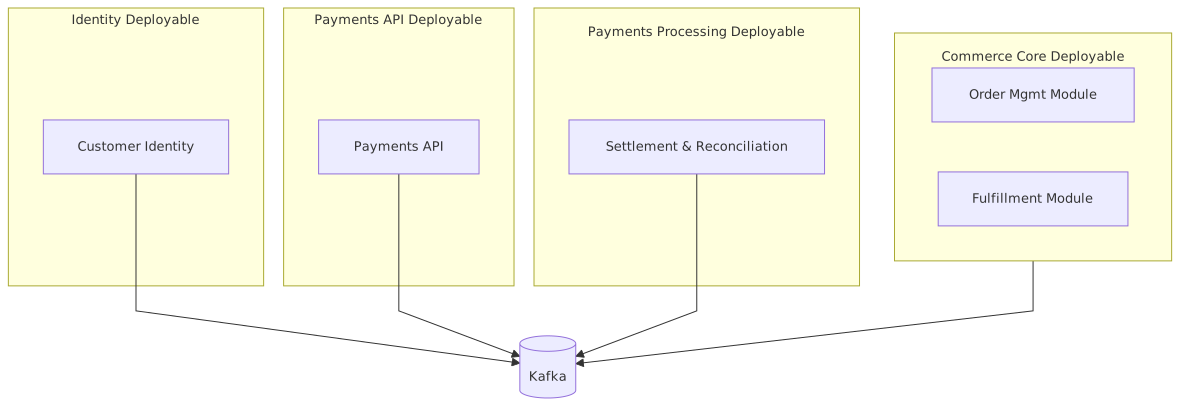
Notice the asymmetry. Order management and fulfillment are distinct bounded contexts in the model, yet they are currently co-deployed inside a commerce core deployable because they share tight workflows, release cadence, and transactional needs. Payments, though one broader domain, is split into API and processing nodes because the runtime concerns differ.
That’s not inconsistency. That’s architectural maturity.
Internal modular boundaries still matter
If several contexts share a deployable, they must still be isolated in code. Otherwise the deployable becomes a monolith in both operation and semantics. Keep separate domain models. Use explicit contracts between modules. Avoid direct table-sharing habits. Distinguish internal commands, domain events, and integration events.
A useful mental model is this: a modular monolith can host bounded contexts; a microservice is not the only container for a domain boundary.
This is particularly valuable in enterprise modernization. You can stabilize language and interactions inside one deployable before deciding whether the boundary deserves a network hop.
Synchronous and asynchronous interactions
Once deployment boundaries appear, interactions need care. Commands that require immediate user feedback often remain synchronous. State propagation and downstream reactions often become event-driven.
Kafka is useful here, but it is not a magic wand. Enterprises adopt Kafka because it decouples producers and consumers, buffers load, supports replay, and fits event-carried integration. But Kafka also introduces ordering concerns, schema evolution issues, duplicate delivery, consumer lag, retention governance, and operational overhead. Use it where asynchronous decoupling is a business need, not as a default replacement for thought. event-driven architecture patterns
A good rule:
- Use APIs for direct intent and immediate response.
- Use events for fact propagation and downstream autonomy.
- Use reconciliation when business correctness matters more than transport purity.
That last point deserves emphasis. Reconciliation is not a sign of bad architecture. It is the price of distributed truth.
Migration Strategy
Most enterprises do not start with greenfield bounded contexts and carefully selected deployment nodes. They start with a monolith and a backlog.
So the practical path is a progressive strangler migration.
Don’t begin by carving the system into twenty services. Begin by identifying candidate domain boundaries in the monolith. Stabilize language. Extract seams. Introduce modular boundaries inside the existing deployment. Then separate runtime units only where the evidence supports it.
A sensible migration sequence looks like this:

Step 1: discover and name the contexts
Run event storming, domain workshops, capability mapping—whatever works in your culture. The point is not ceremony. The point is to expose where language changes and where business rules differ. Create a context map before creating service tickets.
Step 2: modularize in place
Separate packages, schemas if possible, internal APIs, and explicit ownership. Kill direct cross-module object sharing. This step is routinely undervalued. It is where most of the real design work happens.
Step 3: identify extraction candidates
Extract only when there is a compelling driver:
- scaling asymmetry
- team autonomy bottleneck
- release contention
- compliance isolation
- unstable dependencies requiring anti-corruption
- fault isolation need
For example, payment authorization may be extracted early because it depends on external gateways, has strict availability concerns, and changes under a different regulatory cadence. Product catalog may stay inside the modular monolith for a long time if its dependencies are internal and its scaling profile is ordinary.
Step 4: add integration patterns deliberately
Introduce the outbox pattern before relying on domain events crossing deployments. Define integration events separately from internal domain events. Use schema versioning. Add idempotent consumers from day one. If a workflow spans services, define the business states explicitly—pending, accepted, rejected, timed out, reconciled—not just technical statuses.
Step 5: design for reconciliation
This is where mature enterprise architecture parts ways with simplistic microservice enthusiasm.
A distributed order-to-cash flow will fail in partial ways:
- order accepted, payment event delayed
- payment captured, fulfillment command timed out
- invoice generated twice after consumer replay
- shipment completed, billing offset not posted
You do not solve these by pretending exactly-once semantics exist end-to-end. You solve them with:
- idempotent command handling
- immutable business events
- compensating actions where possible
- periodic reconciliation jobs
- audit trails
- exception work queues
Reconciliation is the safety net under eventual consistency. In finance, supply chain, telecom, and insurance, it is not optional. If money, stock, or legal commitments move, there must be a way to compare systems of record and correct drift.
Step 6: keep some contexts co-deployed longer than purity suggests
This is the part many teams resist because it feels less modern. Ignore the aesthetic pressure. If two contexts still change together and rely on rich transactional consistency, keep them in one deployable while preserving their semantic separation. Extraction can come later. Premature distribution is harder to undo than delayed extraction.
Enterprise Example
Consider a global retailer modernizing its order-to-cash platform.
The legacy system is a large Java monolith handling customer registration, cart, order capture, payment orchestration, invoicing, inventory reservation, fulfillment, and returns. The first executive push is predictable: “Move to DDD microservices on Kafka.”
A less disciplined team would create services for Customer, Cart, Order, Inventory, Payment, Billing, Fulfillment, and Returns in one go. They would then discover that order capture, inventory reservation, and fulfillment planning share dense business interactions around substitutions, split shipments, and backorders. Now every checkout becomes a distributed conversation with retries and timeout states nobody modeled properly.
A better architecture begins with bounded contexts:
- Customer Identity
- Order Management
- Inventory Allocation
- Payments
- Billing
- Fulfillment
- Returns
So far, so normal.
But the deployment decision is different. In phase one, the retailer keeps Order Management and Inventory Allocation in the same deployable because reservation logic is transaction-heavy and the teams are still one unit. Payments is extracted early because it integrates with several PSPs, has distinct resilience requirements, and must be PCI-isolated. Billing remains co-deployed with the monolith initially because local tax handling is tangled and changes rarely. Customer Identity is isolated because it is shared across channels and has separate authentication concerns.
Kafka is introduced for integration events:
OrderPlacedPaymentAuthorizedInventoryReservedShipmentDispatchedInvoiceIssuedReturnReceived
But the architects do one thing right that many teams skip: they define a reconciliation service for financial and fulfillment mismatches. Every night—and on-demand for critical cases—it compares order totals, payment captures, invoice amounts, inventory commitments, and shipment facts. If divergence is found, it opens an exception case with reason codes and recommended remediation.
That service will never make it into a conference keynote. It is also the reason the platform survives Black Friday.
Over time, when order and inventory rules stabilize and scaling diverges, Inventory Allocation is split into its own deployable. Not before. When evidence arrives.
This is what enterprise architecture looks like when it respects both semantics and operations.
Operational Considerations
Deployment boundaries are operational contracts. Once a context becomes a separate node, the burden is real.
Observability
Every boundary needs tracing, metrics, structured logs, and business-level telemetry. It’s not enough to know that a consumer lagged. You need to know that PaymentAuthorized was received but no corresponding InvoiceIssued appeared within SLA. Technical observability without business observability is dashboard theater.
Data contracts
Context maps imply translation. Deployment nodes need schemas. With Kafka especially, schema governance matters. Integration events should be stable, intention-revealing, and versioned. Don’t publish internal aggregates as events. Publish business facts others can rely on. EA governance checklist
Backpressure and retries
Kafka smooths load, but downstream systems still choke. Define retry policy, dead-letter handling, replay procedures, and ordering assumptions. Some flows can tolerate out-of-order events. Financial flows often cannot without extra sequence logic.
Security and compliance
Separate deployables help isolate PCI, PII, and region-specific data. But boundaries also create more attack surface: more identities, more secrets, more transport policies, more audit points. Security architecture gets easier locally and harder globally.
Release governance
Independent deployment is valuable only if teams can actually release independently. Shared event contracts, shared libraries, and hidden runtime dependencies often erase the supposed autonomy. Service count is not autonomy. Dependency quality is.
SRE burden
Every new service has a carrying cost. Runbooks, alerts, patching, certificates, autoscaling policy, disaster recovery, capacity planning. If the organization lacks platform maturity, too many deployment boundaries will drown teams in incidental work.
A line I’ve seen hold up well: you can distribute your software faster than you can distribute your operational competence.
Tradeoffs
There is no clean victory condition here, only tradeoffs chosen in the open.
Aligning bounded contexts and deployment boundaries
Pros
- easier ownership
- clearer autonomy
- stronger encapsulation
- independent scaling and release
Cons
- more distributed transactions
- more observability burden
- more integration complexity
- more reconciliation and failure handling
Keeping multiple bounded contexts in one deployable
Pros
- lower operational overhead
- easier consistency
- faster local refactoring
- good migration posture
Cons
- weaker release independence
- risk of semantic leakage in code
- scaling and fault isolation are coarser
- can become a disguised monolith if discipline slips
Splitting one bounded context across multiple deployables
Pros
- runtime specialization
- targeted scaling
- better isolation of batch, API, and streaming workloads
Cons
- more internal coordination inside the same domain
- temptation to fragment the model
- requires stronger engineering maturity
The right answer depends on where the pain is. If the pain is semantic confusion, fix the context map. If the pain is release coupling or runtime profile, adjust deployment boundaries. Don’t prescribe a network for a language problem.
Failure Modes
Architectures around DDD microservices tend to fail in recognizable ways.
1. The distributed monolith
Services are separately deployed, but every request fans out synchronously across half the estate. Releases still require coordination. Failures cascade. Nothing is truly autonomous.
2. Semantic erosion
Teams extract services without stabilizing bounded contexts. The same concept appears in five event schemas with five meanings. Translation is missing, so coupling returns through vocabulary.
3. Event obsession
Kafka becomes the answer to every interaction. Critical user workflows disappear into asynchronous uncertainty. Teams lose control of latency, retries, and ownership. “Eventually consistent” becomes a euphemism for “nobody knows what happened.”
4. Missing reconciliation
The architecture assumes happy-path messaging. Duplicates, delays, missed events, and manual corrections accumulate until finance or operations discovers mismatch. At that point the system needs spreadsheets to function. That is the enterprise smell of a design that stopped halfway.
5. Contexts mirror team politics
Boundaries are drawn around funding lines or manager preferences, not domain semantics. The result changes every reorg and leaves the software carrying old org charts in code.
6. Over-extraction
Services are created before platform capability exists. Delivery slows, reliability drops, and teams spend more time maintaining YAML than improving business capability.
None of these are exotic. They are the normal outcomes of shallow decomposition.
When Not To Use
DDD plus microservices is not a universal prescription.
Don’t use this approach aggressively when:
- the domain is simple and mostly CRUD
- the team is small and communication is cheap
- operational maturity is low
- transaction consistency is central and hard to relax
- change cadence is uniform across the system
- compliance does not require strong isolation
- the organization cannot support event governance and reconciliation
In these cases, a modular monolith with explicit bounded contexts is often the better choice. It preserves domain clarity without paying network and operations tax too early. This is not a compromise. It is often the most professional design.
Likewise, if the business process depends on tight synchronous invariants and cannot tolerate delayed convergence, splitting across deployment boundaries may simply be the wrong tool. Not every enterprise system wants to be event-driven in its core transaction path.
Architecture should fit the economics of the situation. A distributed system is a capital expense paid forever.
Related Patterns
Several patterns help navigate the gap between domain and deployment boundaries.
- Bounded Context: the semantic boundary around a coherent model.
- Context Map: the relationships between contexts and their translation style.
- Modular Monolith: one deployment, many internal domain boundaries.
- Strangler Fig Pattern: progressive replacement of legacy functionality.
- Anti-Corruption Layer: translation between legacy or foreign models.
- Outbox Pattern: reliable publication of integration events from transactional state changes.
- Saga / Process Manager: coordination across long-running distributed workflows.
- CQRS: useful where read and write models or scaling profiles differ, but not mandatory.
- Event Sourcing: powerful in some domains, unnecessary in many; don’t reach for it to fix bad boundaries.
- Reconciliation Processing: comparison and correction across systems of record after asynchronous drift.
Notice that many of these patterns are migration and integration patterns, not just decomposition patterns. That’s because the hard part in enterprises is rarely drawing the box. It is living between the boxes.
Summary
Bounded contexts and deployment boundaries solve different problems.
A bounded context protects business meaning. It tells us where a model is valid, where language is consistent, and where rules belong. A deployment boundary protects runtime independence. It tells us what can scale, fail, release, and operate separately.
Sometimes they align. Often they should not.
The disciplined path is to:
- model the domain first
- draw the context map
- modularize the codebase
- extract deployables only when real operational or organizational forces justify it
- design events, APIs, and reconciliation intentionally
- evolve the shape over time through strangler migration
The big idea is not fashionable, but it is durable: don’t let infrastructure topology dictate business semantics.
If you remember one thing, let it be this: a context map is not a deployment diagram, and a deployment diagram is not a domain model. Mixing them is how enterprises create systems that are distributed in all the wrong places.
The best architectures keep meaning close, distance intentional, and failure expected. That’s not just DDD. That’s grown-up engineering.
Frequently Asked Questions
What is a service mesh?
A service mesh is an infrastructure layer managing service-to-service communication. It provides mutual TLS, load balancing, circuit breaking, retries, and observability without each service implementing these capabilities. Istio and Linkerd are common implementations.
How do you document microservices architecture for governance?
Use ArchiMate Application Cooperation diagrams for the service landscape, UML Component diagrams for internal structure, UML Sequence diagrams for key flows, and UML Deployment diagrams for Kubernetes topology. All views can coexist in Sparx EA with full traceability.
What is the difference between choreography and orchestration in microservices?
Choreography has services react to events independently — no central coordinator. Orchestration uses a central workflow engine that calls services in sequence. Choreography scales better but is harder to debug; orchestration is easier to reason about but creates a central coupling point.