⏱ 21 min read
Most integration mistakes don’t begin with bad technology. They begin with bad naming.
A team says “we need a queue,” but what they really need is a durable history. Another says “let’s publish events,” but what they actually want is a work dispatcher with retries and backpressure. Those are not the same thing. One is a conveyor belt. The other is a ledger. Treating them as interchangeable is how otherwise sensible architectures become haunted houses: messages disappear into dead-letter queues, consumers replay things they should never replay, and the business ends up asking an uncomfortable question—why did we charge this customer twice?
This distinction matters more in modern event-driven systems than teams often admit. Kafka, cloud messaging platforms, and microservices have made asynchronous architecture easy to provision and dangerously easy to misuse. You can wire services together in a day. You can spend the next two years discovering you modeled commands like facts, or facts like work items. event-driven architecture patterns
Here’s the blunt version: a command queue and an event stream solve different problems because they carry different semantics. A queue says, “someone must do this.” A stream says, “this happened.” If you collapse those meanings into one abstraction, the software will eventually leak the truth in production.
This article is about that line. Not just the technical line, but the domain line. We’ll look at the forces that push teams toward one model or the other, the architecture choices behind queues and logs, how to migrate without freezing the business, and where these patterns break down. We’ll use domain-driven design as the compass, because messaging architecture without domain semantics is just plumbing with ambition.
Context
Event-driven architecture has grown up in the enterprise. It is no longer confined to market data systems, telecom backbones, or over-caffeinated startup diagrams. Banks use it for payment workflows and fraud detection. Retailers use it for order orchestration and inventory visibility. Manufacturers use it to stitch together ERP, MES, warehouse systems, and digital channels. The stack often includes Kafka, cloud queues, workflow engines, CDC pipelines, and a patchwork of microservices. microservices architecture diagrams
On the surface, queues and streams can look deceptively similar. Both move messages asynchronously. Both decouple producers from consumers. Both can support retries, scale-out, and fault tolerance. Both can be “event-driven” in a broad sense.
But in architecture, surface similarity is one of the oldest traps.
A queue is usually about work distribution. Messages are intended to be consumed by one worker or one consumer group that shares the work. Ordering may be limited, history may be short-lived, and the system’s concern is successful processing, not long-term historical truth.
An event stream is about fact distribution and retained history. Events are appended to an ordered log, often partitioned. Consumers maintain their own position, can replay from earlier offsets, and derive state from the historical sequence. The point is not merely that processing occurs. The point is that the record exists.
That difference changes how you model business concepts, how you recover from failure, and how you migrate legacy systems.
Problem
Teams often ask the wrong first question:
- “Should we use Kafka or RabbitMQ?”
- “Do we need a queue or a topic?”
- “Can Kafka be our task queue?”
- “Can a queue also serve analytics and audit?”
These are implementation questions. The architectural question comes earlier:
Are we sending intent, or publishing fact?
If the message means “please reserve inventory for order 123,” that is a command. It implies authority, expected action, ownership, and usually a single responsible processor. If the message means “inventory was reserved for order 123,” that is an event. It is a domain fact that many interested parties may observe, and no subscriber should be responsible for making it true after the fact.
When teams blur this line, several pathologies appear:
- Command messages get replayed like events.
A replay is useful for rebuilding a read model. It is dangerous if it resubmits payments, reissues shipments, or recreates tickets.
- Events are treated like work queues.
A single consumer “takes” the event, effectively hiding a business fact from other bounded contexts that also need it.
- Audit and reconciliation become unreliable.
If the messaging layer drops history after processing, the enterprise loses one of the main economic benefits of event-driven design: traceability.
- Domain boundaries become muddled.
Services stop owning decisions and start outsourcing business meaning to infrastructure.
This is not a theoretical issue. It appears every time an enterprise starts modernizing around Kafka and microservices while still carrying decades of queue-based integration habits.
Forces
Architecture is tradeoffs under pressure. Several forces push organizations toward queues, streams, or both.
1. Domain semantics
This is the most important force, and the one teams skip when they are in a hurry.
In domain-driven design terms, a command is directed at an aggregate or service boundary to request behavior. It has an intended receiver. It carries business intent. It can be rejected because the world has changed.
An event is something the domain says is already true. It is past tense for a reason. It should be immutable, meaningful, and comprehensible without hidden procedural assumptions.
If your message vocabulary is full of imperative verbs—CreateShipment, AllocateStock, ApproveClaim—you are probably in command territory. If it is full of past-tense business facts—ShipmentCreated, StockAllocated, ClaimApproved—you are in event territory.
Good architecture respects the grammar of the business.
2. Fan-out and independent consumption
Queues shine when one unit of work should be handled once. Streams shine when many consumers need the same fact for different reasons: billing, analytics, notifications, search indexing, compliance, machine learning, and downstream process coordination.
3. Replay and temporal history
If you need to rebuild projections, backfill a new service, support compliance audits, or perform reconciliation, a retained event log is gold. If you only need work assignment and short-lived delivery guarantees, a queue is often simpler.
4. Throughput and backpressure
Queues are naturally good at smoothing bursts of work. A worker pool drains them as capacity allows. Streams can handle enormous throughput too, but the operational model differs: consumers track offsets, partitions define parallelism, and lag becomes a first-class operational metric.
5. Ordering
A queue may offer local ordering, but distributed worker concurrency often weakens that guarantee. Streams, especially partitioned logs like Kafka topics, can preserve order per key. If your aggregate consistency depends on “all events for Order 123 arrive in sequence,” a keyed stream is often the better fit.
6. Coupling to processing outcome
A command’s lifecycle is tied to whether the work succeeded, failed, timed out, or was retried. An event’s meaning should not depend on whether consumers were awake when it was published. That distinction drives infrastructure choices, retry strategies, and governance. EA governance checklist
7. Organizational maturity
Streams impose discipline. Event contracts, schema evolution, retention policy, partition strategy, replay safety, and consumer offset management are all real concerns. A queue can be more forgiving for localized work execution. Not every team needs a company-wide event backbone on day one.
Solution
The practical answer in most enterprises is not “choose one.” It is use each intentionally.
Use a command queue when you need to distribute actionable work to a responsible processor. Use an event stream when you need durable publication of domain facts to multiple independent consumers. Keep the semantics clean.
A common and healthy architecture looks like this:
- user action or upstream system issues a command
- owning service validates invariants and performs the transaction
- if successful, the service emits one or more domain events
- those events flow through a retained stream for other consumers
- downstream services may react by issuing their own commands internally
That chain matters because it preserves ownership. Commands go to the service that can decide. Events come out of the service that did decide.
Here is the core semantic distinction:

The queue asks for work.
The stream records the answer.
That pattern sounds simple. In practice, the mistakes come from trying to make one mechanism pretend to be the other:
- using Kafka topics as ad hoc work queues with no replay discipline
- using broker queues as “event buses” while deleting all history after first consumption
- publishing technical lifecycle messages instead of domain events
- letting every service emit commands to every other service, creating distributed spaghetti
The architecture should reflect the business conversation, not the vendor marketing page.
Architecture
Let’s make the distinction more concrete.
Command queue architecture
A command queue is typically point-to-point or single-effective-consumer per work item. Even if there are multiple workers, they are sharing responsibility for one stream of commands.
Characteristics:
- targeted responsibility
- work stealing or consumer-group style distribution
- retries, visibility timeout, dead-letter queue
- idempotent command handling still required
- message retention often short
- replay usually dangerous unless explicitly controlled
Typical examples:
- generate invoice PDFs
- submit payment for settlement
- trigger fraud review
- provision a user account
- dispatch warehouse pick task
The danger with commands is duplicate execution. Any queue with at-least-once delivery will occasionally redeliver. If the business action is not idempotent, you’ve built a slot machine.
Event stream architecture
An event stream is append-only and durable. Consumers track progress independently. The producer doesn’t know or care how many consumers there are.
Characteristics:
- immutable domain facts
- retention and replay
- fan-out to multiple bounded contexts
- offset-based consumption
- partitioned ordering by business key
- consumers own their derived state
Typical examples:
- order placed
- payment authorized
- shipment dispatched
- customer address changed
- claim adjudicated
The danger with events is semantic drift. Teams start publishing “things we thought about doing” or “technical notifications” and calling them events. Then replay becomes unsafe, downstream consumers infer too much, and the log stops being trustworthy.
Queue vs log in one picture

The queue distributes work across workers.
The log shares history across readers.
That’s why “queue vs log” is not just an implementation detail. It is a statement about who owns action and who observes truth.
Domain-driven design implications
This is where architecture gets interesting.
In DDD, bounded contexts own their language and rules. Commands belong at the point where a decision can be made. Events emerge from that decision. If one bounded context starts issuing commands directly into another’s internal process without a clear contract, you have accidental orchestration and hidden coupling.
A useful test is this:
- Command: “I need you to do something.”
- Event: “I want everyone to know this happened.”
If every service both sends and consumes imperative messages promiscuously, the model rots. You no longer have bounded contexts; you have asynchronous remote procedure calls wearing event-driven costumes.
A better model is selective choreography supported by explicit ownership. Let the Order context decide order state. Let Inventory decide stock reservation. Let Billing decide payment capture. Events coordinate what happened; commands request new decisions at clear seams.
Migration Strategy
Most enterprises are not starting fresh. They already have MQ brokers, ESBs, batch jobs, ETL scripts, and point-to-point integrations. The move toward Kafka or broader event streaming should not be a flag day rewrite. That road ends in a steering committee and a postmortem.
Use a progressive strangler migration.
Start by identifying integration flows by semantic type:
- pure work dispatch
- state change notification
- audit/history feeds
- request-response masquerading as async messaging
- mixed patterns that need untangling
Then modernize the high-value seams first.
Phase 1: classify and stabilize
Inventory existing queues and topics. Ask of each interface:
- Is this command or event?
- Who owns the business decision?
- Is replay safe?
- Who depends on historical retention?
- What is the idempotency strategy?
- What happens if the consumer is down for 24 hours?
Most organizations are surprised by how many “events” are actually commands with no owner, and how many “queues” are secretly the system of record for integration history.
Phase 2: introduce an event backbone at the edges
Do not immediately route every internal call through Kafka. That is architectural theater.
Instead, begin publishing a small number of high-value domain events from stable systems of record. Use CDC, outbox pattern, or transactional publish mechanisms where needed. Focus on events that have clear business meaning and multiple consumers.
Examples:
OrderPlacedPaymentAuthorizedInvoiceIssuedShipmentDelivered
These events can feed reporting, customer communications, search indexing, and newer microservices without disturbing the transactional core too aggressively.
Phase 3: separate commands from events
For flows that currently use one broker for everything, split the semantics:
- commands remain on queues or command topics with explicit ownership and retry handling
- events move to retained streams with schema governance and replay policy
This is usually the moment architecture becomes more comprehensible.
Phase 4: strangler replacement of legacy consumers
New services consume the event stream and gradually replace legacy consumers or ETL jobs. Existing command handlers may still sit in old systems. That’s fine. Migration should follow business risk, not purity.
Phase 5: reconciliation and confidence building
No enterprise migration survives without reconciliation.
When introducing event streaming beside legacy queues, you need mechanisms to compare outcomes across systems:
- daily count reconciliation by business key
- hash totals across aggregates
- offset-to-transaction checkpoint mapping
- replay-based rebuild of read models compared against source of truth
- exception queues for mismatches
Reconciliation is not a side activity. It is the bridge between “the architecture looks good” and “the CFO trusts the numbers.”
Here is a typical strangler path:
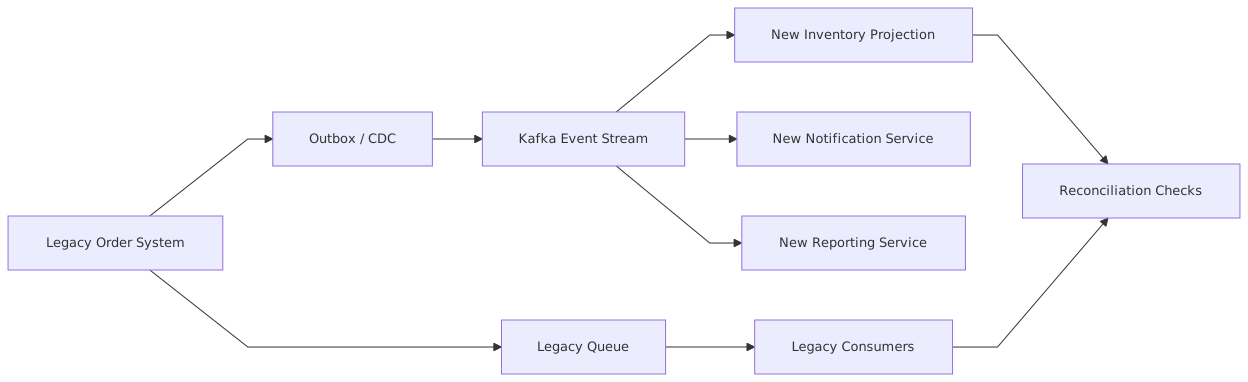
The old world keeps running. The new world starts by observing, then proving, then taking over.
Outbox and transactional boundaries
One practical migration issue deserves emphasis: dual writes kill trust.
If a service updates its database and separately publishes an event, failures in between create divergence. The standard mitigation is the transactional outbox pattern: write the business state and the event record in one local transaction, then relay the outbox to Kafka or another stream.
This doesn’t eliminate all complexity, but it stops one of the ugliest failure modes in distributed systems: “the order exists, but the event never happened.”
Enterprise Example
Consider a large retailer modernizing order fulfillment across e-commerce, stores, and distribution centers.
The legacy estate looks familiar: ERP for inventory, order management package, warehouse system, message broker queues, nightly reconciliation jobs, and dozens of brittle integrations. The business wants near-real-time order status, better stock accuracy, and the ability to add new channels without rewiring everything.
The first instinct from some teams is, naturally, “put Kafka in the middle of everything.”
That’s too crude.
What they actually did
They modeled the domain first.
- Order Service owns order acceptance and lifecycle.
- Inventory Service owns reservation decisions.
- Payment Service owns authorization and capture.
- Fulfillment Service owns picking, packing, and shipment coordination.
Customer checkout issues a PlaceOrder command to the Order Service. That is not an event. It is a request for a decision. The Order Service validates, persists the order, and emits OrderPlaced.
Inventory consumes OrderPlaced and decides whether stock can be reserved. Internally, it may use command queues to distribute reservation work to region-specific processors or adapters into the ERP. But externally it publishes InventoryReserved or InventoryReservationFailed.
Payment consumes OrderPlaced or a policy-specific event and performs authorization. Again, the internal payment execution path uses command semantics because there is one responsible actor and retries must be controlled. Externally it emits PaymentAuthorized or PaymentDeclined.
Fulfillment consumes the events and starts warehouse processes.
The retailer ended up with both patterns:
- Kafka event streams for retained business facts across bounded contexts
- queues and workflow tasks inside operational services for work dispatch, retries, and local process management
That distinction saved them. Why? Because they wanted replay for analytics, customer timeline views, and rebuilding inventory projections—but they absolutely did not want payment capture replayed because someone reprocessed a topic carelessly.
Reconciliation in practice
During migration, they ran the old OMS feeds and the new Kafka-based event stream in parallel. Each day they reconciled:
- orders accepted vs
OrderPlacedcount - successful reservations in ERP vs
InventoryReserved - shipments from WMS vs
ShipmentDispatched - payment captures vs settlement files
Mismatches generated investigation tasks. Some were expected early on: duplicate legacy queue deliveries, missed CDC records during maintenance windows, and a few event schema mistakes where “reserved quantity” meant available quantity in one system and allocated quantity in another. This is why semantics are architecture, not decoration.
Within six months, reporting and notifications were fully cut over to stream consumers. Core fulfillment command handling remained hybrid longer because the warehouse systems were less forgiving.
That is how real enterprise architecture works: not with slogans, but with seams, proofs, and patience.
Operational Considerations
Good semantics do not remove operational reality.
Idempotency
Both command handlers and event consumers must be idempotent. The reason differs:
- commands may be redelivered by the queue
- events may be replayed intentionally or reprocessed after consumer failure
Use business keys, deduplication stores, version checks, or aggregate sequence numbers. “Exactly once” is useful in narrow technical contexts, but as a business guarantee it is usually oversold. Build for at-least-once and prove side effects are safe.
Schema evolution
Streams live longer than projects. Event contracts need versioning strategy, compatibility rules, and ownership. Avro, Protobuf, or JSON Schema with registry governance is usually worth the discipline in a Kafka estate. ArchiMate for governance
Partitioning and ordering
In Kafka, pick partition keys that align with aggregate boundaries. If all events for an order must be processed in order, partition by orderId. Do not partition by something operationally convenient and then act surprised when state becomes inconsistent.
Lag and backpressure
Queues expose backlog depth. Streams expose consumer lag. Both are useful, but they tell different stories. A queue backlog says “work is waiting.” Stream lag says “history is accumulating faster than this consumer can absorb it.”
Retention and storage economics
Streams with long retention provide tremendous value for replay and audit, but storage isn’t free and governance is never free. Keep raw events where they matter; archive where needed; understand legal retention and deletion requirements, especially around personal data.
Dead-letter strategy
Dead-letter queues are often used as emotional support animals. Teams feel better because failed messages went “somewhere.”
That is not enough.
For commands, a dead-letter queue means unresolved business work. Someone must own triage and resubmission. For events, a poison event may indicate schema breakage, semantic incompatibility, or a bad consumer assumption. Simply parking it and moving on may corrupt downstream views silently.
Tradeoffs
There is no universal winner here. There is only fitness for purpose.
Why choose command queues
- simple mental model for work dispatch
- natural fit for single-responsibility processing
- effective retries and throttling
- good for task-oriented integration
- often easier for teams new to async systems
But they are poor systems of record for shared business history.
Why choose event streams
- durable history and replay
- excellent fan-out
- supports projections, audit, analytics, and temporal debugging
- strong fit for microservices and bounded contexts with independent consumers
- useful backbone for enterprise integration modernization
But they demand stronger semantic discipline and operational maturity.
The hybrid truth
Most serious enterprises need both. The real architecture skill lies in placing the boundary correctly.
Use streams between domains. Use queues within process execution where work must be done by one actor. Publish events for facts. Send commands for decisions.
The hybrid architecture is not compromise. It is clarity.
Failure Modes
This is where theory gets tested.
1. Replaying commands
A team stores command messages in Kafka and later reprocesses a topic to recover a projection. Suddenly warehouse tasks are duplicated and customers receive duplicate refunds. The problem was not Kafka. The problem was treating imperative intent as replayable fact.
2. Event ambiguity
An event named OrderUpdated tells consumers almost nothing. What changed? Price? Address? Status? Ambiguous events produce fragile consumers and endless downstream joins. Prefer specific business facts over catch-all noise.
3. Dual-write inconsistency
Database commit succeeds, event publish fails. Or event publishes, transaction rolls back. Now downstream systems disagree with the source of truth. Use outbox or equivalent transactional publishing discipline.
4. Hidden orchestration through events
Service A emits an event expecting B to act, B emits one expecting C to act, and no one owns the end-to-end business process. When something stalls, there is no place to reason about it. Choreography is elegant until the dance has thirty participants and no choreographer.
5. Misplaced ordering assumptions
Consumers assume global order in Kafka when only per-partition order exists. Cross-key dependencies then behave unpredictably. If the business truly needs cross-aggregate coordination, model it explicitly instead of wishing the broker were magic.
6. Retention without governance
An enterprise keeps all events forever, then discovers half of them are low-value technical noise and some contain personal data that should not have been retained. A stream is a strategic asset, but undisciplined data hoarding becomes a liability.
When Not To Use
Some teams now reach for event streaming the way earlier generations reached for ESBs: as the answer before hearing the question.
Don’t.
Do not use an event stream when:
- you only need a simple background task queue
- there is one consumer and no replay value
- the domain vocabulary is not stable enough to justify long-lived event contracts
- the team cannot yet operate partitioned logs, schema governance, and consumer lifecycle safely
- the business action is highly procedural and better expressed as a workflow step than a domain fact
Do not use a command queue when:
- multiple independent consumers need the same business fact
- audit and replay matter
- you need to build projections and derived views over time
- consumers must be able to join late and still reconstruct state
- the event history itself is valuable to the enterprise
And sometimes, frankly, do not use either for a given interaction. A synchronous call may be the right answer when immediate consistency and direct user feedback matter more than decoupling. Not every boundary deserves a broker.
Related Patterns
This topic sits inside a larger family of integration and domain patterns.
Event sourcing
Event sourcing stores aggregate state as a sequence of domain events. It is related to event streams but not synonymous with them. Many teams benefit from streaming events without making every write model event-sourced. Event sourcing is powerful, but expensive in modeling discipline.
CQRS
Command Query Responsibility Segregation often appears with streams because events are excellent for building read models. But CQRS is not mandatory. Don’t introduce it unless the complexity buys you something.
Transactional outbox
Essential for reliable event publication from transactional services.
Saga / process manager
Useful when business workflows span multiple bounded contexts and you need explicit coordination, compensation, timeouts, and observability. Choreography alone often breaks down in long-running enterprise processes.
CDC
Change data capture is a practical migration tool, especially when legacy systems cannot natively emit clean domain events. But CDC gives you data change first, business meaning second. Use it carefully and enrich semantics where necessary.
Inbox / deduplication pattern
A strong companion to idempotent consumers, especially for command processing and external event intake.
Summary
The queue and the log are not rivals. They are different instruments.
A command queue is for directed work: someone must do this, once if possible, safely if repeated. An event stream is for durable fact: this happened, many may care, and history matters. One moves responsibility. The other preserves truth.
The difference sounds small until it isn’t. It affects domain boundaries, replay safety, migration strategy, auditability, and operational design. In a microservices and Kafka-heavy world, teams that ignore this distinction end up with systems that are asynchronous but not coherent.
If you remember one thing, make it this:
Commands ask. Events tell.
Queues dispatch. Streams remember.
Model that cleanly and your architecture has a chance to age well. Blur it, and the broker becomes the place where business meaning goes to die.
For enterprise modernization, the winning move is usually a deliberate hybrid: retain queues where work dispatch and controlled retry are the heart of the problem; introduce event streams where shared business facts, replay, and bounded-context decoupling create lasting value. Migrate progressively, use strangler patterns, reconcile relentlessly, and let domain semantics—not vendor defaults—choose the shape of the wire.
That is what good event-driven architecture looks like in the real world. Not more messaging. Better meaning.
Frequently Asked Questions
What is enterprise architecture?
Enterprise architecture aligns strategy, business processes, applications, and technology in a coherent model. It enables impact analysis, portfolio rationalisation, governance, and transformation planning across the organisation.
How does ArchiMate support architecture practice?
ArchiMate provides a standard language connecting strategy, business operations, applications, and technology. It enables traceability from strategic goals through capabilities and services to infrastructure — making architecture decisions explicit and reviewable.
What tools support enterprise architecture modeling?
The main tools are Sparx Enterprise Architect (ArchiMate, UML, BPMN, SysML), Archi (free, ArchiMate-only), and BiZZdesign. Sparx EA is the most feature-rich, supporting concurrent repositories, automation, scripting, and Jira integration.