⏱ 18 min read
Most enterprise architecture failures do not happen because people are stupid. They happen because smart people keep approving things they did not inspect deeply enough.
That’s the uncomfortable truth.
A lot of organizations treat architecture review and audit as governance theater. A few slide decks. A checklist. Someone from security says “please encrypt data at rest.” Someone from infrastructure asks about resiliency. Everyone nods. The project gets a green light. Six months later, the platform is expensive, brittle, over-privileged, and impossible to operate without tribal knowledge.
I’ve seen this in banks, insurers, retailers, public sector programs, cloud migrations, API programs, event streaming platforms, IAM rollouts. Different logos, same movie. cloud architecture guide
If you want the simple version early: architecture review and audit services exist to catch design risk before it becomes operational pain, security exposure, compliance failure, or multi-year technical debt. That’s the SEO sentence. It’s also the practical one.
But that summary is still too polite.
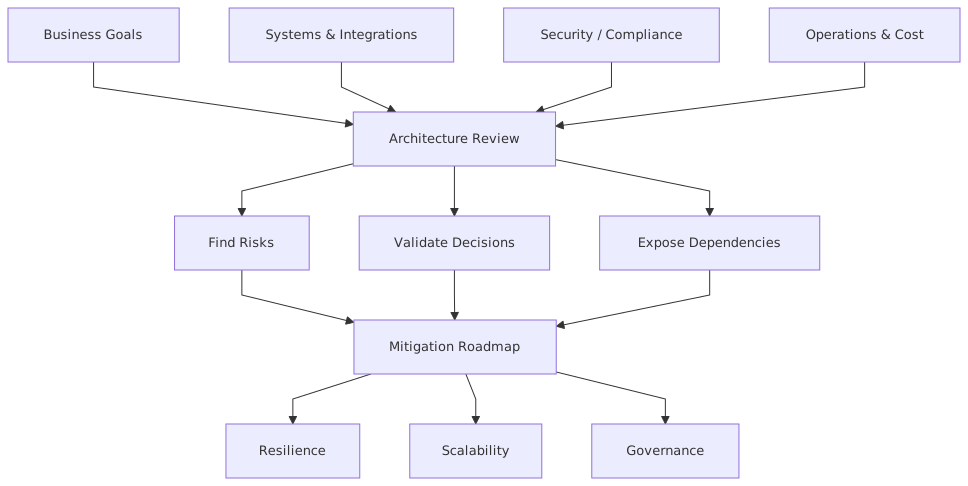
A good architecture review does not exist to make architects feel validated. It exists to challenge assumptions, expose hidden coupling, force trade-off clarity, and stop organizations from institutionalizing bad decisions. An audit, done properly, checks whether what was approved is actually what got built, and whether it still makes sense in the real operating environment. Review is about intent. Audit is about reality. You need both.
And yes, I have a strong opinion here: if your enterprise architecture function does not review and audit delivery with some backbone, then it’s not architecture. It’s diagram management. enterprise architecture consulting
What architecture review and audit services actually are
Let’s keep it plain.
Architecture review
An architecture review is a structured evaluation of a proposed solution, platform, or change before major commitment or at key delivery stages. It answers questions like:
- Does this design align with enterprise standards?
- Is the security model credible?
- Is the integration approach sane?
- Are resilience, scalability, operability, and cost understood?
- Are the trade-offs explicit?
- Are we solving the right problem in the right way?
Architecture audit
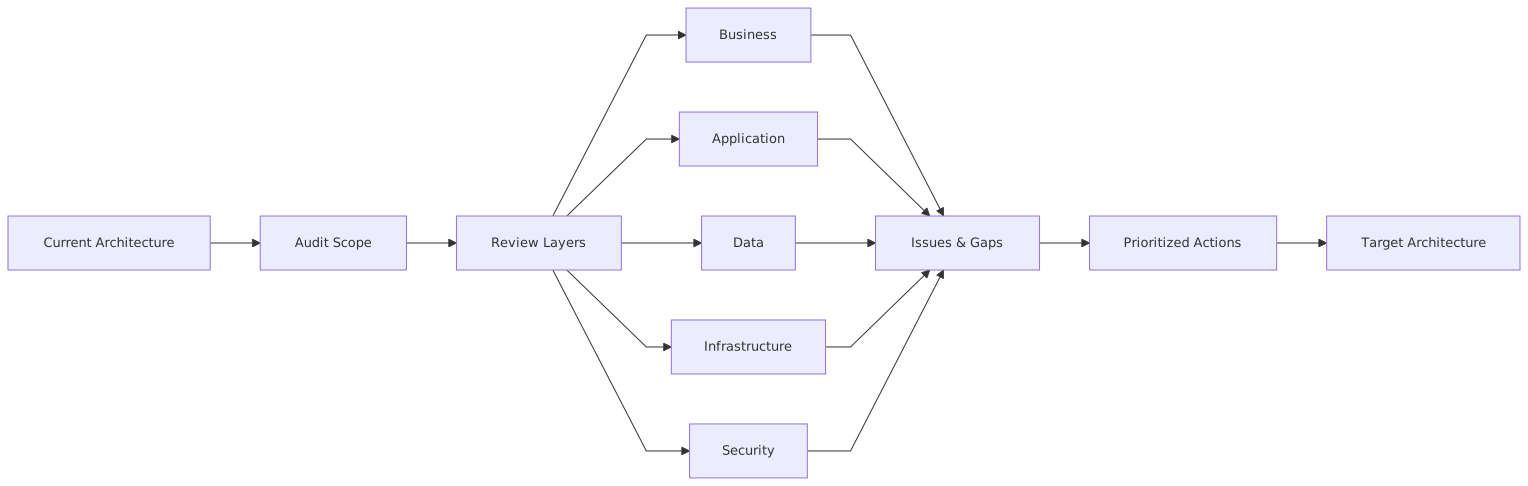
An architecture audit checks the implemented or evolving solution against expected architecture outcomes. It asks:
- Did the team build what was approved?
- Did they bypass key controls?
- Is the runtime environment secure and supportable?
- Are actual dependencies, data flows, and privileges understood?
- Has drift occurred?
- Is the architecture still fit for purpose after changes, incidents, and shortcuts?
That sounds simple because it is simple. People make it complicated to avoid accountability.
A review is not just a design meeting. An audit is not just compliance paperwork. Both are mechanisms for quality control in complex systems.
Why they matter more than most organizations admit
There’s a common executive fantasy that architecture problems can be “fixed later.” That line has burned more money than most failed products.
In real enterprise environments, architecture defects compound. They don’t sit quietly. They spread.
A weak IAM design becomes access sprawl, then audit findings, then Segregation of Duties exceptions, then painful remediation across dozens of applications.
A sloppy Kafka implementation starts as “we need event-driven architecture quickly,” then turns into topic chaos, unclear ownership, duplicate consumers, data retention mistakes, and production incidents nobody can untangle.
A cloud landing zone with vague guardrails becomes a billing problem, a security problem, an operations problem, and eventually a credibility problem.
This is why review and audit matter. They reduce the chance that local convenience becomes enterprise damage.
And there’s another reason people don’t say out loud enough: architecture review protects delivery teams too. A strong review gives teams air cover. It makes trade-offs visible. It helps a program manager hear “no, this shortcut will hurt us later” from a structured governance process, not just from one architect who now looks obstructive.
The contrarian view: too many reviews are useless
Now the part some architects won’t like.
A lot of architecture reviews are bad. Really bad.
They happen too late. They focus on templates instead of risks. They are dominated by generic standards nobody believes in. They reward polished PowerPoint over operational truth. They produce long action lists with no prioritization. Then people wonder why delivery teams avoid them.
That criticism is fair.
An architecture review that asks for a 60-page solution document but never probes failure modes is not governance. It’s bureaucracy with branding. ArchiMate for governance
An audit that checks whether naming conventions were followed but ignores over-privileged service accounts is malpractice dressed as rigor.
So yes, architecture review and audit services matter. But only if they are built around actual risks, actual systems, and actual consequences.
Good review is sharp, practical, and sometimes uncomfortable. Good audit is evidence-based and often annoying in exactly the right way.
How this applies in real architecture work
This is where theory usually falls apart, so let’s get practical.
In real enterprise architecture work, review and audit happen at several levels:
- Initiative level – a new project, major enhancement, migration, acquisition integration.
- Platform level – Kafka platform, IAM service, API gateway, cloud landing zone, data platform.
- Domain level – customer, payments, identity, treasury, fraud, HR.
- Control level – encryption, secrets management, logging, resilience, network segmentation, privileged access.
- Lifecycle level – concept, design, pre-production, post-implementation, periodic health review.
A mature enterprise architecture function does not wait until the end. It inserts review points where decisions are still cheap to change.
Typical checkpoints might include:
- early concept review
- detailed solution review
- security and data review
- pre-production readiness review
- post-implementation audit
- annual architecture fitness audit for critical platforms
The point is not to create meetings. The point is to create decision quality.
What a good review actually examines
If I’m reviewing an enterprise solution, I’m usually looking at a handful of dimensions before anything else:
Notice what’s not in that table: whether the diagram uses the official icon set. I’m exaggerating, slightly, but not much.
Banking example: where weak review hurts for years
Let’s use a real enterprise-style scenario. Not one exact bank, but very recognizable to anyone who has worked in one.
A retail bank launches a customer event platform to support fraud detection, personalization, and near-real-time notifications. The architecture uses Kafka as the event backbone, cloud-hosted analytics, and an IAM integration with the bank’s central identity and privileged access environment. enterprise architecture guide
On paper, this sounds modern and sensible.
The proposed design
- Core banking and digital channels publish customer events into Kafka
- Multiple downstream consumers subscribe:
- Kafka runs in cloud-managed infrastructure
- Application identities use federated IAM roles
- Sensitive topics contain customer profile and transaction metadata
- fraud analytics
- customer notification service
- marketing platform
- data lake ingestion
Again, looks good on a slide.
What a weak review misses
A weak review often approves this because the patterns sound familiar:
- event-driven architecture: good
- cloud-native managed services: good
- centralized IAM integration: good
- analytics enablement: good
But the devil is never in the buzzwords. It’s in the boundaries.
A serious architecture review would ask:
- Who owns each topic and its schema lifecycle?
- Which events are business facts versus convenience copies?
- How is PII classified and masked across environments?
- What is the retention strategy for regulated data?
- Can consumers replay events safely, and under what controls?
- How are service identities provisioned, rotated, and revoked?
- What is the blast radius if a consumer group misbehaves?
- Is customer identity represented consistently across channels and core systems?
- How does resilience work during core banking delays or duplicate event publication?
- What happens when fraud and marketing need the same event at different levels of sensitivity?
These are not academic questions. These are the questions that decide whether the platform becomes an enterprise asset or a governance headache. EA governance checklist
What happened in the real-world pattern
In one version of this story, the review was light. The platform launched fast. Everyone celebrated.
Within 12 months:
- teams created overlapping topics with inconsistent schemas
- non-production environments received production-like PII without proper masking
- one consumer had broad read access to far more topics than needed
- replay capability was poorly controlled, causing duplicate downstream processing
- IAM roles accumulated privileges because onboarding was easier than cleanup
- support teams couldn’t trace ownership for several “temporary” integrations
- cost rose sharply because retention and replication settings were barely understood
None of this was a mystery. It was all predictable.
What a proper review and audit would have changed
A proper review would have enforced:
- topic ownership model
- schema governance
- event taxonomy
- IAM role boundaries by application and domain
- retention rules tied to data classification
- replay controls and operational procedures
- observability standards for producer/consumer health
- support ownership before production approval
Then a post-implementation audit, maybe 90 days after go-live, would verify:
- actual IAM grants match approved design
- topics and ACLs are controlled
- masking and encryption are in place
- alerting works
- costs are within expected bands
- no architecture drift has occurred through “urgent” changes
That is architecture work. Not just drawing Kafka in the middle of a diagram and calling it strategy.
IAM is where weak architecture discipline gets exposed fastest
If you want to know whether an enterprise takes architecture review seriously, look at IAM. Identity always tells the truth eventually.
Many architects talk about IAM at a high level:
- SSO
- MFA
- federation
- RBAC
- privileged access
Fine. But in actual delivery, IAM complexity sits in the details:
- human identities vs workload identities
- joiner/mover/leaver flows
- delegated administration
- emergency access
- role explosion
- entitlement recertification
- machine credential rotation
- service-to-service trust
- audit traceability
A poor review treats IAM like a box on the left side of the diagram. A good review treats IAM as a first-class architecture concern.
Common IAM mistakes architects make
These show up all the time:
- Assuming central IAM equals solved IAM
It does not. Central platforms reduce fragmentation. They do not magically define application authorization models.
- Confusing authentication with authorization
“Users log in with SSO” tells me almost nothing about what they can do.
- Ignoring workload identity design
Human user access gets attention. Service accounts become a swamp.
- Designing roles around org charts
Org charts change. Task-based access models usually age better.
- Approving exceptions without expiry
Temporary elevated access has a strange habit of becoming architecture.
- Not auditing effective permissions
The approved model and the real entitlement landscape often diverge quickly.
In regulated sectors like banking, these are not minor flaws. They become audit findings, security incidents, and trust issues with regulators.
Cloud makes architecture review more important, not less
A weird thing happened during the cloud wave. Some organizations started acting like architecture discipline was less necessary because cloud providers had “best practices.”
That is nonsense.
Cloud gives you faster access to capability. It also gives you faster access to expensive mistakes.
In cloud environments, architecture review must usually look harder at:
- account/subscription structure
- landing zone compliance
- network segmentation
- IAM federation and privileged access
- secrets management
- region strategy
- resilience patterns
- cost controls
- logging and telemetry
- service selection and lock-in risk
- policy-as-code guardrails
The most common cloud mistake architects make is assuming managed services remove design responsibility. They don’t. They move it.
For example:
- using managed Kafka does not remove the need for event governance
- using managed IAM services does not define enterprise authorization boundaries
- using serverless does not eliminate operational accountability
- using multi-region architecture does not guarantee resilience if dependencies are still regional or tightly coupled
A strong cloud architecture review should ask a brutally simple question: what operational mess are we creating in exchange for this speed? If nobody can answer that, the design is not mature.
Common mistakes architects make during reviews
Let’s be honest about our own profession for a minute. Architects are not innocent in this.
Here are the mistakes I see repeatedly.
1. Reviewing for compliance, not for risk
Architects love standards. I do too, in the right dose. But a review that just checks standards alignment can miss the largest risks. The point is not “did you use the approved pattern.” The point is “will this fail badly, expensively, or silently.”
2. Getting seduced by elegance
A clean conceptual design can hide ugly operational truth. The prettier the diagram, the more suspicious I sometimes get.
3. Going too broad and too shallow
Some review boards ask 40 questions and answer none of them deeply. Better to probe 8 critical areas with seriousness.
4. Ignoring delivery reality
If the team has no skills in the proposed platform, that matters. If support is outsourced and the operating model is weak, that matters. Architecture that ignores organizational capability is fantasy architecture.
5. Treating “future state” as a free pass
Architects often approve designs that depend on future capabilities:
- future IAM integration
- future data quality improvements
- future API standardization
- future observability tooling
Sometimes that’s unavoidable. But if the design only works in a future state that doesn’t exist, then the design does not currently work.
6. Not following up after approval
This is a big one. Some architects think approval is the end of the job. It’s not. Delivery pressure changes designs. Shortcuts appear. Vendors improvise. Teams reinterpret decisions. Without audit, architecture drifts.
7. Mistaking vendor confidence for architecture soundness
Vendors can be useful. They can also be very persuasive while skipping over your specific constraints. “Reference architecture” is not the same as your architecture.
Review versus audit: they should not be owned exactly the same way
Here’s a slightly contrarian thought: review and audit should be connected, but not identical in posture.
Architecture review can be collaborative. It should help shape solutions.
Architecture audit needs a bit more independence. Not full adversarial compliance theater, but enough distance to say: “this is what was approved, this is what exists, and these things do not match.”
If the same group always designs, approves, and self-certifies everything, blind spots get institutionalized.
In mature organizations, I like to see:
- solution architects and domain architects involved in review
- enterprise architecture setting principles and challenge
- security, data, platform, and operations represented where relevant
- an audit or assurance function able to assess implementation evidence independently
That doesn’t need to be bureaucratic. It just needs integrity.
What good architecture audit looks like in practice
A proper architecture audit is not a generic control checklist. It’s a targeted inspection of whether the architecture is real, effective, and governable.
Typical evidence I’d want to see includes:
- deployed topology and environment inventory
- actual IAM roles, policies, and privileged access records
- data flow and interface inventory
- topic/queue/schema inventory for event platforms
- encryption and secrets configuration
- monitoring dashboards and alert thresholds
- incident records and postmortems
- DR test results
- cost and capacity reports
- exceptions register and remediation status
For Kafka specifically, an architecture audit might check:
- topic naming and ownership
- ACL design
- schema registry governance
- retention and compaction settings
- consumer lag monitoring
- replay procedures
- dead-letter strategy
- cluster resilience and upgrade process
For IAM, it might check:
- role definitions and approval paths
- stale accounts
- service principal sprawl
- privileged access workflows
- segregation of duties conflicts
- access recertification evidence
- emergency access logs
For cloud, it might check:
- account guardrails
- network routes and exposure
- public endpoint exceptions
- secrets handling
- logging coverage
- backup and recovery testing
- drift from landing zone standards
This is where architecture becomes measurable.
How to make review services useful instead of hated
If your review service is seen as a blocker, you may have a culture problem. But you may also have a design problem in the service itself.
A few practices help a lot.
Review early
Don’t wait for final design. Review when major choices are still movable.
Tailor the review depth
A low-risk enhancement should not face the same process as a bank-wide IAM redesign.
Focus on top risks
Force prioritization. Every review should clearly state:
- top 3 risks
- top 3 mandatory actions
- accepted trade-offs
- unresolved decisions
Require evidence, not just intent
“Will implement later” is not evidence. “Here is the role model, onboarding workflow, and revocation process” is evidence.
Track actions to closure
If review outputs disappear into meeting minutes, the service is decorative.
Audit after implementation
This is where credibility comes from. Teams take architecture seriously when they know someone will verify the result.
Build a feedback loop
If the same issues repeat across projects, update standards, patterns, and platform services. Review should improve the enterprise, not just individual projects.
A practical review model that works
You don’t need a giant governance machine. A lightweight but disciplined model often works better. architecture decision record template
That’s enough structure for most enterprises. The trick is quality of challenge, not quantity of gates.
The uncomfortable part: architecture review exposes organizational politics
One reason review and audit are often watered down is simple: they expose power.
A serious review can reveal that:
- a strategic platform is under-designed
- a vendor-led implementation ignored standards
- a senior stakeholder pushed a shortcut
- a cloud migration skipped control maturity
- an IAM program has weak ownership
- an event platform has no real governance model
Not everyone wants that visible.
So architecture leaders need some courage. Not theatrical “guardian of standards” behavior. Real courage. The kind that says:
- this design is not ready
- this risk is being underestimated
- this exception needs an expiry and owner
- this platform needs an audit before expansion
- this issue is not technical only; it is operating model debt
If architecture review never creates discomfort, it probably isn’t doing much.
Final thought
Architecture review and audit services matter because enterprise systems are too interconnected, too regulated, too expensive, and too politically messy to rely on optimism.
That’s really it.
When done badly, review becomes bureaucracy and audit becomes checkbox theater. We should say that plainly. But when done well, they are some of the few mechanisms that consistently improve decision quality across large organizations.
They protect resilience. They reduce security exposure. They control cost drift. They force clarity around ownership. They keep cloud from becoming chaos, Kafka from becoming event spaghetti, and IAM from becoming a permanent audit finding.
Most importantly, they keep architecture grounded in reality.
And reality, unlike slideware, always collects its debt.
FAQ
1. What is the difference between an architecture review and an architecture audit?
An architecture review evaluates the proposed design before or during delivery. An architecture audit checks the implemented solution against the approved architecture, controls, and real operating conditions. Review is forward-looking. Audit is evidence-based and retrospective, though it should also inform future changes.
2. How often should enterprise architecture audits happen?
It depends on criticality. High-risk platforms like IAM, payment systems, customer data platforms, and Kafka/event backbones should usually have a post-implementation audit and periodic health audits, often annually or after major change. Lower-risk systems can be assessed less frequently.
3. Do architecture reviews slow down delivery?
Bad ones do. Good ones reduce rework, production incidents, and expensive redesign later. In practice, lightweight early reviews usually speed up delivery because they surface integration, security, and operational issues before teams are too committed.
4. What are the biggest warning signs that a solution needs a deeper architecture review?
A few obvious ones: unclear ownership, heavy IAM complexity, regulated data, broad integration scope, major cloud cost exposure, event-driven patterns with multiple consumers, vendor-led design with little internal capability, or any solution depending on future-state controls that do not exist yet.
5. What should be included in an architecture review for banking or regulated industries?
At minimum: business traceability, data classification, IAM and privileged access model, resilience and DR design, auditability, encryption and key management, integration controls, operational readiness, compliance obligations, and evidence that the design can actually be supported in production. In banking especially, vague control statements are not enough. You need implementation detail. architecture traceability in Sparx EA
Frequently Asked Questions
What is enterprise architecture?
Enterprise architecture is a discipline that aligns an organisation's strategy, business processes, information systems, and technology. Using frameworks like TOGAF and modeling languages like ArchiMate, it provides a structured view of how the enterprise operates and how it needs to change.
How does ArchiMate support enterprise architecture practice?
ArchiMate provides a standard modeling language that connects strategy, business operations, applications, data, and technology in one coherent model. It enables traceability from strategic goals through business capabilities and application services to the technology platforms that support them.
What tools are used for enterprise architecture modeling?
The main tools are Sparx Enterprise Architect (ArchiMate, UML, BPMN, SysML), Archi (free, ArchiMate-only), and BiZZdesign Enterprise Studio. Sparx EA is the most feature-rich option, supporting concurrent repositories, automation, scripting, and integration with delivery tools like Jira and Azure DevOps.