⏱ 19 min read
Most ArchiMate workshops fail for a simple reason: people treat them like diagramming sessions.
That’s the wrong mental model.
A good ArchiMate modeling workshop is not about “capturing the architecture.” It is about forcing an enterprise to confront its own contradictions. The workshop is where strategy collides with delivery, where application owners discover they are not actually talking about the same customer journey, and where security teams finally see that “central IAM” is not a box on a slide but a dependency that can block half the roadmap. EA governance checklist
I’ll say it plainly: if your ArchiMate workshop ends with a beautiful model and no sharper decisions, it was theatre.
Enterprises do not need more architecture theatre. They need working sessions that expose ambiguity, align stakeholders, and create models people can actually use in portfolio planning, transformation design, governance, and implementation sequencing.
So let’s start simple.
What is an ArchiMate modeling workshop, really?
At its simplest, an ArchiMate modeling workshop is a structured session where business, application, technology, and security stakeholders build a shared architecture model using the ArchiMate language. ArchiMate modeling guide
That’s the SEO-friendly version.
The real version is this: it is a decision workshop disguised as modeling.
ArchiMate gives you a common language to describe:
- business capabilities
- value streams and processes
- applications and services
- data and integrations
- technology platforms and infrastructure
- relationships, dependencies, and impact
In enterprise terms, that means you can model things like:
- how a retail banking onboarding journey works
- which applications support it
- where Kafka is used for event distribution
- how IAM controls access
- which cloud services host the workloads
- what breaks when one part changes
That is why ArchiMate matters. Not because it is elegant. Honestly, many people find it visually heavy at first. It matters because it gives architects a way to connect strategy to implementation without dropping all nuance.
And workshops matter because architecture is rarely wrong due to notation. It is wrong because the people in the room carry different assumptions and nobody surfaces them early enough.
Why enterprises need workshops, not solo modelers
A common anti-pattern in architecture teams is the lone architect building “the enterprise model” in a repository and then presenting it back to the business like a completed sculpture.
That almost never works.
Enterprises are too political, too fragmented, and too dynamic for architecture to be authored in isolation. The architect can curate, structure, and challenge. But the model has to be socially built if it is going to be socially used.
This is especially true in large organizations where:
- business units use the same words differently
- platform teams think in services while business leaders think in products
- security teams model control points, not journeys
- cloud engineers model landing zones, not customer outcomes
- integration teams think Kafka topics are architecture, when they are only part of it
A workshop creates the conditions for these views to meet.
Not politely. Productively.
That distinction matters.
The real purpose of an ArchiMate workshop
Let me be contrarian for a moment. The purpose of an ArchiMate workshop is not to make everyone agree. ArchiMate tutorial

Consensus is overrated in architecture.
The purpose is to make disagreement explicit, bounded, and actionable.
That means a workshop should help you answer questions like:
- What business capability are we actually trying to improve?
- Which applications are core versus replaceable?
- Where are our integration dependencies concentrated?
- Is Kafka a strategic event backbone or just a patch over bad application design?
- Does IAM support a federated future state or is it still tied to legacy directories?
- Which workloads belong in cloud, and which are there only because “cloud-first” became a slogan?
- What transition architectures are realistic over the next 12–24 months?
Those are enterprise architecture questions. ArchiMate is useful because it lets you represent them across layers.
But the workshop only works if it is grounded in real work.
How this applies in real architecture work
In real enterprise architecture, ArchiMate workshops are useful in five situations.
1. Strategy-to-execution alignment
Leadership says, “We want to improve customer onboarding.”
Fine. That means nothing until someone models:
- the value stream steps
- process variants across channels
- applications involved
- manual handoffs
- identity verification dependencies
- event flows
- compliance controls
- infrastructure hosting patterns
That model becomes the bridge between ambition and delivery.
2. Target-state architecture design
When enterprises talk about target state, they often jump straight to technology choices. Cloud, APIs, Kafka, IAM modernization, zero trust. All valid topics. But target state without business anchoring becomes a shopping list.
An ArchiMate workshop lets you define target state in a more disciplined way:
- business capabilities to strengthen
- application services to consolidate
- technology services to standardize
- security services to centralize or federate
- migration dependencies to sequence
3. Transformation planning
This is where ArchiMate earns its keep.
A good model helps you identify transition architectures, plateaus, and work packages. In plain English: what changes first, what depends on what, and what can wait.
In a bank, for example, you may want to modernize customer identity, move event-driven processing onto Kafka, and shift selected workloads to cloud. Those cannot be planned as independent streams if they all touch onboarding, fraud checks, entitlements, and audit logging.
The workshop is where those collisions become visible.
4. Impact analysis
If you decommission a legacy IAM component, what applications break?
If you move a payments service to cloud, what latency or compliance implications appear?
If you standardize Kafka as the integration backbone, which current point-to-point interfaces become redundant and which still need to exist?
Workshops help create the baseline needed for impact analysis. Not perfect baseline. Good enough baseline.
Perfect architecture repositories are a myth anyway.
5. Governance and communication
Architecture governance often fails because review boards ask for documents no one reads. ArchiMate models, used well, give governance a shared artifact that is visual, traceable, and connected to real decisions.
But only if the workshop produces a model tied to actual scope and actual choices.
What a good ArchiMate workshop looks like
A useful workshop is not a giant room with 30 people arguing over symbols.
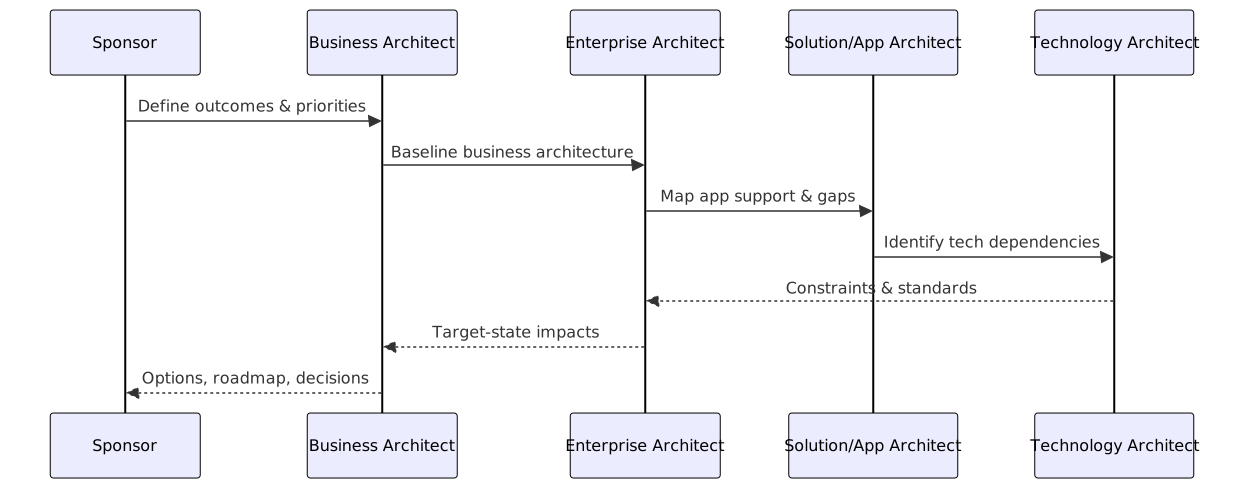
It is a sequence of focused sessions, each with a clear modeling objective.
Here is the pattern I’ve seen work best.
That is the practical shape.
Notice what is missing: a two-day marathon where everyone tries to model the enterprise in one go. That approach burns attention, creates shallow models, and gives extroverts too much power.
Smaller, sharper sessions are better.
Start simpler than architects want to
Architects love abstraction. Sometimes too much.
One of the biggest workshop mistakes is starting with a full meta-model lecture and a massive notation taxonomy. You can watch the energy leave the room.
Do not begin there.
Start with a simple explanation:
- what business outcome are we discussing?
- what are the main capabilities or processes?
- which applications support them?
- what integrations and platforms matter?
- what decisions do we need from this workshop?
Then introduce only the ArchiMate concepts needed for that conversation.
In most enterprise workshops, you do not need to teach the whole language. You need enough to model:
- business actors, roles, processes, capabilities, services
- application components and services
- data objects or business objects where useful
- technology nodes, system software, technology services
- relationships like serving, realization, assignment, flow, access, triggering
That’s enough to get meaningful work done.
Frankly, many workshops improve when the notation is slightly hidden behind practical language. Let people talk about “customer onboarding service” and “identity verification step” before you insist on whether something is formally a business service or process. Precision matters, but timing matters too.
A real enterprise example: retail bank onboarding modernization
Let’s make this concrete.
A regional bank wanted to modernize retail customer onboarding. On paper, the goal sounded straightforward:
- reduce onboarding time from two days to under 30 minutes
- improve digital channel completion rates
- centralize identity and access management
- introduce event-driven integration using Kafka
- move selected onboarding services to cloud
Classic transformation brief. Also classic mess.
What the bank thought it had
Leadership believed onboarding was one process supported by one main customer platform.
It was not.
During the first workshop, we mapped the actual flow and found:
- separate onboarding variants for branch, web, and mobile
- three different identity verification mechanisms
- two customer master data stores
- one legacy IAM stack for employees and a separate customer identity platform
- point-to-point integrations between onboarding apps and core banking
- Kafka already in use, but only by the payments domain
- cloud-hosted document services, while the main onboarding engine remained on-prem
This is why workshops matter. Nobody was lying. They were just each seeing a different slice.
How the model changed the conversation
We used a baseline ArchiMate view connecting:
- the business process for customer onboarding
- business roles like branch advisor, digital applicant, compliance analyst
- application services such as identity verification, document capture, KYC screening, account creation
- application components providing those services
- technology services including event streaming, authentication, container hosting
- nodes across on-prem and cloud environments
Then we modeled pain points:
- duplicate KYC checks across channels
- manual compliance review triggered by missing identity attributes
- IAM inconsistency causing role provisioning delays for branch-assisted onboarding
- no common event model for onboarding status
- cloud services used tactically, not as part of a coherent target architecture
That baseline did something important. It killed the fantasy that this was just a front-end redesign.
The target-state workshop
In the target-state session, the bank wanted to standardize around:
- a unified customer identity service
- Kafka for onboarding events
- cloud-hosted document and workflow services
- a common onboarding orchestration layer
- central policy enforcement tied to IAM
- phased retirement of channel-specific onboarding logic
Good direction. But here is the contrarian bit: we did not model Kafka as the center of the universe.
Enterprises often over-romanticize event-driven architecture. Kafka is powerful, yes. But in workshops, teams start drawing event topics everywhere and suddenly every problem looks like an event problem. It isn’t.
We positioned Kafka where it made sense:
- status event propagation
- downstream notification
- analytics and monitoring feed
- decoupled triggers for fraud and compliance services
But synchronous identity validation and account creation still needed direct service interactions in some steps. Pretending otherwise would have created a dishonest target state.
Likewise with IAM. Security teams sometimes model IAM as if centralization automatically simplifies things. In reality, centralized IAM can become a bottleneck if entitlement models, legacy app adapters, and customer-versus-workforce identity boundaries are not addressed.
In the workshop, that became visible. The target state had to distinguish:
- customer IAM / CIAM services
- workforce IAM services
- shared policy and audit capabilities
- application-specific authorization dependencies
Without that distinction, the roadmap would have been fantasy. ArchiMate in TOGAF ADM
The transition architecture
The final model drove a phased roadmap:
- standardize onboarding event taxonomy and Kafka topics
- unify identity verification service across channels
- externalize document capture and workflow to cloud services
- introduce CIAM integration for digital onboarding
- migrate branch-assisted onboarding to the same orchestration backbone
- retire duplicate KYC paths and reduce manual review points
That sequencing mattered because it reflected both business value and dependency reality.
The workshop did not solve everything. It did something more useful: it gave the bank a shared, credible architecture story that product, security, integration, and cloud teams could all work from.
That is real enterprise architecture work.
Common mistakes architects make in ArchiMate workshops
This is where I have strong opinions.
1. Modeling too much, too early
Architects often try to capture the whole enterprise context in the first session. Bad idea.
A workshop needs a bounded question. If the topic is onboarding modernization, stay disciplined. Adjacent domains matter only where they affect the decision.
Scope creep kills modeling quality.
2. Confusing notation purity with value
Yes, ArchiMate semantics matter. But if you spend 25 minutes debating whether something is a business service or an application service while executives check their phones, you’ve lost the room.
Use enough rigor to preserve meaning. Do not weaponize the notation.
3. Letting one domain dominate
In many workshops, one tribe takes over:
- security turns everything into controls
- integration turns everything into APIs and Kafka topics
- cloud teams turn everything into landing zones and Kubernetes clusters
- business teams stay at slogan level and refuse operational detail
The architect’s job is to rebalance the model across layers. Enterprise architecture is cross-layer by definition.
4. Treating current state as if it must be complete
You do not need a perfect baseline to have a useful workshop. You need a sufficient baseline.
This is a huge point. Teams waste weeks trying to inventory every application, every interface, every server. By the time they are ready, the transformation question has moved on.
Model enough current state to support the decision at hand.
5. Jumping to target state without pain-point analysis
A lot of architects love future-state pictures. They are cleaner. More flattering. Less political.
But if you skip pain points, your target state becomes generic. “Centralize IAM, adopt cloud, use event-driven architecture.” Fine. That could describe 500 enterprises.
Pain points make the target specific and defensible.
6. Ignoring operating model reality
This is one of the most expensive mistakes.
The model may say a shared platform team provides Kafka, IAM, and cloud services. Great. But can delivery teams actually consume those services without six months of approvals? Is there a funding model? Are support boundaries clear? Is there a service catalog?
Architecture workshops that ignore operating model constraints produce elegant nonsense.
7. Failing to capture decisions explicitly
At the end of each workshop, there should be a short list of decisions, assumptions, and open issues. Not just updated diagrams.
Otherwise the model becomes passive documentation instead of an active architecture instrument.
Banking, Kafka, IAM, and cloud: where workshops help most
These topics show up constantly in enterprise work, and they are exactly where ArchiMate workshops can cut through confusion.
Banking
Banking transformations are full of layered complexity:
- regulatory constraints
- channel fragmentation
- legacy core dependencies
- identity and access controls
- auditability needs
- product and customer data overlap
ArchiMate helps because banking is not just process or technology. It is dependency management across business, application, security, and infrastructure layers.
Kafka
Kafka is often introduced as a strategic integration backbone. Sometimes that is right. Sometimes it is overreach.
A workshop helps determine:
- which business events matter
- who produces and consumes them
- where eventing reduces coupling
- where request-response still belongs
- what governance is needed for topics, schemas, and ownership
Without that modeling, Kafka turns into a distributed dumping ground.
IAM
IAM is one of those domains everybody claims to understand until you model it.
Workshops help distinguish:
- authentication versus authorization
- customer versus workforce identity
- policy decision versus policy enforcement
- role design versus entitlement management
- legacy dependencies versus target-state services
This is especially useful in mergers, digital channel modernization, and zero trust initiatives.
Cloud
Cloud conversations are often too infrastructure-centric. Workshops can reconnect cloud choices to business and application outcomes.
For example:
- which services need elasticity
- which workloads benefit from managed services
- which data residency constraints matter
- where hybrid patterns are unavoidable
- what platform services are shared versus domain-owned
Cloud is not the architecture. It is part of the architecture.
That sounds obvious. In many enterprises, it still needs saying.
A practical workshop structure that actually works
If I were setting this up in an enterprise tomorrow, I’d use something like this.
Before the workshop
Do not walk in cold.
Prepare:
- a draft scope statement
- a short list of business outcomes
- known applications and platforms
- integration context
- IAM and cloud constraints
- a seed diagram, even if rough
- a glossary of contentious terms
A seed model matters. Blank canvases are overrated. They slow people down and reward whoever speaks first.
During the workshop
Use a visible board or modeling tool and move through a sequence:
- confirm business outcome and scope
- identify key actors, capabilities, and processes
- map supporting applications and services
- identify data and integration touchpoints
- overlay IAM, security, and compliance controls
- map technology dependencies including cloud and platforms
- mark pain points and constraints
- sketch target-state changes
- identify transition steps and decisions
Keep the pace up. Long silence around notation usually means people are lost or bored.
After the workshop
This is where many teams fail.
You need to produce:
- cleaned-up views, not over-polished art
- a decision log
- assumptions and risks
- open questions
- candidate work packages
- recommended next workshops or deep dives
The workshop is not the endpoint. It is the forcing function for the next level of architecture work.
What views to use in enterprise workshops
Not every ArchiMate view is equally useful in a workshop. Some are better for repository completeness than live stakeholder discussion.
These are the views I find most practical.
You do not need all of them in one session. Pick based on the decision.
That is another contrarian point: architecture workshops should be view-driven, not framework-driven. Use the minimum set of views needed to answer the question.
Facilitation matters more than notation
The biggest variable in workshop quality is not ArchiMate skill. It is facilitation skill.
A strong architect-facilitator does three things well:
- translates between stakeholder languages
- spots ambiguity quickly
- keeps the session tied to decisions
That means interrupting, sometimes.
If an integration lead spends ten minutes explaining Kafka partitioning in a target-state workshop about onboarding operating model, cut it short. Useful topic, wrong altitude.
If a business stakeholder insists “we just need one customer view” without acknowledging legal entity, product, and channel distinctions, challenge it.
If the cloud team starts prescribing a platform before application coupling is understood, slow them down.
Architecture workshops need a bit of friction. Too much politeness produces vague models.
What success looks like
A successful ArchiMate workshop does not produce the biggest model.
It produces:
- a shared understanding of scope and dependencies
- a credible current-state picture
- a target state that reflects business and technical reality
- explicit decisions and trade-offs
- a transition path people can actually execute
And maybe most importantly, it gives the enterprise a common language for the next argument.
Because there will be a next argument.
That is healthy. Architecture is not about ending debate. It is about making debate more precise.
Final thought
ArchiMate modeling workshops are worth doing, but only if you stop treating them as diagram production exercises.
Use them to expose ambiguity.
Use them to test strategy against delivery.
Use them to reveal where Kafka is useful and where it is hype.
Use them to separate IAM aspiration from IAM reality.
Use them to challenge lazy cloud assumptions.
Use them to build transition architectures that survive contact with the enterprise.
And yes, use ArchiMate. It is one of the better enterprise architecture languages we have for connecting the layers.
But remember this: the value is not in the notation.
The value is in what the notation forces people to admit.
FAQ
1. How long should an ArchiMate modeling workshop be in a large enterprise?
Usually 90 minutes to 3 hours per session works best. For bigger transformations, run a series of focused workshops rather than one giant session. People think they want a full-day workshop. They usually don’t.
2. Do business stakeholders need to know ArchiMate notation?
No. They need to understand the concepts being discussed, not the full notation spec. The architect should translate the language into practical terms and only introduce notation detail where it helps clarity.
3. Is ArchiMate useful for cloud and platform architecture, or only enterprise-level business models?
It is useful for both. In cloud programs, ArchiMate helps connect business capabilities and application changes to platform services, deployment patterns, IAM dependencies, and transition roadmaps. That cross-layer link is exactly where many cloud initiatives struggle.
4. How do you model Kafka in ArchiMate without overcomplicating things?
Keep it tied to business and application needs. Model event-producing and event-consuming application services, relevant data or business objects, and the technology services or platforms supporting event streaming. Do not turn the entire workshop into a topic catalog session unless that is the actual goal.
5. What is the most common failure pattern in enterprise ArchiMate workshops?
Trying to create a complete architecture model instead of supporting a specific decision. When the workshop loses its decision focus, the model becomes either too abstract to matter or too detailed to be usable.
Frequently Asked Questions
What is enterprise architecture?
Enterprise architecture is a discipline that aligns an organisation's strategy, business processes, information systems, and technology. Using frameworks like TOGAF and modeling languages like ArchiMate, it provides a structured view of how the enterprise operates and how it needs to change.
How does ArchiMate support enterprise architecture practice?
ArchiMate provides a standard modeling language that connects strategy, business operations, applications, data, and technology in one coherent model. It enables traceability from strategic goals through business capabilities and application services to the technology platforms that support them.
What tools are used for enterprise architecture modeling?
The main tools are Sparx Enterprise Architect (ArchiMate, UML, BPMN, SysML), Archi (free, ArchiMate-only), and BiZZdesign Enterprise Studio. Sparx EA is the most feature-rich option, supporting concurrent repositories, automation, scripting, and integration with delivery tools like Jira and Azure DevOps.