⏱ 5 min read
Introduction
In an increasingly interconnected world, interoperability and semantic consistency across systems are crucial for organizations undergoing digital transformation. As organizations mature in their Enterprise Architecture (EA) practices, there's a growing need to bridge human-readable architectural models with machine-readable ontologies. This is where the convergence of ArchiMate—a visual modeling language for enterprise architecture—and OWL (Web Ontology Language)—a formal specification language for s...
1. Understanding the Gap: Models vs. Ontologies
Traditional EA models focus on representation, documentation, and communication across stakeholders. However, they often fall short in enabling semantic reasoning, data inference, and machine integration. Ontologies fill this gap by providing a structured, machine-readable format with formal logic that supports automated processing.
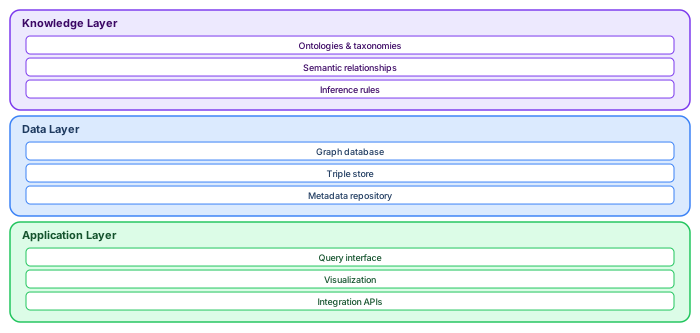
- ArchiMate: Designed for visual clarity, stakeholder alignment, layered architecture (Business, Application, Technology), and motivation modeling.
- OWL: Built on Description Logics, supports inheritance, class definitions, restrictions, object/data properties, and logical reasoning.
2. Why Map ArchiMate to OWL?
By transforming ArchiMate models into OWL ontologies, enterprises can:
- Enable reasoning over architectural elements (e.g., detect inconsistencies or infer component relationships).
- Integrate architectural models into the Linked Data ecosystem.
- Align architecture with standards like RDF, SKOS, and SHACL.
- Enable knowledge graph-based architecture management.
3. Mapping Concepts: From ArchiMate Metamodel to OWL Classes
The ArchiMate metamodel defines a well-structured set of elements like Capability, ApplicationComponent, BusinessProcess, etc. These elements can be converted to OWL classes or individuals: ArchiMate tutorial for enterprise architects
- ArchiMate Element → OWL Class: For taxonomy-like structures (e.g., ApplicationService, BusinessActor).
- Relationship → OWL ObjectProperty: Specialization, Assignment, Realization can be formalized using object properties.
- Tagged Values → OWL DataProperties: Useful for capturing element attributes like priority, maturity, etc.
4. Toolchains and Practical Conversion Approaches
While Sparx EA doesn’t natively export to OWL, several strategies are available:
- XMI Export + XSLT: Export model in XMI format and use an XSLT transformation to convert to OWL/RDF.
- Open Source Tools: Use Archi with the Archi plug-in ecosystem to support RDF/OWL serialization.
- Custom Scripts: Python scripts using libraries like RDFLib can parse XML exports from EA and output OWL triples.
- SPARQL Endpoints: Load transformed ontologies into triple stores (e.g., Apache Jena, Stardog) to support semantic queries.
5. Case Example: Smart City Architecture
Consider a smart city initiative involving traffic management, IoT sensors, data governance, and open APIs. Using ArchiMate, city architects model the applications, actors, and flows. By transforming this into OWL, they can: ArchiMate layers explained
- Query which components use specific standards (e.g., OGC, NGSI-LD).
- Infer system dependencies based on service relationships.
- Apply SHACL rules to validate architecture compliance (e.g., mandatory interfaces).
6. Interoperability with Existing Standards
OWL modeling facilitates integration with global interoperability standards:
- FIBO: For financial ontologies aligning with regulatory reporting.
- SKOS: To capture business glossaries and controlled vocabularies.
- Dublin Core: For metadata annotation across architecture repositories.
7. Challenges and Considerations
- Granularity mismatch: OWL often demands finer-grained relationships than ArchiMate provides.
- Reasoner complexity: OWL reasoning can be computationally expensive for large models.
- Governance: Ontology updates must be tightly aligned with EA version control processes.
- Stakeholder understanding: Bridging the gap between visual EA tools and semantic tools requires organizational maturity.
8. Tips for a Successful Transition
- Define use cases for OWL export clearly—reporting, compliance, integration?
- Start with a pilot (e.g., model a single domain like ITSM or Procurement).
- Work with knowledge engineers to structure your OWL model effectively.
- Ensure consistent naming, definitions, and metamodel alignment.
- Use ontology editors (Protégé, TopBraid) to review and test reasoning.
9. Future Directions: EA Meets AI
Semantic EA modeling is a foundation for AI-enhanced architecture practices. Some emerging areas include:
- Automated Architecture Recommendations: Based on ontological reasoning.
- Natural Language Queries on EA: Ontology-backed chat interfaces for non-technical stakeholders.
- AI-driven Risk Detection: Using pattern matching on OWL-described architecture patterns.
Conclusion
Bridging ArchiMate models to OWL ontologies opens up a world of semantic reasoning, standards-based interoperability, and intelligent architecture management. As organizations strive for agility, traceability, and integration, modeling for both human clarity and machine interpretation becomes a necessity. Tools like Sparx EA, when paired with OWL transformations, provide the architecture community with a solid foundation for the next generation of enterprise modeling. ArchiMate relationship types
ArchiMate, OWL, RDF, Ontologies, Enterprise Architecture, Semantic Modeling, Sparx EA, XMI, Knowledge Graphs, Interoperability, Digital Twin, Semantic Web, EA Tools, TOGAF, RDFLib, Reasoning, Business Semantics, Ontology Engineering, SHACL, SKOS, Linked Data, Architecture Governance, AI in EA, Smart Cities, Compliance Modeling ArchiMate modeling best practices
If you’d like hands-on training tailored to your team — Sparx Enterprise Architect, BPMN, SysML or the Archi tool — or modelling coaching in ArchiMate and TOGAF-aligned governance, you can reach us via our contact page.
Frequently Asked Questions
What is architecture governance in enterprise architecture?
Architecture governance is the set of practices, processes, and standards that ensure architecture decisions are consistent, traceable, and aligned to organisational strategy. It typically includes an Architecture Review Board (ARB), architecture principles, modeling standards, and compliance checking.
How does ArchiMate support architecture governance?
ArchiMate supports governance by providing a standard language that makes architecture proposals comparable and reviewable. Governance decisions, architecture principles, and compliance requirements can be modeled as Motivation layer elements and traced to the architectural elements they constrain.
What are architecture principles and how are they modeled?
Architecture principles are fundamental rules that guide architecture decisions. In ArchiMate, they are modeled in the Motivation layer as Principle elements, often linked to Goals and Drivers that justify them, and connected via Influence relationships to the constraints they impose on design decisions.