⏱ 10 min read
Introduction: implementing ArchiMate at enterprise scale
Implementing ArchiMate in a large organization is fundamentally different from a pilot with five architects. Enterprise-scale adoption requires coordinated action across three dimensions: governance (the rules), tooling (the infrastructure), and people (the skills and culture). Most failed ArchiMate implementations fail on the people dimension — not because the tool was wrong or the language was inadequate, but because adoption was not managed as an organizational change program.
Recommended Reading
Here we provide a phased implementation roadmap, a maturity assessment framework, a governance structure, measurable success criteria, and mitigation strategies for the failure patterns we see repeatedly in large organizations. EA governance checklist
Implementation roadmap: from pilot to enterprise adoption

Large organizations cannot adopt ArchiMate in a big-bang rollout. The proven approach is progressive adoption over 12–18 months across three phases. ArchiMate tutorial for enterprise architects
Phase 1 — Pilot (Months 1–3): Select 3–5 experienced architects in one domain (e.g., Application Architecture). Provide intensive ArchiMate training (3–5 days). Establish initial modeling conventions: naming patterns, required tagged values, initial viewpoint catalog. Build the first shared repository with 200–500 elements. Deliver three pilot views that demonstrate value to a specific stakeholder group — for example, an Application Cooperation view that the integration team uses for impact analysis. The pilot phase proves the concept and establishes local champions.
Phase 2 — Standards and Expansion (Months 4–9): Codify the conventions learned during the pilot into a formal modeling guide (10–15 pages, not 100). Expand to 2–3 additional domains (Business Architecture, Technology Architecture). Train 15–20 additional architects. Deploy the shared repository with role-based security. Integrate with governance processes — architecture review boards should begin requiring model-based evidence for change requests. The standards phase prevents the fragmentation that occurs when multiple teams model independently without shared conventions.
Phase 3 — Enterprise-wide Adoption (Months 10–18): Roll out to all architecture teams. Publish stakeholder-facing views via WebEA or a portal. Automate quality checks with validation scripts. Measure adoption KPIs and report to leadership. Establish a modeling community of practice for ongoing learning and convention refinement. The enterprise phase transforms ArchiMate from a team tool into an organizational capability.
Three pillars: governance, tooling, and people
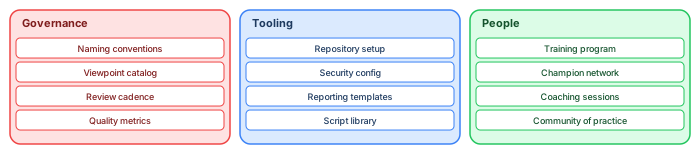
Governance pillar: Naming conventions (per element type), required properties (Owner, Lifecycle Status, Business Criticality), viewpoint catalog (8–12 standard viewpoints with examples), review cadence (quarterly quality reviews), and quality metrics (completeness, freshness, traceability).
Tooling pillar: Repository setup (DBMS-backed for multi-user, Pro Cloud Server for remote access), security configuration (role-based access mapped to Active Directory groups), reporting templates (standard views for architecture review boards), and a script library (naming validation, orphan detection, property completeness checks).
People pillar: Training program (Foundation certification for all architects, Practitioner for leads), champion network (one ArchiMate champion per domain team who provides local support), coaching sessions (monthly 1-hour sessions where architects bring modeling questions), and a community of practice (quarterly meetup for sharing patterns, reviewing conventions, and celebrating wins).
Maturity assessment: where does your organization stand?

Before planning implementation, assess your current maturity. Most organizations start at Level 1 or 2.
Level 1 — Initial: Individual architects create ad-hoc diagrams using whatever tool is available (Visio, PowerPoint, whiteboard photos). No shared vocabulary, no repository, no consistency. Models are personal artifacts on laptops. Advancement requires: buy a tool, start a pilot, define basic conventions.
Level 2 — Managed: A shared repository exists. Basic naming rules have been established. Some architects have received training. Models are beginning to appear in architecture reviews, but consistency is uneven. Advancement requires: formalize the modeling guide, expand training, integrate with governance.
Level 3 — Defined: A viewpoint catalog defines which views the organization produces and for whom. Validation scripts enforce naming and property rules. ArchiMate models are formal inputs to governance decisions. Advancement requires: automate quality checks, establish metrics, publish stakeholder-facing views.
Level 4 — Optimized: Automated quality gates run on the repository. Model metrics (completeness, freshness, traceability) are tracked on dashboards. ArchiMate is the authoritative source of truth for portfolio management, lifecycle decisions, and migration planning. Most organizations should aim for Level 3; Level 4 is appropriate for organizations where architecture models drive investment decisions.
Governance framework for sustained adoption

ArchiMate adoption fails without governance. Governance is not bureaucracy — it is the minimum set of rules that enable consistent, trustworthy modeling at scale. ArchiMate layers explained
Naming conventions: Define patterns per element type. Application Components: PascalCase with domain prefix (PAY_PaymentGateway). Business Processes: verb-noun (Process Payment). Business Services: consumer perspective (Payment Authorization). Technology Services: include technology type (PostgreSQL Database Service). Enforce with validation scripts.
Required properties: Every Application Component: Owner, Lifecycle Status (Active/Phase Out/Retired/Planned), Business Criticality (Critical/High/Medium/Low). Every Business Process: Owner, Value Stream. Every Technology Node: Environment, Location. These enable portfolio queries and governance reports.
Viewpoint catalog: Publish 8–12 standard viewpoints with examples. Every new view must follow a cataloged viewpoint. Custom viewpoints require architecture board approval.
Review cadence: Quarterly model quality reviews check for orphan elements, stale content (not modified in 180+ days), naming violations, and missing properties. Annual reviews assess whether the viewpoint catalog still meets stakeholder needs.
Quality metrics: Track and report monthly: adoption rate (% of architects modeling actively), model completeness (% of Application Components with all required properties), stakeholder satisfaction (quarterly survey), decision traceability (% of architecture decisions referencing a model view).
Common implementation failures and mitigations
"We modeled everything and nobody uses it." Root cause: modeling was not driven by stakeholder concerns. Mitigation: start with viewpoints that answer real questions for real people. If nobody asked the question, do not build the view.
"Every architect models differently." Root cause: no conventions were established before scaling. Mitigation: publish the modeling guide during Phase 1. Review models in architecture board meetings. Use automated validation.
"The model is out of date." Root cause: model maintenance was not built into architecture workflows. Mitigation: assign element ownership. Establish quarterly reviews. Make model updates a deliverable in architecture engagement contracts — not an afterthought.
"The tool is too complex." Root cause: the tool was configured with every possible feature before anyone started modeling. Mitigation: start with a minimal configuration. Add features (scripting, custom profiles, automation) only when the team asks for them.
"Leadership lost interest." Root cause: ArchiMate value was never demonstrated in terms leadership cares about (cost, risk, speed). Mitigation: within the first 3 months, deliver one view that directly supports a leadership decision — for example, an application rationalization view that identifies $2M in annual license savings from retiring duplicates.
Measuring implementation success
Define KPIs before implementation begins. Recommended targets for 12-month assessment:
Adoption rate: 80% of architects actively modeling in the shared repository. Model completeness: 90% of Application Components with all required properties filled. Stakeholder satisfaction: 4/5 average on quarterly survey ("Do ArchiMate views help you make better decisions?"). Decision traceability: 70% of architecture decisions reference a model-based view as evidence. Model freshness: 75% of elements in active domains modified within the last 180 days.
Change management: the human side of ArchiMate adoption

ArchiMate adoption is an organizational change program, not a tool deployment. The ADKAR change management model provides a useful framework: ArchiMate relationship types
Awareness (Months 1–2): Architects and stakeholders need to understand why the organization is adopting ArchiMate. What problem does it solve? What happens if we do not solve it? Communicate the business case — not "we need better diagrams" but "we need traceable architecture decisions that reduce change risk and accelerate delivery."
Desire (Months 3–4): Individual architects need to want to adopt ArchiMate. Address the "what's in it for me?" question. For architects: your models become reusable, queryable, and linked to governance decisions instead of dying in PowerPoint. For managers: your architecture reviews become evidence-based instead of opinion-based.
Knowledge (Months 5–8): Provide training. Foundation certification for all architects (3 days). Practitioner for lead architects (additional 2 days). Tool-specific training (Archi or Sparx EA) for hands-on modeling skills (2 days). Total investment: 5–7 training days per architect over 4 months.
Ability (Months 9–14): Support architects as they apply ArchiMate to real work. Coaching sessions (monthly, 1 hour). Peer reviews of new views. Access to the ArchiMate champion for quick questions. This phase is where most implementations fail — training happens, but follow-up support does not. Without support, architects revert to previous habits within 6 weeks.
Reinforcement (Month 15+): Celebrate successes. Publish case studies of architecture decisions improved by ArchiMate models. Recognize architects who produce high-quality views. Integrate ArchiMate competence into performance reviews. Make modeling a valued skill, not an administrative burden.
Tool selection: Archi vs Sparx EA vs SaaS platforms
The tool choice affects implementation complexity. Archi (free, open-source) is ideal for pilots and small teams — zero license cost, fast setup, excellent ArchiMate support, but limited enterprise features (no DBMS repository, no built-in multi-user). Sparx Enterprise Architect (commercial, $229–$699 per seat perpetual) provides multi-notation support, DBMS repository, COM API, scripting, and Pro Cloud Server — ideal for large organizations that also model in UML, BPMN, or SysML. SaaS platforms (LeanIX, Ardoq) provide portal-first experiences with built-in dashboards but limited modeling depth — ideal for organizations that prioritize portfolio management over detailed architecture modeling.
Start the pilot with whichever tool has the lowest friction. If the pilot succeeds, the business case for a commercial tool becomes easy to make. If it fails, you have not wasted license budget.
If you’d like hands-on training tailored to your team — Sparx Enterprise Architect, BPMN, SysML, Apache Kafka or the Archi tool — or modelling coaching in ArchiMate and TOGAF-aligned governance, you can reach us via our contact page.
Frequently Asked Questions
What is enterprise architecture?
Enterprise architecture is a discipline that aligns an organisation's strategy, business operations, information systems, and technology infrastructure. It provides a structured framework for understanding how an enterprise works today, where it needs to go, and how to manage the transition.
How is ArchiMate used in enterprise architecture practice?
ArchiMate is used as the standard modeling language in enterprise architecture practice. It enables architects to create consistent, layered models covering business capabilities, application services, data flows, and technology infrastructure — all traceable from strategic goals to implementation.
What tools are used for enterprise architecture modeling?
Common enterprise architecture modeling tools include Sparx Enterprise Architect (Sparx EA), Archi, BiZZdesign Enterprise Studio, LeanIX, and Orbus iServer. Sparx EA is widely used for its ArchiMate, UML, BPMN and SysML support combined with powerful automation and scripting capabilities.