⏱ 18 min read
Most Sparx Enterprise Architect implementations do not fail because the tool is weak. They fail because organizations treat EA like a drawing package with admin overhead. EA governance checklist
That’s the blunt truth.
A company buys Sparx EA, stands up a repository, imports a framework, creates a few nice ArchiMate views, maybe adds BPMN for good measure, and then wonders why six months later nobody trusts the content. The repository becomes another dead portal. Architects go back to PowerPoint. Delivery teams ignore it. Governance turns into a ritual. And leadership says, “We tried architecture tooling. It didn’t stick.”
No. You did not try architecture tooling. You installed software.
Sparx EA implementation services, when done properly, are not about deploying a modeling tool. They are about creating a working architecture system: repository structure, meta-model discipline, governance workflows, integration to delivery, role-based usage, and just enough control so the thing survives contact with real projects.
That’s the simple explanation up front.
If you are searching for what “Sparx EA implementation services” actually means, here it is in plain language: it is the work required to configure Enterprise Architect so architects, analysts, security teams, and delivery teams can model, govern, and reuse enterprise architecture in a way that supports real decisions. Not theoretical decisions. Real ones: cloud migration sequencing, IAM control ownership, Kafka domain boundaries, application lifecycle management, and regulatory traceability.
And yes, that sounds less exciting than “digital transformation.” It is also far more useful.
Sparx EA Is Powerful. That’s Also the Problem.
Sparx EA is one of those tools that can do almost everything. UML, BPMN, ArchiMate, requirements, data modeling, roadmaps, traceability, scripts, MDG technologies, governance extensions, integrations, baselines, document generation. It’s all there. ArchiMate layers explained
Which is exactly why implementations go sideways.
When a tool is flexible, organizations project their confusion into it. Every team wants their own conventions. Every architect wants their own viewpoint. Every governance lead wants mandatory metadata. Every PMO wants status fields. Every security team wants risk tagging. Every integration team wants a service catalog. Very quickly the repository turns into a junk drawer with notation.
A serious Sparx EA implementation service brings order to that chaos. It answers questions most organizations avoid at the beginning:
- What decisions will this repository support?
- Who is allowed to create what?
- What is the minimum meta-model that gives value?
- Which diagrams are authoritative, and which are just working views?
- How does repository content connect to delivery pipelines, CMDBs, IAM inventories, cloud landing zones, and event platforms?
- What governance is mandatory and what is performative nonsense?
That last question matters more than people admit. TOGAF roadmap template
What Sparx EA Implementation Services Should Actually Include
A lot of vendors talk about implementation as if it means installation, user setup, and maybe some training. That is not implementation. That is provisioning.
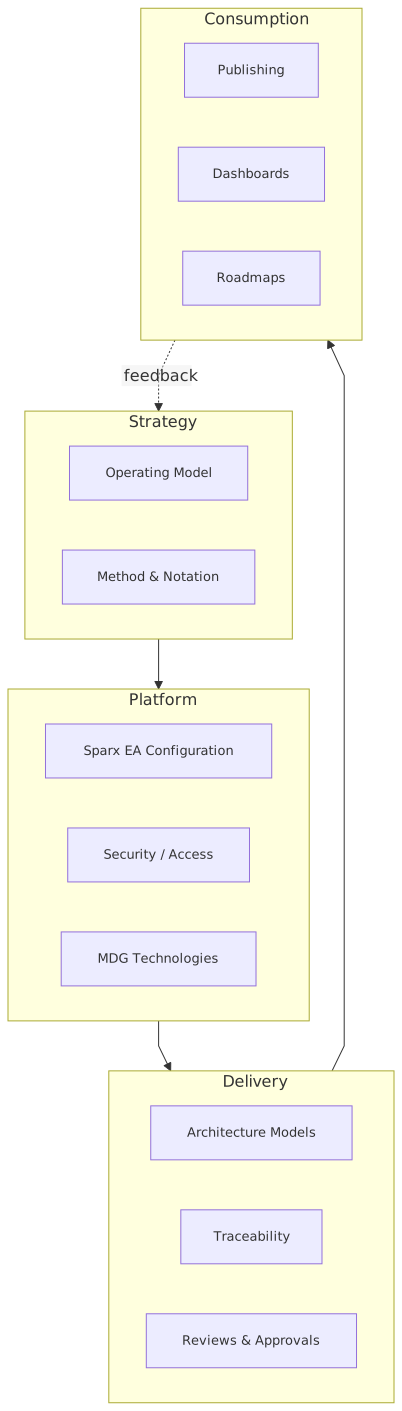
A proper implementation service usually includes these layers:
If these things are not included, you are probably not buying implementation services. You are buying a workshop series with a software login.
The First Contrarian Point: Do Less Modeling
Architects often assume the answer to weak architecture is more architecture artifacts. It usually isn’t.

One of the best things an implementation team can do in Sparx EA is reduce the number of things people are allowed to model. Aggressively. Sparx EA training
That sounds anti-architecture. It isn’t. It is pro-clarity.
A banking organization, for example, does not need 47 kinds of application interaction diagrams. It needs a small number of useful views that support actual decisions:
- capability to application mapping
- application to technology dependency
- IAM trust and authorization boundaries
- Kafka topic ownership and producer/consumer lineage
- cloud deployment and environment segregation
- regulatory control traceability for critical services
That’s enough to create enormous value.
The moment you let every architect invent notation habits inside Sparx EA, consistency dies. Then search dies. Then trust dies. Then reuse dies. Then the tool gets blamed.
What This Looks Like in Real Architecture Work
Let’s leave theory for a moment.
In real enterprise architecture work, Sparx EA should help answer questions like:
- Which banking applications depend on the customer identity provider?
- Which Kafka topics expose regulated customer data?
- Which cloud-hosted services still rely on on-prem authentication?
- Which IAM roles are attached to critical payment processing functions?
- Which applications are in scope for a zero-trust initiative?
- Which systems consume a customer profile event, and who owns schema changes?
- What target state dependencies block migration of a core lending platform to cloud?
Those are architecture questions. They are not diagram questions.
A well-implemented Sparx EA repository lets you navigate those questions without manually rebuilding context every time. It should connect strategy, business capability, application portfolio, integration patterns, security controls, and technology deployment.
That is where implementation quality matters. If your meta-model cannot represent trust boundaries, event ownership, platform services, cloud tenancy, and identity dependencies in a usable way, then your repository will look elegant and still be operationally useless.
A Real Enterprise Example: Retail Banking Modernization
Here’s a realistic example, based on patterns I’ve seen more than once.
A mid-sized retail bank was running a modernization program across digital onboarding, payments, and customer servicing. They had:
- on-prem core banking platforms
- a growing Kafka event backbone
- Azure cloud services for new digital workloads
- a fragmented IAM landscape with legacy AD, a customer IAM platform, and separate privileged access tooling
- architecture artifacts scattered across PowerPoint, Visio, SharePoint, and Excel
They implemented Sparx EA because leadership wanted “end-to-end traceability.” That phrase should always make architects nervous, because it usually means someone wants infinite control with finite investment.
The first attempt failed.
Why? Classic reasons:
- They imported too much legacy content.
Old diagrams from five years of projects were loaded into the repository with almost no rationalization.
- No clear meta-model.
Teams used ArchiMate, UML, and freehand conventions interchangeably.
- Everything was mandatory.
Every element needed dozens of properties. Architects spent more time filling metadata than thinking.
- No ownership model.
Nobody knew who was allowed to update application objects versus integration objects versus security objects.
- No integration to delivery reality.
Kafka topics were modeled manually, cloud services were out of date, IAM dependencies were incomplete.
Six months in, the repository looked impressive in demos and was nearly useless in delivery.
Then they reset.
The second implementation was smaller and much better. They focused on five decision domains:
- application portfolio
- IAM and trust architecture
- Kafka event landscape
- cloud migration state
- regulatory control mapping for critical services
They defined a strict meta-model with only the relationships they needed. They introduced role ownership:
- enterprise architects owned capability and target-state structures
- domain architects owned application and integration objects
- security architects owned IAM and trust metadata
- platform teams submitted validated updates for Kafka and cloud platform assets
Most importantly, they tied repository usage to real governance events:
- solution design approval
- technology exception review
- production readiness checkpoints
- control attestation for regulated applications
Now the repository mattered. If a project introduced a new Kafka topic carrying customer PII, it had to declare producer, consumer domains, retention policy reference, data classification, and IAM dependencies. If a new customer-facing service used cloud-native authentication, it had to show trust integration with the enterprise IAM stack and identify any fallback dependency on legacy identity stores.
That changed conversations.
Architecture review stopped being “show me your diagram” and became “show me your dependencies, ownership, controls, and migration consequences.”
That is what a successful Sparx EA implementation service should enable.
Banking, Kafka, IAM, and Cloud: Why These Matter So Much
These four areas expose whether your repository is architecture-grade or just decorative.
Banking
Banking architecture is brutally dependency-heavy. Products, channels, customer data, payments, fraud, risk, and compliance are all tightly coupled. If your Sparx EA implementation cannot represent application criticality, business capability impact, control obligations, and transition states, then your roadmaps are fiction.
A real banking repository must support questions like:
- Which services are customer-impacting and require high resilience?
- Which applications support KYC, AML, lending, or payment settlement?
- Which target-state changes create regulatory evidence obligations?
- Which systems still depend on unsupported middleware?
This is not optional. In regulated industries, architecture without traceability is just opinion with shapes.
Kafka
Kafka introduces a very specific architecture challenge: teams think event-driven means decoupled, but in practice it often means hidden dependency.
A proper Sparx EA implementation should model:
- topic ownership
- producer and consumer systems
- schema stewardship
- data classification
- event domain boundaries
- environment-specific topic patterns
- platform versus domain responsibility
- replay and retention implications where relevant
Common mistake: architects model Kafka as a single box labeled “event bus.” That is lazy architecture. It hides operational and governance reality. The important thing is not that Kafka exists. The important thing is who publishes what, who consumes what, what contract exists, and where the blast radius lands when a schema changes.
IAM
Identity and access management is usually under-modeled in enterprise architecture, which is absurd because identity is one of the most important control planes in any enterprise.
In Sparx EA, IAM should not be an afterthought buried in security documentation. It should be represented as part of the architecture landscape:
- identity providers
- trust relationships
- authentication patterns
- authorization services
- privileged access boundaries
- machine identity dependencies
- federation paths
- application onboarding state
- legacy identity stores and decommission dependencies
Common mistake: architects document IAM only at the project level and never connect it to enterprise application dependencies. Then during cloud migration they discover half the estate still depends on old LDAP patterns or hard-coded service identities nobody owns.
Cloud
Cloud architecture in repositories is often either too abstract or too technical.
Too abstract means every workload is just “in Azure.” Useless.
Too technical means the repository becomes a second-rate infrastructure catalog. Also useless.
The right implementation sits in the middle. It models architecture-relevant cloud structures:
- workload placement
- environment segregation
- landing zone alignment
- shared platform service consumption
- resilience patterns
- IAM dependency
- network boundary significance
- migration state
- data residency or regulatory relevance where needed
The goal is not to recreate Terraform in Sparx EA. The goal is to represent enough cloud reality that architects can make decisions and explain consequences.
Common Mistakes Architects Make in Sparx EA Implementations
Let’s be honest. Architects are often the problem.
Not because they lack intelligence. Usually the opposite. They overcomplicate things because they can see too many possibilities.
Here are the mistakes I see repeatedly.
1. Starting with the framework instead of the operating problem
People start with TOGAF, ArchiMate, or an industry reference model and assume the repository should mirror the framework. ArchiMate modeling guide
Wrong starting point.
Start with the decisions you need to support. Frameworks are useful, but they are not the operating model. If your biggest challenge is cloud transition dependency and IAM risk, then build for that first.
2. Designing a meta-model for completeness
Completeness is the enemy of adoption.
A meta-model should be designed for usefulness, consistency, and maintainability. Not philosophical purity. If a relationship will never be queried, governed, or used in reporting, ask whether it needs to exist.
3. Confusing architecture governance with administrative punishment
If updating Sparx EA feels like filing taxes, people will avoid it or fake it.
A lot of implementation teams create mandatory fields and review gates that look mature on paper and destroy actual usage. Governance should protect quality, not exhaust the people doing the work.
4. Letting every domain customize everything
This is where repository sprawl begins.
Some local variation is fine. Unlimited variation is fatal. Shared enterprises need shared semantics. If one team models “application service,” another models “API,” and another models “capability interface” for the same thing, your repository is lying to you.
5. Treating diagrams as the primary asset
The repository element model is the asset. Diagrams are views.
This sounds obvious. It is not practiced enough. Teams still create one-off diagrams full of unmanaged objects and then wonder why impact analysis is impossible.
6. Ignoring ownership and lifecycle
Every important element should have an owner and a lifecycle status. Otherwise old content accumulates and trust collapses.
7. Failing to integrate with real source systems
A repository that depends entirely on manual updates will decay. Not maybe. Definitely.
If your cloud inventory, Kafka platform metadata, IAM application registrations, or application portfolio sources exist elsewhere, decide what should be synchronized, referenced, or governed by federation. Manual everything is not a strategy.
What Good Implementation Services Do Differently
A strong implementation partner does not just know Sparx EA features. They understand architecture behavior inside enterprises.
That means they push back.
They will say things clients do not always enjoy hearing:
- You do not need every notation.
- You are trying to model too much too early.
- Your governance process is too heavy.
- Your application catalog is too dirty to import as-is.
- Your IAM architecture is more fragmented than your diagrams suggest.
- Your Kafka landscape has no clear domain ownership.
- Your cloud “target state” is still a collection of project-level decisions, not an enterprise design.
That kind of pushback is valuable. In fact, if your implementation partner never disagrees with you, be careful. They may be selling comfort instead of outcomes.
A good team usually works in phased increments:
Phase 1: Foundation
- repository setup
- security and access model
- basic package structure
- minimum meta-model
- naming and lifecycle rules
Phase 2: Priority Use Cases
- application portfolio
- cloud migration views
- IAM dependency mapping
- Kafka ownership and lineage
- governance workflows tied to architecture review
Phase 3: Integration and Scale
- CMDB or portfolio sync
- cloud metadata alignment
- reporting dashboards
- controlled extension of viewpoints
- quality assurance and repository stewardship
This phased approach is less glamorous than “enterprise-wide architecture transformation.” It is also how you avoid creating an expensive empty cathedral.
How This Applies Day to Day for Architects
This is where many articles become vague. So let’s make it practical.
If you are a domain architect in a bank working on customer onboarding, a well-implemented Sparx EA repository should help you:
- identify the current systems involved in onboarding
- see which IAM services handle employee and customer authentication
- understand which Kafka events are produced during onboarding
- assess whether those events contain regulated data
- determine which services are already cloud-hosted versus on-prem
- reuse target-state patterns rather than inventing new ones
- document variances that governance can review quickly
If you are an enterprise architect planning a cloud migration wave, it should help you:
- group applications by dependency and control complexity
- identify IAM blockers before migration planning starts
- see which workloads rely on Kafka connectivity patterns not yet cloud-ready
- expose shared platform dependencies that create sequencing constraints
- build transition architectures that are based on actual relationships, not workshop optimism
If you are a security architect, it should help you:
- map trust boundaries across cloud and on-prem services
- identify applications using legacy auth patterns
- connect critical controls to application and integration components
- support audit and control discussions with architecture evidence
If Sparx EA is not helping in these ways, then the implementation is incomplete, no matter how nice the diagrams look.
The Governance Question Nobody Likes
Who keeps the repository clean?
This is where implementations quietly die after the consultancy exits.
You need a real operating model. Not a slide with RACI boxes no one reads. A real one.
At minimum:
- one platform owner for Sparx EA administration and standards
- one architecture method owner for meta-model and viewpoint control
- domain content owners for key architecture areas
- quality checks for lifecycle, duplicates, naming, and orphaned elements
- a change process for extending stereotypes or tagged values
- periodic repository rationalization
And here is another contrarian thought: not every architect should be a full editor.
That upsets some people. But broad write access often creates repository entropy. In many enterprises, a stewarded contribution model works better than unrestricted editing. Architecture is collaborative, yes. That does not mean semantic anarchy is a virtue.
Measuring Whether the Implementation Is Working
You cannot assess success only by counting diagrams or active users. Those are vanity metrics.
Better indicators include:
- percentage of architecture reviews using repository-backed evidence
- reduction in duplicate application or integration records
- number of projects reusing approved target-state patterns
- time to perform impact analysis for changes in IAM, Kafka, or cloud platforms
- percentage of critical applications with verified ownership and lifecycle state
- accuracy of dependency mapping in migration planning
- governance exceptions identified earlier in project delivery
In the banking example, one of the most useful measures was simple: how quickly could architects identify all applications and event flows affected by a change in customer identity integration? Before the repository reset, that answer took days and several meetings. After the reset, it took under an hour to assemble a credible impact view.
That is implementation value.
Final Opinion: Sparx EA Is Worth It, But Only If You Take Architecture Seriously
Sparx EA is not fashionable. It is not the slickest tool in the market. It does not win beauty contests. Good. Architecture should be more interested in truth than cosmetics.
What makes Sparx EA valuable is that it can support disciplined, connected, enterprise-scale modeling without forcing you into a simplistic view of architecture. But that flexibility demands maturity. If your organization wants a repository that behaves like a governed architecture system, you need implementation services that cover method, structure, ownership, integration, and operating discipline.
If you just want prettier diagrams, save the money and stay in PowerPoint.
That may sound harsh, but architects should stop pretending tool implementation is neutral. It is not. The way you implement Sparx EA reveals what you think architecture is for.
If architecture is for decision support, dependency visibility, governance with evidence, and reusable enterprise design, then Sparx EA can be excellent.
If architecture is for producing artifacts that comfort management while delivery teams work around them, no tool will save you.
And that is the real issue. Not the software. The seriousness.
FAQ
1. What are Sparx EA implementation services in simple terms?
They are the services needed to turn Sparx Enterprise Architect into a usable enterprise architecture platform, not just an installed tool. That includes repository design, meta-model setup, governance workflows, integrations, migration of old content, and training tied to real roles.
2. How long does a typical Sparx EA implementation take?
A useful initial implementation often takes 8 to 16 weeks for foundation and first use cases. Larger enterprises may take several months more to integrate application portfolio data, IAM structures, cloud views, and event platform models like Kafka. The mistake is trying to do everything in one wave.
3. Should Sparx EA integrate with CMDB, cloud, or IAM tools?
Usually yes, but selectively. Do not integrate everything because you can. Integrate where architecture decisions depend on current operational truth. Application portfolio sources, cloud inventories, IAM registrations, and event platform metadata are common candidates. The key is deciding what Sparx EA owns versus what it references.
4. What is the biggest reason Sparx EA repositories fail?
Poor implementation discipline. Specifically: no clear meta-model, too much imported legacy content, weak ownership, excessive governance overhead, and no connection to actual project and platform decisions. The tool gets blamed for organizational indecision.
5. Is Sparx EA a good fit for banking and regulated enterprises?
Yes, often very much so. Banking environments need traceability across applications, controls, IAM, integrations, and target-state transitions. Sparx EA can support that well if implemented with strict modeling standards and a practical operating model. Without that discipline, it becomes just another repository nobody trusts.
Frequently Asked Questions
What is enterprise architecture?
Enterprise architecture is a discipline that aligns an organisation's strategy, business processes, information systems, and technology. Using frameworks like TOGAF and modeling languages like ArchiMate, it provides a structured view of how the enterprise operates and how it needs to change.
How does ArchiMate support enterprise architecture practice?
ArchiMate provides a standard modeling language that connects strategy, business operations, applications, data, and technology in one coherent model. It enables traceability from strategic goals through business capabilities and application services to the technology platforms that support them.
What tools are used for enterprise architecture modeling?
The main tools are Sparx Enterprise Architect (ArchiMate, UML, BPMN, SysML), Archi (free, ArchiMate-only), and BiZZdesign Enterprise Studio. Sparx EA is the most feature-rich option, supporting concurrent repositories, automation, scripting, and integration with delivery tools like Jira and Azure DevOps.