⏱ 19 min read
Most data platforms fail in a strangely familiar way. They don’t collapse because the warehouse is too slow, the streaming bus is too small, or the cloud bill is too high. They fail because nobody can answer a simple question with confidence: what does this data mean, who changed it, and what should happen next?
That sounds mundane. It isn’t.
In most enterprises, data arrives like freight at a crowded port. Files land in object storage. CDC events pour out of operational systems. Kafka topics accumulate messages nobody fully understands. Dashboards blossom. Machine learning teams train on extracts that were “good enough” six months ago. And somewhere in the middle of all that motion sits a brittle web of scripts, mappings, hand-maintained schemas, tribal knowledge, and hope. event-driven architecture patterns
Hope is not architecture.
A metadata-driven architecture is what happens when a data platform stops treating metadata as decoration and starts treating it as a control system. Not just labels on tables. Not just a lineage catalog for auditors. I mean operational metadata, business metadata, policy metadata, schema metadata, workflow metadata, quality rules, ownership, contracts, domain semantics—the information that tells the platform how data should be interpreted, processed, governed, and served.
That shift matters because a modern data platform is no longer a passive repository. It is an active machine. It ingests, transforms, validates, enriches, publishes, secures, and retires data continuously. Machines like that need a nervous system. Metadata is the nervous system.
This article lays out how to think about metadata-driven architecture in a serious enterprise setting: where domain-driven design fits, how metadata flows through ingestion and serving layers, what Kafka and microservices are good for, how to migrate using a progressive strangler approach, where reconciliation becomes non-negotiable, and when the whole idea is simply too much machinery for the problem at hand. microservices architecture diagrams
Context
The old world was simpler, if not better. Data architecture used to be built around a warehouse, an ETL tool, and a schedule. Source systems exported data. Integration teams transformed it nightly. Reporting teams consumed curated marts. Metadata existed, but mostly as documentation and maybe a semantic layer if you were lucky.
That world has been replaced by one where data moves in several tempos at once. Transactional systems emit changes in milliseconds. SaaS platforms expose APIs with idiosyncratic schemas. Data products need both raw history and real-time state. Governance teams require lineage, retention, and access policies. Business teams expect self-service but still demand trusted numbers. AI initiatives intensify all of it because now even “slightly wrong” metadata compounds into model drift and bad decisions at scale. EA governance checklist
The result is a platform problem, not a tooling problem.
And the platform problem is ultimately semantic. Every serious enterprise has learned some version of this lesson: moving data is easy; preserving meaning is hard.
If customer means one thing in CRM, another in billing, and a third in service operations, then no amount of orchestration glamour will save you. If “active account” is encoded differently across channels, your KPI is political, not analytical. If a schema registry knows field types but not domain intent, then compatibility checks will prevent some breakage while allowing semantic corruption to sail through untouched.
Metadata-driven architecture is an attempt to put semantics, behavior, and policy at the center of platform design.
Problem
Most data platforms evolve as layered accidents.
One team builds ingestion pipelines. Another team introduces Kafka for event streaming. A governance office procures a catalog. Security adds masking policies. A BI group defines metrics in a semantic layer. Data science teams create feature pipelines. MDM appears to solve identity. Workflow engines orchestrate everything. Over time, each capability accumulates its own metadata store, its own identifiers, its own API, and its own incomplete version of reality.
What emerges is not a metadata architecture. It is metadata sprawl.
This creates familiar enterprise pain:
- pipelines break because schema changes are discovered too late
- data products drift because business definitions are embedded in code
- governance controls are applied inconsistently
- lineage is reconstructed after incidents instead of driving the runtime
- onboarding a new source system requires bespoke engineering
- reconciliation between batch and streaming paths becomes a permanent fire
- domain ownership is unclear, so platform teams become bottlenecks
- migration from legacy ETL to event-driven pipelines stalls because nobody trusts equivalence
The deeper issue is coupling. Behavior is hardcoded into pipelines, services, transformation jobs, dashboards, and access controls. Every change is expensive because semantics are scattered. The platform cannot adapt without surgery.
A metadata-driven approach does not eliminate complexity. It relocates it into explicit models, contracts, and policies where it can be managed.
That is a much better bargain.
Forces
Good architecture is rarely about ideal forms. It is about balancing unpleasant truths.
Here are the forces that shape metadata-driven data platforms.
1. Domain semantics matter more than technical schemas
A customer_id column is not a customer model. A JSON schema is not a business contract. Technical metadata tells you structure. Domain metadata tells you meaning, boundaries, lifecycle, ownership, and acceptable use.
This is where domain-driven design earns its keep. In data platforms, bounded contexts are not an ivory-tower abstraction; they are practical survival gear. They help define where a term is authoritative, where translation is needed, and where a shared concept is actually a dangerous illusion.
2. The platform must support multiple tempos
Batch, micro-batch, and streaming will coexist. CDC, file drops, APIs, and events will coexist. Governance controls must apply across all of them. Metadata has to work at design time and runtime. ArchiMate for governance
3. Enterprise change is continuous and political
New acquisitions arrive with alien schemas. Legacy systems refuse to die. Regulatory rules change. Product teams rename fields casually. Data ownership shifts during reorganizations. Architecture must assume drift.
4. Self-service and control pull in opposite directions
The business wants faster onboarding and less central dependency. Risk and compliance want stronger oversight. Metadata is one of the few levers that can increase automation and improve control—if designed well.
5. Migration matters as much as destination
No large enterprise gets to start clean. The real test of architecture is whether it can coexist with legacy ETL, monolithic warehouses, bespoke jobs, and manually curated reports long enough to replace them without losing trust.
Solution
The core idea is simple: make metadata a first-class runtime asset rather than a passive documentation afterthought.
In a metadata-driven platform, metadata is not just stored; it is executed against.
That means the platform uses metadata to determine:
- how to ingest a source
- how to validate schemas and contracts
- how to map source concepts to domain concepts
- which transformations apply
- what quality rules must pass
- which Kafka topics or storage zones receive output
- which policies govern retention, masking, access, and lineage
- how data products are published and versioned
- how reconciliation and exception handling work
- how observability should interpret failures
This architecture usually includes several classes of metadata:
- Technical metadata: schemas, formats, partitions, storage locations, topic names, API specs
- Operational metadata: job runs, checkpoints, offsets, SLAs, freshness, retries, failure states
- Business metadata: business glossary, domain terms, KPI definitions, ownership, criticality
- Policy metadata: retention, privacy classifications, masking rules, entitlement models
- Transformation metadata: mappings, derivations, rule sets, enrichment logic
- Lineage metadata: upstream/downstream relationships, version dependencies, publication history
- Quality metadata: constraints, thresholds, anomaly rules, reconciliation criteria
The trick is not building one giant metadata repository that becomes the new enterprise cathedral. The trick is building a coherent metadata model with clear responsibilities and APIs, then allowing specialized stores and services behind it.
This is where people get it wrong. They hear “metadata-driven” and immediately imagine an all-powerful generic engine that can do everything through configuration. That path often ends in an accidental low-code platform nobody enjoys maintaining.
Metadata should drive variability where variability is real and recurring. It should not be a theological crusade against code.
Some things belong in metadata:
- source-to-domain mappings
- policy assignments
- data contract versions
- quality thresholds
- publication rules
- lineage links
Some things still belong in code:
- complex domain algorithms
- performance-sensitive transformations
- one-off statistical logic
- deeply custom enrichment behavior
If you try to encode all business behavior into metadata, you don’t remove complexity. You hide it in unreadable configuration.
Architecture
A practical metadata-driven data platform usually has four structural ideas.
1. Domain-aligned data products
Following domain-driven design, data should be organized around bounded contexts, not around raw source systems alone. Sales, Billing, Claims, Fulfillment, Risk, and Customer Support are not just folders in a lake; they are domains with language, ownership, and publication responsibilities.
Metadata must encode those semantics:
- domain owner
- authoritative source
- canonical events and entities
- quality expectations
- publication contracts
- policy obligations
2. Control plane and data plane separation
The data plane moves and processes data. The control plane manages metadata, policy, orchestration decisions, and operational coordination.
This is one of the most important design choices. Mixing metadata logic directly into every pipeline creates an estate of special cases. A control plane allows consistency without centralizing all execution in one place.

3. Evented metadata flow
In mature platforms, metadata changes should themselves be evented. A schema update, contract approval, classification change, or ownership transition is not merely an admin action. It can trigger validation, pipeline deployment checks, policy regeneration, topic compatibility checks, or consumer notifications.
Kafka is useful here, not because every problem needs a topic, but because metadata changes often need durable, ordered propagation across loosely coupled services. The same event backbone carrying business events can also carry governance and platform signals—provided you keep the domains distinct and contracts disciplined.
4. Reconciliation as a built-in concern
Any platform that supports both streaming and batch, or that migrates from legacy to modern pipelines, will need reconciliation. Not as a side report. As a first-class capability.
Reconciliation metadata defines:
- equivalence criteria between source and target
- tolerance windows
- duplicate handling policy
- late-arriving event rules
- field-level comparison strategy
- aggregate balancing rules
- exception routing and remediation ownership
Without this, migration turns into ideology. With it, migration becomes measurable.
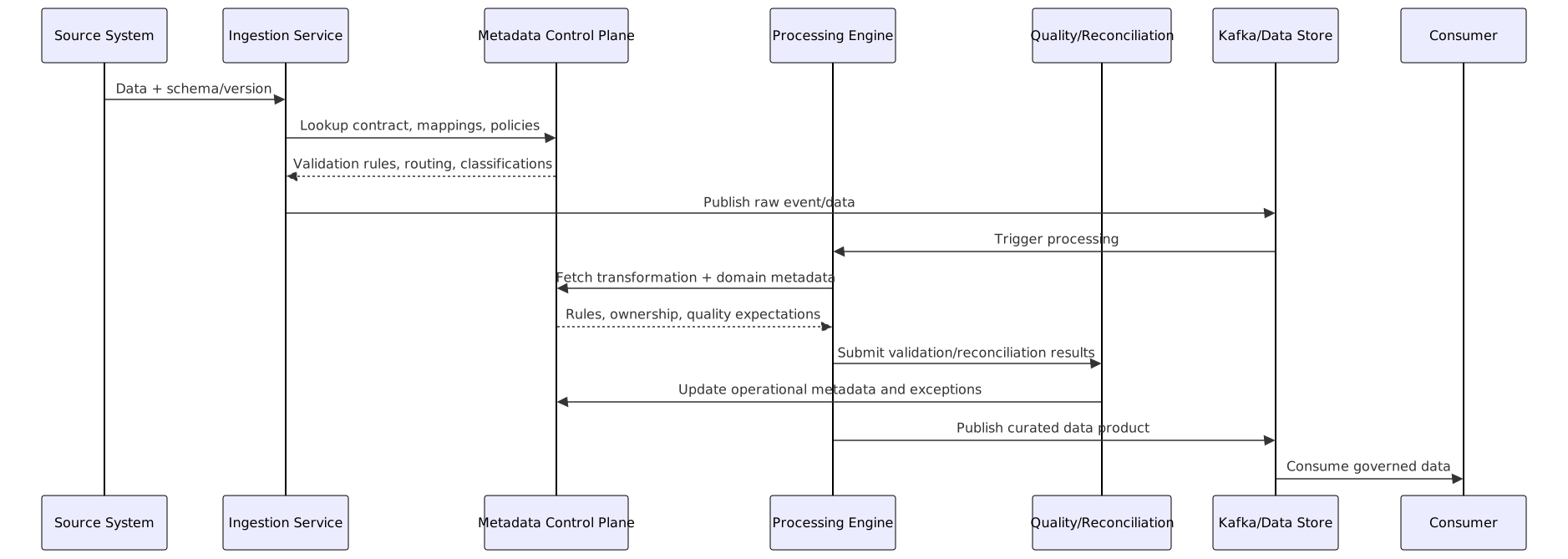
Here is a representative metadata flow.
Migration Strategy
The right migration strategy is almost never “stop everything and redesign the platform.” Enterprises do not migrate that way. Enterprises migrate in the cracks between quarterly priorities.
So use a progressive strangler approach.
Start by identifying a narrow but valuable slice: one domain, one set of critical data products, one ingestion path, one policy problem that repeatedly hurts. Build the metadata control plane for that slice while leaving legacy pipelines intact. Then route new flows through the new path, and gradually wrap legacy assets with metadata adapters.
There are five sensible migration stages.
Stage 1: Make metadata explicit
Inventory existing schemas, transformations, owners, schedules, quality checks, and policies. This sounds obvious, but many organizations discover that key logic exists only in SQL jobs, ETL GUIs, and human memory.
At this stage, do not chase perfection. Build enough of a model to externalize what currently drives runtime behavior.
Stage 2: Introduce contracts and domain boundaries
Define bounded contexts and authoritative publishers. Establish data contracts for high-value datasets and events. Use schema registry patterns where relevant, but go beyond field types into semantic expectations.
This is where teams often discover they don’t have a “customer” problem. They have four bounded contexts using the same noun dishonestly.
Stage 3: Externalize policy and validation
Move quality checks, compatibility rules, retention classes, and access classifications into metadata-managed services. Pipelines should call policy engines and validation services, not reimplement them ad hoc.
Stage 4: Dual run with reconciliation
Run new metadata-driven pipelines in parallel with legacy ETL or warehouse jobs. Reconcile outputs repeatedly. Publish trust scores. Make discrepancies visible and owned.
This is the part organizations want to skip because it looks slow. They shouldn’t. Reconciliation is what turns migration from a leap of faith into an engineering discipline.
Stage 5: Strangle legacy orchestration
Once confidence is proven, redirect consumers to curated products produced under the metadata-driven model. Retire legacy transformations incrementally. Keep metadata about retired assets for lineage and audit history.
A migration map often looks like this:
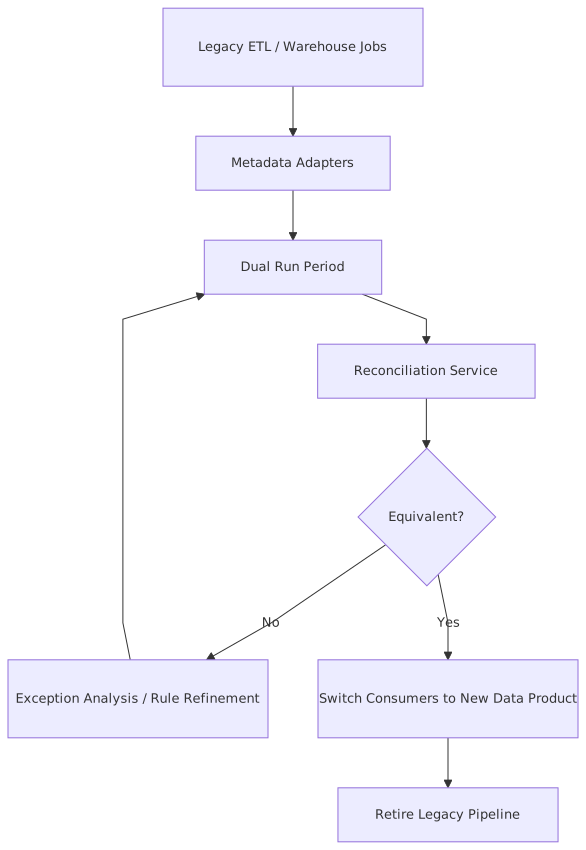
The strangler pattern works here for the same reason it works in application modernization: replacement succeeds when new capabilities surround and gradually absorb old behavior instead of demanding one heroic cutover.
Enterprise Example
Consider a global insurer with operations across policy administration, claims, billing, broker channels, and customer service. Like most insurers, it grew through acquisition. Each acquired business brought its own policy system, claims platform, document repository, product taxonomy, and customer identifiers.
The company wanted a modern data platform for analytics, regulatory reporting, fraud detection, and digital servicing. It already had a warehouse, several ETL tools, Kafka for event distribution, and a data catalog. On paper, it looked mature. In reality, it had five versions of policy, inconsistent claim status semantics, and no reliable way to reconcile daily regulatory submissions against near-real-time operational dashboards.
The first instinct was to build a canonical insurance model across the enterprise. That would have been a mistake. Insurance domains overlap, but they do not collapse neatly into one shared truth. Policy issuance, claims adjudication, billing, and customer servicing each have bounded contexts. The meaning of “active,” “closed,” “exposure,” or even “customer” changes with context and time.
So the platform team did something smarter.
They defined domain-owned data products:
- Policy domain published policy lifecycle events and policy state snapshots
- Claims domain published claim events, reserve movements, and adjudication outcomes
- Billing domain published invoice and payment products
- Customer servicing domain published interaction and preference products
A metadata control plane held:
- data contracts for each event and table product
- mappings from legacy source codes to domain codes
- policy classifications for PII and financial sensitivity
- retention rules by jurisdiction
- quality assertions such as reserve balance checks and claim lifecycle completeness
- lineage from source platforms to published products
- reconciliation rules between warehouse reports and event-derived aggregates
Kafka was used for domain event distribution and some metadata-change notifications. Microservices handled validation, policy enforcement, and publication workflows. Batch pipelines still existed for historical loading and some regulatory extracts, but they consumed the same metadata contracts as the stream processors.
The migration started with claims, not customer, because claims had painful reconciliation issues and measurable business value. The team dual-ran event-derived claim movement aggregates against warehouse-generated regulatory figures for three months. They found predictable mismatches:
- late-arriving adjustments
- duplicate events from a regional claims platform
- code translation inconsistencies between legacy and domain models
- timezone-related day-boundary errors
None of this was surprising. What mattered was that the platform had encoded reconciliation expectations in metadata, so exceptions were visible, categorized, and assigned. The business got a trust dashboard instead of a guessing game.
By the time the insurer moved policy and billing domains onto the same model, the platform had become less a collection of pipelines and more a governed marketplace of domain products. Not perfect. No enterprise platform ever is. But materially better: changes were faster, audit questions were easier, and semantic drift was harder to hide.
That is what good architecture does. It does not make complexity disappear. It makes complexity legible.
Operational Considerations
A metadata-driven platform creates a new operational burden: the metadata itself becomes production-critical.
That means you need to operate it like software, not like a wiki.
Versioning
Metadata models, contracts, mappings, and policies need explicit versioning. Backward compatibility rules should be different for different artifact types. A schema may tolerate additive changes; a privacy classification may require immediate propagation; a transformation rule change may need staged rollout.
Deployment discipline
Changes to metadata should pass through CI/CD pipelines with validation, simulation, and impact analysis. If a data contract changes, the platform should know which producers, consumers, quality rules, and dashboards are affected.
Observability
You need observability for data and metadata together:
- freshness
- volume anomalies
- contract violations
- policy enforcement failures
- lineage breaks
- reconciliation drift
- ownership gaps
If pipeline telemetry is rich but metadata health is opaque, you are flying half-blind.
Ownership model
The best pattern is usually federated ownership with strong platform standards. Domains own semantics and product contracts. The platform owns control-plane capabilities, common policy services, and enforcement mechanisms.
This is a classic enterprise compromise and a good one. Centralized semantics become bottlenecks. Fully decentralized metadata becomes chaos.
Security
Metadata often contains sensitive information: data classifications, critical lineage, system topology, and ownership structures. Treat it accordingly. The catalog is not just a convenience layer; in many organizations it is a map of the kingdom.
Tradeoffs
Metadata-driven architecture is powerful, but it is not free.
The first tradeoff is speed now versus speed later. In the short term, externalizing semantics, contracts, and policies slows teams down. In the long term, it reduces repeated reinvention and shortens change cycles. Many organizations never get the long-term benefit because they abandon the discipline halfway through.
The second tradeoff is flexibility versus readability. More metadata means more runtime adaptability. It also means more indirection. Debugging can become difficult when behavior emerges from the combination of contracts, policy rules, mapping definitions, and orchestration metadata.
The third tradeoff is central consistency versus domain autonomy. Shared metadata standards help interoperability, but too much central modeling creates bureaucracy. Too little creates semantic fragmentation.
The fourth is generic platform ambition versus practical scope. Metadata can drive many things, but not everything should be made configurable. The line between a platform and an overgeneralized framework is thinner than architects like to admit.
Failure Modes
Most failures are not technical impossibilities. They are design overreach or organizational denial.
The giant metadata swamp
Everything gets dumped into a “central metadata repository” with no coherent model, no ownership boundaries, and no lifecycle discipline. Soon it is stale, contradictory, and distrusted.
Configuration replacing design
Teams attempt to move all business logic into metadata tables and rule engines. Complexity becomes opaque. Testing becomes painful. Developers quietly bypass the platform.
Technical metadata without domain semantics
A catalog, schema registry, and lineage graph are deployed, but nobody defines bounded contexts, business terms, or authoritative ownership. The platform knows structure but not meaning.
No reconciliation discipline
New pipelines are declared “equivalent” to legacy outputs without measurable reconciliation. Consumers discover mismatches first. Trust is lost, and trust is expensive to regain.
Event enthusiasm without contract rigor
Kafka gets introduced and every team emits whatever they like. Topic sprawl follows. Consumer coupling increases. Metadata cannot save an undisciplined event landscape.
Platform team as semantic bottleneck
If every metadata change requires a central team to interpret business meaning, self-service dies. Domain ownership must be real, not ceremonial.
When Not To Use
Not every data problem deserves metadata-driven architecture.
Do not use this approach when:
- you have a small platform with a handful of stable pipelines and minimal governance pressure
- domain semantics are simple and unlikely to change
- the cost of metadata control planes outweighs the cost of occasional manual fixes
- the organization lacks discipline for contracts, ownership, and operational metadata management
- you are solving a one-off analytical integration rather than building a durable enterprise platform
In those cases, straightforward pipeline code and lightweight documentation may be the better answer. Architecture should fit the problem, not flatter the architect.
This matters because metadata-driven design has become fashionable. Fashion is dangerous in enterprise architecture. It encourages people to install machinery they cannot operate.
Related Patterns
Several patterns often sit alongside metadata-driven architecture.
Data contracts formalize producer-consumer expectations. They are often the backbone of metadata governance.
Data mesh contributes the idea of domain-owned data products, though many organizations benefit from the idea without adopting the label wholesale.
Event-driven architecture is useful when metadata changes and business changes both need loose coupling and propagation. Kafka often plays well here, especially for contract-aware eventing.
Master data management helps where entity identity and survivorship matter, but it should not be confused with broader metadata architecture.
Schema registry is necessary in event platforms but insufficient on its own. Type compatibility is not semantic compatibility.
Strangler pattern is the right migration posture for most legacy modernization efforts in data platforms.
CQRS-style separation sometimes appears in serving layers, where write-side event streams and read-side analytical products are governed by shared metadata but optimized differently.
Summary
A metadata-driven architecture in a data platform is not about building a prettier catalog. It is about moving semantics, policy, quality, and operational intent out of hidden code paths and into explicit, governable models that the platform can act on.
That shift pays off when the enterprise is large enough, change is constant enough, and trust matters enough.
The design center should be domain semantics, not technical schemas alone. Bounded contexts matter because shared language is usually less shared than people think. Kafka and microservices can help, but only if contracts and ownership are disciplined. Migration should be progressive, not heroic. Reconciliation must be built in, especially when replacing legacy pipelines or mixing batch and streaming. And the architecture must remain honest about tradeoffs: metadata can illuminate complexity, but it can also become another layer of fog if overgeneralized.
The best metadata-driven platforms feel less like giant central systems and more like well-run cities. Rules are visible. Streets connect. Neighborhoods keep their identity. Changes can happen without tearing up the whole map.
That is the goal.
Not a perfect model of the enterprise.
A platform that knows enough about the meaning of data to move it safely through change.
Frequently Asked Questions
What is a data mesh?
A data mesh is a decentralised data architecture where domain teams own and serve their data as products. Instead of a central data team, each domain is responsible for data quality, contracts, and discoverability.
What is a data product in architecture terms?
A data product is a self-contained, discoverable, trustworthy dataset exposed by a domain team. It has defined ownership, SLAs, documentation, and versioning — treated like a software product rather than an ETL output.
How does data mesh relate to enterprise architecture?
Data mesh aligns data ownership with business domain boundaries — the same boundaries used in domain-driven design and ArchiMate capability maps. Enterprise architects play a key role in defining the federated governance model that prevents data mesh from becoming data chaos.