⏱ 19 min read
Multi-region architecture usually begins with a lie.
The lie is simple: data is just data, and if we copy enough of it into enough places, the system will become global, resilient, and fast. This is how many enterprises drift into a mess of replicated databases, region-local caches, conflicting updates, and governance arguments dressed up as technical design. At first, it looks sophisticated. Then a customer changes their billing address in Frankfurt while an order service in Virginia still believes the old value. A compliance team asks which region truly owns payroll records. An operations team discovers that “active-active” really means “active-arguing.”
The hard part of multi-region systems is not moving bytes across oceans. The hard part is deciding who is allowed to tell the truth.
That is what cross-region data ownership is really about. It is not primarily a networking problem, nor a cloud topology problem, nor even a replication problem. It is a domain problem. Which region owns which business facts? Which updates are authoritative? Which data is merely projected, cached, or replicated for read performance? Which processes can cross regional boundaries, and which must not? Once you answer those questions in domain language, architecture gets clearer. Until then, you are just arranging confusion more efficiently.
This article looks at cross-region data ownership through an enterprise architecture lens: domain-driven design, bounded contexts, event-driven integration, Kafka-backed propagation, migration by strangler pattern, and the unpleasant but necessary mechanics of reconciliation. We will also talk about the tradeoffs, the ugly failure modes, and the situations where this pattern is the wrong answer. event-driven architecture patterns
Context
Most large enterprises do not become multi-region by clean design. They arrive there through growth, acquisition, regulation, latency complaints, and a few urgent board-level demands. A bank opens operations in APAC. A retailer acquires a European brand. A SaaS platform promises local data residency. A manufacturer wants regional autonomy because headquarters cannot keep every warehouse waiting on a single US-hosted transactional database.
Soon, the system landscape changes shape:
- customer-facing applications run in multiple geographic regions
- microservices are deployed regionally for resilience and latency
- event streams span continents
- some data must remain local for sovereignty or compliance reasons
- other data must be globally visible
- teams need a model that preserves both autonomy and consistency
This is where many organizations reach for database replication as the primary design move. It is understandable. Replication is concrete. It can be bought from vendors. It produces architecture diagrams with arrows that make executives feel safe. But replication is not ownership. If three regions can all update the same customer master, you do not have high availability. You have distributed ambiguity.
Cross-region data ownership provides a more disciplined frame: every critical class of business data has a designated owning region, and other regions consume that data through asynchronous propagation, explicit synchronization, or carefully constrained command routing.
That sounds simple. It isn’t. But it is simpler than pretending there is no authority model at all.
Problem
The core problem is this: in a multi-region system, different parts of the business need low-latency access to shared information, but uncontrolled write access across regions creates inconsistency, operational fragility, and regulatory risk.
The symptoms are familiar:
- duplicate customer profiles created in different regions
- conflicting updates to orders, inventory, or entitlements
- downstream services unable to tell whether a local copy is authoritative
- read-your-write failures after region failover
- circular synchronization loops between regional systems
- data residency violations caused by over-replication
- audit disputes because no one can identify the system of record
The issue becomes sharper in microservices architectures. Every service wants autonomy. Every team wants local control. Kafka topics make replication easy enough that people often publish facts with no explicit semantic contract around authority. The result is not event-driven elegance. It is event-driven folklore. microservices architecture diagrams
A robust design must answer a few blunt questions:
- Where is the source of truth for each business concept?
- Who can perform writes?
- How do other regions learn about changes?
- What happens when regions are partitioned or unavailable?
- How are conflicts detected and reconciled?
- What data may never leave a region?
These are not implementation details. They are architecture decisions that sit directly on top of domain semantics.
Forces
Cross-region data ownership exists because several forces pull in opposite directions.
Latency versus authority
Users expect local responsiveness. The business wants transactions close to the point of use. But strong consistency across distant regions is slow and expensive. Physics is a stakeholder whether you invite it or not.
Regional autonomy versus global coherence
Regional business units often need independence. They may have different products, regulations, or operating hours. Yet the enterprise still needs coherent customer identity, finance, risk, and reporting.
Compliance versus convenience
Data sovereignty, residency, privacy, and sector-specific regulations can restrict where data is stored or processed. The easiest technical option—copy everything everywhere—is often the least legal.
Availability versus correctness
During a regional outage, do you allow writes elsewhere? For some data, yes. For some, never. A global shopping cart can tolerate eventual reconciliation. A regulated trading ledger cannot.
Service autonomy versus enterprise semantics
Microservices encourage local data ownership, which is good. But ownership at the service level does not automatically solve ownership at the regional level. Without a common semantic model, one region’s “customer” might be another region’s “subscriber,” “party,” or “account holder.”
Cost versus control
Operating active-active services across regions is expensive. Running cross-region Kafka replication, CDC pipelines, reconciliation jobs, and regional observability stacks is not cheap. If the business does not need the complexity, adding it is architecture theater.
These forces are why simplistic answers fail. “Just replicate” ignores semantics. “Just centralize” ignores latency and resilience. “Just use eventual consistency” ignores the business cost of inconsistency.
Solution
The most practical pattern is this:
Assign explicit ownership of business data to a region aligned to domain semantics, allow writes only in the owning region, distribute changes through events or replication to non-owning regions, and treat all remote copies as derivative unless the domain explicitly supports federated authority.
This approach works best when paired with domain-driven design.
Start with bounded contexts, not infrastructure. A customer identity context may have one ownership model. Orders may have another. Inventory may be region-owned by warehouse geography. Pricing may be centrally owned but regionally overridden. Compliance documents may be legally pinned to a jurisdiction.
That nuance matters. “Customer data ownership” is often too coarse a phrase to be useful. Enterprises get into trouble because they assign ownership at the table or database level rather than at the domain concept level. The business does not operate on tables. It operates on concepts with rules, lifecycle, and authority.
A better framing looks like this:
- Customer Identity: globally unique identity, possibly home-region owned
- Order: owned by region of origination
- Inventory Position: owned by physical fulfillment region
- Product Catalog: centrally mastered, regionally projected
- Consent and Privacy Preferences: often jurisdiction-owned
- Ledger Entries: legally constrained, often region-locked
Once you define ownership by domain, the integration model becomes clearer.
Core principles
- Single write authority per ownership scope
A given record or aggregate should have one authoritative write location at a time.
- Remote copies are projections
They are for reads, analytics, local processing, or derived workflows—not silent peer updates.
- State changes travel as facts
Prefer business events or ordered change streams over ad hoc batch copying.
- Commands route to the owner
If a non-owning region needs a change, it sends a command or request to the owning region.
- Conflicts are explicit, not accidental
If federated updates are allowed, conflict resolution rules must be designed, not wished into existence.
- Ownership may be static or partitioned
Some domains use fixed ownership by geography. Others partition by customer home region, legal entity, warehouse, or account.
Architecture
A good regional ownership architecture separates command authority from read locality.
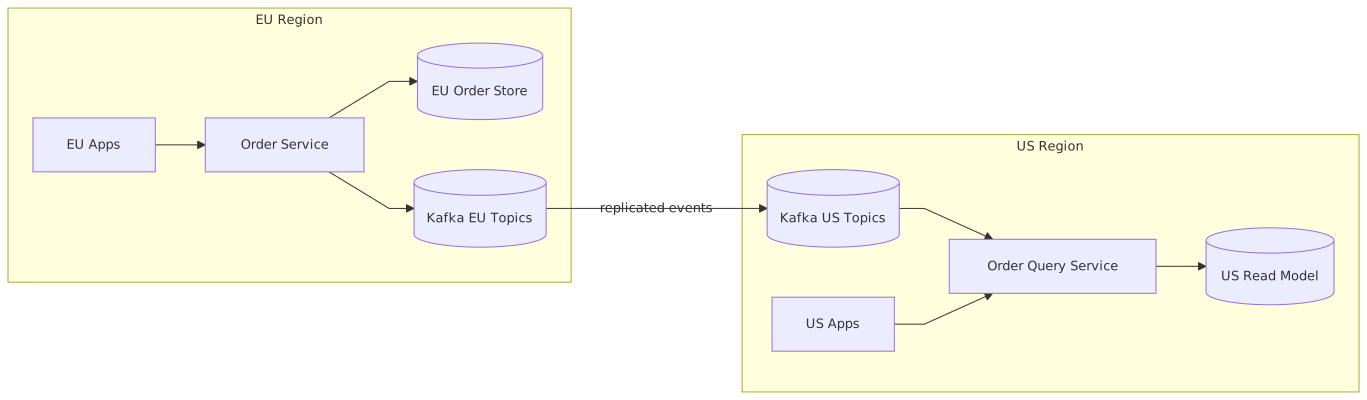
In this example, orders originated in the EU are owned in the EU. The EU order service performs authoritative writes and publishes events. US services consume those events into local read models. The US region gets low-latency reads without pretending it owns the order.
This is not exotic. It is disciplined.
Ownership models
There are three common regional ownership styles.
1. Central ownership with regional projections
A central region or central service owns the data; other regions maintain read copies.
Use this when the domain needs strong control and global uniformity. Product master is a common example.
2. Home-region ownership
Each business entity is assigned a home region. All writes route there, regardless of where the request originated.
This is common for customer profiles, subscriptions, and account records.
3. Region-native ownership
Data is owned by the region where the business event physically occurs. Orders, warehouse inventory, and local case management often fit this model.
Many enterprises use all three at once.
Domain semantics first
DDD helps here because ownership should align with aggregate boundaries and bounded contexts.
If a customer aggregate includes identity, consent, tax residency, and active subscriptions, you should not casually split ownership of those pieces across regions unless the domain tolerates it. Splitting an aggregate for infrastructure convenience usually creates a reconciliation problem later. The map of ownership should be a map of business authority.
A useful rule: if the business would escalate a dispute to one team or jurisdiction, that is probably where ownership belongs.
Kafka and event propagation
Kafka is often a good fit because regional ownership relies heavily on durable event propagation. But Kafka does not solve semantics. It solves transport.
A solid pattern is:
- owning service writes to its local transactional store
- publish domain events using an outbox pattern
- replicate topics cross-region using MirrorMaker 2 or equivalent
- non-owning regions build read models, caches, or workflow triggers
- consumers maintain idempotency and version awareness
Do not publish raw table changes as if they are business meaning. CDC has its place, especially in migration, but regional ownership should be visible in business events where possible: CustomerHomeRegionAssigned, OrderPlaced, InventoryReserved, ConsentWithdrawn.
Command routing
If a user in APAC needs to update a US-owned customer profile, the APAC region should not mutate its local replica. It should route a command to the owning region.
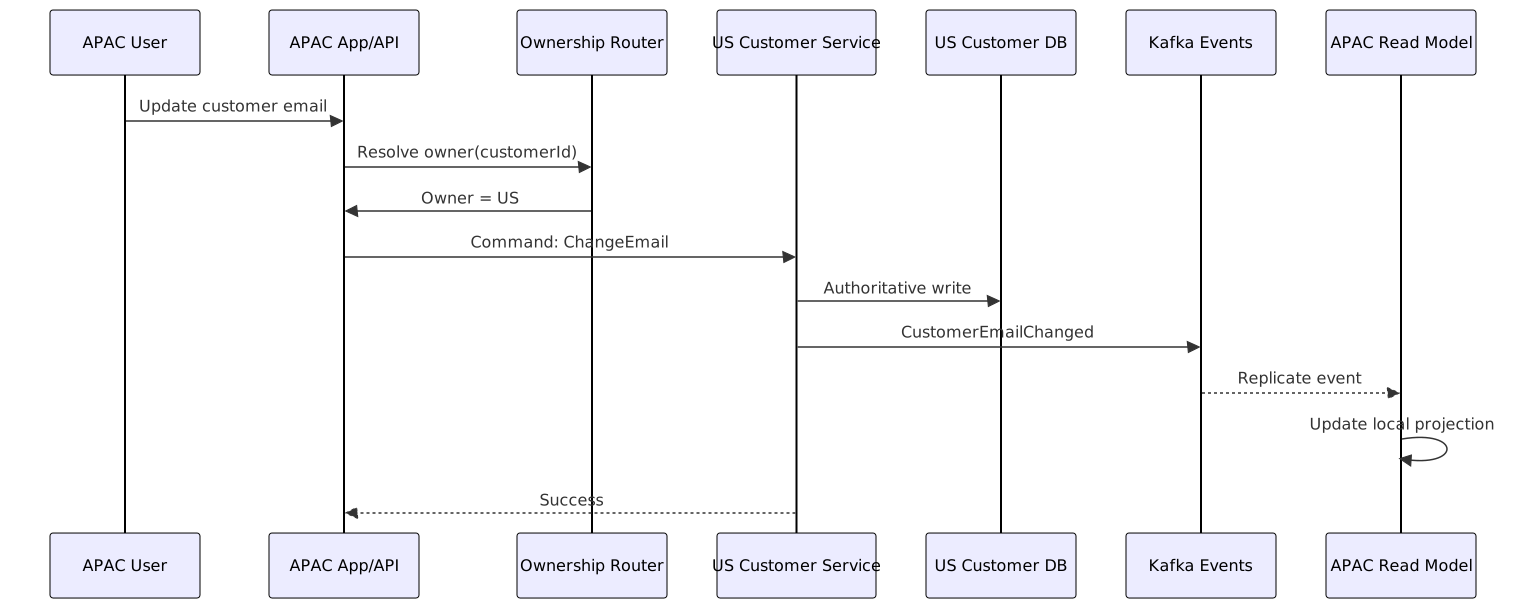
This introduces latency on writes, yes. That is the price of authority. If the business cannot tolerate that latency, then perhaps the ownership partitioning is wrong—or perhaps the domain requires a different model, such as region-local sub-entities with asynchronous consolidation.
Migration Strategy
No serious enterprise gets to this architecture in one grand rewrite. They arrive with a patchwork: shared databases, region-specific forks, ETL feeds, point-to-point sync jobs, and services that do not know whether they are masters or mirrors.
The right migration is progressive and boring. That is a compliment.
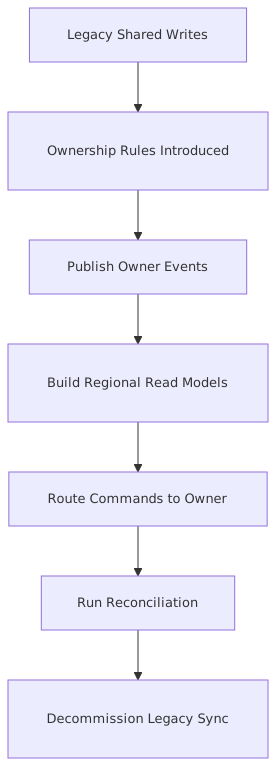
Use a strangler approach.
Step 1: Identify ownership seams
Start by mapping domain concepts to current systems of record, actual write locations, and downstream dependencies. This exercise is usually sobering because the official architecture is rarely the same as the production truth.
Look for seams where ownership can be made explicit:
- customer by legal domicile
- order by originating marketplace
- inventory by warehouse region
- case records by servicing jurisdiction
Step 2: Introduce an ownership registry
Before moving data, make ownership resolvable. This may be a service, routing table, or deterministic rule engine. Given an entity ID, the platform must answer: which region owns this?
This sounds trivial until you discover mergers, legacy IDs, and historical exceptions.
Step 3: Build read models in non-owning regions
Create local projections from the current owner’s change stream. At first, these read models may coexist with legacy shared reads. That is fine. The point is to establish a directional flow: owner publishes, others consume.
Step 4: Redirect writes
This is the key move. Cut over one command at a time so writes go only to the owning region. Keep old paths visible and auditable until confidence grows.
Step 5: Retire peer updates
Remove bilateral synchronization logic, database-level multi-master settings, and “temporary” conflict scripts. Temporary scripts are immortal unless someone kills them.
Step 6: Reconcile and cleanse
Historical divergence will surface. You need reconciliation pipelines to compare owner state with projections, identify drift, and repair it safely.
Reconciliation matters more than architects like to admit
In slideware, events flow perfectly and all consumers are healthy. In enterprise reality, topics get replayed, schemas change, consumers lag, and old systems wake up at 2 a.m. to write stale state into places they no longer own.
Reconciliation is the safety net that turns an ownership model from theory into operations. Typical reconciliation methods include:
- version comparison using entity sequence numbers
- periodic snapshots from owning region
- hash-based record comparison
- replay from durable event logs
- exception queues for semantic mismatches
- manual stewardship for non-deterministic conflicts
A mature organization treats reconciliation as a product capability, not a cleanup exercise.
Enterprise Example
Consider a global insurer operating in North America, Europe, and Asia-Pacific.
At first, the company ran policy administration centrally, then regional business units demanded autonomy for latency, local regulation, and market-specific products. Over time, each region developed its own customer and policy services. A central CRM still held “golden customer” records, regional policy systems kept policyholder details, and claims systems copied customer addresses locally to improve response times. Kafka had been introduced, but mostly as a convenient backbone for moving integration events around. There was no shared ownership model.
Then the cracks widened:
- a customer updated contact information in Germany, but the APAC claims service still used stale data
- GDPR restrictions raised questions about where consent records lived
- duplicate identities caused policy matching errors
- global fraud analytics consumed inconsistent customer profiles
- a region outage triggered emergency failover, and two regions accepted conflicting profile updates
The insurer redesigned ownership around domain semantics.
Their model
- Customer Identity: home-region owned based on regulatory domicile
- Policy: owned by issuing region
- Claims: owned by handling region, with policy and customer data consumed as projections
- Consent: jurisdiction-owned and never overwritten by remote projections
- Fraud Signals: globally aggregated derived data, not source master data
A customer from France with a policy issued in Singapore could therefore have:
- identity owned in EU
- policy owned in APAC
- claim owned in APAC during an incident
- consent preferences mastered in EU
- fraud markers computed centrally from events
This is exactly the sort of domain nuance that database-centric ownership models miss.
How they implemented it
Each owning service persisted authoritative state in-region and emitted domain events via outbox to regional Kafka clusters. Topics were mirrored selectively—not all data moved everywhere. Non-owning regions built local read models for policy servicing and claims workflows.
When a claims agent in APAC needed to update a French customer’s phone number, the APAC application routed a command to the EU identity service. Until the event came back, the local workflow used a pending state rather than pretending the update was complete.
They also introduced a reconciliation platform. Every night, key aggregates were compared between owner snapshots and remote projections. Drift above threshold created an incident and blocked certain downstream processes until resolved.
The biggest lesson was not technical. It was organizational. Product owners had to accept that “fast local writes” were not free. Sometimes the answer to a business demand was: you are asking to override another region’s authority; that changes the operating model, not just the API.
That is architecture doing its job.
Operational Considerations
Cross-region ownership turns hidden inconsistency into explicit operating discipline.
Observability
You need visibility into:
- event replication lag by region
- projection freshness
- command routing latency
- reconciliation drift rates
- ownership resolution failures
- schema compatibility across regions
Without this, teams will blame “eventual consistency” for issues that are actually broken pipelines.
Idempotency and ordering
Consumers must be idempotent. Event replay is normal, not exceptional. Ordering should be preserved per aggregate key where business meaning depends on sequence.
Schema evolution
Regional systems often evolve at different speeds. Backward-compatible events are essential. If ownership events break consumers in another region, your global model becomes brittle.
Data classification
Not all fields should replicate. Sensitive columns may need masking, tokenization, or omission. Ownership architecture should be paired with data classification and policy enforcement.
Failover policy
This is where many designs become hand-wavy. If the owning region is down, what exactly happens?
Possible responses:
- reject writes
- queue commands for later
- allow temporary local capture with deferred adjudication
- transfer ownership through controlled failover
The right answer depends on the domain. There is no universally correct setting.
Tradeoffs
This pattern has a price. Good architecture always does.
Benefits
- clear source of truth
- better regulatory posture
- fewer accidental write conflicts
- simpler mental model for downstream consumers
- improved auditability
- supports local read performance with controlled consistency
Costs
- remote write latency
- more complex routing logic
- operational burden of event replication and reconciliation
- need for stronger domain modeling
- harder emergency failover
- organizational friction when regions want autonomy beyond what the model permits
The crucial tradeoff is this: you trade invisible inconsistency for visible coordination. That is almost always worth it in enterprise systems, but it is not free.
Failure Modes
There are a handful of ways these architectures fail repeatedly.
1. Ownership defined too technically
If ownership is assigned by database, table, or application boundary rather than domain authority, teams create constant exceptions. Exceptions become side doors. Side doors become the real system.
2. Remote replicas treated as writable “just this once”
This is the oldest sin in distributed systems. Temporary local writes become permanent because business urgency always beats architecture purity unless the system prevents it.
3. Event streams without semantic contracts
If Kafka topics are merely change feeds with no ownership semantics, downstream teams infer meaning differently. You end up with synchronized confusion.
4. No reconciliation capability
Eventually, projections drift. If you cannot detect and repair divergence, the architecture decays quietly.
5. Ownership transfers handled casually
Sometimes entities must move between regions: customer relocation, legal restructuring, portfolio migration. If transfer is not explicit and transactional at the business level, you can end up with dual ownership or orphaned authority.
6. Global transactions forced where they do not belong
Trying to preserve synchronous ACID behavior across regions for every use case is usually a path to latency, fragility, and disappointment.
When Not To Use
Cross-region data ownership is not automatically the right answer.
Do not use it when:
The system is not truly multi-region in business terms
If you deploy in multiple regions only for disaster recovery or stateless scaling, but your write model remains centralized, then simple primary-region ownership with regional read caches may be enough.
The domain requires global, synchronous consensus on every write
Some domains—high-frequency trading controls, tightly coupled financial ledgers, certain manufacturing control systems—may need stronger centralized control or specialized consensus mechanisms rather than region-partitioned ownership.
Data is mostly reference data
For static or slowly changing reference data, a central master with broad replication is simpler.
The organization lacks domain clarity
If the business cannot agree what a customer, account, or policy is, introducing regional ownership will expose that confusion brutally. Sometimes the first step is domain refactoring, not regional architecture.
You cannot support operational maturity
If there is no appetite for replication monitoring, schema discipline, reconciliation tooling, and data governance, then this pattern will be implemented halfway and fail messily. EA governance checklist
Related Patterns
Cross-region ownership often works with these patterns:
- Bounded Contexts: define semantic boundaries before technical ones
- CQRS: owner handles commands; remote regions maintain read models
- Outbox Pattern: reliable event publication from authoritative writes
- Saga / Process Manager: coordinate workflows spanning owners
- Strangler Fig Pattern: migrate progressively from shared-write legacy systems
- Event Sourcing: useful in some domains, though not required
- Data Mesh governance concepts: helpful for federated accountability, if used pragmatically
- Master Data Management: sometimes complementary, though MDM alone does not solve regional write authority
One caution: MDM platforms are often proposed as the answer to regional ownership. They can help for identity resolution and golden record stewardship, but they are not a substitute for transactional authority in operational domains.
Summary
Cross-region data ownership is the discipline of deciding who gets to tell the truth in a distributed enterprise.
That sentence matters because many multi-region systems spend years avoiding it. They replicate first, argue later, and reconcile forever. A better approach is to make authority explicit: align ownership to domain semantics, route writes to the owner, publish changes as events, build regional projections for local use, and invest heavily in reconciliation because reality is never as tidy as your diagrams.
The architecture works best when it is rooted in domain-driven design. Bounded contexts define the meaning. Aggregates define the consistency boundary. Regions become places where authority lives, not just where compute runs.
The migration should be progressive. Introduce ownership rules, build read models, redirect writes, reconcile aggressively, and retire old shared-write paths one by one. This is classic strangler work: practical, iterative, and a little unglamorous. That is why it succeeds.
There are tradeoffs. Remote writes are slower. Operations get harder. Teams lose some local freedom. But the alternative is usually worse: silent conflict, uncertain authority, and architecture that looks distributed but behaves like a family argument.
A global enterprise does not need every region to own everything. It needs every important fact to have a home.
Frequently Asked Questions
What is enterprise architecture?
Enterprise architecture aligns strategy, business processes, applications, and technology in a coherent model. It enables impact analysis, portfolio rationalisation, governance, and transformation planning across the organisation.
How does ArchiMate support architecture practice?
ArchiMate provides a standard language connecting strategy, business operations, applications, and technology. It enables traceability from strategic goals through capabilities and services to infrastructure — making architecture decisions explicit and reviewable.
What tools support enterprise architecture modeling?
The main tools are Sparx Enterprise Architect (ArchiMate, UML, BPMN, SysML), Archi (free, ArchiMate-only), and BiZZdesign. Sparx EA is the most feature-rich, supporting concurrent repositories, automation, scripting, and Jira integration.